The Federal Reserve maintains interest rates at 3.50-3.75%, and the dollar rebounds, suppressing Bitcoin to $89,500 and causing stagnation. The three major indicators reveal the reasons for the stall: the 200-day EMA provides only minimal support, ETF cost basis at $86,600 offers no profit buffer, and 19.5% supply loss. Trump’s pressure to cut rates and Bisset’s strong dollar policy increase uncertainty.
Federal Reserve stands firm, dollar rebounds, suppressing bulls
On Wednesday, as expected by the market, the Federal Reserve kept interest rates unchanged, with the federal funds rate target range remaining at 3.50-3.75%, citing persistent inflation and steady economic growth as reasons. The Federal Open Market Committee (FOMC) statement did not hint at the timing of the next rate cut. After the Fed held rates steady on Wednesday, the dollar’s rally was sustained. Since September, the Fed has cut rates three consecutive times, and the market initially expected a prolonged easing cycle.
Corpay Chief Market Strategist Karl Schamotta said: “The Fed did nothing, but their stance is very firm. The decision was passed with a 10-2 vote, and they slightly upgraded their assessment of the labor market. The Fed clearly signals a desire to hold steady for now.” This hawkish stance exceeded some market participants’ expectations, forcing traders who bet on a rate cut to close positions, pushing the dollar index higher.
On Wednesday, the dollar appreciated against seven of the ten major currencies, including the yen, which depreciated by 0.75%. The strengthening dollar directly suppresses Bitcoin, as the two typically have an inverse relationship. When the dollar appreciates, dollar-denominated assets like Bitcoin become more expensive for international investors holding other currencies, reducing demand. Additionally, a stronger dollar often coincides with rising U.S. Treasury yields, increasing the appeal of risk-free assets and weakening Bitcoin and other risk assets’ relative advantage.
Ballinger Group Forex Market Analyst Kyle Chapman said: “What reassures the market is that the core members of the committee did not bow to Trump; their stance remains firm.” While this independence maintains the Fed’s credibility, it also means markets should not expect political pressure to lead to an early rate cut. The first reason Bitcoin’s rebound today is stagnating is that the hawkish stance has shattered expectations of rate cuts, strengthening the dollar and suppressing risk assets.
Trump and Bisset’s contradictory statements increase uncertainty
Although Bisset’s comments prompted the dollar to rebound, market observers also point out that Trump’s unpredictable policy moves have heightened uncertainty, including his threats to take over Greenland, which unsettles overseas allies, his pressure on the Fed to cut rates, and potential tax cuts that could worsen the country’s fiscal outlook. All these factors increase the risk of foreign capital avoiding U.S. assets.
When asked on Tuesday whether the dollar had fallen too much, Trump said it was “performing very well,” which the market interpreted as a signal that further dollar weakness was possible. Trump’s remarks pushed the dollar to its lowest level in nearly four years, with some of the softness spilling over into the U.S. bond market, pushing long-term yields higher. However, U.S. Treasury Secretary Scott Bessent reiterated on Wednesday that the U.S. prefers a strong dollar policy.
Bessent told CNBC: “The U.S. has always pursued a strong dollar policy.” He also stated that the U.S. “will absolutely not” intervene in the Japanese currency market, dismissing ongoing speculation since last Friday. Erica Camilleri, Senior Global Macro Analyst at Manulife Investment Management, said: “Bessent’s comments eased investor concerns and helped restore confidence in government monetary policy.”
This conflicting signal between Trump and Bisset is a key reason why Bitcoin’s rebound today is stagnating. When the market cannot determine the true stance of the U.S. government, investors tend to stay on the sidelines rather than aggressively go long. Bitcoin is highly sensitive to policy uncertainty; clear and consistent signals are needed to drive sustained upward movement.
Three on-chain indicators reveal the truth of stagnation
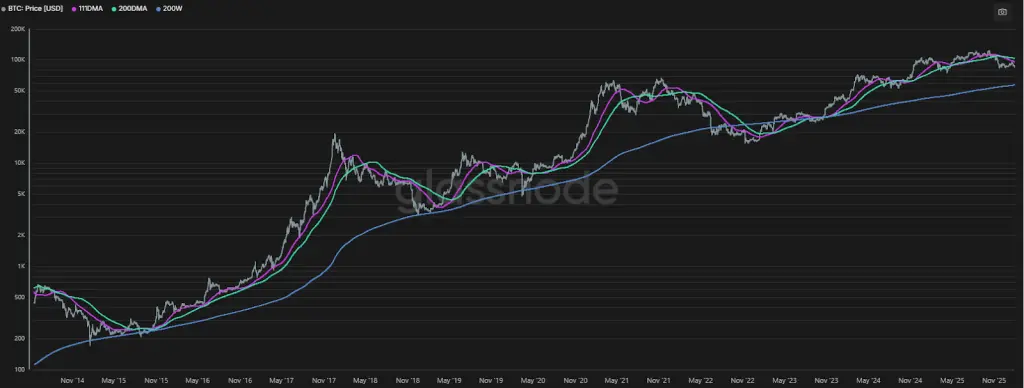
(Source: Glassnode)
Bitcoin has rebounded to $89,500, but is this the start of a new bull market or just another temporary rally? Analysts believe that the next step is to observe whether some deeper market mechanism indicators will begin to reverse, shifting toward risk appetite.
First indicator: 200-day EMA provides minimal support but lacks breakout momentum. Glassnode data shows Bitcoin continues to trade above its 200-day exponential moving average, a long-term indicator closely watched by many institutional and macro-oriented traders. Historically, trading above this level is associated with structural bull markets, while trading below is linked to bear phases. The 200-day moving average remains in an upward trend, indicating long-term demand has not yet broken down, and recent pullbacks appear corrective.
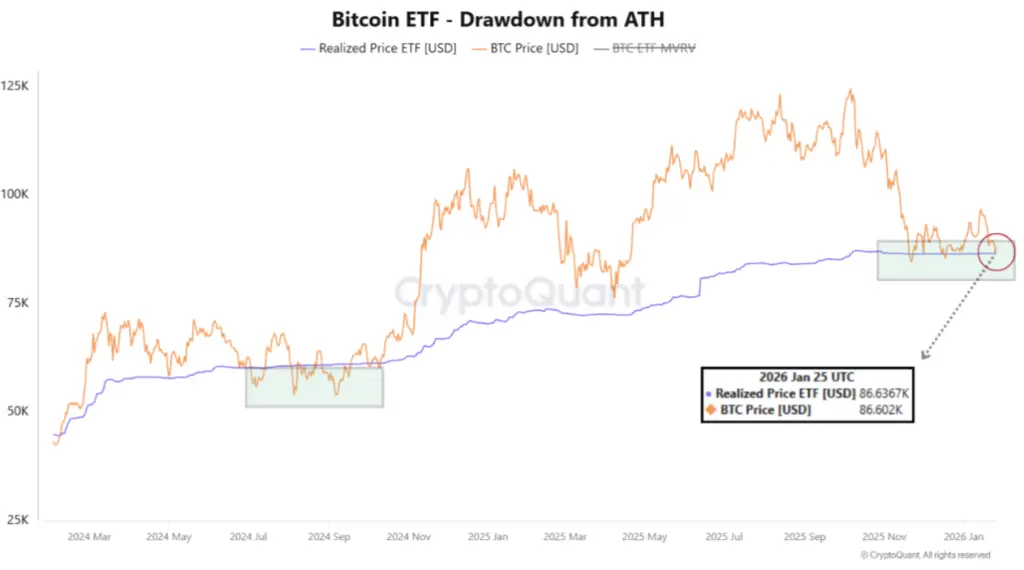
(Source: CryptoQuant)
Second indicator: ETF realized price at $86,600 acts as a psychological threshold. CryptoQuant’s on-chain data shows Bitcoin is currently hovering near the ETF realized price of around $86,600, which is the average cost basis for ETF buyers. Since October 2025, ETF holdings have decreased by over $6 billion, down 8% from peak levels, indicating this relatively new investor group is facing its first major stress test. Analysts describe this zone as a psychological turning point; staying above it can boost confidence and stabilize capital flows, while trading below this level historically accelerates redemptions.
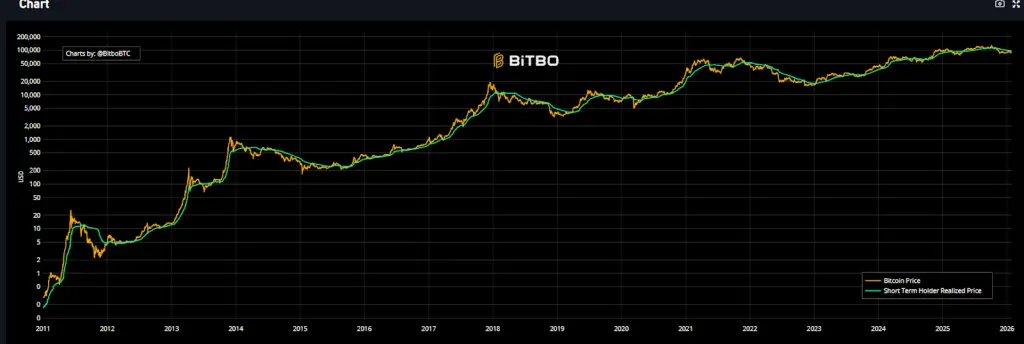
(Source: Bitbo)
Third indicator: Short-term holder cost basis provides final support. BitBo data shows Bitcoin’s price remains above the actual cost basis of short-term holders, estimated at the lower end of the $60,000 to $70,000 range. This suggests most new buyers are still in profit, reducing the likelihood of panic selling. Glassnode reports that only about 19.5% of short-term supply is in loss, well below levels associated with widespread capitulation.
However, CryptoQuant analysts are concerned because the trend of Bitcoin supply in loss is rising, a pattern historically indicative of a deeper bear market. The reason Bitcoin’s rebound today is stagnating is the combined effect of these three major indicators: technically, support is minimal; institutional demand is cautious; and short-term buyers lack profit buffers.
Disclaimer: The information on this page may come from third parties and does not represent the views or opinions of Gate. The content displayed on this page is for reference only and does not constitute any financial, investment, or legal advice. Gate does not guarantee the accuracy or completeness of the information and shall not be liable for any losses arising from the use of this information. Virtual asset investments carry high risks and are subject to significant price volatility. You may lose all of your invested principal. Please fully understand the relevant risks and make prudent decisions based on your own financial situation and risk tolerance. For details, please refer to
Disclaimer.
Related Articles
AAVE, ZRO Drop 20% Following Kelp DAO Hack
AAVE and ZRO tokens declined approximately 20% over one week following the Kelp DAO hack on the 18th, which exposed structural vulnerabilities in the DeFi lending and cross-chain bridge infrastructure. As of the 24th at 11:15 AM (according to CoinMarketCap), AAVE traded at $94.68 (down 16.53% weekly
CryptoFrontier04-25 07:07
Gate Daily Report (April 24): US Treasury sanctions Cambodian crypto “pig butchering” scams; Tether mints an additional 1 billion USDT
Bitcoin (BTC) rebound momentum is weakening, with a temporary quote around $78,030 as of April 24. The U.S. Treasury Department’s Office of Foreign Assets Control (OFAC) sanctioned a Cambodian politician linked to a crypto “pig butchering” scam center. Tether issued another 1 billion USDT on the Ethereum network; over the past 5 days, it has issued a total of 3 billion USDT on the Ethereum network.
MarketWhisper04-24 01:55
Gate Daily Report (April 23): The U.S. government runs Bitcoin nodes; Tesla’s BTC holdings remain unchanged
Bitcoin (BTC) continues the rebound trend from the beginning of the week, trading at around $78,230 as of April 23. U.S. Pacific Command Commander Samuel Paparo said in a congressional hearing that the U.S. government operates Bitcoin nodes to conduct cybersecurity tests, but does not participate in mining. Tesla’s first-quarter Bitcoin holdings remain unchanged, and its digital-asset impairment loss is $173 million.
MarketWhisper04-23 01:39
Ethereum Breaks Through $2,400 as Daily Decline Holds at 0.15%
Gate News message, April 22 — Ethereum broke through the $2,400 mark today, though the cryptocurrency recorded a 0.15% decline over the 24-hour period.
GateNews04-22 17:43
OpenSea Launches Mobile Perpetuals Trading for Beta Users, Kicks Off 5-Day Trading Contest
Gate News message, April 22 — OpenSea has rolled out mobile perpetuals (Perps) trading functionality to select beta users and will launch a five-day trading contest beginning April 23 at 5 a.m. UTC+8. The competition is restricted to mobile beta testers, with all participants receiving an initial
GateNews04-22 15:29
Gate Daily Report (April 22): A U.S. PACE bill is set to allow the Federal Reserve to pay for access; Kalshi plans to launch sustainability futures
Bitcoin (BTC) sees a short-term rebound, temporarily trading at around $76,230 as of April 22. A bipartisan PACE bill in the U.S. would seek to allow the Federal Reserve’s payment system to be connected, with support from the crypto industry. According to The Information, Kalshi is considering launching sustainable futures to expand its cryptocurrency business.
MarketWhisper04-22 01:38


