# USIranTalksProgress

849.69K
#USIranTalksProgress
The evolving situation around the U.S.–Iran negotiations has become one of the most important macro narratives shaping global markets right now. What initially appeared to be another round of diplomatic engagement has rapidly transformed into a high-stakes geopolitical turning point—one that could influence oil prices, financial markets, and the direction of risk assets, including crypto, over the coming months.
At the center of this story is a fragile balance between diplomacy and escalation. The recent round of talks in Islamabad, involving U.S. officials including JD V
BTC-1,68%
CryptoDiscovery
#USIranTalksProgress
The evolving situation around the U.S.–Iran negotiations has become one of the most important macro narratives shaping global markets right now. What initially appeared to be another round of diplomatic engagement has rapidly transformed into a high-stakes geopolitical turning point—one that could influence oil prices, financial markets, and the direction of risk assets, including crypto, over the coming months.
At the center of this story is a fragile balance between diplomacy and escalation. The recent round of talks in Islamabad, involving U.S. officials including JD Vance, highlighted both progress and deep divisions. While both sides described the discussions as constructive in tone, the absence of a concrete agreement revealed how far apart the core positions still remain. Iran’s stance suggests a longer negotiation horizon, while the U.S. appears to be pushing for quicker, more definitive commitments.
What makes this moment particularly critical is timing. The temporary ceasefire window is approaching expiration, and markets are increasingly sensitive to any signal—positive or negative—that could indicate what comes next. The role of Islamic Revolutionary Guard Corps in shaping Iran’s negotiation posture has added another layer of complexity, signaling that decisions are not purely diplomatic but also strategic and security-driven.
Meanwhile, developments on the ground are amplifying the stakes. The Strait of Hormuz remains the single most critical pressure point in the global energy system. Any disruption here does not just affect regional trade—it has immediate global consequences. With roughly a fifth of the world’s oil passing through this narrow corridor, even the perception of risk is enough to move markets aggressively.
Recent reports of increased naval monitoring and shipping disruptions have already introduced a significant risk premium into oil prices. Brent Crude hovering near elevated levels reflects not just current supply conditions, but fear of what could happen next. Insurance costs for tankers have risen, rerouting has begun in some cases, and governments are closely watching energy security implications.
What’s new—and increasingly important—is how deeply interconnected these geopolitical tensions have become with financial markets beyond oil. Unlike previous cycles, crypto markets are now reacting in real time to macro events. Bitcoin, in particular, has shown notable resilience. While traditional assets have displayed sharp reactions to headlines, Bitcoin’s relatively controlled volatility suggests that a portion of geopolitical risk may already be priced in.
Institutional behavior is another key variable shaping the narrative. Large players are no longer reacting impulsively to geopolitical stress. Instead, they are positioning strategically. Flows into spot ETFs, accumulation by corporate treasuries, and steady on-chain activity indicate that long-term conviction remains intact even as short-term uncertainty rises.
At the same time, traditional safe-haven dynamics are reasserting themselves. Gold continues to attract defensive capital, while the US Dollar strengthens during moments of heightened tension. This creates a complex environment where capital rotates rapidly between risk-on and risk-off assets depending on headlines, rather than long-term trends.
Looking deeper, the oil market itself is entering a structurally sensitive phase. Supply chains are already tight, and spare production capacity globally is limited. Any escalation would not just cause a temporary spike—it could trigger a sustained supply shock. On the other hand, even a partial diplomatic breakthrough could release significant downward pressure on prices as risk premiums unwind.
From a broader macro perspective, this situation is also feeding directly into inflation expectations. Rising energy prices impact transportation, manufacturing, and food supply chains. Central banks, already navigating a delicate balance between growth and inflation, may be forced to reassess their policies if oil remains elevated or spikes further.
For traders and investors, the current environment is defined by asymmetry. The upside reaction to a successful deal may be gradual and measured, driven by relief and normalization. The downside—or rather, the escalation scenario—carries far more explosive potential, with rapid price spikes in oil and sharp sell-offs in risk assets.
Crypto markets, however, present a slightly different dynamic. If a deal is reached, the removal of macro uncertainty could unlock significant upside momentum, especially as institutional inflows accelerate. If tensions escalate, short-term volatility is likely, but strong structural demand may limit deeper downside compared to traditional markets.
Another emerging factor is market adaptation. Compared to previous geopolitical crises, markets today are quicker to absorb shocks. Algorithmic trading, global liquidity flows, and 24/7 crypto markets create a system where reactions are faster—but recoveries can also be quicker if conditions stabilize.
What makes this moment unique is not just the geopolitical tension itself, but how many layers of the global system it touches simultaneously—energy, finance, crypto, policy, and investor psychology. Each headline now carries cross-market implications, and each decision made in negotiations has ripple effects far beyond the region.
As the deadline approaches, all eyes remain on whether diplomatic channels can produce a workable framework or whether tensions will re-escalate into a more disruptive phase. The next signals—whether it’s a new delegation, a policy statement, or changes in shipping activity—will likely determine short-term market direction.
For now, markets remain in a state of heightened alertness, balancing optimism with caution. Volatility is not just expected—it is inevitable in such an environment.
And in times like these, one principle continues to define successful positioning: understanding that geopolitical events are no longer isolated incidents—they are catalysts that reshape entire market ecosystems in real time. 📊🔥🌐
#Gate13thAnniversaryLive

repost-content-media
  • Reward
  • Comment
  • Repost
  • Share
MemeCore’s $M token is up 118% YTD, and it’s signaling something deeper than just another meme cycle.
It’s testing whether viral culture can sustain real economic infrastructure.
That’s the “meme 2.0” thesis.
Not just tokens riding attention
but entire ecosystems built around memetic economies.
On paper, it sounds unserious.
In practice, it makes sense.
Memes are native to the internet.
They generate attention, communities, and liquidity.
Turning that into structured economic activity isn’t irrational it’s an extension.
$M benefits from operating in a category most general-purpose L1s don’t o
M2,17%
post-image
  • Reward
  • Comment
  • Repost
  • Share
#USIranTalksProgress
USIranTalksProgress — Market Pulse, Geopolitics & Risk Repricing
The evolving US–Iran diplomatic situation has quietly turned into one of the most influential macro drivers across global markets, shaping sentiment far beyond the Middle East. What initially began as a short, tactical ceasefire arrangement has now expanded into a more complex and uncertain negotiation window, where diplomacy, military positioning, sanctions pressure, and energy security are all colliding at once. The latest extension announced by Donald Trump through Truth Social has effectively prolonged
post-image
post-image
post-image
  • Reward
  • 5
  • Repost
  • Share
Luna_Star:
LFG 🔥
View More
#USIranTalksProgress
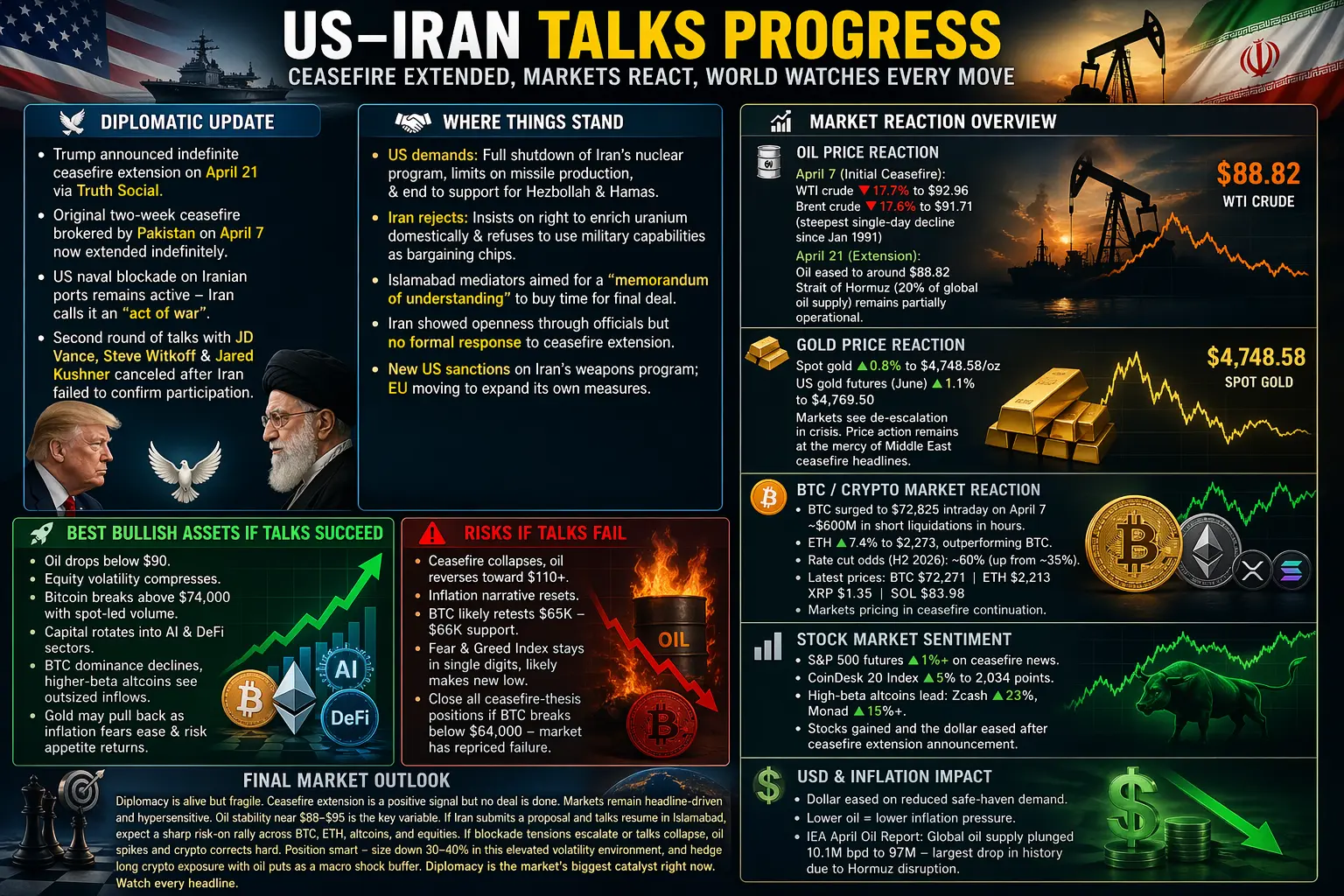
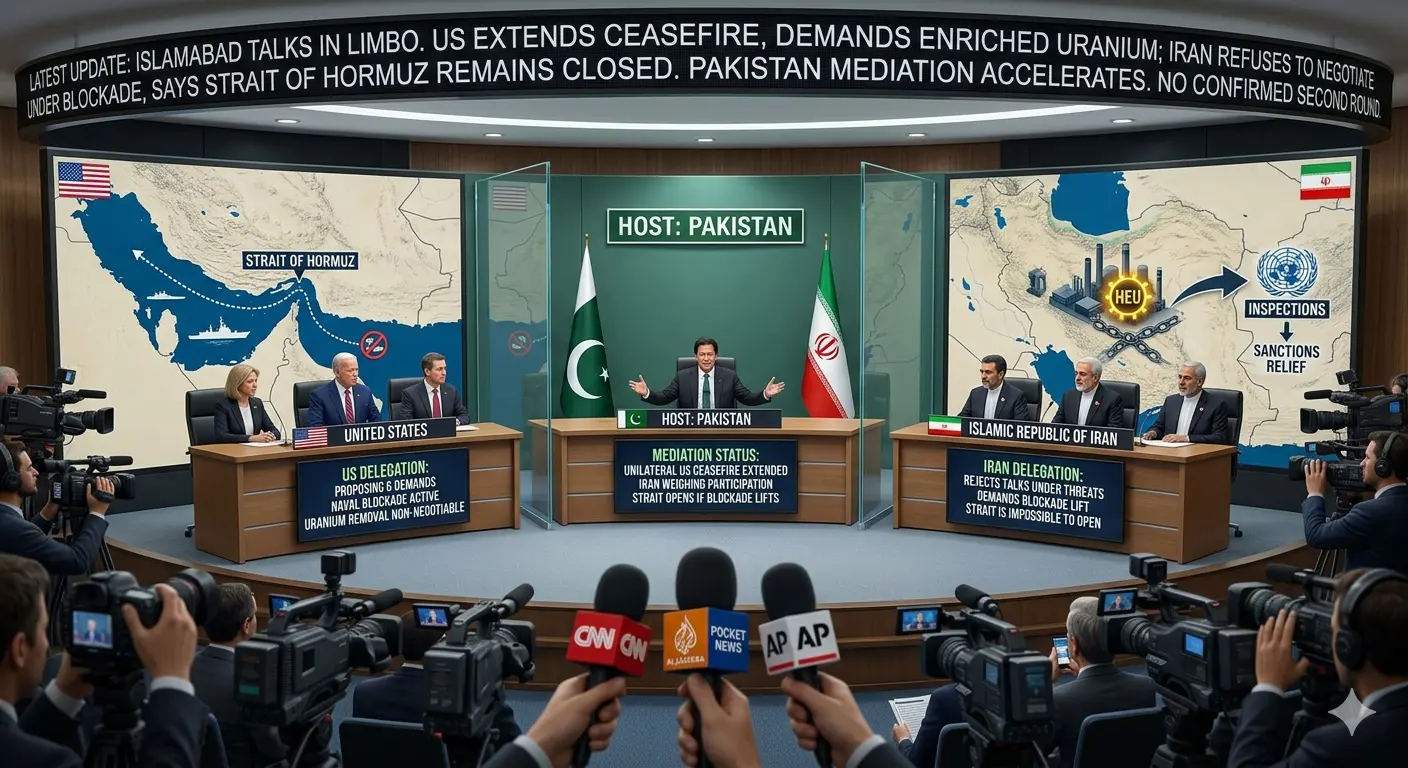
The US-Iran conflict entered a critical diplomatic phase. Trump announced a ceasefire extension on April 21 via Truth Social, allowing Iran more time to submit a "unified proposal." The original two-week ceasefire brokered by Pakistan on April 7 was set to expire but has now been extended indefinitely. However, the US naval blockade on Iranian ports remains fully active, which Iran has labeled an "act of war," creating a fragile and uncertain path toward any real peace deal.
Progress Details Where Things Stand
The US is seeking a complete shutdown of Iran's nuclear progra
BTC-1,68%
ETH-3,62%
post-image
post-image
  • Reward
  • 18
  • Repost
  • Share
Luna_Star:
LFG 🔥
View More
#USIranTalksProgress
Global markets are closely watching the latest developments in US-Iran negotiations, as geopolitical uncertainty continues to influence investor sentiment across risk assets, including crypto.
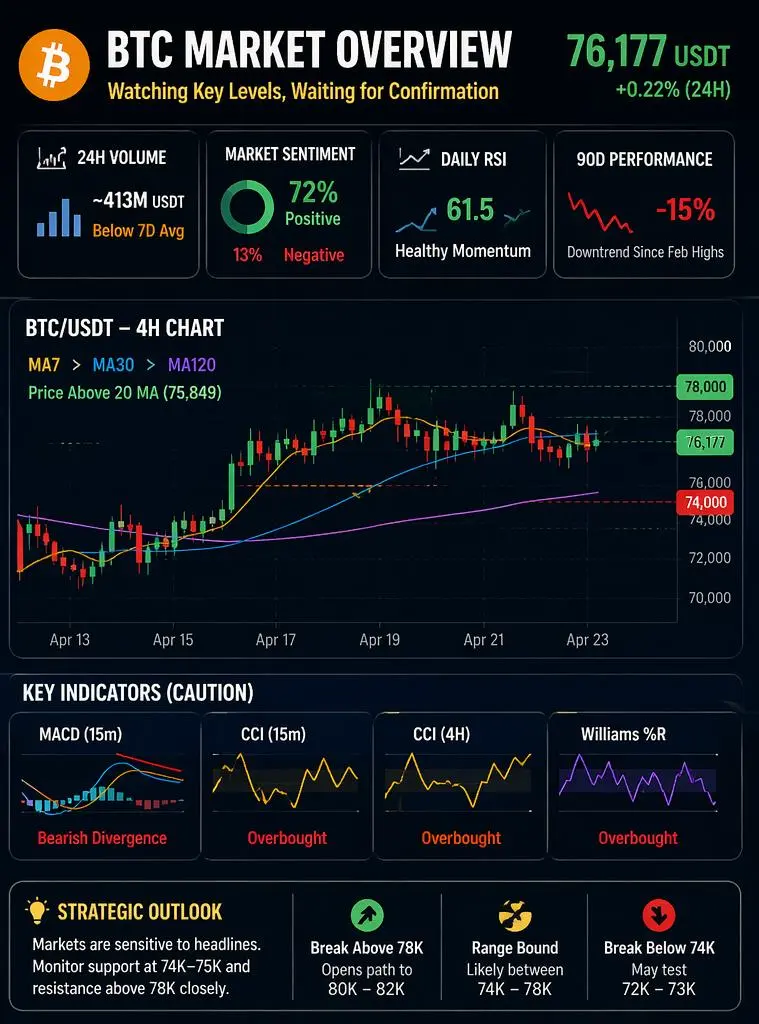
Bitcoin remains in a sensitive range, with traders focused on key support and resistance levels while waiting for clearer signals from both diplomacy and macro conditions. A positive outcome in talks could improve market confidence, while delays or unresolved tensions may keep volatility elevated.
Current BTC structure shows resilience above important moving averages, but lower trad
BTC-1,68%
post-image
post-image
  • Reward
  • 2
  • Repost
  • Share
HighAmbition:
Chong Chong GT 🚀
View More
#USIranTalksProgress
Ceasefire Extension, Oil Shockwaves, and the Global Market Reset: A Macro Breakdown 🌍📊
The evolving diplomatic situation between the United States and Iran has become one of the most powerful macro drivers shaping global markets right now. What initially appeared to be a temporary pause in tensions has transformed into a complex, fragile negotiation phase where every headline has immediate consequences across commodities, equities, and digital assets. The extension of the ceasefire has not resolved the conflict—it has merely delayed escalation, creating a high-stakes en
BTC-1,63%
DOGE-1,68%
  • Reward
  • 12
  • Repost
  • Share
ybaser:
2026 GOGOGO 👊
View More
#USIranTalksProgress
US-Iran Negotiations: Current Status and Market Implications
The ongoing negotiations between the United States and Iran represent one of the most significant geopolitical developments affecting global markets in 2026. Here is a comprehensive breakdown of the current situation and actionable guidance for traders.
The Negotiation Landscape
Talks began in April 2025 following correspondence between the Trump administration and Iranian leadership, evolving through multiple rounds mediated by Oman and more recently Pakistan. The current phase involves high-level delegations i
BTC-1,68%
post-image
  • Reward
  • 6
  • Repost
  • Share
Luna_Star:
Buy To Earn 💰️
View More
#USIranTalksProgress
US-Iran Talks Progress: A Comprehensive Analysis of Geopolitical Developments and Market Implications
The ongoing negotiations between the United States and Iran have entered a critical phase, with both sides making conflicting claims about progress while the Strait of Hormuz remains a central point of contention. This article examines the current state of talks, the key sticking points, and the potential impact on major assets including Bitcoin, gold-backed tokens, and crude oil.
Current State of US-Iran Negotiations
The talks between Washington and Tehran have been char
HighAmbition
#USIranTalksProgress
US-Iran Talks Progress: A Comprehensive Analysis of Geopolitical Developments and Market Implications
The ongoing negotiations between the United States and Iran have entered a critical phase, with both sides making conflicting claims about progress while the Strait of Hormuz remains a central point of contention. This article examines the current state of talks, the key sticking points, and the potential impact on major assets including Bitcoin, gold-backed tokens, and crude oil.
Current State of US-Iran Negotiations
The talks between Washington and Tehran have been characterized by a pattern of tentative progress followed by sudden reversals. President Donald Trump has expressed optimism about the negotiations, stating that a deal to end the conflict is "mostly complete" and describing conversations with Iranian officials as "very good." However, Iranian negotiators have maintained that significant gaps remain, particularly regarding nuclear enrichment timelines and access to the Strait of Hormuz.
The most recent developments show a fragile ceasefire holding between the parties, set to expire on Wednesday. Iranian Foreign Minister Seyed Abbas Araghchi announced that the Strait of Hormuz would be "completely open" for commercial vessels during the ceasefire period. However, this announcement was quickly followed by confusion and contradictory reports, with Iranian media later stating that the strait had been closed again after the US failed to meet its obligations.
Key Sticking Points in the Negotiations
Three primary issues are preventing a comprehensive agreement from being reached. First, Iran's uranium stockpiles and enrichment capabilities remain a major concern for US negotiators. President Trump has publicly stated that Iran must hand over all its "nuclear dust," referring to stockpiles of enriched uranium, as a precondition for any deal.
Second, the timeline for enrichment restrictions has become a contentious issue. While Iran has shown willingness to discuss limits on its nuclear program, the specific duration and scope of these restrictions remain unresolved. Prediction markets currently place the probability of an enrichment agreement at approximately30%, up from22% just one week ago.
Third, and perhaps most immediately impactful, is the issue of Strait of Hormuz access. Iran has demanded that the United States lift its naval blockade of Iranian ports as a precondition for keeping the strait open. The US, meanwhile, has maintained its blockade while simultaneously claiming that Iran has agreed to open the waterway. This disconnect has created a dangerous ambiguity that could trigger renewed conflict.
The Strait of Hormuz: A Geopolitical Flashpoint
The Strait of Hormuz represents one of the world's most critical chokepoints for global energy supplies. Approximately20.9 million barrels of oil per day normally flow through this narrow waterway, representing roughly21% of global petroleum consumption. When Iran closed the strait earlier this year, oil prices surged past115 dollars per barrel, triggering what analysts termed the "Energy Shock of2026."
The current situation remains volatile. While Iran announced the strait's reopening on Friday, reports indicate that tankers remain anchored and hesitant to transit due to ongoing uncertainty. The US Navy fired on an Iranian container ship in the Gulf of Oman on Sunday, claiming it attempted to evade the blockade, while Iran has accused the US of breaking the ceasefire agreement.
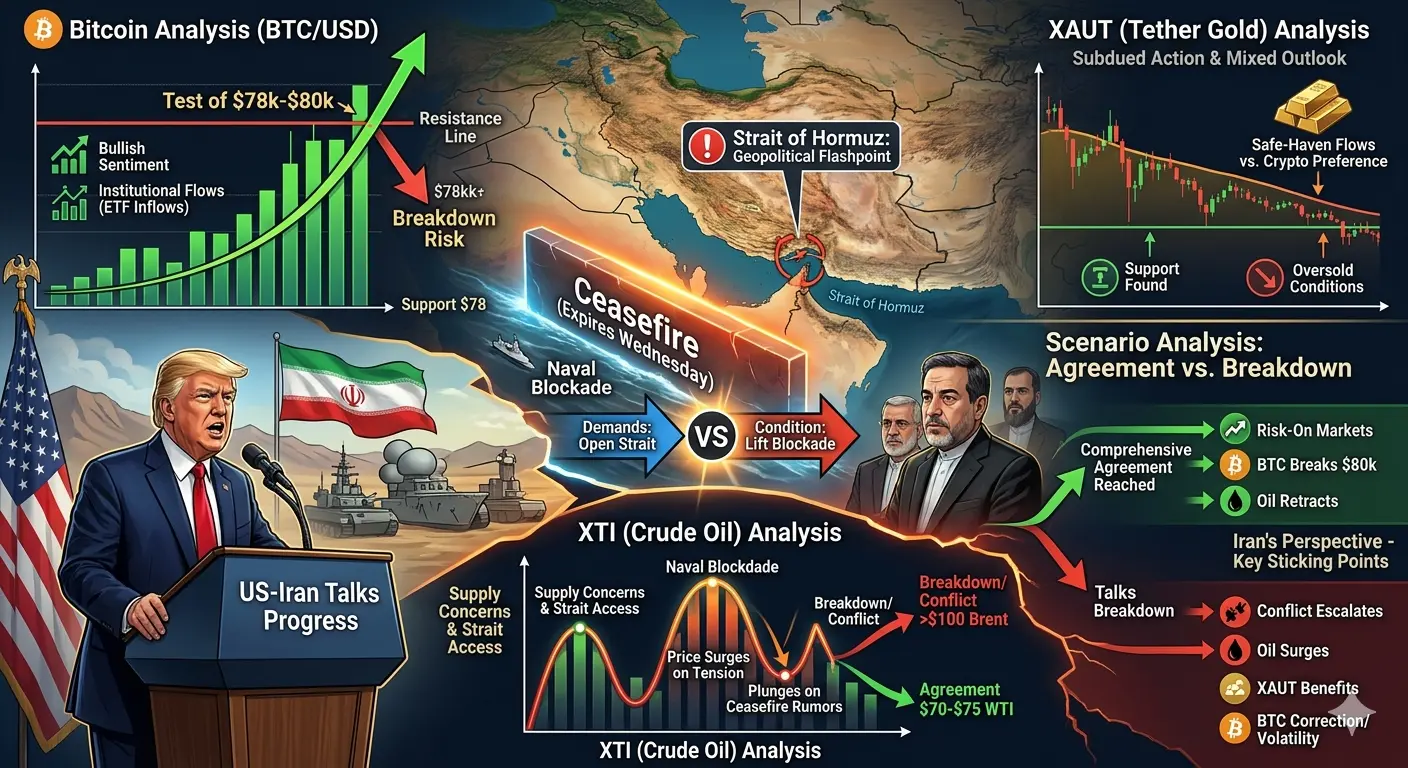
Bitcoin Analysis: Testing Critical Resistance Levels
Bitcoin has demonstrated remarkable resilience amid the geopolitical turmoil, currently trading at approximately78,242 dollars with a24-hour gain of2.63%. The cryptocurrency has established itself as a dual-purpose asset during this crisis, functioning both as a risk-on speculative investment and as a hedge against geopolitical volatility.
The technical picture for Bitcoin shows several important developments. On the4-hour timeframe, moving averages are aligned in a bullish formation with MA7 above MA30 and MA30 above MA120, indicating a strong uptrend. However, daily indicators suggest caution, with both CCI and Williams %R showing overbought conditions. Additionally, a MACD bearish divergence has formed on the daily chart, suggesting potential for a pullback.
Bitcoin's recent surge past78,000 dollars coincided with President Trump's announcement that the US-Iran deal was nearing completion. Institutional demand has provided significant support, with US spot Bitcoin ETFs recording approximately1.9 billion dollars in net inflows last week, the best five-day stretch since early February. BlackRock's IBIT ETF alone attracted612 million dollars, with the asset manager reportedly buying roughly280 million dollars of Bitcoin daily during the most intense flow period.
The critical question for Bitcoin is whether it can maintain momentum and test the80,000 dollar level. If the US-Iran agreement is successfully finalized, Bitcoin could benefit from reduced geopolitical risk premium and continued institutional accumulation. However, a breakdown in talks or renewed conflict could trigger a sharp correction, with support levels around74,000 to73,000 dollars coming into play.
XAUT (Tether Gold) Analysis: Safe Haven Dynamics
Tether Gold, representing tokenized physical gold, has shown more subdued price action amid the geopolitical tensions. Currently trading at approximately4,701 dollars per token, XAUT has declined0.78% over the past24 hours and is down2.33% over the past week. This underperformance relative to Bitcoin suggests that investors have favored the cryptocurrency's upside potential over traditional safe-haven assets.
Technical indicators for XAUT present a mixed picture. The15-minute timeframe shows bearish momentum with a MACD death cross and prices trading below the20-period moving average. However, longer timeframes show the asset finding support, with the4-hour CCI indicating oversold conditions that could presage a bounce.
The relationship between XAUT and geopolitical risk has been somewhat counterintuitive during this crisis. While gold typically rallies during periods of uncertainty, the tokenized version has lagged, possibly due to cryptocurrency market dynamics overwhelming traditional safe-haven flows. If US-Iran talks collapse and conflict escalates, XAUT could see renewed demand as investors seek tangible store-of-value assets. Conversely, a successful agreement might see continued underperformance as risk appetite returns to markets.
XTI (Oil) Analysis: Volatility and Supply Concerns
Crude oil prices have experienced extreme volatility throughout the US-Iran crisis, with West Texas Intermediate surging to over90 dollars per barrel and Brent crude approaching100 dollars. The price action reflects the market's sensitivity to any developments affecting Strait of Hormuz access.
The supply disruption has been substantial. With as much as13 million barrels per day of production impacted by the closure, underlying market conditions remain tight despite recent price moderation. When Iran announced the strait's reopening on Friday, oil prices plunged nearly10%, with US crude falling to85.37 dollars per barrel. However, the subsequent confusion about whether the strait was truly open has reignited supply concerns.
The outlook for oil prices remains highly dependent on the negotiation outcome. A successful agreement that ensures sustained Strait of Hormuz access could see prices retreat toward pre-crisis levels around70 to75 dollars per barrel. However, continued uncertainty or a breakdown in talks could push prices back above100 dollars, with some analysts warning that sustained closure could drive prices even higher.
Scenario Analysis: Agreement vs. Breakdown
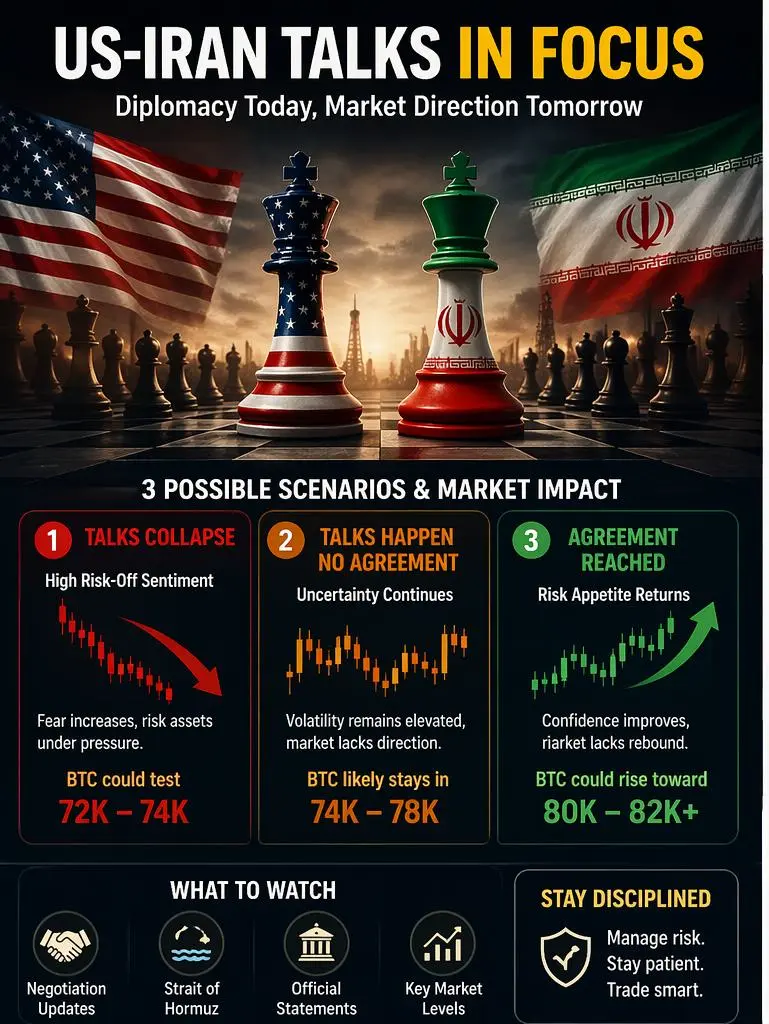
If the US and Iran successfully reach a comprehensive agreement by the deadline, several market outcomes appear likely. Bitcoin could break above80,000 dollars as geopolitical risk premium dissipates and institutional flows continue. The reduced uncertainty would likely support risk assets broadly, potentially triggering a rotation out of safe-haven assets like XAUT. Oil prices would likely retreat significantly as supply concerns ease, with Brent potentially falling back to the85 to90 dollar range.
Conversely, if talks break down and conflict resumes, Bitcoin would likely test support levels around74,000 to73,000 dollars, though its growing institutional adoption may provide a floor absent a severe risk-off event. XAUT would likely benefit from safe-haven flows, potentially reclaiming the4,800 dollar level. Oil prices would surge, with Brent likely retesting100 dollars and potentially exceeding it if the strait closure proves prolonged.
Conclusion
The US-Iran negotiations represent a critical inflection point for global markets. While both sides have expressed optimism, the gap between public statements and actual progress remains significant. The Strait of Hormuz issue, in particular, threatens to derail talks even if nuclear enrichment questions are resolved.
For investors, the current environment demands careful attention to headline risk and a recognition that market prices may not fully reflect the probability of a negative outcome. Bitcoin's test of the78,000 to80,000 dollar range will likely serve as a barometer for market confidence in a peaceful resolution. Gold-backed tokens and oil prices will similarly reflect the evolving probability of agreement or conflict.
The coming days will be decisive. With the ceasefire set to expire on Wednesday and both sides maintaining firm positions on key issues, markets should prepare for the possibility of significant volatility regardless of the outcome. support risk assets broadly, potentially triggering a rotation out of safe-haven assets like XAUT. Oil prices would likely retreat significantly as supply concerns ease, with Brent potentially falling back to the 85 to 90 dollar range.
Conversely, if talks break down and conflict resumes, Bitcoin would likely test support levels around 74,000 to 73,000 dollars, though its growing institutional adoption may provide a floor absent a severe risk-off event. XAUT would likely benefit from safe-haven flows, potentially reclaiming the 4,800 dollar level. Oil prices would surge, with Brent likely retesting 100 dollars and potentially exceeding it if the strait closure proves prolonged.
Conclusion
The US-Iran negotiations represent a critical inflection point for global markets. While both sides have expressed optimism, the gap between public statements and actual progress remains significant. The Strait of Hormuz issue, in particular, threatens to derail talks even if nuclear enrichment questions are resolved.
For investors, the current environment demands careful attention to headline risk and a recognition that market prices may not fully reflect the probability of a negative outcome. Bitcoin's test of the 78,000 to 80,000 dollar range will likely serve as a barometer for market confidence in a peaceful resolution. Gold-backed tokens and oil prices will similarly reflect the evolving probability of agreement or conflict.
The coming days will be decisive. With the ceasefire set to expire on Wednesday and both sides maintaining firm positions on key issues, markets should prepare for the possibility of significant volatility regardless of the outcome.
repost-content-media
  • Reward
  • 2
  • Repost
  • Share
Vortex_King:
To The Moon 🌕
View More
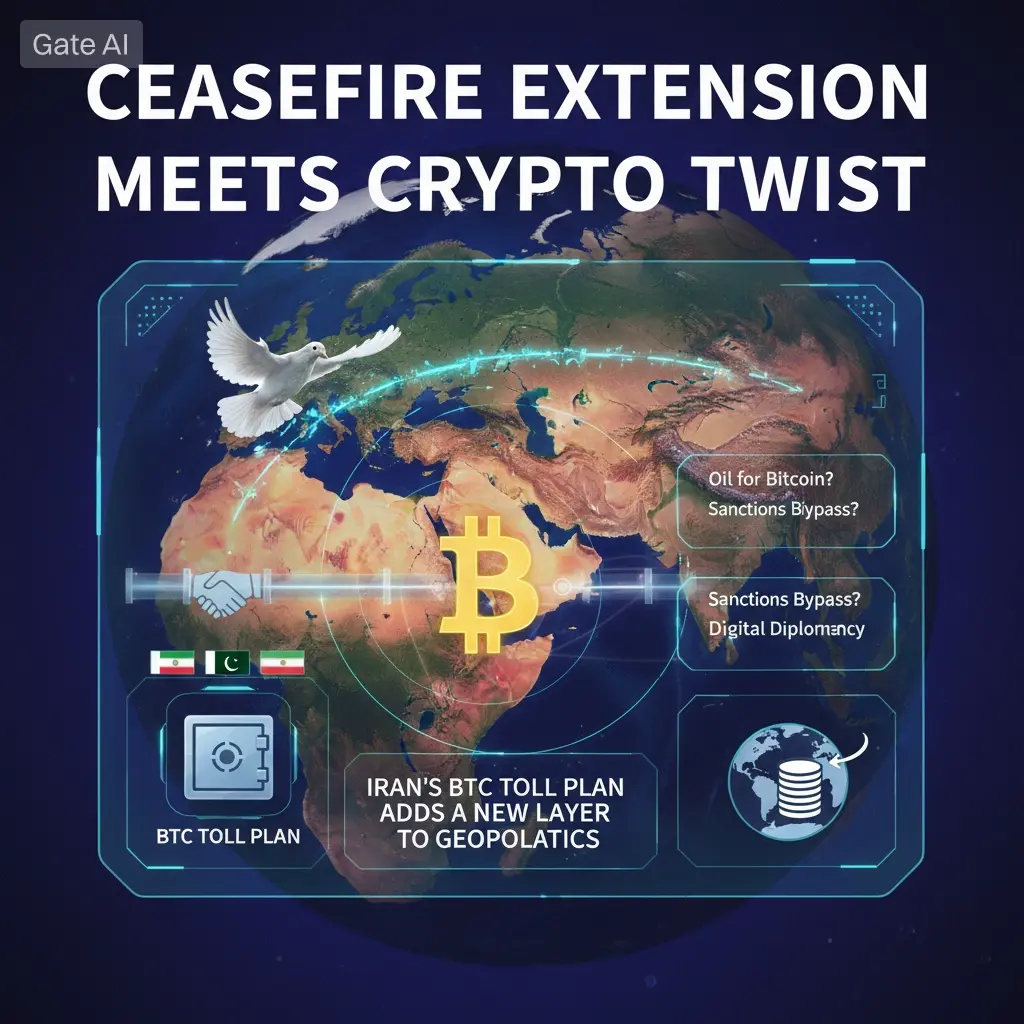
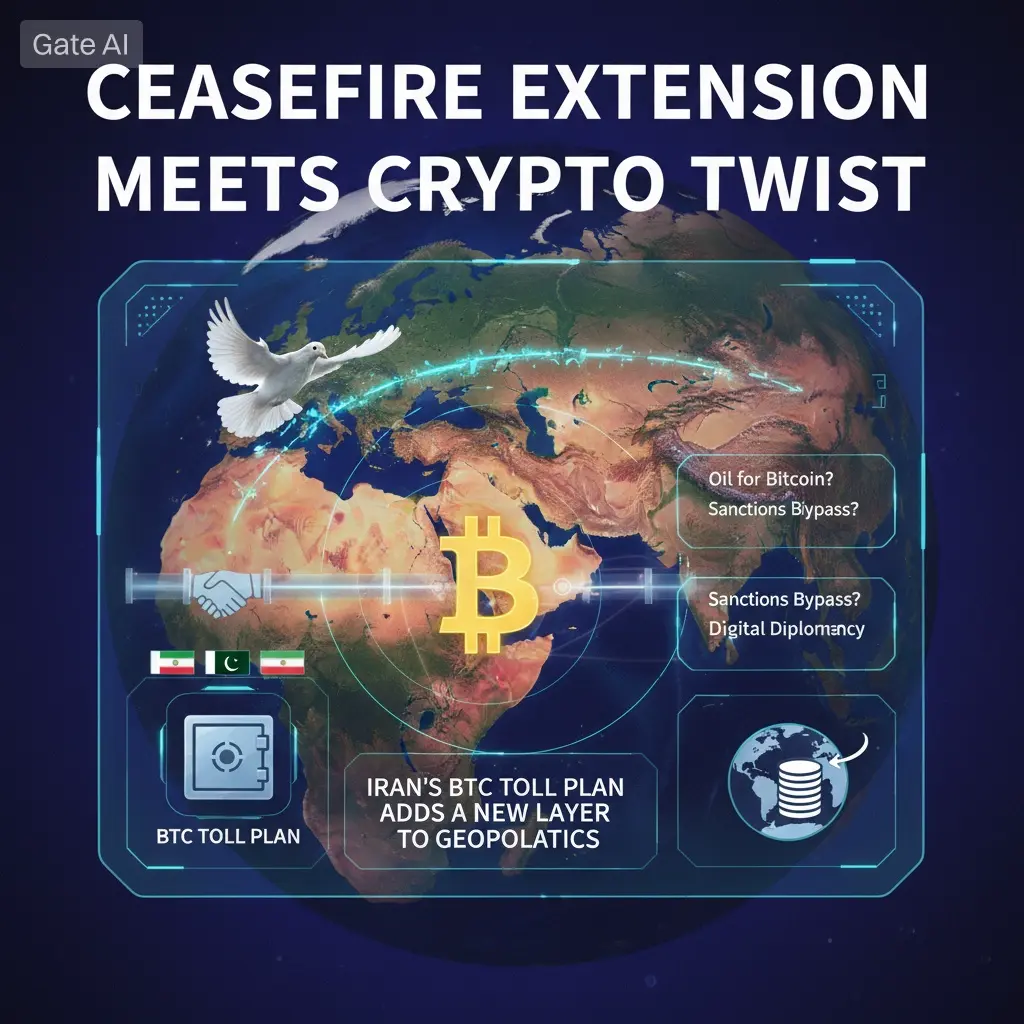
Ceasefire Extension Meets Crypto Twist: Iran’s BTC Toll Plan Adds a New Layer to Geopolitics
The latest development in the U.S.–Iran narrative introduces a mix of de-escalation and unexpected innovation at the same time. An extended ceasefire, reportedly influenced by diplomatic efforts through Pakistan, suggests that immediate geopolitical pressure may be easing. But almost simultaneously, a far more unconventional move emerges—Iran beginning to charge Bitcoin-based tolls on oil tankers passing through the Strait.
At first glance, these two developments seem to pull in opposite directions. A
BTC-1,68%
CryptoSelf
Ceasefire Extension Meets Crypto Twist: Iran’s BTC Toll Plan Adds a New Layer to Geopolitics
The latest development in the U.S.–Iran narrative introduces a mix of de-escalation and unexpected innovation at the same time. An extended ceasefire, reportedly influenced by diplomatic efforts through Pakistan, suggests that immediate geopolitical pressure may be easing. But almost simultaneously, a far more unconventional move emerges—Iran beginning to charge Bitcoin-based tolls on oil tankers passing through the Strait.
At first glance, these two developments seem to pull in opposite directions. A ceasefire extension typically signals stability, reduced risk, and a cooling of tensions. But the introduction of BTC-denominated tolls introduces a new dimension entirely—one that blends geopolitics with digital finance in a way that markets are not fully accustomed to pricing.
What makes this particularly interesting is the signal it sends. Charging tolls in Bitcoin is not just a technical choice; it reflects a strategic direction. In an environment shaped by sanctions and restricted access to global financial systems, alternative settlement methods become more than optional—they become necessary. Bitcoin, in this context, is not being used as a speculative asset, but as a functional tool.
This creates a layered narrative. On one side, the ceasefire reduces immediate escalation risk, which typically supports broader market stability. On the other, the BTC toll mechanism highlights that structural tensions remain unresolved. It suggests adaptation rather than resolution.
The Strait itself remains one of the most critical energy chokepoints globally. Any development tied to its operation—whether military, diplomatic, or now financial—carries implications that extend far beyond the region. Introducing crypto into that equation adds complexity, because it brings a decentralized element into a traditionally state-controlled system.
From a market perspective, this kind of development doesn’t create a simple directional reaction. Instead, it introduces new variables. Reduced conflict risk can support risk assets, while the normalization of Bitcoin in geopolitical transactions can influence long-term perception and adoption narratives.
But there’s also a psychological element. When Bitcoin begins to appear in real-world, state-influenced processes, it subtly shifts how the asset is viewed. It moves further away from being purely speculative and closer to being part of the global financial toolkit—even if in unconventional ways.
At the same time, this is not a clean transition. It raises questions about regulation, enforcement, and global response. If such mechanisms expand, they could trigger reactions from international regulators or reshape how digital assets are treated in geopolitical contexts.
For now, what stands out is the contrast. A ceasefire suggests calm, while the BTC toll initiative suggests adaptation under pressure. Together, they create a narrative that is not about resolution, but evolution.
And markets are now being asked to price both at once.
#GateSquare #CreatorCarnival #ContentMining #USIranTalksProgress #TopCopyTradingScout
repost-content-media
  • Reward
  • 34
  • Repost
  • Share
ShainingMoon:
To The Moon 🌕
View More
Ceasefire Extension Meets Crypto Twist: Iran’s BTC Toll Plan Adds a New Layer to Geopolitics
The latest development in the U.S.–Iran narrative introduces a mix of de-escalation and unexpected innovation at the same time. An extended ceasefire, reportedly influenced by diplomatic efforts through Pakistan, suggests that immediate geopolitical pressure may be easing. But almost simultaneously, a far more unconventional move emerges—Iran beginning to charge Bitcoin-based tolls on oil tankers passing through the Strait.
At first glance, these two developments seem to pull in opposite directions. A
BTC-1,68%
post-image
  • Reward
  • 40
  • Repost
  • Share
MuteVerse:
LFG 🔥
View More
Load More