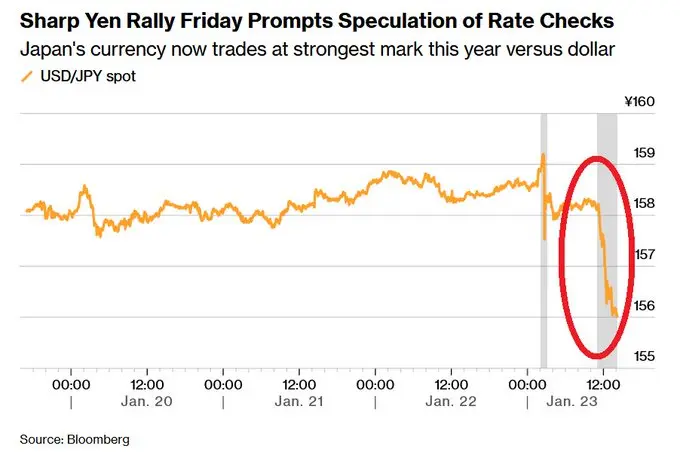
The Japanese Yen experienced its largest single-day gain since June, plunging from 160 to 155.6, with the Prime Minister warning of “abnormal fluctuations.” The New York Fed and major banks are communicating, which is usually a precursor to coordinated intervention. The Plaza Accord of 1985 showed that joint efforts by the US and Japan could stabilize the Yen, weaken the dollar, and boost asset prices. However, short-term risks include unwinding arbitrage positions; in August 2024, a rate hike by the Bank of Japan triggered Bitcoin to crash from 64,000 to 49,000 USD, evaporating 15 billion.
Yen Short Positions Hit Ten-Year Highs Triggering Intervention Alerts
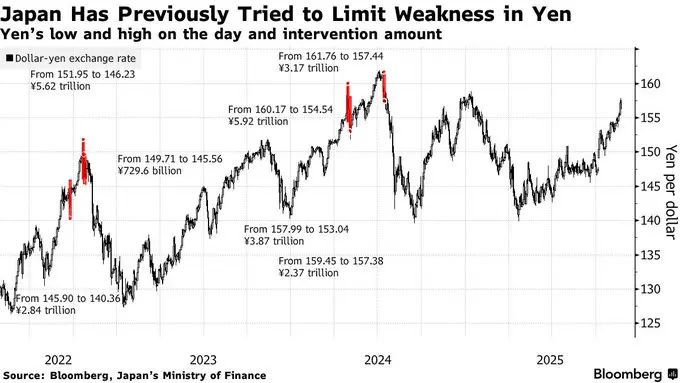
(Source: Bloomberg)
Japanese Prime Minister Sanae Sato warned of potential “abnormal” fluctuations in the Yen, leading to a sharp drop in USD/JPY from around 160 to 155.6. Notably, this is the highest level since 2026 and the largest single-day increase since August. Traders note that Yen short positions have reached a ten-year high, and if the Yen weakens further, market volatility could intensify.
Market analyst Walter Bloomberg wrote: “With Yen short positions at a ten-year high and elections approaching, officials seem prepared to act again, especially if the Yen weakens further.” This observation reveals the political economy behind Yen interventions. Japan is scheduled to hold a general election soon, and the Yen’s depreciation-driven rise in import prices and living costs could become a political burden for the ruling party. Under this backdrop, the government has a strong incentive to stabilize or even push up the Yen exchange rate.
Adding to the complexity, reports indicate that the New York Fed has communicated with several major banks regarding the Yen exchange rate issue. Notably, this is often a precursor to coordinated currency intervention. The NY Fed, responsible for US FX market operations, communicates with banks as part of the preparatory phase for official intervention, assessing market depth, determining intervention scale, and coordinating execution details.
The Yen short positions reaching a ten-year high imply significant investor bets on Yen depreciation. These shorts mainly stem from arbitrage trades: investors borrow low-interest Yen and invest in high-yield assets (such as USD assets, emerging market bonds, or cryptocurrencies). When the Yen suddenly strengthens, these trades face double losses: first, Yen appreciation increases repayment costs; second, high-yield asset prices may fall. If losses grow, traders are forced to unwind positions, selling high-yield assets and buying Yen, which could trigger market volatility.
Although the Yen at 155.6 remains in a historically weak zone, the sharp rebound in the short term has inflicted notable losses on Yen shorts. If the Fed and Japan truly coordinate intervention, the Yen could strengthen further to 150 or even 145, increasing the pressure for unwinding arbitrage positions.
The Plaza Accord’s Historical Lessons for Global Assets
Historical precedents suggest that US-Japan joint actions can be highly effective. Past interventions, including the 1985 Plaza Accord and actions during the 1998 Asian financial crisis, stabilized the Yen, weakened the dollar, and boosted global asset prices. Analysts now warn that coordinated interventions could produce results similar to 2008, flooding markets with liquidity.
The 1985 Plaza Accord is the most famous case of currency intervention. At that time, the overvalued dollar hurt US export competitiveness, prompting the US to coordinate with Japan, Germany, France, and the UK to intervene and lower the dollar. This effort was highly successful, with the dollar depreciating about 50% over two years, and the Yen appreciating significantly. Notably, global asset prices generally rose after this intervention, including the formation of the Japanese stock market bubble.
The 1998 US-Japan coordinated intervention during the Asian financial crisis was equally important. The Yen’s plunge triggered a chain collapse of Asian currencies, but coordinated buying of Yen by the US and Japan stabilized the situation. After this intervention, global risk assets rebounded, paving the way for the tech bubble of 1999-2000.
“Federal Reserve is intervening to save the Yen,” said Chartered Financial Analyst Michael Gayed, emphasizing that if intervention is only targeted at Japan, it might force the Bank of Japan to sell US Treasuries to obtain dollars, potentially destabilizing the global debt markets. This highlights the risks of unilateral intervention. Japan is one of the largest foreign holders of US debt; if the BOJ sells large amounts of US Treasuries to buy dollars, it could push US interest rates higher and cause turmoil in global bond markets.
Conversely, coordinated actions with the US can prevent such outcomes, while deliberately weakening the dollar to support the Yen. In coordinated interventions, the Fed can directly sell dollars to buy Yen, avoiding the need for Japan to use its US Treasury reserves, thus reducing bond market risks. This “win-win” structure is a key reason why US-Japan coordinated intervention is preferable to unilateral actions.
Bitcoin Faces Short-Term Crash and Long-Term Surge Contradiction
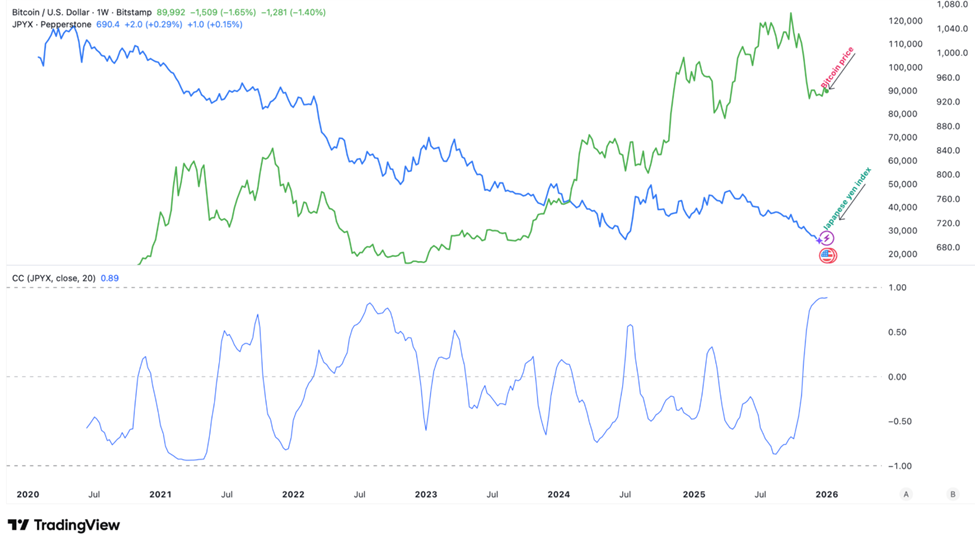
(Source: Trading View)
Market strategists note that this move has far-reaching implications. Selling dollars to buy Yen will weaken the dollar, increase global liquidity, and boost asset prices across stocks, commodities, and cryptocurrencies. For example, Bitcoin shows one of the strongest positive correlations with Yen and an inverse relationship with the dollar. A weaker dollar could lead to significant re-pricing in crypto markets, but unwinding leveraged Yen arbitrage trades may cause short-term volatility.
In August 2024, the Bank of Japan raised interest rates slightly, strengthening the Yen and triggering a six-day crypto sell-off, with market value evaporating by 15 billion USD, including Bitcoin dropping from 64,000 to 49,000 USD. This historical case offers important warnings for the current situation. The August event demonstrated that a sudden Yen appreciation can trigger chain unwinding of arbitrage trades, with cryptocurrencies being the first to suffer as high-risk assets.
The short-term risk is a replay of the August scenario. If the Fed and Japan truly coordinate intervention, the Yen could rapidly strengthen below 150, forcing large-scale unwinding of Yen arbitrage trades. These traders would need to sell risk assets like Bitcoin to buy Yen for repayment, exerting downward pressure on crypto markets. Based on August’s experience, such selling could last several days to a week, with Bitcoin falling 20-30%.
However, the long-term effects could be entirely opposite. A weaker dollar makes US debt easier to manage and boosts exports. Improved macroeconomic conditions could increase risk appetite, leading to capital flowing back into stocks and cryptocurrencies. Additionally, dollar depreciation makes Bitcoin priced in USD relatively cheaper compared to other currencies, potentially attracting non-dollar buyers. If intervention succeeds and markets adapt to new exchange rates, Bitcoin could reach new highs within weeks or months.
Related Articles
Germany's March PPI Rises 2.5% Month-on-Month, Beating 1.3% Forecast
Germany's producer price index rose 2.5% month-on-month in March, surpassing expectations of 1.3% and reversing February's 0.5% decline, signaling a rise in producer-level inflation.
GateNews8h ago
Japan's 40-Year Government Bond Yield Falls 7 Basis Points to 3.775%
Japan's 40-year government bond yield dropped to 3.775%, down 7 basis points, while the 20-year bond yield decreased to 3.230%, falling by 3.5 basis points.
GateNews8h ago
Moody’s: Stablecoins don’t pose a near-term threat to banks, but a $300 billion market cap reveals long-term risks
Moody’s Analytics said that stablecoins will not replace traditional bank deposits on a large scale in the near term, mainly because the United States’ payment infrastructure is mature and regulatory prohibitions limit their use. But as the stablecoin market capitalization rises, it could over the long term drive outflows from bank deposits and reduce banks’ ability to create credit. In addition, regulatory controversy around the CLARITY Act further increases uncertainty in the market.
MarketWhisper9h ago
TradFi Rise Alert: USDCLP (US Dollar vs Chile Peso) Rises Over 1.5%
Gate News: According to the latest Gate TradFi data, USDCLP (US Dollar vs Chile Peso) has surged by 1.5% in a short period. Current volatility is significantly higher than recent averages, indicating increased market
GateNews10h ago
TradFi Rise Alert: VIX (VIX) Rises Over 1.5%
Gate News: According to the latest Gate TradFi data, VIX (VIX) has surged by 1.5% in a short period. Current volatility is significantly higher than recent averages, indicating increased market activity.
GateNews13h ago
ETH drops 0.69% in 15 minutes: large on-chain transfer outflows trigger a rebound of spot sell pressure
During the period from 2026-04-19 22:00 to 2026-04-19 22:15(UTC), the ETH price fell from 2275.98 USDT to 2252.72 USDT. The return over 15 minutes was -0.69%, and the amplitude reached 1.02%. During this round of unusual price movement, short-term market volatility increased, attention on major coins rose, trading activity improved, and volatility was clearly tilted bearish.
The main driver behind this unusual move is the frequent occurrence of on-chain ETH large transfers with both high frequency and notable volume concentrated in a short period. Using a certain well-known hot wallet as a hub, more than 20,000 ETH were transferred out in a short time, and some of it has been traced on-chain and confirmed to have flowed to other exchanges’ receiving addresses. After funds briefly flowed into trading platforms, the number of sell orders in the spot market increased significantly, bringing about a phase of liquidity pressure and further intensifying the downward move in price. In addition, the futures market is linked to spot volatility; during the decline, highly leveraged long positions were liquidated passively, pushing short-term prices to release more downside pressure.
At the same time, the pace of ETF capital inflows has slowed since mid-April. Within the latest range, continuous net inflows have been trending steadily, and coupled with some funds making small redemptions, this weakens the market’s institutional support. Global risk sentiment is also facing synchronized pressure—repeated swings in macro-level expectations for the Federal Reserve’s policy and heightened geopolitical tensions have driven inflows into safe-haven assets. The U.S. Dollar Index strengthened in the short term, global equity markets came under pressure, and this further reinforced ETH’s ongoing downside pressure. In addition, the 24-hour trading volumes for spot and futures were 21.75 billion USD and 42.76 billion USD, respectively; futures open interest was 30.93 billion USD. The liquidation size showed no abnormality, indicating a structural adjustment under multi-dimensional market convergence.
Going forward, it is necessary to stay alert to risks such as continued large outflows on-chain and ETF capital movements shifting from inflows to outflows. If the macro environment deteriorates further, ETH may further intensify volatility. For short-term support, watch the 2250 USDT area; resistance is at 2275 USDT. The ETF trend, the direction of on-chain transfers, and macro news remain the key indicators to monitor for the next stage. Please closely follow subsequent market developments and the flow of large on-chain funds, and promptly capture relevant trading information.
GateNews16h ago


