#MegaETHMainnetLaunches
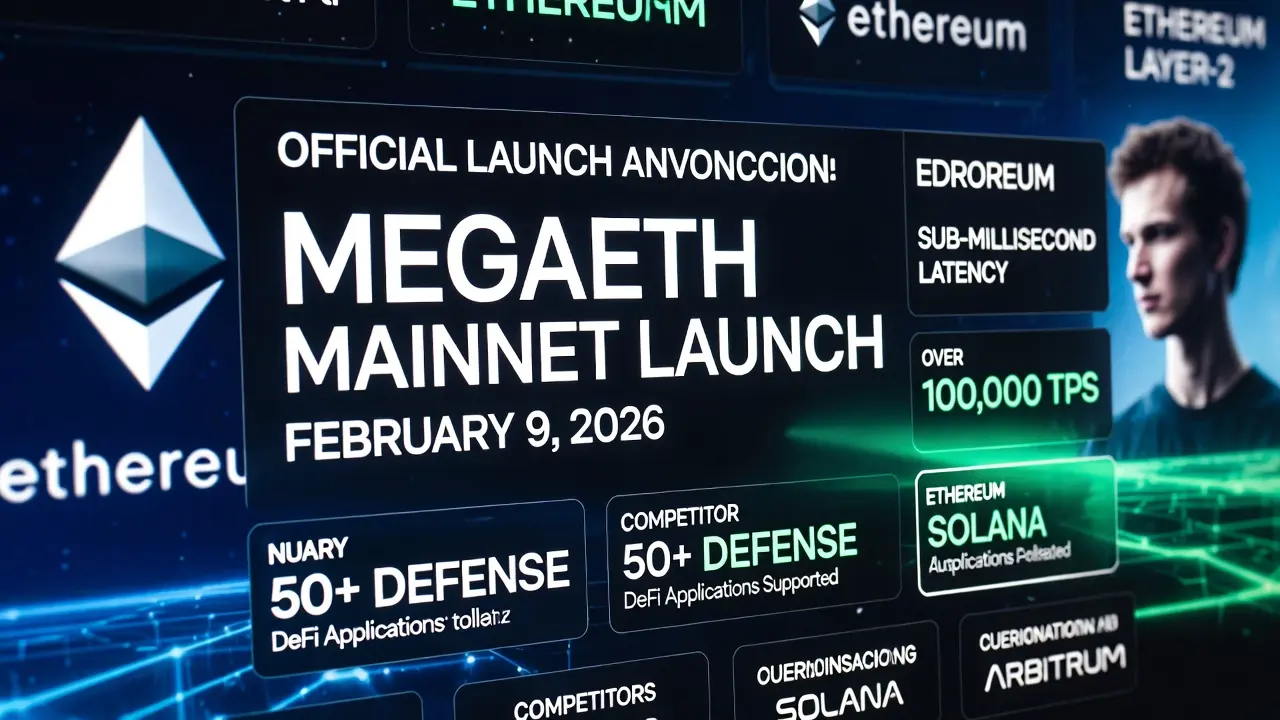
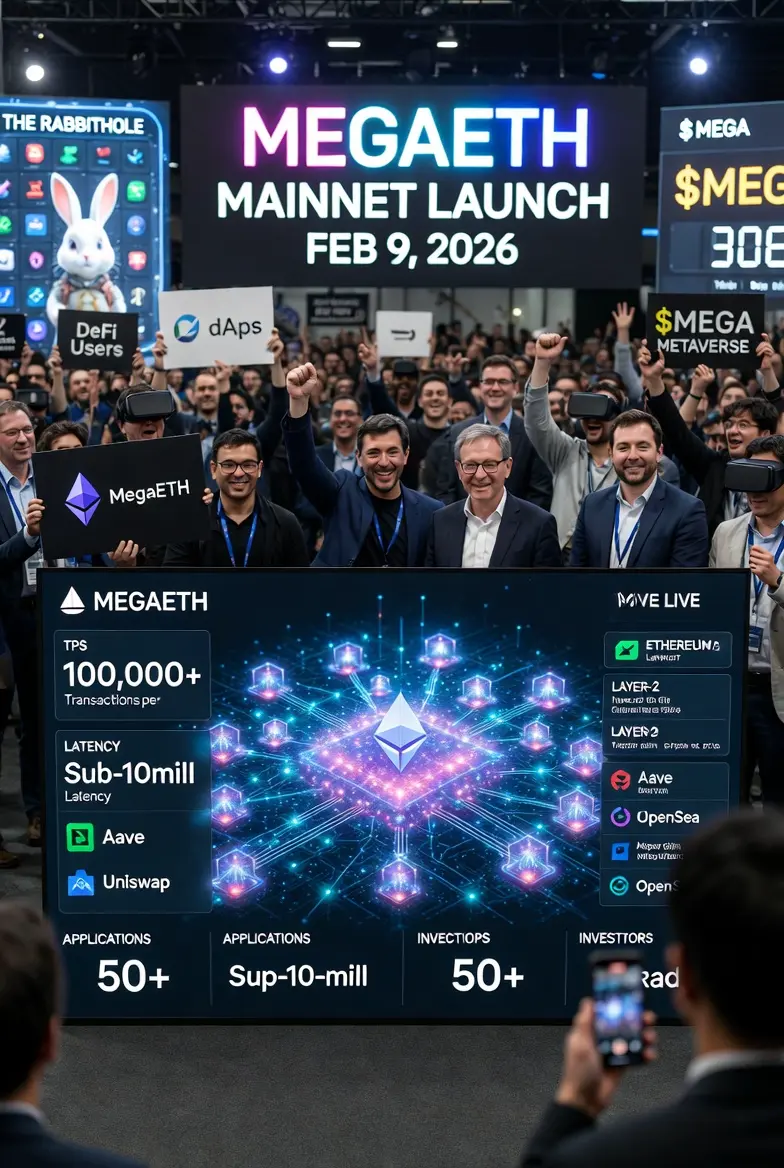
The official launch of MegaETH's mainnet on February 9, 2026, marks a major milestone in Ethereum's scaling ecosystem. This high-performance Ethereum Layer-2 (L2) network, often called the "first real-time blockchain," went live amid ongoing debates about how Ethereum should evolve to handle mass adoption, ultra-low latency applications, and competition from high-throughput chains like Solana.
Here's a fully extended, detailed breakdown of everything surrounding this launch, structured as a comprehensive professional post-style discussion in English:
1. What is MegaETH?
MegaETH is an Ethereum-based Layer-2 rollup developed by MegaLabs, designed to deliver "real-time" blockchain performance. It remains fully secured and settled on Ethereum (L1) while optimizing execution for extreme speed.
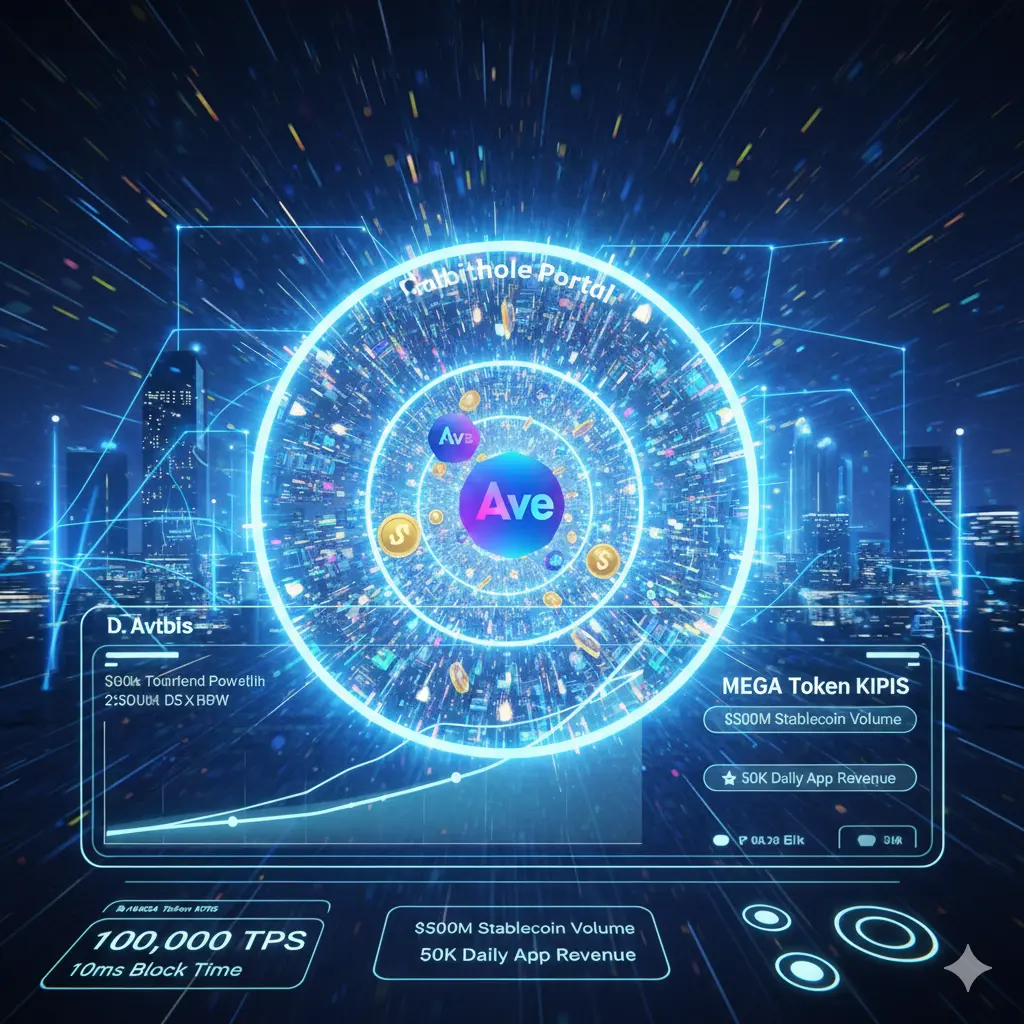
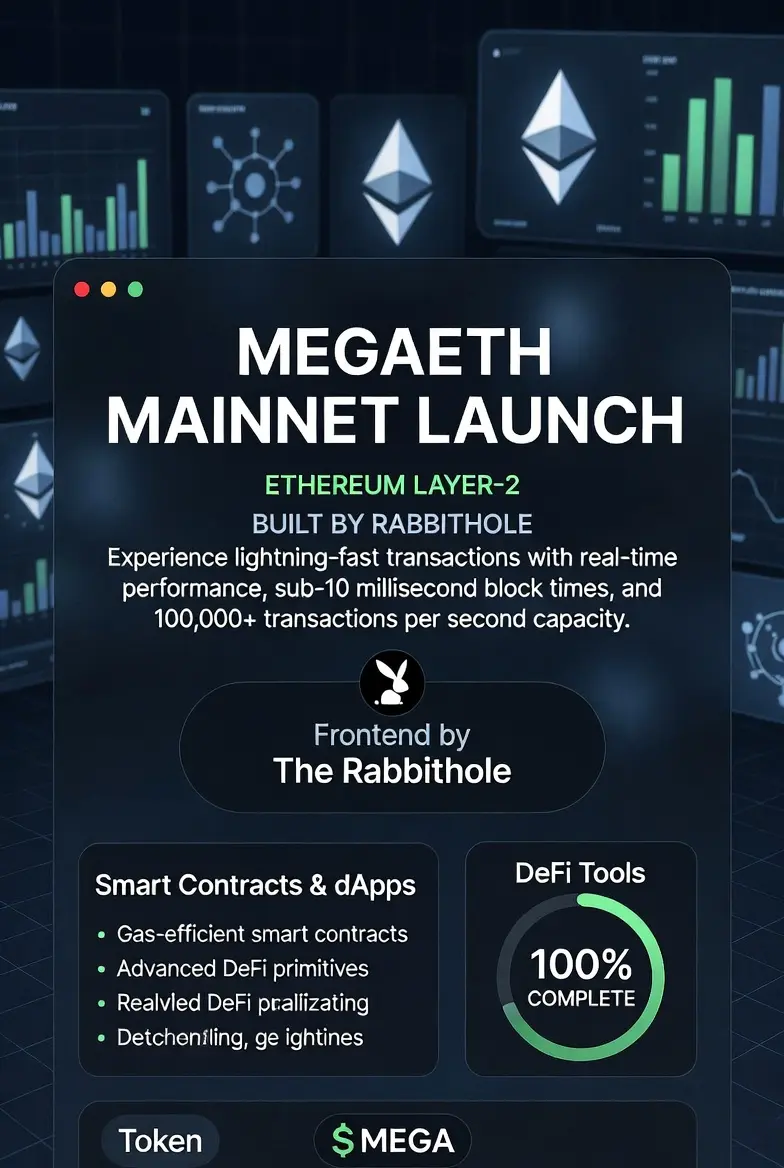
Core Promise: Sub-millisecond latency, sub-10ms block times, and throughput targeting over 100,000 TPS (transactions per second), with stress tests hitting ~50,000–55,000 TPS.
Key Tech: Heterogeneous architecture with specialized nodes (e.g., separating sequencer and full-node roles), hyper-optimized EVM-compatible execution, real-time state streaming, and integrations like proximity markets for MEV (Maximal Extractable Value).
Compatibility: Fully EVM-compatible, preserving Ethereum composability so developers can build/deploy apps using familiar tools without major changes.
Vision: Make on-chain interactions feel as instant as traditional web/apps, unlocking use cases in DeFi, gaming, real-time payments, high-frequency trading, and more that struggle on current L1/L2s due to delays.
2. Mainnet Launch Details (February 9, 2026)
Launch Date: Public mainnet activated on February 9, 2026 (just days ago as of now).
Day-One Stats: Over 50 applications deployed at launch, including integrations with major DeFi protocols.
Infrastructure Readiness: Chainlink Scale integration live from day one (enabling access to ~$14B in assets like Aave, GMX, Lido's wstETH, Lombard's BTC.b/LBTC). Redstone oracles co-located for real-time data feeds from major exchanges. Rango Exchange routing active for seamless bridging/liquidity.
Early Activity: TVL quickly climbed to $40M+ within 24 hours. Normal TPS started lower (24–30 TPS initially, as expected for a fresh chain), but the stack was pre-built for scaling.
Stress Test Pre-Launch: In late January 2026, a global stress test processed 11B+ transactions in 7 days, with peaks at 55k TPS, proving sustained high load before going public.
3. Performance Claims vs. Reality
Targets: >100k TPS, 10+ Ggas/s, sub-10ms block times → Aims to rival or exceed Solana-level speed while staying Ethereum-secured.
Real-World: Stress tests validated ~55k TPS; early mainnet focused on stability/low fees rather than maxing out immediately.
Why It Matters: Current Ethereum L1 handles ~15–30 TPS; top L2s like Arbitrum/Base do hundreds to low thousands. MegaETH pushes toward "web2-like" feel, potentially enabling new app categories (e.g., on-chain gaming without lag, instant DeFi executions).
4. Backing, Funding, and Team
Backers: Strong support from Ethereum co-founder Vitalik Buterin, ConsenSys founder Joseph Lubin, Dragonfly Capital, and others like EigenLayer's Sreeram Kannan.
Funding: Raised aggressively — seed ($20M+), community rounds, and a massive $1.39B oversubscribed token sale/ICO in late 2025 (at ~$1B valuation). Total raised estimates vary but highlight huge institutional conviction.
Token ($MEGA): No immediate airdrops/farming hype; token launch/TGE delayed until key ecosystem milestones (e.g., adoption targets). Focus on long-term value over short-term pumps.
Economics: Partnerships like Ethena's USDM stablecoin for yield/sequencer cost alignment; low fees emphasized for users/builders.
5. Ecosystem and Apps at Launch
Rabbithole: Official ecosystem frontend/portal for discovering apps.
Day-One Apps: 50+ live, spanning DeFi, bridges, oracles, and more.
Incentives: Mainnet reward campaigns planned (e.g., 2.5% $MEGA supply over 6–8 months in phases) to bootstrap activity.
Growth Potential: With instant execution + real-time data, it could attract high-frequency DeFi, proximity MEV markets, and apps impossible on slower chains.
6. Broader Implications for Ethereum Scaling Debate
Context: Ethereum faces criticism for L2 fragmentation, high fees during congestion, and slower user experience vs. monolithic chains.
MegaETH's Position: Challenges traditional L2 norms by prioritizing extreme performance over decentralization trade-offs (some centralization concerns around sequencer/specialized nodes).
Vitalik's Views: Mixed — strong backer, but Ethereum community debates if such specialized L2s dilute L1 focus or accelerate adoption.
Market Impact: Launch provides a "floor" for ETH scaling innovation during a bearish/down period (ETH ~62% off peaks in early 2026). Could stabilize by absorbing activity and proving high-throughput is possible on Ethereum rails.
7. Risks and Criticisms
Centralization Concerns: Heavy reliance on optimized/heterogeneous nodes raises questions about long-term decentralization.
Competition: Faces Solana, other L2s (e.g., Base, Arbitrum), and emerging high-perf chains.
Adoption Hurdle: Early activity "quiet" (normal for day 1–2 launches); success depends on developer migration and real-world usage.
Market Timing: Amid ETH downturn and L2 uncertainty, but infrastructure was launch-ready.
8. Investor/Builder Takeaways
MegaETH's mainnet launch is a bold bet on performance-first scaling within Ethereum. It combines massive funding, top-tier backers, pre-built infra, and ambitious tech to potentially redefine what's possible onchain.
For builders: Real-time execution opens new design spaces.
For users/investors: Watch TVL growth, TPS under load, and app traction over the next weeks/months.
This isn't just another L2 — it's Ethereum pushing toward "instant" crypto, right as the ecosystem needs fresh momentum.
If you're tracking Ethereum upgrades or scaling solutions in 2026, MegaETH is one of the most exciting developments unfolding right now. 🚀
(Condensed version for quick share: MegaETH mainnet live Feb 9, 2026! Ethereum L2 targeting 100k+ TPS, sub-ms latency, 50+ apps day one, backed by Vitalik. Real-time blockchain era begins amid scaling debates.)
The official launch of MegaETH's mainnet on February 9, 2026, marks a major milestone in Ethereum's scaling ecosystem. This high-performance Ethereum Layer-2 (L2) network, often called the "first real-time blockchain," went live amid ongoing debates about how Ethereum should evolve to handle mass adoption, ultra-low latency applications, and competition from high-throughput chains like Solana.
Here's a fully extended, detailed breakdown of everything surrounding this launch, structured as a comprehensive professional post-style discussion in English:
1. What is MegaETH?
MegaETH is an Ethereum-based Layer-2 rollup developed by MegaLabs, designed to deliver "real-time" blockchain performance. It remains fully secured and settled on Ethereum (L1) while optimizing execution for extreme speed.
Core Promise: Sub-millisecond latency, sub-10ms block times, and throughput targeting over 100,000 TPS (transactions per second), with stress tests hitting ~50,000–55,000 TPS.
Key Tech: Heterogeneous architecture with specialized nodes (e.g., separating sequencer and full-node roles), hyper-optimized EVM-compatible execution, real-time state streaming, and integrations like proximity markets for MEV (Maximal Extractable Value).
Compatibility: Fully EVM-compatible, preserving Ethereum composability so developers can build/deploy apps using familiar tools without major changes.
Vision: Make on-chain interactions feel as instant as traditional web/apps, unlocking use cases in DeFi, gaming, real-time payments, high-frequency trading, and more that struggle on current L1/L2s due to delays.
2. Mainnet Launch Details (February 9, 2026)
Launch Date: Public mainnet activated on February 9, 2026 (just days ago as of now).
Day-One Stats: Over 50 applications deployed at launch, including integrations with major DeFi protocols.
Infrastructure Readiness: Chainlink Scale integration live from day one (enabling access to ~$14B in assets like Aave, GMX, Lido's wstETH, Lombard's BTC.b/LBTC). Redstone oracles co-located for real-time data feeds from major exchanges. Rango Exchange routing active for seamless bridging/liquidity.
Early Activity: TVL quickly climbed to $40M+ within 24 hours. Normal TPS started lower (24–30 TPS initially, as expected for a fresh chain), but the stack was pre-built for scaling.
Stress Test Pre-Launch: In late January 2026, a global stress test processed 11B+ transactions in 7 days, with peaks at 55k TPS, proving sustained high load before going public.
3. Performance Claims vs. Reality
Targets: >100k TPS, 10+ Ggas/s, sub-10ms block times → Aims to rival or exceed Solana-level speed while staying Ethereum-secured.
Real-World: Stress tests validated ~55k TPS; early mainnet focused on stability/low fees rather than maxing out immediately.
Why It Matters: Current Ethereum L1 handles ~15–30 TPS; top L2s like Arbitrum/Base do hundreds to low thousands. MegaETH pushes toward "web2-like" feel, potentially enabling new app categories (e.g., on-chain gaming without lag, instant DeFi executions).
4. Backing, Funding, and Team
Backers: Strong support from Ethereum co-founder Vitalik Buterin, ConsenSys founder Joseph Lubin, Dragonfly Capital, and others like EigenLayer's Sreeram Kannan.
Funding: Raised aggressively — seed ($20M+), community rounds, and a massive $1.39B oversubscribed token sale/ICO in late 2025 (at ~$1B valuation). Total raised estimates vary but highlight huge institutional conviction.
Token ($MEGA): No immediate airdrops/farming hype; token launch/TGE delayed until key ecosystem milestones (e.g., adoption targets). Focus on long-term value over short-term pumps.
Economics: Partnerships like Ethena's USDM stablecoin for yield/sequencer cost alignment; low fees emphasized for users/builders.
5. Ecosystem and Apps at Launch
Rabbithole: Official ecosystem frontend/portal for discovering apps.
Day-One Apps: 50+ live, spanning DeFi, bridges, oracles, and more.
Incentives: Mainnet reward campaigns planned (e.g., 2.5% $MEGA supply over 6–8 months in phases) to bootstrap activity.
Growth Potential: With instant execution + real-time data, it could attract high-frequency DeFi, proximity MEV markets, and apps impossible on slower chains.
6. Broader Implications for Ethereum Scaling Debate
Context: Ethereum faces criticism for L2 fragmentation, high fees during congestion, and slower user experience vs. monolithic chains.
MegaETH's Position: Challenges traditional L2 norms by prioritizing extreme performance over decentralization trade-offs (some centralization concerns around sequencer/specialized nodes).
Vitalik's Views: Mixed — strong backer, but Ethereum community debates if such specialized L2s dilute L1 focus or accelerate adoption.
Market Impact: Launch provides a "floor" for ETH scaling innovation during a bearish/down period (ETH ~62% off peaks in early 2026). Could stabilize by absorbing activity and proving high-throughput is possible on Ethereum rails.
7. Risks and Criticisms
Centralization Concerns: Heavy reliance on optimized/heterogeneous nodes raises questions about long-term decentralization.
Competition: Faces Solana, other L2s (e.g., Base, Arbitrum), and emerging high-perf chains.
Adoption Hurdle: Early activity "quiet" (normal for day 1–2 launches); success depends on developer migration and real-world usage.
Market Timing: Amid ETH downturn and L2 uncertainty, but infrastructure was launch-ready.
8. Investor/Builder Takeaways
MegaETH's mainnet launch is a bold bet on performance-first scaling within Ethereum. It combines massive funding, top-tier backers, pre-built infra, and ambitious tech to potentially redefine what's possible onchain.
For builders: Real-time execution opens new design spaces.
For users/investors: Watch TVL growth, TPS under load, and app traction over the next weeks/months.
This isn't just another L2 — it's Ethereum pushing toward "instant" crypto, right as the ecosystem needs fresh momentum.
If you're tracking Ethereum upgrades or scaling solutions in 2026, MegaETH is one of the most exciting developments unfolding right now. 🚀
(Condensed version for quick share: MegaETH mainnet live Feb 9, 2026! Ethereum L2 targeting 100k+ TPS, sub-ms latency, 50+ apps day one, backed by Vitalik. Real-time blockchain era begins amid scaling debates.)