Record-low RSI and a 50% OI drop signal deep stress as ETF outflows weaken institutional support.
Bitcoin has printed one of the most extreme technical readings in its history. Momentum has collapsed to levels never recorded on the weekly timeframe. As spotted by Ash Crypto, weekly RSI has fallen below every prior macro panic event. Notably, the current conditions place Bitcoin in rare statistical territory.
Historic RSI Breakdown Meets 50% Open Interest Collapse in Bitcoin Market
Trading near $64,000, Bitcoin’s weekly RSI has dropped into the mid-20s. That reading sits below levels seen during the Mt. Gox collapse, 2018 bear market bottom, March 2020 COVID crash, and 2022 FTX selloff.
BITCOIN JUST MADE HISTORY.
But it’s not something we all wanted.
Bitcoin weekly RSI has just reached its lowest level in history.
– Lower than tariffs Crash
– Lower than the FTX crash
– Lower than the Covid Crash
– Lower than the 2018 bottom
– Lower than the Mt. Gox hack… pic.twitter.com/HRWQZD0GRY
— Ash Crypto (@AshCrypto) February 24, 2026
Historically, major cycle lows have formed when the weekly RSI reached the 30–35 range. Even during capitulation phases, readings rarely stayed under 30 for long. Current compression marks an outlier in Bitcoin’s price history.
Derivatives data shows clear stress across the market. Open interest across exchanges has dropped from around $45–47 billion at the 2025 highs to about $21 billion. That is a decline of more than 50%. As a result, many traders have closed or been forced out of their positions, even though the price is still well above past-cycle lows.
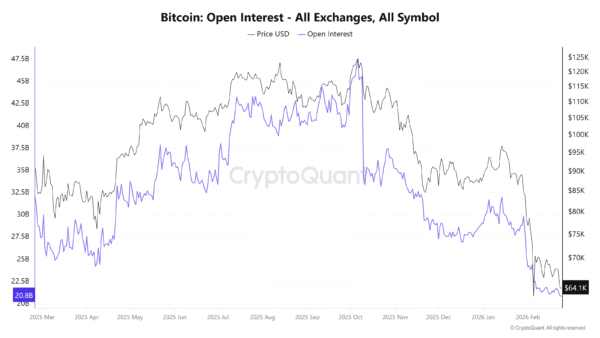
_Image Source: _CryptoQuant
At the same time, liquidations have removed excess risk faster than the spot price has fallen. In previous cycles, sharp drops in open interest were often followed by large price moves. However, direction usually depended on whether strong spot buying returned.
BTC Faces Multi-Timeframe Pressure as Valuation Nears Long-Term Support
On-chain data shows more pressure building, but not full capitulation. As per data, the MVRV ratio has dropped to around 1.1, which is close to long-term value support. In past cycles, market tops formed above 2.5. Meanwhile, normal mid-cycle conditions ranged between 1.5 and 2.0. Capitulation usually appeared near 1.0.
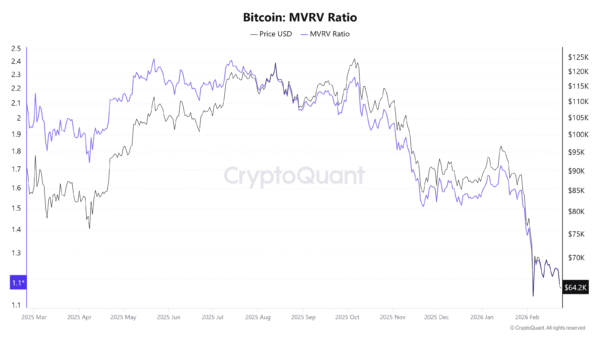
_Image Source: _CryptoQuant
At current levels, Bitcoin is trading close to the average cost basis of holders. However, it has not fallen below 1.0, where deeper loss conditions and stronger long-term bottoms often form.
At the same time, institutional flows look weaker than in past resets. Spot Bitcoin ETFs have seen about $1.2 billion in monthly net outflows. As the price declined, total net assets also moved lower.
During the 2024–2025 rally, steady ETF inflows helped push prices higher. Now, price is falling while flows remain negative. As a result, institutional demand appears to be slowing rather than returning.
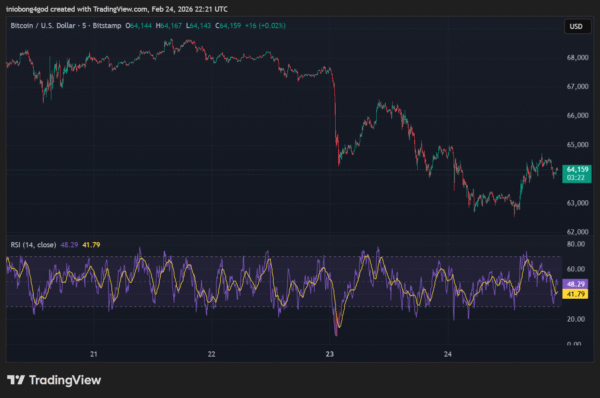
_Image Source: _TradingView
Short-term momentum is starting to stabilize. The five-hour RSI recently dropped into oversold levels, then bounced back toward neutral. As a result, immediate selling pressure seems to have eased around the $64,000 area.
However, higher timeframes remain deeply oversold. So while short-term pressure has cooled, longer-term momentum is still very weak, creating tension across multiple timeframes.
Disclaimer: The information on this page may come from third parties and does not represent the views or opinions of Gate. The content displayed on this page is for reference only and does not constitute any financial, investment, or legal advice. Gate does not guarantee the accuracy or completeness of the information and shall not be liable for any losses arising from the use of this information. Virtual asset investments carry high risks and are subject to significant price volatility. You may lose all of your invested principal. Please fully understand the relevant risks and make prudent decisions based on your own financial situation and risk tolerance. For details, please refer to
Disclaimer.
Related Articles
Gold and silver fall across the board, and the BTC/ETH volatility index rises slightly
On April 13, gold and silver prices fell to $4,732.92 per ounce and $74.209 per ounce, respectively. The BTC volatility index rose by 0.42%, and the ETH volatility index rose by 0.31%. The U.S. dollar versus the Chinese yuan and the Japanese yen edged up slightly, major European stock indexes generally fell, while WTI and Brent crude oil prices rose. The Gate platform supports trading for multiple asset types.
GateNews29m ago
BTC 15-minute rise of 0.86%: A rebound driven by a convergence of short liquidations and inflows into ETFs
2026-04-13 13:45 to 2026-04-13 14:00 (UTC), the BTC price fluctuated within the 70945.9 to 71699.9 USDT range. Within 15 minutes, it recorded a notable gain of +0.86%, with a swing of 1.06%. Market attention has surged, short-term volatility has clearly intensified, and on-chain large transfers, spot, and derivatives trading volumes have expanded in sync, indicating that the activity level of funds by major players is at one of the highest points of the year.
The main driving force behind this anomaly is that BTC has been probing the 72000–73500 USDT range with a large amount of leverage shorts
GateNews34m ago
Bernstein: The Bitcoin market has already priced in the risk from quantum computing, and developers have 3 to 5 years to push forward with a post-quantum upgrade
Bernstein’s research report states that the Bitcoin pullback reflects market concerns about the risks of quantum computing, and argues that the quantum threat is manageable and does not constitute a systemic risk. Current technological progress provides a cushion for Bitcoin, giving developers 3 to 5 years to push forward a post-quantum upgrade. Institutional investors will help drive consensus formation, but user migration remains the main challenge.
GateNews35m ago
The New York Times reignites the “Satoshi identity mystery”; after Adam Back was targeted, he quickly clarified
Author: Nancy, PANews
Satoshi Nakamoto’s true identity remains the mystery that has continued in the crypto world for 17 years. Speculation about this pseudonym has never stopped—from cryptographers to corporate founders, various candidates have been brought up in turn, but there has always been a lack of evidence strong enough to settle the matter once and for all.
Recently, The New York Times published a long-form investigation of more than 10,000 words. Based on multiple comparisons drawn from language style, technical pathways, and historical context, it ranked Blockstream CEO Adam Back as the strongest candidate for Satoshi Nakamoto. However, this claim was quickly and clearly denied by Back himself, and the relevant arguments were widely questioned across the industry as being hard to support.
The dispute over Satoshi Nakamoto’s identity reignites as the long-form investigation targets Adam Back
In this investigation, New York Times reporter John Carreyrou spent more than a year thoroughly sifting through decades of archives, as well as the cypherpunk email list to
区块客1h ago
Exodus, the Nasdaq-listed Bitcoin treasury company, sues the W3C to demand enforcement of the acquisition agreement
U.S.-listed Bitcoin custody company Exodus Movement filed a lawsuit in Delaware state court on April 13, seeking W3C Corp and its CEO to carry out the 2025 share acquisition agreement and to speed up the completion of the transaction. Exodus has received approval from the UK’s financial regulator and plans to drive the acquisition forward through litigation and the enforcement of security interests.
GateNews1h ago


