The central bank will focus on designing a regulatory framework for the so-called institutional VASPs, defined as organizations that operate infrastructure and provide crypto services to other institutions. The move would bring clarity to companies like Fireblock, Ripple, and Bitgo in the Brazilian market.
Brazil to Regulate Institutional VASPs by 2027
Brazil is advancing fast to bring clarity to all sectors of the crypto market, including Business-to-Business (B2B) interactions.
Local reports indicate that the Central Bank of Brazil will advance regulations regarding the operation of institutional virtual asset service providers (VASPs) in the country before 2027.
Institutional VASPs are defined as companies that construct, provide, and operate crypto infrastructure to serve other institutions, focusing their action on serving other businesses rather than end users.
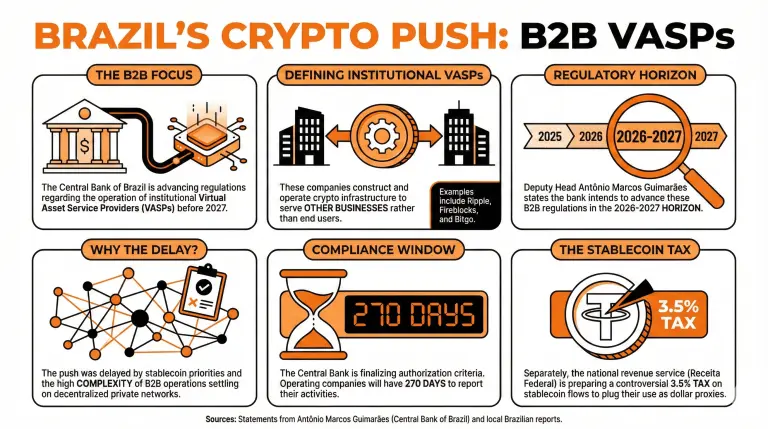
Companies like Ripple, which operates crypto-based payment networks; Fireblocks, which provides various crypto infrastructure products and services; and Bitgo, a custody provider, would fall under this classification.
During a live transmission, Antônio Marcos Guimarães, deputy head of the bank’s Regulation Department, stated that the bank would “intend to advance in the regulation of institutional VASPs (B2B)” in the 2026-2027 horizon.
Furthermore, he stated that the proposal to regulate these institutions’ activities was born of the bank’s public consultations. Nonetheless, other regulatory activities involving stablecoins and more pressing matters took the bank’s attention before this.
An element that has taken this regulatory push aback is the complexity of these businesses’ activities, as there is no brokerage between them, and transactions or deals are settled using decentralized private networks.
In addition, Guimarães added that the bank is finalizing the authorization criteria for companies operating in the country, which will have 270 days to report their activities.
Brazil has been hard at work regarding crypto regulation in 2026, having already streamlined new rules for banks entering the crypto market.
In addition, the national revenue service (Receita Federal) is reportedly preparing a controversial measure that would tax stablecoin flows with 3.5%, aiming to plug a loophole that allowed users and institutions to benefit from using these solutions as dollar proxies for payments and remittances.
FAQ
- What steps is Brazil taking towards crypto regulation?
Brazil is advancing regulations for institutional virtual asset service providers (VASPs) to clarify operations in the B2B sector before 2027.
- What defines an institutional VASP in Brazil?
Institutional VASPs are companies that provide and manage crypto infrastructure specifically to serve other businesses rather than individual users.
- What is the Central Bank’s timeline for these regulations?
Deputy head Antônio Marcos Guimarães indicated that the regulation of institutional VASPs is expected to progress during the 2026-2027 timeframe.
- Are there additional regulatory measures related to stablecoins?
Yes, Brazil’s national revenue service is preparing to implement a 3.5% tax on stablecoin flows to close a loophole in their use as dollar proxies for payments.
Disclaimer: The information on this page may come from third parties and does not represent the views or opinions of Gate. The content displayed on this page is for reference only and does not constitute any financial, investment, or legal advice. Gate does not guarantee the accuracy or completeness of the information and shall not be liable for any losses arising from the use of this information. Virtual asset investments carry high risks and are subject to significant price volatility. You may lose all of your invested principal. Please fully understand the relevant risks and make prudent decisions based on your own financial situation and risk tolerance. For details, please refer to
Disclaimer.
Related Articles
Tether-linked Super PAC’s first $300,000 spending went to a company co-founded by the CEO, allegedly involving pay-to-play and favoritism.
A super political action committee affiliated with Tether filed paperwork with the U.S. Federal Election Commission showing that its first $300k expenditure went to Nxum Group, founded by Tether U.S. CEO Bo Hines, to buy campaign ads for Georgia Republican candidate Clay Fuller, raising questions about pay-to-play.
GateNews18m ago
Sports betting event contracts are derivatives! The U.S. CFTC blocks local law enforcement and seeks regulatory authority over prediction markets
The U.S. federal government is working with the CFTC and the Department of Justice to try to shift regulatory authority over Kalshi prediction markets from state and local governments to the federal level, arguing that contracts for sports events are financial derivatives. If the court backs this position, it will change the legal status of prediction markets and unify nationwide regulation, reducing the influence of state and local gambling laws.
CryptoCity2h ago
ClearBank receives MiCA approval to become a CASP, plans to launch EURC and USDC stablecoin services
ClearBank has recently been approved by the Netherlands Authority for the Financial Markets to become a provider of crypto-asset services. It will launch EURC and USDC stablecoin services, aiming to improve the efficiency of cross-border payments. It will also deepen its collaboration with a certain CEX by offering savings accounts that cover the Financial Services Compensation Scheme.
GateNews2h ago
French Lawmakers Push New Crypto Reporting Rules
_France advances new crypto reporting rules, tightens oversight, and considers new tax measures for digital assets._
France is moving forward with stricter crypto rules to improve transparency and control. Officials are taking steps from two directions at the same time. Thus, new policies are
LiveBTCNews3h ago
U.S. Senator Warns: The CLARITY Act should be passed as soon as possible, or the regulatory window will close until 2030
U.S. Senator Cynthia Lummis is calling for advancing the 《CLARITY Act》 legislation as soon as possible, warning that otherwise it may take nearly four years to restart the regulatory framework. The bill is intended to provide a clear regulatory structure for the crypto industry and to promote innovation and market development. Multiple industry figures and regulators support the legislation, emphasizing the need to avoid regulatory uncertainty.
GateNews3h ago
The U.S. Senate is set to reconvene, and the Clarity Act crypto bill will move into a critical review: stablecoin yields and SEC/CFTC jurisdiction remain to be resolved
The U.S. Senate will reconvene on April 13, with the Clarity Act as the first order of business. The bill aims to establish a regulatory framework for the cryptocurrency market and clarify the jurisdiction of the SEC versus the CFTC. Although a compromise has been reached on the stablecoin yield issue, the bill still faces other disputes. To get legislation completed before Congress adjourns in August, tagging must be completed by the end of April; otherwise, it will be pushed to the fall. If successful, it will provide a clear legal environment for the U.S. crypto market.
ChainNewsAbmedia3h ago


