The central bank will focus on designing a regulatory framework for the so-called institutional VASPs, defined as organizations that operate infrastructure and provide crypto services to other institutions. The move would bring clarity to companies like Fireblock, Ripple, and Bitgo in the Brazilian market.
Brazil to Regulate Institutional VASPs by 2027
Brazil is advancing fast to bring clarity to all sectors of the crypto market, including Business-to-Business (B2B) interactions.
Local reports indicate that the Central Bank of Brazil will advance regulations regarding the operation of institutional virtual asset service providers (VASPs) in the country before 2027.
Institutional VASPs are defined as companies that construct, provide, and operate crypto infrastructure to serve other institutions, focusing their action on serving other businesses rather than end users.
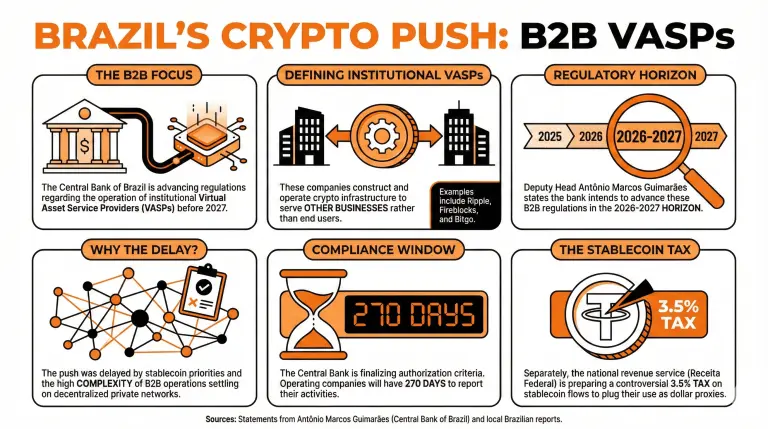
Companies like Ripple, which operates crypto-based payment networks; Fireblocks, which provides various crypto infrastructure products and services; and Bitgo, a custody provider, would fall under this classification.
During a live transmission, Antônio Marcos Guimarães, deputy head of the bank’s Regulation Department, stated that the bank would “intend to advance in the regulation of institutional VASPs (B2B)” in the 2026-2027 horizon.
Furthermore, he stated that the proposal to regulate these institutions’ activities was born of the bank’s public consultations. Nonetheless, other regulatory activities involving stablecoins and more pressing matters took the bank’s attention before this.
An element that has taken this regulatory push aback is the complexity of these businesses’ activities, as there is no brokerage between them, and transactions or deals are settled using decentralized private networks.
In addition, Guimarães added that the bank is finalizing the authorization criteria for companies operating in the country, which will have 270 days to report their activities.
Brazil has been hard at work regarding crypto regulation in 2026, having already streamlined new rules for banks entering the crypto market.
In addition, the national revenue service (Receita Federal) is reportedly preparing a controversial measure that would tax stablecoin flows with 3.5%, aiming to plug a loophole that allowed users and institutions to benefit from using these solutions as dollar proxies for payments and remittances.
FAQ
- What steps is Brazil taking towards crypto regulation?
Brazil is advancing regulations for institutional virtual asset service providers (VASPs) to clarify operations in the B2B sector before 2027.
- What defines an institutional VASP in Brazil?
Institutional VASPs are companies that provide and manage crypto infrastructure specifically to serve other businesses rather than individual users.
- What is the Central Bank’s timeline for these regulations?
Deputy head Antônio Marcos Guimarães indicated that the regulation of institutional VASPs is expected to progress during the 2026-2027 timeframe.
- Are there additional regulatory measures related to stablecoins?
Yes, Brazil’s national revenue service is preparing to implement a 3.5% tax on stablecoin flows to close a loophole in their use as dollar proxies for payments.
Disclaimer: The information on this page may come from third parties and does not represent the views or opinions of Gate. The content displayed on this page is for reference only and does not constitute any financial, investment, or legal advice. Gate does not guarantee the accuracy or completeness of the information and shall not be liable for any losses arising from the use of this information. Virtual asset investments carry high risks and are subject to significant price volatility. You may lose all of your invested principal. Please fully understand the relevant risks and make prudent decisions based on your own financial situation and risk tolerance. For details, please refer to
Disclaimer.
Related Articles
Coinbase CEO Brian Armstrong Backs Passage of CLARITY Act After Earlier Pushback
Coinbase CEO Brian Armstrong has shifted his stance, now supporting the CLARITY Act after previously criticizing it. He believes recent negotiations improved the bill, which he calls strong, and emphasizes the need for Congress to pass it.
CryptoNewsFlash1h ago
Fastest by next year! Japan’s Cabinet approves an amendment: classify cryptocurrency as a “financial product” to strengthen regulation
The Japanese government passed an amendment to the Financial Instruments and Exchange Act, for the first time classifying cryptocurrencies as “financial products,” implementing regulation and banning insider trading. Issuers will be required to disclose information every year; if the amendment is approved, it is expected to take effect in 2027. In addition, penalties will be increased: the maximum prison term for selling tokens without registration will be raised to 10 years, and the maximum fine will increase to 10 million yen.
区块客1h ago
Europe Pushes Centralized Oversight for Crypto Providers
_ECB backs EU plan to centralize crypto oversight under ESMA, aiming to reduce fragmentation and strengthen market integration._
The European Union is moving toward stronger and more unified crypto regulation. A significant proposal has been backed by the European Central Bank. This proposal is int
LiveBTCNews4h ago
Japan Stablecoin Regulations: Full Breakdown—From Fund Settlement to JPYC Launch, Understand Three Compliant Issuance Paths at a Glance
Japan is one of the major economies to establish a comprehensive legal framework for stablecoins at the earliest stage in the world. With the formal implementation of the 2023 amendments to the Act on Payment Services (amended Funds Settlement Act), the issuance of yen stablecoins has moved from a legal gray area to clear regulation, and in 2025 it will see the official launch of the first compliant yen stablecoin, JPYC. This article fully reviews the development of Japan’s stablecoin regulations, three compliant issuance pathways, and the main current market cases, so that financial institutions in Taiwan and the crypto industry can use it as a reference.
Background of Japan’s stablecoin legislation: From the UST collapse to regulatory formation
In May 2022, the algorithmic stablecoin TerraUSD (UST) collapsed, triggering intense global attention on stablecoin regulation. Japan then accelerated its legislative efforts; in June of the same year, Japan’s National Diet formally passed a stablecoin bill, clearly defining stablecoins as those that must be linked to fiat currency, and that must be
ChainNewsAbmedia6h ago


