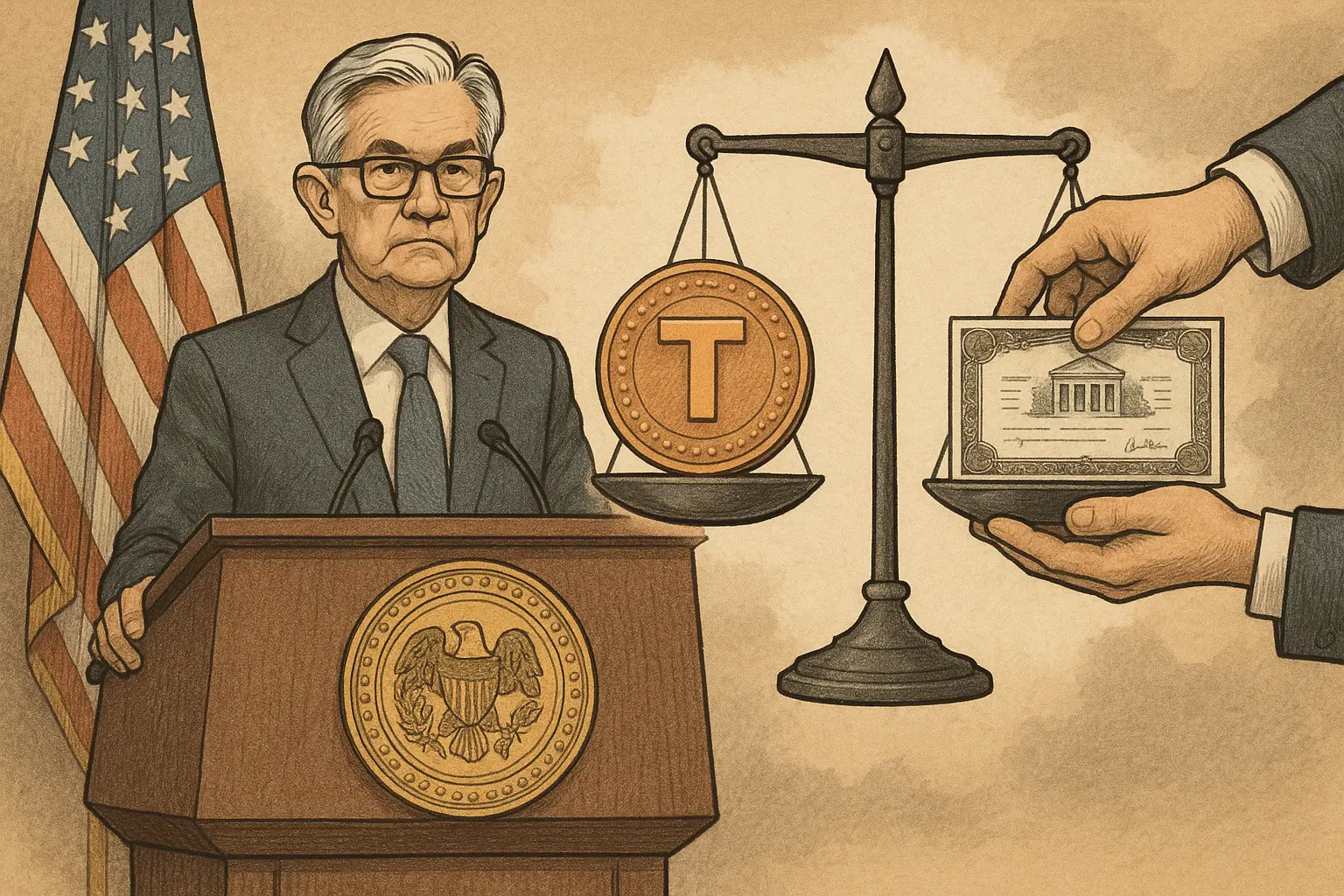
The U.S. Federal Reserve released a document on Thursday explicitly stating that banks should treat tokenized securities the same as traditional securities when calculating regulatory capital. The document emphasizes that the current capital framework is “technologically neutral,” and that blockchain technology itself does not influence the method of regulatory capital recognition. This guidance represents the second major written directive from the leading U.S. financial regulators regarding on-chain tokenized assets, following the SEC’s confirmation in January that tokenized securities fall under federal securities laws.
Federal Reserve FAQ: Five Core Positions
 (Source: Federal Reserve)
This document clarifies the regulatory stance and provides clear compliance guidance for financial institutions:
Technology Neutrality Principle: The technology used to issue or transfer securities (including blockchain technology) does not affect how regulatory capital is treated; the legal nature and risk characteristics are the core criteria for capital treatment.
Equal Treatment Rule: Qualified tokenized securities should be subject to the same capital rules as non-tokenized securities.
Financial Collateral Eligibility: If tokenized securities meet the same legal and risk management standards as traditional securities, they can be used as financial collateral under existing rules.
Blockchain Type Irrelevance: Capital rules do not differentiate between permissioned and permissionless blockchains.
Existing Framework Applies: There is no need to wait for new legislation; banks can directly operate tokenized securities businesses under the current capital framework.
SEC and Federal Reserve Double Confirmation: Formalizing a Complete Regulatory Loop
The Federal Reserve’s guidance is not an isolated event but part of a systematic effort by U.S. regulators to clarify the legal status of blockchain assets. In January, the SEC first confirmed that tokenized securities are subject to federal securities laws, requiring registration, disclosure, and investor protection measures similar to those for traditional securities. The recent confirmation by the Federal Reserve that tokenized securities hold an equivalent status in bank capital calculations further completes the regulatory loop, covering both legal and capital treatment frameworks.
For large financial institutions actively exploring tokenization, such as BlackRock and Fidelity, regulatory uncertainty has long been a major obstacle to advancing tokenized products. This double confirmation significantly reduces compliance friction and provides a more solid policy foundation for scaling tokenization activities.
RWA Market Status: Policy Benefits for a $26 Billion Market
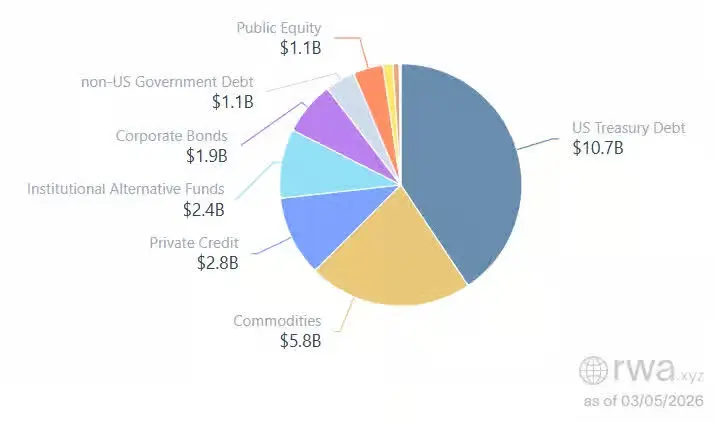 (Source: RWA.xyz)
This guidance coincides with rapid growth in the real-world asset (RWA) tokenization market. According to the latest data from RWA.xyz, the market value of publicly traded tokenized stocks is approximately $1.1 billion, with the broader tokenized RWA market reaching $26 billion, predominantly led by tokenized U.S. Treasury products.
The Federal Reserve’s clarification of capital rules expands the application scope for tokenized RWAs from a banking capital management perspective: banks holding tokenized Treasuries or stocks no longer face additional capital deductions and can consider including them as financial collateral, further aligning tokenized assets with traditional financial instruments.
Frequently Asked Questions
Q: What practical impact does the Federal Reserve’s “technology neutral” principle have on banks?
A: Banks evaluating regulatory capital requirements for tokenized securities do not need to adopt conservative measures solely because of the “tokenized” technology form. As long as the legal nature and risk profile are the same as traditional securities, the same capital rules apply. This allows banks to directly apply existing capital frameworks to tokenized activities, reducing compliance uncertainty.
Q: How can tokenized securities qualify as financial collateral?
A: To qualify as financial collateral, tokenized securities must meet legal requirements (including SEC registration compliance) and risk management standards (such as liquidity and credit ratings). These standards are identical to those for traditional securities. If these are met, banks can use them as collateral under current capital rules without waiting for new specific regulations.
Q: What is the difference and connection between this Federal Reserve guidance and the SEC’s January clarification?
A: The SEC’s clarification focuses on the legal aspect, confirming that issuance and trading of tokenized securities must comply with federal securities laws. The Federal Reserve’s guidance focuses on capital management, confirming that banks should treat tokenized and non-tokenized securities equally in capital calculations. Together, they cover different regulatory dimensions, forming a comprehensive policy framework for institutional applications of tokenized traditional assets.
Disclaimer: The information on this page may come from third parties and does not represent the views or opinions of Gate. The content displayed on this page is for reference only and does not constitute any financial, investment, or legal advice. Gate does not guarantee the accuracy or completeness of the information and shall not be liable for any losses arising from the use of this information. Virtual asset investments carry high risks and are subject to significant price volatility. You may lose all of your invested principal. Please fully understand the relevant risks and make prudent decisions based on your own financial situation and risk tolerance. For details, please refer to
Disclaimer.
Related Articles
Polymarket Prepares pUSD Rollout and Protocol Upgrade to Cut Failed Trades
Polymarket's protocol upgrade introduces pUSD, a USDC-backed collateral token on Polygon, enhancing order management, reducing failed trades, and lowering gas costs. The update aims for a smoother user experience while improving trading architecture and security.
CryptoNewsFlash3h ago
Nous Research Deep Dive: A Decentralized AI Lab That Paradigm Invested in at a $1B Valuation, Comprehensive Breakdown of the Hermes Model and the Psyche Network
Nous Research is an open-source AI lab focused on the Hermes series of models. In 2025, it received a $50 million investment from Paradigm, valuing it at $1 billion. What makes it unique is that it develops AI technology with a crypto-native team and then integrates it with the blockchain. Its core product, the Hermes model, is designed around the goal of reducing the refusal rate, and its data sources rely mainly on synthetic data. At the same time, Psyche Network builds a decentralized AI training network on Solana, incentivizing participants through a token mechanism. Nous Research adopts an open-source and decentralized strategy, aiming to demonstrate its technical capability and feasibility.
ChainNewsAbmedia4h ago
Ondo Finance submits a letter to the U.S. SEC requesting no enforcement action, concerning on-chain record-keeping of tokenized securities rights on the rights chain
Ondo Finance filed a request with the SEC on April 13, seeking confirmation that recording securities interests on the Ethereum mainnet in a tokenized form is compliant under certain patterns. Ondo believes that this on-chain recording can improve collateral monitoring, optimize processes, and simplify reconciliations, with the goal of operating in coordination with traditional finance.
GateNews6h ago
Pi Network Distributes 26.5M PI to 1M KYC Validators
Pi Network has taken another step forward in building its ecosystem. The project recently distributed 26.5 million PI tokens to more than 1 million KYC validators.
These rewards were given to users who helped verify identities on the network. This process is important. Because it ensures that
Coinfomania6h ago
Aave Faces a Major Trust Crisis: Service Providers Exit En Masse, with “Technology, Governance, and Risk Control” Fully Failing
Author: Jae, PANews
Compared with the external pressure of a bear market, Aave has instead seen a “black swan” emerge internally first.
Aave, which has long occupied the throne of lending agreements, is now facing the most severe ecosystem shake-up since its founding. There has been no hacker attack, no code vulnerabilities—only power gone out of control and conflicting interests.
From BGD Labs, a technical cornerstone, decisively leaving, to a public break between governance pioneer ACI (Aave Chan Initiative), and then to Chaos Labs, the risk-management steward, announcing that it is parting ways— a major “service provider retreat” is unfolding.
The depth of this game goes far beyond a mere cooperation dispute; it has triggered
区块客7h ago
Hyperliquid introduces a priority fee mechanism on mainnet; the order priority fee cap is reduced to 8 bps
Hyperliquid founder Jeff announced on Discord that the priority fee mechanism has been live on the mainnet in Alpha mode, including two types: Gossip and Order. Users can pay with HYPE tokens; the order priority fee cap has been reduced from 20 bps to 8 bps. Currently, it only applies to IOC orders for HIP-3 assets.
GateNews8h ago


