Stephen Gandel believes that stablecoins rewards will not endanger the banking system and that estimates of deposit flight are excessive. Nonetheless, he acknowledged that the equity returns of banking institutions might be affected, as banks will be forced to pay higher interest rates.
Analyst: Bank’s Stablecoin Reward-Tied Deposit Flight Numbers Are Flawed
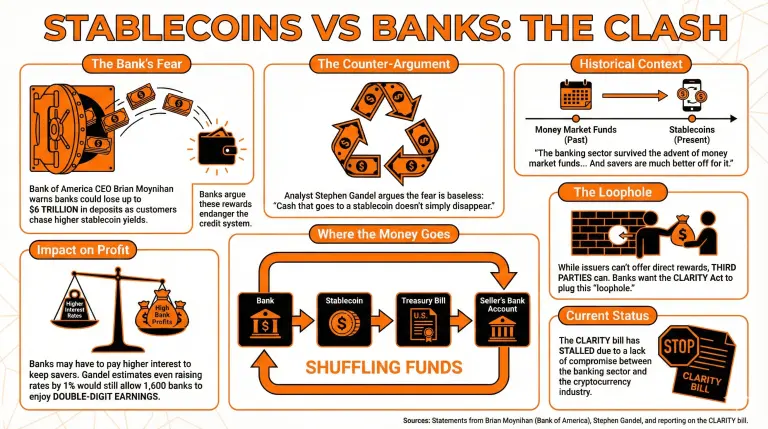
The discussion of stablecoin rewards in the CLARITY bill has prompted concerns from banks, which claim these rewards might endanger the credit system.
According to Bank of America’s CEO Brian Moynihan, banks could lose up to $6 trillion in deposits, as customers seek higher yields by holding stablecoins under the custody of cryptocurrency exchanges.
Stephen Gandel, a seasoned financial analyst and journalist, claims that the banks’ arguments are baseless, as there is no way to pull deposits from the system completely.
He explained:
“Cash that goes to a stablecoin doesn’t simply disappear – it goes into the reserve assets like Treasury bills or bank accounts.”
This means that whenever stablecoin issuers buy U.S. Treasuries to support their issuance, the party selling the debt instruments would have extra cash in their account. In this way, funds would just be shuffled around.
Gandel acknowledges that individual banks will have to pay more to keep savers’ cash under their control, potentially affecting their business model profitability. He alleges that raising interest levels by 1% would still allow 1,600 national banks to enjoy double-digit earnings, with the U.S. remaining the nation with the most banks even after this shift.
“The banking sector survived the advent of money market funds, even if many smaller regional lenders didn’t. And savers are much better off for it. The same may be true if stablecoins take off,” he concluded.
While stablecoins issuers have been banned from offering direct rewards to holders, third parties can still do it. Banks have qualified this as a loophole and are actively trying to plug it by including this consideration in the CLARITY Act.
Nonetheless, the bill has stalled due to a lack of compromise on this subject from both banks and the cryptocurrency industry.
FAQ
- What concerns have banks raised regarding stablecoin rewards in the CLARITY bill?
Banks argue that allowing stablecoin rewards could lead to a loss of up to $6 trillion in deposits as customers seek higher yields from cryptocurrency exchanges.
- How does financial analyst Stephen Gandel view the banks’ concerns?
Gandel claims the banks’ fears are unfounded, noting that cash moving to stablecoins does not disappear but is reallocated into assets like Treasury bills or bank accounts.
- What impact might the shift to stablecoins have on individual banks?
While banks may need to increase interest rates to retain customers, Gandel believes many national banks can still thrive, even with a 1% increase in rates.
- What is the current status of the CLARITY Act concerning stablecoin rewards?
The bill has stalled due to disagreements between banks and the cryptocurrency industry over how to manage stablecoin rewards and related loopholes.
Disclaimer: The information on this page may come from third parties and does not represent the views or opinions of Gate. The content displayed on this page is for reference only and does not constitute any financial, investment, or legal advice. Gate does not guarantee the accuracy or completeness of the information and shall not be liable for any losses arising from the use of this information. Virtual asset investments carry high risks and are subject to significant price volatility. You may lose all of your invested principal. Please fully understand the relevant risks and make prudent decisions based on your own financial situation and risk tolerance. For details, please refer to
Disclaimer.
Related Articles
Bitcoin Posts Its Strongest Weekly Gain Since October 2025: CPI Cooldown and US-Iran Ceasefire Provide a Double Boost, Lifting the Price to $73K
Bitcoin’s weekly gain this week reached nearly 7%, marking the strongest single-week performance since October 2025, as the U.S. core CPI data came in below expectations and a ceasefire agreement between Iran and Israel boosted market sentiment. The price briefly broke through $73,000. Market expectations have intensified that the Federal Reserve may start cutting rates sooner, and technical indicators show volatility compression, suggesting that significant price swings may be ahead. In the short term, attention should be paid to the ceasefire negotiations and the Federal Reserve’s policy direction.
ChainNewsAbmedia3h ago
The U.S. Department of Energy will lend 8.5 million barrels of crude oil from the Strategic Petroleum Reserve to four companies
Gate News message. On April 11, the U.S. Department of Energy announced that it will lend 8.5 million barrels of crude oil from the Strategic Petroleum Reserve to four companies. Companies that will borrow crude oil from the U.S. Strategic Petroleum Reserve include Macquarie and Phillips 66.
GateNews4h ago
U.S. April one-year inflation expectations initial reading was 4.8%, higher than the expected 4.3%.
Gate News message: On April 10, the United States’ initial forecast for the 1-year inflation rate was 4.8% for April, higher than the market expectation of 4.3%, with the prior value at 3.80%. This data is an important component of the University of Michigan consumer sentiment index and reflects consumers’ expectations for inflation levels over the next year.
GateNews15h ago
After the CPI data was released, U.S. oil was quoted at $97.57 per barrel, while Brent oil was quoted at $95.46 per barrel
Gate News message, April 10, after the CPI data was released, the latest price of WTI U.S. crude oil (U.S. West Texas Intermediate) was $97.57 per barrel, and Brent crude oil (the international benchmark) was latest at $95.46 per barrel. The U.S. Dollar Index DXY (an indicator that measures the strength of the U.S. dollar against a basket of currencies) fell 10 points in the short term, with the latest reading at 98.68.
GateNews16h ago
The U.S. Dollar Spot Index is down about 1.4% this week, marking its largest weekly drop since January.
Gate News message: On April 10, the U.S. dollar spot index has fallen cumulatively by about 1.4% this week, marking the largest weekly drop since January. After the CPI data was released, market trading strategies focused on buying the U.S. dollar and oil. The foreign exchange market has now entered a news-headline-driven trading phase, and progress in the Iran-U.S. negotiations amid a fragile ceasefire is becoming the new focal point.
GateNews16h ago
The U.S. CPI year-over-year rate in March was 3.3%; rising gasoline prices contributed nearly three-quarters
Gate News message: On April 10, the U.S. March unadjusted CPI year-over-year rate recorded 3.3%, with gasoline prices accounting for nearly three-quarters of the CPI increase.
GateNews16h ago


