ETF outflows remove key liquidity support, increasing Bitcoin’s vulnerability to selling pressure.
Bitcoin opened the year under clear pressure as demand from investment products weakened sharply. As per onchain reports, capital that fueled much of the last two rallies is now retreating. And this drop, coupled with growing macro and geopolitical uncertainty, has triggered cautious sentiment.
Bitcoin Liquidity Contracts as ETF Momentum Reverses
According to an analysis shared by Darkfost, cumulative spot Bitcoin ETF flows flipped to negative within weeks. Compared with previous years, BTC investment vehicles began 2026 with substantial investment losses.
The case was different in 2024 as cumulative inflows climbed throughout the year. More so, momentum accelerated in the final quarter, pushing BTC-tied funds to close above $30 billion. Liquidity flowed into the sector as demand for these products remained strong. Capital absorption helped support the OG coin’s price.
Momentum carried into the first half of last year, during which cumulative inflows peaked near the $27–28 billion range. Similar to the previous year, liquidity remained high, as the products continued to absorb supply from the spot market.
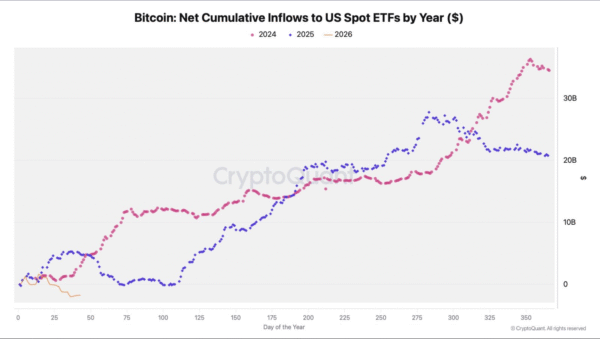
_Image Source: _X/Darkfost
However, these products showed early signs of fatigue towards the end of last year. As per data, cumulative inflows dropped from a peak of $27 billion to near $20 billion by year-end. Flow data flattened before trending lower in the second half. Unfortunately, the spotted weakness towards the end of last year now appears to be extending into 2026.
Current outflows remove a key marginal buyer from the market. Without steady ETF demand, spot liquidity tightens. Price action becomes more sensitive to selling pressure. Short-term volatility tends to rise under such conditions.
Liquidity Tightens as Crypto Funds Struggle to Regain Demand
Investors seem to be reassessing risk exposure, given that global uncertainty has triggered a risk-off outlook. Typically, reduced appetite for risk assets is first observed in crypto markets. In fact, flow data shows that many traders are staying out of the market for now.
The contrast between 2024–2025 and early 2026 remains stark. Prior years showed steady capital accumulation and expanding liquidity. The current year shows contraction and capital withdrawal. Market structure looks more fragile as a result.
Stable ETF flows could improve sentiment. Rising cumulative inflows would signal that demand is returning. In addition, steady buying may help absorb supply again. Until that happens, tight liquidity may continue to exert downward pressure on Bitcoin.
Darkfost’s analysis frames the current weakness as part of a broader slowdown rather than a sudden break. Last year’s waning momentum has now been confirmed in the current market atmosphere. For now, the appetite for crypto-tied investment funds remains a key variable to watch.
Disclaimer: The information on this page may come from third parties and does not represent the views or opinions of Gate. The content displayed on this page is for reference only and does not constitute any financial, investment, or legal advice. Gate does not guarantee the accuracy or completeness of the information and shall not be liable for any losses arising from the use of this information. Virtual asset investments carry high risks and are subject to significant price volatility. You may lose all of your invested principal. Please fully understand the relevant risks and make prudent decisions based on your own financial situation and risk tolerance. For details, please refer to
Disclaimer.
Related Articles
Macro investors: A BTC breakout above $76,000 and an ETH breakout above $2,400 may signal a trend reversal
Macro investor Jordi Visser believes that if Bitcoin and Ethereum break through $76,000 and $2,400 respectively, it will kick off a sustainable uptrend. He expects high inflation to push investors to seek profitable assets, and notes that the probability of an economic recession has fallen to 24%. This view contrasts with the current bearish expectations in the crypto industry.
GateNews35m ago
Bitcoin Developers Release Major Update on Testnet, What Changed? - U.Today
Bitcoin developers have released v31.0rc4 for testing, introducing enhanced privacy through Tor and I2P networks, improved mempool design, fee efficiency, and performance upgrades. This update aims to optimize transaction management and protect user anonymity.
UToday1h ago
U.S.-Iran talks: after 21 hours, no agreement reached. Vance says he has proposed a “final proposal”; Iran refuses a nuclear weapons commitment.
The U.S. vice president, Vance, did not reach an agreement in the US-Iran negotiations held in Islamabad. The core dispute is that Iran refused the U.S. demand for a nuclear weapons commitment. The breakdown of the talks has increased geopolitical risk, affecting financial markets—especially crude oil and Bitcoin prices. Even though the negotiations were unsuccessful, both sides may still continue discussions, and the market will watch for further developments.
ChainNewsAbmedia1h ago
Famed trader “Maji” ends 13 straight wins, closing a Bitcoin long position at a loss of $192k
Gate News, April 12. Lookonchain monitoring shows that the well-known trader “Maji” saw their 13-win streak come to an end. Due to the market downturn, they just closed a Bitcoin long position, incurring a loss of about $192k.
GateNews3h ago
BTC 15-minute drop of 1.75%: Derivatives liquidity deterioration and capital withdrawals in sync weigh on prices
From 01:30 to 01:45 (UTC) on 2026-04-12, the BTC price saw significant volatility within the 71,560.0–73,017.1 USDT range. The candlestick return rate recorded -1.75%, and the amplitude reached 2.00%. During this period, market attention increased, the trading atmosphere clearly became more cautious, and heightened volatility triggered short-term capital vigilance.
The primary driving force behind this unusual move is the continued deterioration of liquidity in the derivatives market: CME futures open interest fell to a 14-month low, and institutional arbitrage capital accelerated its withdrawal. Futures trading volume trended lower over the long run, and arbitrage basis compression caused the market to deepen in…
GateNews4h ago


