
Key Takeaways
-
Ethereum (ETH) has dropped over 10% this week, trading near $2,980 after rejecting the $3,400 resistance zone.
-
Despite the sell-off, whales and institutions are aggressively accumulating ETH during the dip.
-
On-chain data shows large purchases by Trend Research and an OTC whale via FalconX and Wintermute.
-
ETH continues to trade within a long-term ascending triangle pattern on the daily chart.
-
The rising trendline near $2,900 remains a critical support zone for a potential rebound.
-
A reclaim of the 50-day moving average around $3,088 could revive bullish momentum toward $3,400.
As of January 21, 2026, Ethereum (ETH) is trading near $2,980, down roughly 5% on the day and more than 10% over the past week. The drop follows a rejection from Sunday’s local high around $3,360, as broader market sentiment soured.

Source: Coinmarketcap
This pullback hasn’t happened in isolation. Rising geopolitical tensions and growing fears around a global commodity super cycle have pushed investors into risk-off mode. Bitcoin (BTC) slipping below $90,000 only added fuel to the sell-off, dragging Ethereum and the wider altcoin market lower.
That said, beneath the surface, Ethereum’s structure still tells a more nuanced story.
Whales Step In on the Ethereum Dip
Despite the sharp correction, large players appear to be treating this dip as an opportunity rather than a warning sign.
On-chain data shared by Lookonchain shows that whales and institutions are actively accumulating ETH during the decline:
-
Trend Research borrowed $70 million USDT from Aave and used it to purchase 24,555 ETH (worth ~$75.5 million). The firm now reportedly holds 651,310 ETH, valued at around $1.92 billion.
-
An OTC whale wallet (0xFB7) acquired 20,000 ETH (approximately $58.8 million) via FalconX and Wintermute.
While short-term price action looks shaky, this kind of buying suggests that smart money may be positioning for a rebound rather than bracing for a deeper collapse.
Ascending Triangle Still Intact on the Daily Chart
Looking at the daily ETH chart, the broader technical structure remains constructive.
Ethereum continues to trade within a well-defined ascending triangle that has been forming since late 2025. This pattern is characterized by:
-
A series of higher lows, supported by a rising trendline
-
A strong horizontal resistance zone around $3,350–$3,400
During the latest sell-off, ETH once again pulled back toward its rising trendline support, currently sitting near the $2,900–$2,920 area. This zone has acted as a reliable demand region multiple times over the past few months.
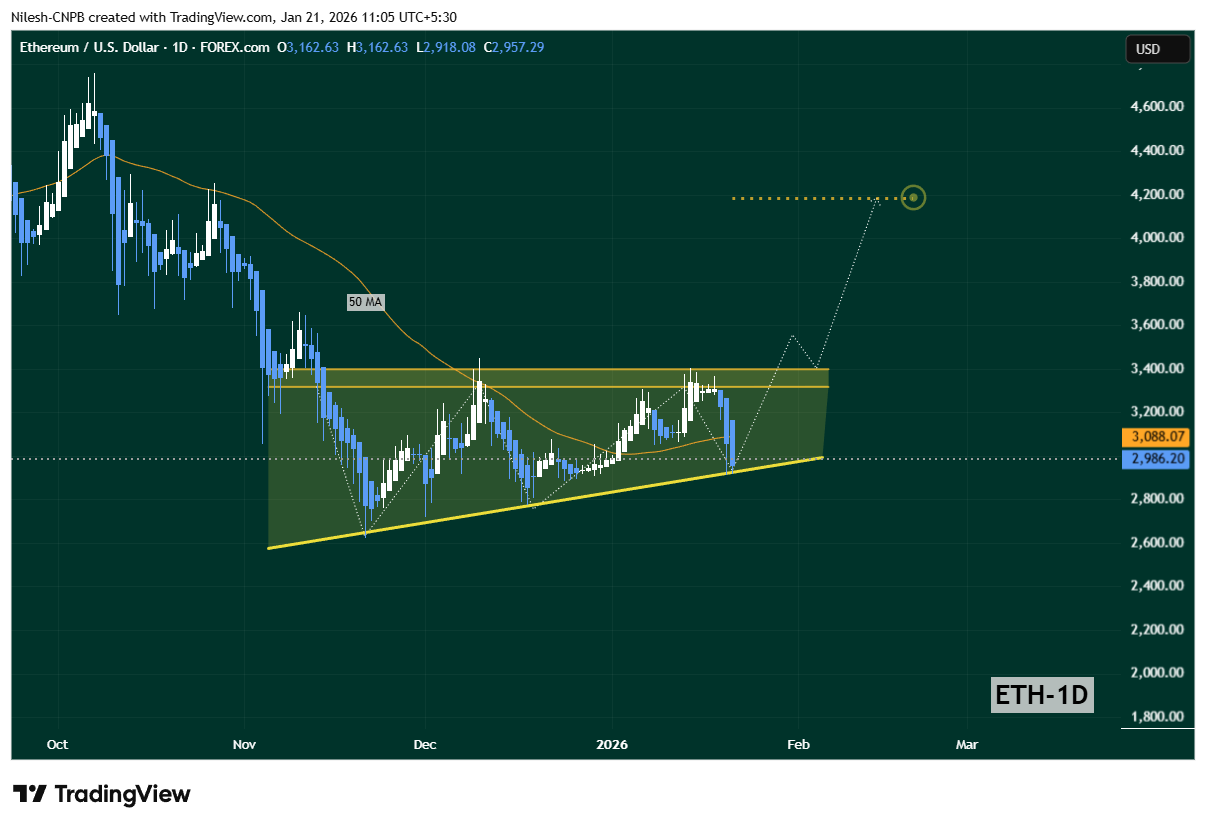
Ethereum (ETH) Daily Chart/Coinsprobe (Source: Tradingview)
For now, price is hovering just above this support, suggesting buyers are still defending it. However, ETH remains below the 50-day moving average, which is currently near $3,088, indicating that short-term momentum has yet to fully recover.
What’s Next for ETH?
If Ethereum manages to hold the ascending trendline near $2,900, the structure of the ascending triangle remains valid. A successful reclaim of the 50-day moving average would be an important first step toward restoring bullish momentum.
Should that happen — especially if broader market conditions stabilize and Bitcoin finds support — ETH could once again make a run at the $3,400 resistance zone, where a breakout attempt would be back on the table.
That said, the risk is clear. A decisive daily close below the rising trendline would weaken the bullish thesis and could open the door to a deeper short-term correction.
For now, Ethereum sits at a critical inflection point — caught between macro-driven fear and quiet accumulation from deep-pocketed players watching the dip closely.
Disclaimer: The views and analysis presented in this article are for informational purposes only and reflect the author’s perspective, not financial advice. Technical patterns and indicators discussed are subject to market volatility and may or may not yield the anticipated results. Investors are advised to exercise caution, conduct independent research, and make decisions aligned with their individual risk tolerance.
About Author: Nilesh Hembade is the Founder and Lead Author of Coinsprobe, with over 5 years of experience in the cryptocurrency and blockchain industry. Since launching Coinsprobe in 2023, he has been providing daily, research-driven insights through in-depth market analysis, on-chain data, and technical research.
Disclaimer: The information on this page may come from third parties and does not represent the views or opinions of Gate. The content displayed on this page is for reference only and does not constitute any financial, investment, or legal advice. Gate does not guarantee the accuracy or completeness of the information and shall not be liable for any losses arising from the use of this information. Virtual asset investments carry high risks and are subject to significant price volatility. You may lose all of your invested principal. Please fully understand the relevant risks and make prudent decisions based on your own financial situation and risk tolerance. For details, please refer to
Disclaimer.
Related Articles
Schwab Wealth Management opens Bitcoin and Ethereum trading: 38.9 million users enter, disrupting the crypto market landscape
Traditional finance giant Charles Schwab plans to launch “Schwab Crypto” in the second quarter of 2026, offering spot trading of Bitcoin and Ethereum to 38.9 million customers. This model will lower the investment threshold, change the previous way investors indirectly allocate to crypto assets, and meet market demand. Meanwhile, with low fees and a large customer base, Schwab may disrupt existing crypto platforms, and in the future it may also roll out stablecoin products to build a digital asset ecosystem.
GateNews47m ago
In the past 24 hours, liquidations across the entire network totaled $197 million, with short liquidations accounting for over 54%.
Gate News message, April 7, according to CoinAnk data, over the past 24 hours the entire network liquidated $197 million in total, including approximately $89.12 million in long positions and approximately $108 million in short positions. By coin, liquidations were approximately $98.06 million for Bitcoin and approximately $37.04 million for Ethereum.
GateNews1h ago
Ethereum spot ETFs had total net inflows of $120 million yesterday, and none of the ten ETFs had net outflows
On April 6, Ethereum spot ETF total net inflows reached $120 million, and all ten ETFs achieved net inflows. BlackRock’s ETF ETHA and Fidelity’s ETF FETH had single-day net inflows of $60.82 million and $40.05 million, respectively, with historical net inflows of $11.62B and $2.33B, respectively. Total net asset value was $12.28B, and the net asset ratio was 4.74%.
GateNews2h ago
The SEC will roll out new rules to “regulate cryptocurrencies”: defining what counts as fundraising and what falls under securities; it has already been submitted to the White House
The U.S. Securities and Exchange Commission (SEC) is set to roll out new rules for “regulating cryptocurrencies” to完善 the crypto asset regulatory framework and clarify whether trading constitutes a security. The rule is based on the 1933 Securities Act and may affect compliance pathways for mainstream assets, aiming to balance protecting investors with encouraging innovation.
GateNews3h ago
Bit Digital staked 43,335 ETH via liquid_col, worth approximately $91.34 million
Gate News message: On April 7, according to monitoring by Onchain Lens, Bitcoin mining company Bit Digital staked 43,335 ETH via liquid_col, worth approximately $91.34 million.
GateNews3h ago
Global central banks exploit crypto infrastructure at low cost, mBridge uses an Ethereum-based architecture
The global cryptocurrency market fell sharply between 2021 and 2022, while central banks in various countries began to use blockchain infrastructure developed by the private sector—such as the BIS’s mBridge project—without having to bear development costs. This model has sparked controversy, because when central banks adopt technology that has already undergone deep validation by the private sector, it may erode incentives for private-sector innovation and affect future financial venture investments.
MarketWhisper4h ago


