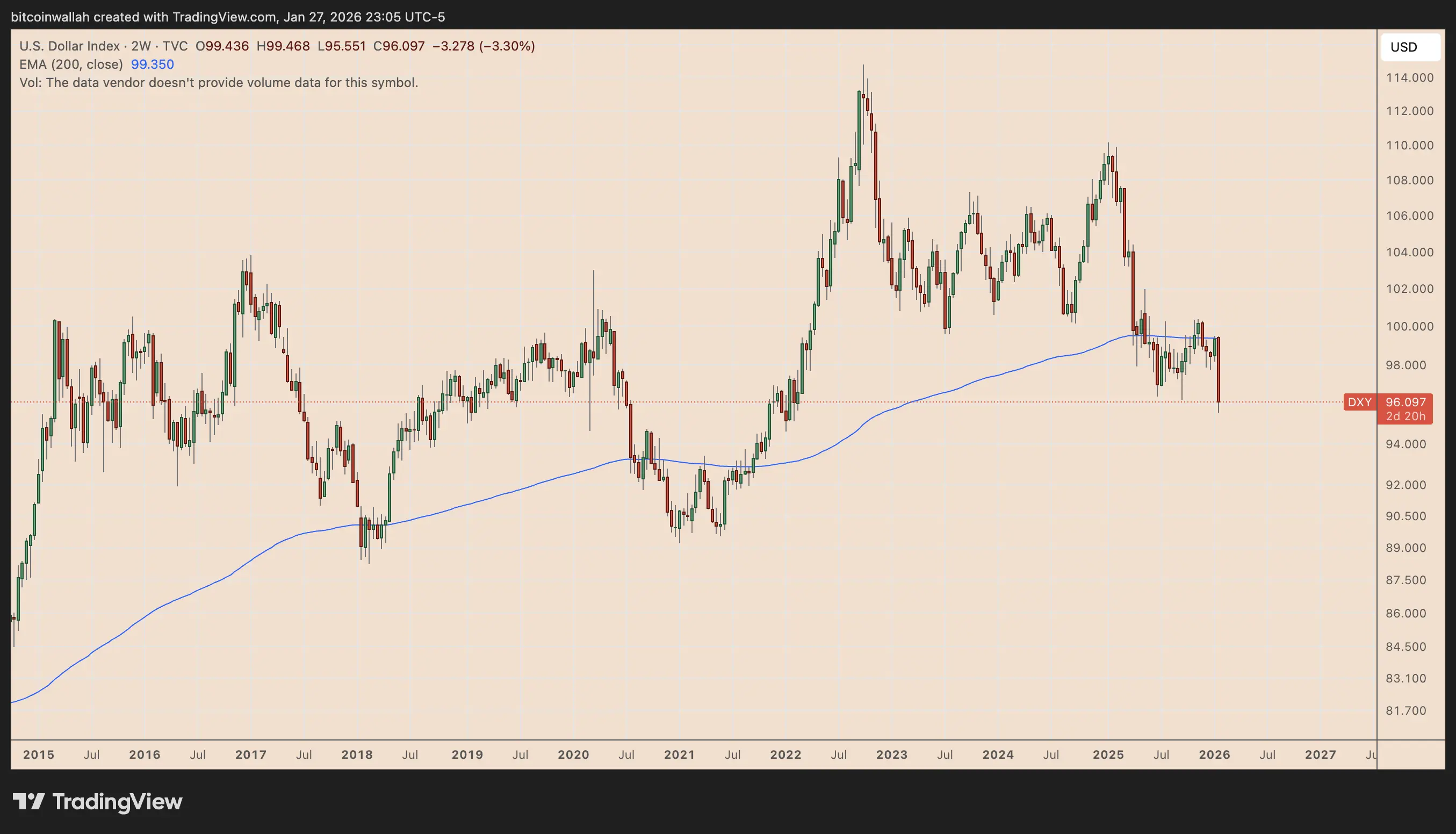
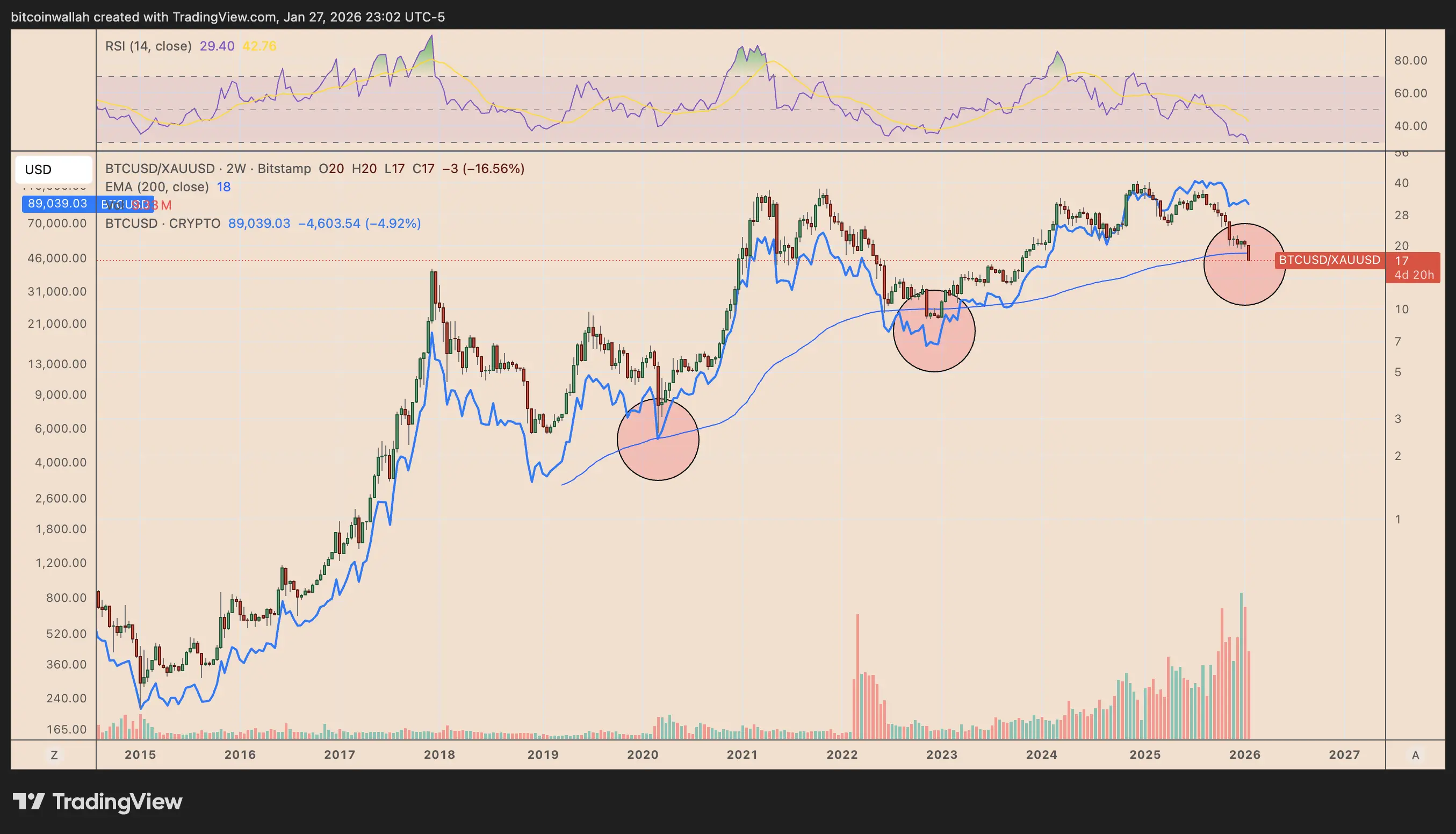
Dollar Index 96 Approaching a Critical Turning Point. History shows that after the USD falls below 96 in 2017, BTC surged tenfold; in 2020, it increased by 540%. If fractal patterns repeat, it could reach $150,000. However, current high interest rates and real yields increase the risk of yen carry trade unwinding. The BTC/XAU ratio has fallen back below the 200-week moving average, and historically, every four years, touching this level has signaled the start of a new cycle.
The Significance of the 96 Level in the Dollar Index’s Historical Turning Points
(Source: Trading View)
The USD Index (DXY) is currently trading near 96.3, continuing its overall downtrend, which accelerates during periods of macroeconomic pressure. Traders attribute the dollar’s weakness to changes in global capital flows, as markets reassess tariffs, growth expectations, and cross-asset allocations related to Japan. Against this backdrop, the USD index is very close to 96, a key pivot point in previous cycles.
In 2017, when the USD index last broke below 96, Bitcoin soared from about $2,000 to $20,000 within six months, a 900% increase. This epic rally occurred amid a weakening dollar, as market funds shifted from USD assets to risk assets and alternative investments, with Bitcoin as the emerging “digital gold” narrative riding this capital wave.
In 2020, a similar decline in the dollar was followed by Bitcoin skyrocketing from around $10,000 to $64,000 in nine months, a 540% increase. This rally was driven by massive monetary easing post-COVID-19, near-zero interest rates, quantitative easing, and large fiscal stimulus measures that suppressed real yields and reactivated “fiat devaluation” trades, boosting Bitcoin and broader risk assets.
Historical Correlation Between USD and Bitcoin Gains
2017 Cycle: USD falls below 96 → BTC from $2,000 to $20,000 (900% increase, 6 months)
2020 Cycle: USD falls below 96 → BTC from $10,000 to $64,000 (540% increase, 9 months)
Current 2026: USD tests 96 again → BTC from $90,000 target to $150,000? (67% increase, timing uncertain)
This fractal pattern is no coincidence but reflects the inverse relationship between the USD as a global reserve currency and risk assets. When the dollar weakens, dollar-denominated assets like gold and Bitcoin become relatively cheaper, attracting international capital inflows. Additionally, dollar weakness often coincides with Fed easing or global liquidity improvements, catalyzing risk asset rallies.
However, simple historical analogies do not guarantee future repeats. Market participants must evaluate current cycle differences compared to past ones to make rational judgments. This cautious approach is what distinguishes professional traders from blindly following trends.
Three Major Differences in the 2026 Macro Environment
Compared to 2017 and 2020, the current macro environment is more severe, potentially dampening the positive impact of dollar weakness on Bitcoin. First, interest rates are significantly higher. In 2020, the Fed cut rates near zero; now, rates remain around 4.5%-5%. The high-rate environment suppresses risk asset valuations because the risk-free rate (e.g., US Treasuries) is more attractive, reducing the motivation to allocate funds to risk assets.
Second, real yields are rising. Real yield (nominal interest minus inflation expectations) is a key variable in Bitcoin pricing. In 2020, real yields were negative, meaning holding cash implied a loss of purchasing power, prompting investors to seek inflation hedges like Bitcoin. Currently, real yields are positive, and holding US Treasuries yields actual returns, weakening Bitcoin’s appeal as an inflation hedge.
Third, yen carry trade unwinding risks are mounting. A strengthening yen and the cyclical “yen carry trade unwinding” dynamic could exacerbate global risk conditions, forcing deleveraging in forex and equity markets, which often spills over into Bitcoin. Yen carry trade involves borrowing in low-interest yen, converting to higher-yield currencies (like USD), or buying risk assets (stocks, Bitcoin). When the yen suddenly appreciates, these leveraged positions are forced to close, triggering chain reactions of selling. The August 2024 yen carry unwinding event caused global stocks and Bitcoin to plunge, and similar risks remain.
However, if Fed policy expectations shift toward easing, ETF and institutional demand for Bitcoin could offset some of these effects. This could lead to capital inflows into Bitcoin, raising the likelihood of reaching $150,000 in 2026. Therefore, while the USD fractal offers a bullish framework, it must be supported by Fed policy shifts and sustained institutional demand to materialize.
BTC/XAU Ratio Reaches Four-Year Cycle Lows
(Source: Trading View)
Traders also monitor Bitcoin’s performance relative to gold, with some believing the BTC/XAU ratio better reflects long-term cycles. Historically, when valued in gold, the BTC/XAU ratio tends to dip near its 200-2W (200-week) moving average roughly every four years. The ratio again approaches this baseline, reminiscent of previous “reset” phases when Bitcoin’s relative performance to gold slowed before entering a new expansion phase.
The significance of the BTC/XAU ratio lies in removing fiat devaluation distortions. When measured in gold rather than USD, it reveals Bitcoin’s true performance against the “ultimate hard asset.” Gold, with thousands of years of history as a store of value, remains relatively stable and unaffected by single-country policies. Thus, the BTC/XAU ratio better reflects Bitcoin’s intrinsic value growth rather than mere fiat devaluation benefits.
Testing the 200-2W moving average has historically been meaningful. At the 2018 bear market bottom and after the 2022 FTX collapse, the ratio touched this line before embarking on new bull runs. Currently, approaching this level again, from a cycle perspective, may signal the end of a correction phase and the start of a new relative expansion against gold.
However, market participants often see the 200-2W MA test as a confirmation signal rather than an immediate buy signal, since the ratio can remain depressed for extended periods. In 2018, Bitcoin hovered sideways for months after touching this line before rebounding; similar in 2022. Traders should view this as a “bottoming” phase rather than an “entry” signal, requiring confirmation from other indicators (e.g., volume expansion, momentum shifts).
Nevertheless, repeated testing of this level makes it a potential macro turning point. When the dollar fractal and gold ratio indicators align, the reliability of signals increases significantly. This is why, despite a more severe macro environment, many traders remain cautiously optimistic.
Feasibility of the $150,000 Target
If the dollar fractal pattern ultimately plays out, Bitcoin could reach $150,000. This target is based on logic: from the current $90,000, a 67% increase is much lower than 2017’s 900% or 2020’s 540%, indicating market maturation and reduced volatility. Still, a 67% rise for a market cap approaching $2 trillion would require about $1.2 trillion in new capital inflows.
Where might this capital come from? First, continued ETF inflows. Since the launch of US spot Bitcoin ETFs, over $50 billion has flowed in. If dollar weakness and Fed policy easing accelerate, ETF inflows could increase further. Second, increased institutional allocations. With clearer regulation (e.g., CLARITY Act), pension funds and sovereign wealth funds might raise their Bitcoin holdings from current 1-2% to 5-10%. Third, global reallocation driven by dollar weakness, with emerging markets and European investors increasing Bitcoin exposure.
However, achieving this target depends on multiple conditions aligning; any disruption could invalidate the fractal.


