Article by: 100y.eth
Compiled by: Saoirse, Foresight News
Under the “GENIUS Act,” stablecoin issuers are prohibited from paying interest to stablecoin holders.
However, currently, Coinbase is offering a 3.35% reward to users holding USDC on its platform. This is possible because the “GENIUS Act” only bans issuers from paying interest and does not restrict distributors.
Nevertheless, before the relevant Senate committee in the United States reviews the “Crypto Market Structure Bill” on January 15 (which aims to systematize cryptocurrency regulation), a debate has already fully erupted over “whether the interest ban on stablecoins should be extended to the distribution stage.”
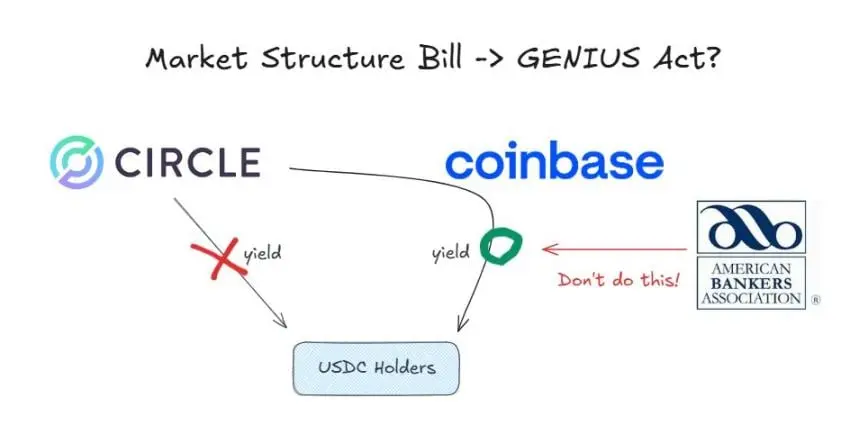
Strong Opposition from the Banking Industry
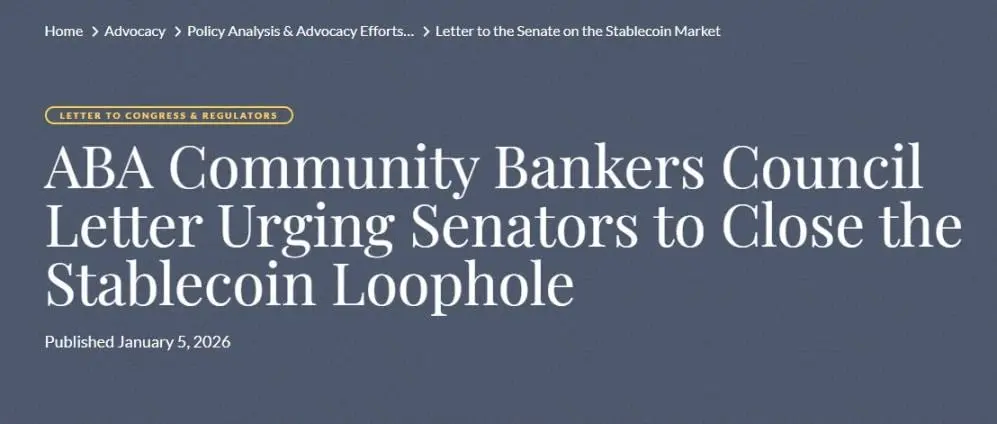
The American Bankers Association (ABA) is the main group calling for a complete ban on stablecoin interest payments. In a public letter released on January 5, the association advocates that the interest payment ban in the “GENIUS Act” should not only apply to issuers but should be broadly interpreted to include related parties. They are pushing to explicitly include this interpretation in the “Crypto Market Structure Bill.”
Reasons Behind the Banking Industry’s Firm Opposition
The banking sector’s desire to fully ban stablecoin interest payments is actually quite simple:
- Concern over outflow of bank deposits;
- Reduced deposits mean decreased lending capacity;
- Stablecoins are not insured by the Federal Deposit Insurance Corporation (FDIC).
Ultimately, stablecoins threaten the long-standing, stable, and highly profitable business model that the banking industry has relied on for decades.
Crypto Industry’s Counterattack
From the perspective of the crypto industry, the banking industry’s move is a major issue. If, due to lobbying pressure, the “Crypto Market Structure Bill” expands the restrictions of the “GENIUS Act,” it would effectively be a de facto rewriting and narrowing of the law. Unsurprisingly, this has triggered strong opposition from the crypto sector.
Coinbase’s Position
Coinbase Chief Policy Officer Faryar Shirzad countered by citing relevant research indicating that stablecoins have not caused substantial outflows of bank deposits. He also pointed to news about digital renminbi paying interest as new evidence in this debate.
Paradigm’s View
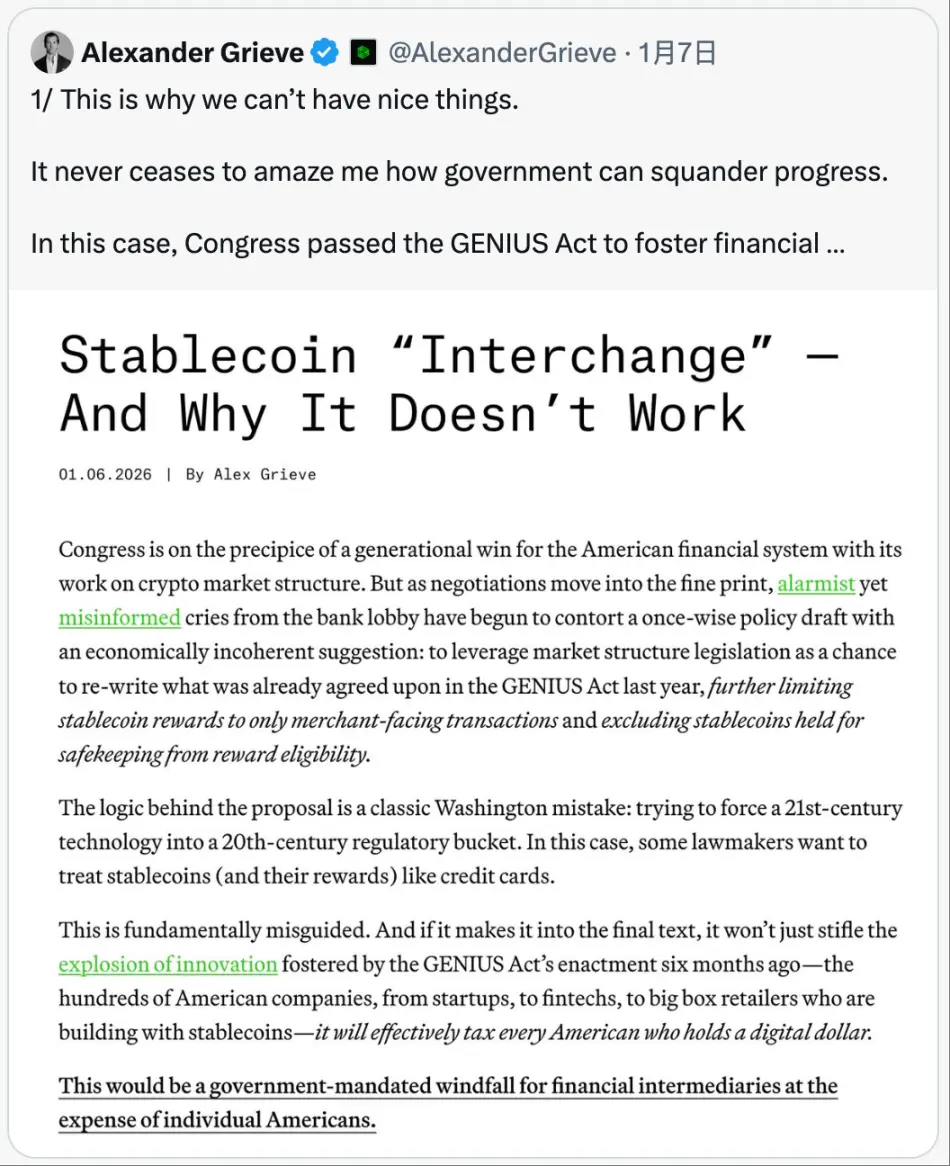
Alexander Grieve, Vice President of Government Affairs at crypto investment firm Paradigm, offered another perspective. He believes that even if stablecoins used solely for payment scenarios are allowed to pay interest, it is essentially a disguised form of “holding tax” on consumers.
What About China and South Korea?
Although China and South Korea are not advancing their cryptocurrency policies as quickly as some other Asian countries, both have recently introduced a series of new measures related to central bank digital currencies (CBDCs) and stablecoin policies. The policy differences between the two countries on interest payments are particularly noteworthy:
China’s central bank has decided to pay interest on digital renminbi holdings, treating it the same as regular bank deposits to promote its adoption.
South Korea’s policy approach is closer to the US: it bans issuers from paying interest but does not explicitly prohibit distributors from doing so.
From a macro perspective, China’s aggressive stance is understandable. Digital renminbi is not a private stablecoin but a legal digital currency issued directly by the central bank. Promoting the digital renminbi can balance the dominance of private platforms like Alipay and WeChat Pay and strengthen a central bank-led financial system.
Conclusion
New technologies give rise to new industries, and the emergence of new industries often threatens traditional sectors.
Traditional financial institutions, represented by banks, are facing an irreversible trend toward the stablecoin era. At this juncture, resisting change is more harmful than beneficial; embracing transformation and exploring new opportunities is the smarter choice.
In fact, even for existing market participants, the stablecoin industry holds enormous opportunities. Many banks have already begun proactive layouts:
Bank of New York Mellon is developing custody services for stablecoin reserves;
Cross River Bank is acting as an intermediary for USDC fiat on-ramp via APIs;
JPMorgan is experimenting with tokenized deposits.
Major card organizations are also involved. As on-chain payment volumes continue to grow, traditional card organizations may face shrinking business. However, companies like Visa and Mastercard are not opposing this trend; instead, they actively support stablecoin payment settlements and seek new development opportunities.
Asset management firms are also entering the space. BlackRock and other funds are actively promoting the tokenization of various investment funds.
If the banking lobby succeeds in having the clauses banning stablecoin interest payments included in the “Crypto Market Structure Bill,” the crypto industry will suffer a heavy blow.
As a crypto industry practitioner, I can only hope that the “Crypto Market Structure Bill” will not include provisions that effectively nullify the “GENIUS Act.”
Disclaimer: The information on this page may come from third parties and does not represent the views or opinions of Gate. The content displayed on this page is for reference only and does not constitute any financial, investment, or legal advice. Gate does not guarantee the accuracy or completeness of the information and shall not be liable for any losses arising from the use of this information. Virtual asset investments carry high risks and are subject to significant price volatility. You may lose all of your invested principal. Please fully understand the relevant risks and make prudent decisions based on your own financial situation and risk tolerance. For details, please refer to
Disclaimer.
Related Articles
Circle releases a cross-chain infrastructure roadmap, with CCTP cumulative transfers exceeding $110 billion
Circle has released a cross-chain interoperability infrastructure roadmap. Since CCTP launched in April 2023, it has processed over $110B in USDC transfers and supports 20 blockchains. In the future, it plans to expand to other assets and launch multiple innovative products to simplify cross-chain workflows.
GateNews04-11 00:03
Compass Point downgrades Circle’s rating to “Sell,” and cuts its price target to $77
Compass Point analyst downgraded Circle’s rating from “Neutral” to “Sell,” and cut the target price to $77. The reason is that USDC growth is mainly coming from low-profit platforms, which is affecting the company’s earnings. The analyst expects first-quarter performance to miss expectations, with EBITDA falling 19% quarter-over-quarter. Despite this, if the crypto market rebounds, Circle’s outlook could still improve.
GateNews04-10 16:06
Circle minted a total of 10.5 billion USDC on Solana over the past month
Gate News update, on April 10, Circle added another 250 million newly minted USDC today. Data shows that over the past month, Circle has cumulatively minted 10.5 billion USDC on Solana.
GateNews04-10 15:51
Circle Responds to the Drift Protocol Hack: USDC Freezing Must Be Executed Legally, Urges Faster Crypto Legislation
Circle’s Chief Strategy Officer Dante Disparte responded to the Drift Protocol theft incident, emphasizing that freezing USDC is being carried out according to law, calling for stronger coordination between law and technology, and suggesting that DeFi protocols should draw on protection mechanisms from traditional markets to advance legal protection of property rights and financial privacy.
GateNews04-10 12:19
Caixin: Polymarket’s use of USDC settlement creates legal risk for participants within China
The article discusses legal disputes involving Polymarket prediction markets, especially the unclear boundary between insider trading and gambling. It emphasizes that using USDC for settlement exposes Chinese participants to legal risk, and it mentions the “End Prediction Market Corruption Act” proposed by a U.S. senator, which prohibits certain government officials and their family members from participating in prediction market trading.
GateNews04-10 12:02
Crypto Card Spending Hits $600M Monthly as USDC Gains on USDT - Coinspeaker
Crypto-linked card spending reached $600 million in monthly volume in March 2026, more than tripling from $187 million recorded a year prior – a 211% annual increase that signals structural rather than cyclical adoption across point-of-sale payment infrastructure.
Cumulative card volume across the
Coinspeaker04-10 07:46


