Juttmunda

vip
Age 0.6 Yıl
Peak Tier 0
No content yet
#US-IranTalksVSTroopBuildup
Negotiation Signals vs Military Positioning
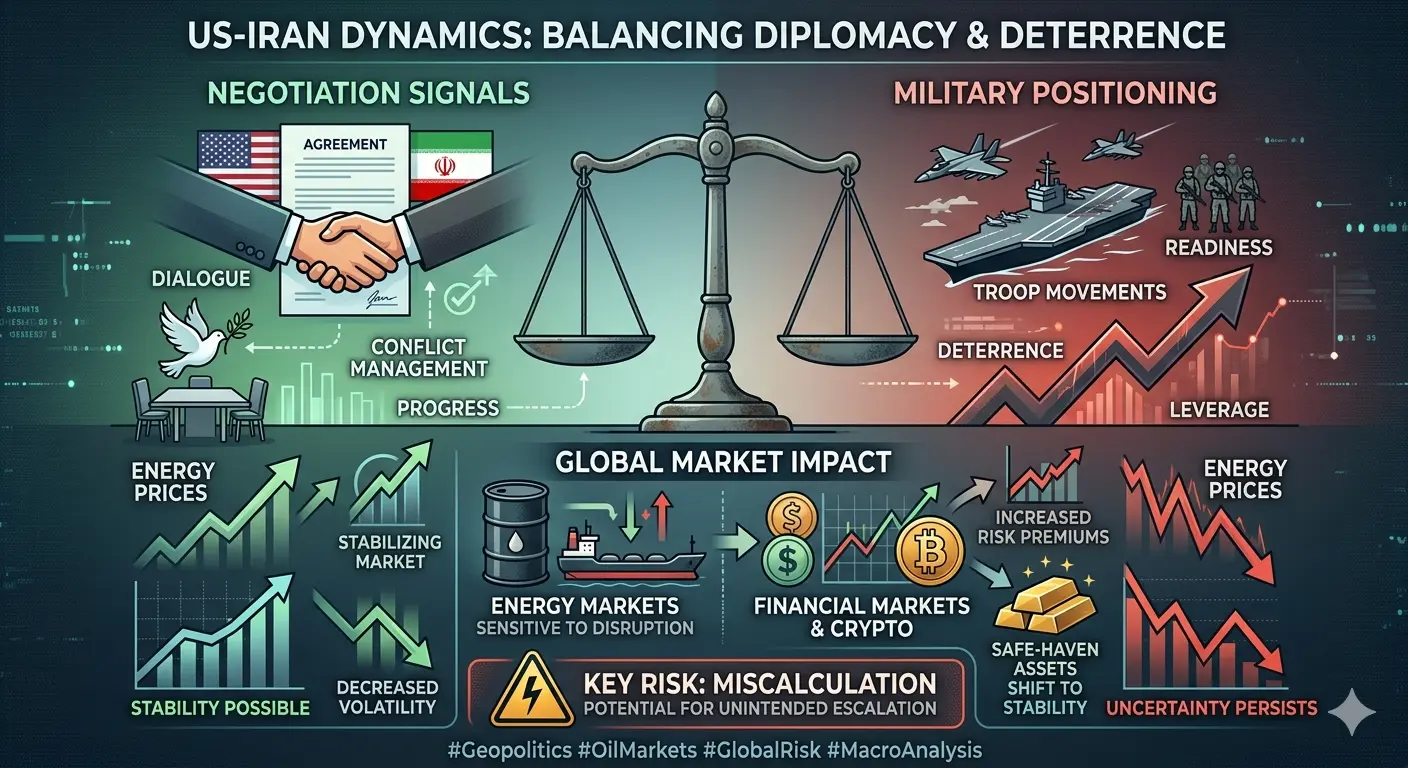
The current US-Iran dynamic reflects a high-stakes balance between diplomacy and deterrence. While renewed signals of dialogue suggest a possible pathway toward de-escalation, simultaneous troop movements and military readiness indicate that underlying tensions remain unresolved.
This dual-track approach is strategic rather than contradictory. Diplomatic engagement provides a channel for conflict management, while military positioning reinforces leverage and ensures preparedness in case negotiations fail. However, operat
BlackRiderCryptoLord
#US-IranTalksVSTroopBuildup
Negotiation Signals vs Military Positioning
The current US-Iran dynamic reflects a high-stakes balance between diplomacy and deterrence. While renewed signals of dialogue suggest a possible pathway toward de-escalation, simultaneous troop movements and military readiness indicate that underlying tensions remain unresolved.
This dual-track approach is strategic rather than contradictory. Diplomatic engagement provides a channel for conflict management, while military positioning reinforces leverage and ensures preparedness in case negotiations fail. However, operating on both tracks at once increases the complexity of the situation and narrows the margin for error.
For global markets, this creates a persistent layer of uncertainty. Energy markets are particularly sensitive due to the region’s importance in global oil supply and key maritime routes. Even without direct conflict, the risk of disruption is enough to influence pricing, elevate volatility, and impact broader economic sentiment.
Beyond energy, financial markets tend to adjust by increasing risk premiums. Investors become more cautious, liquidity can tighten, and capital often shifts toward safer or more stable assets. This environment affects not only traditional markets but also risk-sensitive sectors such as crypto, which increasingly responds to macro and geopolitical developments.
From a strategic perspective, the current phase is less about immediate confrontation and more about positioning. Both sides are attempting to strengthen their negotiating stance while maintaining optionality. This creates a situation where headlines may shift rapidly, but underlying uncertainty persists.
A key risk in this environment is miscalculation. When diplomatic efforts and military signals operate simultaneously, the potential for unintended escalation increases. Markets are particularly sensitive to such risks, often reacting sharply even to minor developments.
At the same time, prolonged tension without escalation can lead to a normalization of risk. Markets may begin to absorb geopolitical uncertainty as a constant factor, reducing the intensity of reactions unless a clear shift occurs.
The critical variable remains the trajectory of engagement. Progress in negotiations could ease tensions, stabilize energy expectations, and reduce volatility. Conversely, stalled talks combined with increased military activity could amplify uncertainty and trigger broader market reactions.
In essence, this is a leverage-driven phase where diplomacy and force are being used in parallel to shape outcomes. Stability is possible, but it depends on whether dialogue can maintain momentum and prevent escalation.
Until clearer direction emerges, the environment favors caution, adaptability, and close monitoring of geopolitical developments, as these factors will continue to influence both regional stability and global market behavior.
repost-content-media
  • Reward
  • Comment
  • Repost
  • Share
#US-IranTalksVSTroopBuildup
Negotiation Signals vs Military Positioning
The current US-Iran dynamic reflects a high-stakes balance between diplomacy and deterrence. While renewed signals of dialogue suggest a possible pathway toward de-escalation, simultaneous troop movements and military readiness indicate that underlying tensions remain unresolved.
This dual-track approach is strategic rather than contradictory. Diplomatic engagement provides a channel for conflict management, while military positioning reinforces leverage and ensures preparedness in case negotiations fail. However, operat
BlackRiderCryptoLord
#US-IranTalksVSTroopBuildup
Negotiation Signals vs Military Positioning
The current US-Iran dynamic reflects a high-stakes balance between diplomacy and deterrence. While renewed signals of dialogue suggest a possible pathway toward de-escalation, simultaneous troop movements and military readiness indicate that underlying tensions remain unresolved.
This dual-track approach is strategic rather than contradictory. Diplomatic engagement provides a channel for conflict management, while military positioning reinforces leverage and ensures preparedness in case negotiations fail. However, operating on both tracks at once increases the complexity of the situation and narrows the margin for error.
For global markets, this creates a persistent layer of uncertainty. Energy markets are particularly sensitive due to the region’s importance in global oil supply and key maritime routes. Even without direct conflict, the risk of disruption is enough to influence pricing, elevate volatility, and impact broader economic sentiment.
Beyond energy, financial markets tend to adjust by increasing risk premiums. Investors become more cautious, liquidity can tighten, and capital often shifts toward safer or more stable assets. This environment affects not only traditional markets but also risk-sensitive sectors such as crypto, which increasingly responds to macro and geopolitical developments.
From a strategic perspective, the current phase is less about immediate confrontation and more about positioning. Both sides are attempting to strengthen their negotiating stance while maintaining optionality. This creates a situation where headlines may shift rapidly, but underlying uncertainty persists.
A key risk in this environment is miscalculation. When diplomatic efforts and military signals operate simultaneously, the potential for unintended escalation increases. Markets are particularly sensitive to such risks, often reacting sharply even to minor developments.
At the same time, prolonged tension without escalation can lead to a normalization of risk. Markets may begin to absorb geopolitical uncertainty as a constant factor, reducing the intensity of reactions unless a clear shift occurs.
The critical variable remains the trajectory of engagement. Progress in negotiations could ease tensions, stabilize energy expectations, and reduce volatility. Conversely, stalled talks combined with increased military activity could amplify uncertainty and trigger broader market reactions.
In essence, this is a leverage-driven phase where diplomacy and force are being used in parallel to shape outcomes. Stability is possible, but it depends on whether dialogue can maintain momentum and prevent escalation.
Until clearer direction emerges, the environment favors caution, adaptability, and close monitoring of geopolitical developments, as these factors will continue to influence both regional stability and global market behavior.

repost-content-media
  • Reward
  • Comment
  • Repost
  • Share
#US-IranTalksVSTroopBuildup
Negotiation Signals vs Military Positioning
The current US-Iran dynamic reflects a high-stakes balance between diplomacy and deterrence. While renewed signals of dialogue suggest a possible pathway toward de-escalation, simultaneous troop movements and military readiness indicate that underlying tensions remain unresolved.
This dual-track approach is strategic rather than contradictory. Diplomatic engagement provides a channel for conflict management, while military positioning reinforces leverage and ensures preparedness in case negotiations fail. However, operat
BlackRiderCryptoLord
#US-IranTalksVSTroopBuildup
Negotiation Signals vs Military Positioning
The current US-Iran dynamic reflects a high-stakes balance between diplomacy and deterrence. While renewed signals of dialogue suggest a possible pathway toward de-escalation, simultaneous troop movements and military readiness indicate that underlying tensions remain unresolved.
This dual-track approach is strategic rather than contradictory. Diplomatic engagement provides a channel for conflict management, while military positioning reinforces leverage and ensures preparedness in case negotiations fail. However, operating on both tracks at once increases the complexity of the situation and narrows the margin for error.
For global markets, this creates a persistent layer of uncertainty. Energy markets are particularly sensitive due to the region’s importance in global oil supply and key maritime routes. Even without direct conflict, the risk of disruption is enough to influence pricing, elevate volatility, and impact broader economic sentiment.
Beyond energy, financial markets tend to adjust by increasing risk premiums. Investors become more cautious, liquidity can tighten, and capital often shifts toward safer or more stable assets. This environment affects not only traditional markets but also risk-sensitive sectors such as crypto, which increasingly responds to macro and geopolitical developments.
From a strategic perspective, the current phase is less about immediate confrontation and more about positioning. Both sides are attempting to strengthen their negotiating stance while maintaining optionality. This creates a situation where headlines may shift rapidly, but underlying uncertainty persists.
A key risk in this environment is miscalculation. When diplomatic efforts and military signals operate simultaneously, the potential for unintended escalation increases. Markets are particularly sensitive to such risks, often reacting sharply even to minor developments.
At the same time, prolonged tension without escalation can lead to a normalization of risk. Markets may begin to absorb geopolitical uncertainty as a constant factor, reducing the intensity of reactions unless a clear shift occurs.
The critical variable remains the trajectory of engagement. Progress in negotiations could ease tensions, stabilize energy expectations, and reduce volatility. Conversely, stalled talks combined with increased military activity could amplify uncertainty and trigger broader market reactions.
In essence, this is a leverage-driven phase where diplomacy and force are being used in parallel to shape outcomes. Stability is possible, but it depends on whether dialogue can maintain momentum and prevent escalation.
Until clearer direction emerges, the environment favors caution, adaptability, and close monitoring of geopolitical developments, as these factors will continue to influence both regional stability and global market behavior.
repost-content-media
  • Reward
  • Comment
  • Repost
  • Share
#USStocksHitRecordHighs
Momentum, Liquidity, and the Question of Sustainability
U.S. equities pushing into record territory is not just a headline moment — it is a reflection of layered macro forces aligning in a way that continues to support risk assets despite persistent uncertainty. The rally is being driven by a combination of resilient economic data, strong corporate earnings in key sectors, and ongoing expectations that monetary policy will gradually ease without triggering a sharp slowdown.
At the core of this move is liquidity. Even in a higher interest rate environment compared to pr
BlackRiderCryptoLord
#USStocksHitRecordHighs
Momentum, Liquidity, and the Question of Sustainability
U.S. equities pushing into record territory is not just a headline moment — it is a reflection of layered macro forces aligning in a way that continues to support risk assets despite persistent uncertainty. The rally is being driven by a combination of resilient economic data, strong corporate earnings in key sectors, and ongoing expectations that monetary policy will gradually ease without triggering a sharp slowdown.
At the core of this move is liquidity. Even in a higher interest rate environment compared to previous cycles, markets are forward-looking. The expectation that rate cuts will eventually materialize — even if delayed — has been enough to sustain valuation expansion, particularly in large-cap and technology-driven segments. Capital is rotating toward companies with pricing power, strong balance sheets, and exposure to structural growth themes such as AI, automation, and digital infrastructure.
Earnings performance has also played a central role. Many leading firms have managed to exceed expectations, not necessarily through explosive revenue growth, but through efficiency, cost control, and strategic positioning. This has reinforced investor confidence that corporations can navigate tighter financial conditions while maintaining profitability. As a result, multiples have remained elevated, supported by the belief that future earnings growth will justify current pricing.
However, record highs do not eliminate risk — they often compress it into less visible areas. Market breadth remains a key concern. A significant portion of gains continues to be concentrated in a relatively small group of mega-cap stocks, raising questions about the underlying strength of the broader market. When leadership narrows, markets become more vulnerable to sentiment shifts if those leaders begin to stall.
Valuation is another factor that cannot be ignored. As indices reach new highs, the margin for error decreases. Any negative surprise — whether from inflation data, policy shifts, geopolitical tensions, or earnings disappointments — can trigger disproportionate reactions. In this environment, the market is not just pricing current conditions, but an optimistic version of the future.
From a macro perspective, the balance remains delicate. Inflation has cooled compared to peak levels, but it has not fully normalized. Central banks are navigating a narrow path between supporting growth and maintaining credibility on inflation control. If policy remains restrictive for longer than expected, it could challenge the sustainability of current equity valuations.
For crypto and broader digital asset markets, this development carries indirect implications. Strong equity performance often signals a risk-on environment, which can support flows into alternative assets. However, it can also compete for capital, especially when traditional markets offer strong returns with perceived lower volatility.
The current phase of record highs should be understood not as a conclusion, but as a transition point. Markets are shifting from recovery to expansion, but that transition is rarely smooth. Volatility tends to re-emerge as narratives are tested against real economic data.
In practical terms, this is a market that rewards discipline over emotion. Chasing highs without context increases exposure to downside risk, while ignoring momentum entirely can mean missing structural trends. The key lies in understanding that record highs are not inherently bearish or bullish — they are signals of strength that must be continuously validated.
The coming months will likely be defined by whether earnings growth can keep pace with expectations, whether inflation continues to moderate, and whether central banks can execute a soft landing without destabilizing financial conditions. Until then, record highs remain both a sign of confidence and a reminder of how much optimism is already priced in.
repost-content-media
  • Reward
  • Comment
  • Repost
  • Share
#WCTCTradingChallengeShare8MUSDT
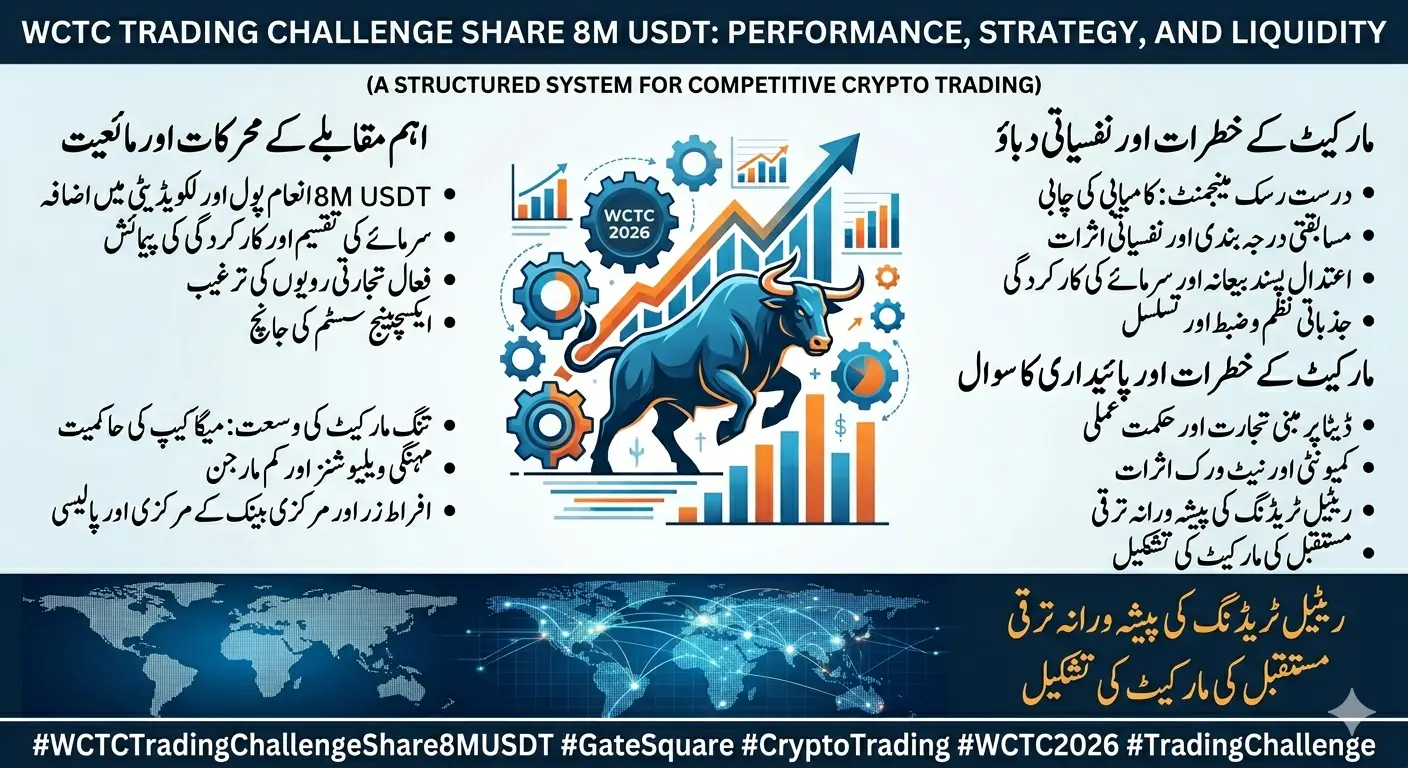
represents a significant moment within the evolving landscape of competitive crypto trading events, where capital allocation, trader performance metrics, and exchange-driven incentive systems are increasingly converging into structured, high-stakes ecosystems. An 8 million USDT reward pool is not simply a promotional figure; it reflects a broader strategic mechanism designed to attract liquidity, activate user participation, and stress-test trading infrastructure under real market conditions.
At its core, trading competitions of this scale function as multi-la
ORDER-0,94%
BlackRiderCryptoLord
#WCTCTradingChallengeShare8MUSDT
represents a significant moment within the evolving landscape of competitive crypto trading events, where capital allocation, trader performance metrics, and exchange-driven incentive systems are increasingly converging into structured, high-stakes ecosystems. An 8 million USDT reward pool is not simply a promotional figure; it reflects a broader strategic mechanism designed to attract liquidity, activate user participation, and stress-test trading infrastructure under real market conditions.
At its core, trading competitions of this scale function as multi-layered economic simulations. They are not only about who generates the highest profit, but also about how participants manage risk exposure, leverage efficiency, volatility adaptation, and portfolio resilience across different market regimes. In modern crypto markets, where rapid price fluctuations, derivatives depth, and cross-asset correlations define trading behavior, such competitions act as both performance arenas and behavioral laboratories.
The #WCTCTradingChallengeShare8MUSDT framework can be interpreted through several key dimensions:
Market Engagement and Liquidity Expansion
Large-scale trading challenges are designed to significantly increase active participation across spot and derivatives markets. When traders engage simultaneously under competitive conditions, order book depth improves, spreads tighten, and market efficiency temporarily increases. This creates a feedback loop where higher participation leads to better execution conditions, which in turn attracts even more volume. The presence of an 8M USDT incentive pool further amplifies this dynamic by encouraging both retail and semi-professional traders to allocate additional capital and increase trading frequency.
Behavioral Incentives and Strategic Trading
Unlike passive investment environments, trading challenges reward active decision-making. Participants are incentivized to identify short-term inefficiencies, capitalize on volatility spikes, and optimize entry and exit timing with precision. This often leads to a shift in trader psychology from long-term holding strategies to performance-driven tactical execution. In such environments, discipline becomes more important than aggression. Overleveraging or emotional trading typically results in drawdown, while structured risk management and statistical trading approaches tend to outperform.
Risk Management as a Competitive Edge
One of the most critical yet often underestimated aspects of trading competitions is risk control. In high-volatility environments, capital preservation becomes as important as profit generation. Traders who maintain controlled leverage ratios, diversified position exposure, and predefined stop-loss frameworks often achieve more consistent rankings than those who pursue high-risk, high-reward trades. The structure of an 8M USDT challenge implicitly rewards sustainability over short-term spikes in performance.
Exchange Ecosystem Development
From an ecosystem perspective, initiatives like #WCTCTradingChallengeShare8MUSDT serve as strategic growth engines for trading platforms. They enhance user retention, increase daily active trading volume, and strengthen brand positioning in a highly competitive exchange landscape. Beyond marketing value, such events also provide operational insights into system scalability, latency performance, liquidation mechanics, and liquidity stress handling under peak trading conditions.
Competitive Stratification of Traders
These challenges naturally create stratification within the participant base. High-frequency traders, algorithmic systems, and experienced derivatives specialists often occupy top leaderboard positions due to their ability to process market signals faster and execute with higher precision. Meanwhile, emerging traders gain exposure to real-market conditions that accelerate learning curves. This dual-layer structure transforms the event into both a competition and an educational environment.
Psychological Pressure and Decision Making
Trading under competitive ranking pressure introduces a unique psychological dimension. Unlike isolated trading environments, participants constantly evaluate their performance relative to others. This can lead to overtrading, revenge trading, or deviation from planned strategies. The most successful participants typically exhibit emotional discipline, patience during drawdowns, and consistency in execution rather than sporadic high-profit trades.
Capital Efficiency and Leverage Dynamics
Leverage plays a central role in trading challenges, especially in derivatives markets. However, efficient capital utilization does not necessarily mean maximum leverage usage. Instead, optimal position sizing aligned with volatility conditions often produces superior risk-adjusted returns. Traders who dynamically adjust leverage based on market momentum, liquidity depth, and macro catalysts tend to perform more sustainably over the duration of the challenge.
Data-Driven Trading and Strategy Optimization
In modern trading environments, data analytics increasingly define competitive advantage. Participants who utilize historical price data, order flow analysis, funding rate trends, and volatility clustering models can systematically improve decision quality. The #WCTCTradingChallengeShare8MUSDT structure effectively rewards those who integrate quantitative decision frameworks into real-time trading execution.
Market Cycles and Timing Advantage
Performance in trading challenges is often influenced by prevailing market cycles. Bullish environments tend to favor momentum strategies, while bearish or sideways markets reward range trading and arbitrage approaches. Understanding macro market context, including liquidity flows, macroeconomic signals, and sentiment shifts, becomes essential for sustained performance across the competition period.
Community and Network Effects
Beyond individual performance, large-scale trading challenges foster community interaction among participants. Traders share strategies, performance benchmarks, and market insights, indirectly improving collective market intelligence. This network effect enhances the overall engagement value of the event and contributes to long-term ecosystem growth.
Long-Term Implications
While the immediate focus of #WCTCTradingChallengeShare8MUSDT is competitive performance and reward distribution, the long-term implications extend further. Events of this scale contribute to the professionalization of retail trading, bridging the gap between institutional-grade strategy frameworks and individual trader participation. Over time, this leads to a more mature, efficient, and liquid trading environment.
Conclusion
The
initiative reflects more than just a trading competition; it represents a structured financial engagement system where performance, discipline, and strategy intersect under real market conditions. With an 8 million USDT incentive structure, the challenge amplifies participation, enhances liquidity, and drives behavioral evolution among traders. In an increasingly sophisticated digital asset landscape, such events play a crucial role in shaping the next phase of market participation, where skill, data, and discipline define success more than speculation alone.
repost-content-media
  • Reward
  • Comment
  • Repost
  • Share
#Gate13thAnniversary
#Gate13thAnniversary — Thirteen Years of Evolution, Infrastructure Growth, and Exchange-Level Transformation in the Global Digital Asset Economy
The thirteenth anniversary of Gate marks more than just a calendar milestone for a cryptocurrency exchange; it represents a full-cycle narrative of survival, adaptation, and expansion within one of the most volatile and competitive financial sectors in modern history. Over the past thirteen years, Gate has transitioned from an early-stage trading platform operating in a fragmented and uncertain digital asset environment into a mu
BlackRiderCryptoLord
#Gate13thAnniversary
#Gate13thAnniversary — Thirteen Years of Evolution, Infrastructure Growth, and Exchange-Level Transformation in the Global Digital Asset Economy
The thirteenth anniversary of Gate marks more than just a calendar milestone for a cryptocurrency exchange; it represents a full-cycle narrative of survival, adaptation, and expansion within one of the most volatile and competitive financial sectors in modern history. Over the past thirteen years, Gate has transitioned from an early-stage trading platform operating in a fragmented and uncertain digital asset environment into a multi-layered global exchange ecosystem that now participates in spot trading, derivatives markets, launchpad infrastructure, Web3 integration, and broader blockchain financial services. This evolution reflects not only internal strategic execution but also the wider transformation of the cryptocurrency industry itself, which has moved from experimental technology to a structured financial asset class with institutional participation.
At its core, Gate’s journey can be analyzed through three distinct phases: foundation and survival, expansion and diversification, and ecosystem consolidation. In the early phase, when cryptocurrency markets were still largely unregulated and dominated by retail speculation, exchanges faced existential risks including liquidity constraints, security vulnerabilities, and regulatory uncertainty. Survival in this period required not just technical capability but operational discipline and rapid adaptability. Gate’s ability to persist through early market cycles, including multiple boom-and-bust phases such as the 2017 bull run and subsequent 2018 correction, established its initial credibility within the industry.
The second phase of growth aligned with the broader maturation of the crypto market. As digital assets gained mainstream attention, the demand for more sophisticated trading infrastructure increased significantly. This period saw the emergence of derivatives markets, structured trading products, and the expansion of token listing ecosystems. Gate strategically expanded its product suite beyond basic spot trading, integrating futures contracts, margin trading, staking mechanisms, and token launch platforms. This diversification was essential in positioning the platform as more than just a trading venue; it became a financial infrastructure provider supporting multiple layers of digital asset interaction. During this phase, user expectations also evolved, demanding higher liquidity, lower latency execution, enhanced security frameworks, and broader asset coverage.
Security infrastructure became one of the defining pillars of exchange credibility. In an industry frequently affected by hacks, liquidity crises, and counterparty risks, exchanges that survived were those that continuously invested in cold storage systems, multi-signature wallet architecture, and real-time risk management engines. Gate’s long-term sustainability can be attributed in part to its emphasis on maintaining operational security and risk isolation frameworks that reduce systemic exposure. As regulatory frameworks began to emerge across different jurisdictions, compliance also became a critical component of exchange operations. Navigating varying legal landscapes required adaptive compliance models capable of aligning with regional financial regulations while maintaining global service continuity.
The third and current phase of Gate’s evolution is ecosystem consolidation and Web3 integration. Unlike earlier stages where exchanges functioned primarily as trading intermediaries, modern platforms are increasingly becoming integrated financial ecosystems. Gate’s expansion into launchpad services, venture participation, blockchain incubation, and decentralized infrastructure reflects this structural shift. The role of exchanges is no longer limited to order matching; instead, they are becoming entry points into broader digital economies. This includes facilitating early-stage token access, supporting blockchain project funding, enabling staking economies, and integrating decentralized finance mechanisms into centralized platforms.
One of the most significant industry-wide changes during this period has been the increasing institutional participation in digital assets. Hedge funds, asset managers, and even traditional financial institutions have entered crypto markets, demanding higher standards of transparency, reporting, custody solutions, and regulatory alignment. Exchanges like Gate have had to evolve their infrastructure to accommodate these requirements, including enhanced API connectivity, institutional-grade custody solutions, and improved liquidity aggregation systems. This institutional shift has fundamentally changed market dynamics, reducing purely speculative behavior and increasing correlation with macroeconomic conditions.
Market cycles have also played a crucial role in shaping Gate’s operational trajectory. The crypto industry is characterized by cyclical volatility driven by Bitcoin halving events, liquidity expansion phases, regulatory announcements, and macroeconomic liquidity conditions. Each cycle has tested the resilience of exchanges differently. Bull markets stress scalability and system performance due to high user influx and trading volume spikes, while bear markets test financial sustainability, operational efficiency, and user retention strategies. Gate’s ability to remain operational across multiple full market cycles demonstrates structural resilience within its business model.
Another key dimension of Gate’s development has been its expansion into global markets. Cryptocurrency exchanges are inherently international platforms, yet they must navigate fragmented regulatory environments. Expansion into multiple jurisdictions requires not only localized compliance frameworks but also multilingual support systems, regional liquidity partnerships, and culturally adaptive product offerings. This global positioning allows exchanges to distribute risk across markets while capturing diverse user bases with different trading behaviors and asset preferences.
From a technological perspective, the evolution of exchange infrastructure over the past decade has been substantial. Early matching engines were relatively simple, capable of handling limited throughput. Modern systems, however, must process millions of transactions per second with near-zero latency expectations. This requires advanced microservices architecture, distributed computing systems, and high-performance database optimization. Gate’s continued investment in infrastructure scalability reflects the broader industry requirement for real-time financial execution environments that rival traditional equity markets in speed and reliability.
The introduction of decentralized finance (DeFi) further disrupted traditional exchange models. Instead of centralized order books, DeFi protocols introduced automated market makers and liquidity pools, enabling permissionless trading environments. While this created competitive pressure for centralized exchanges, it also opened opportunities for integration. Many centralized platforms, including Gate, began incorporating DeFi-related services such as staking aggregation, yield products, and cross-chain asset management tools. This hybrid model represents a convergence between centralized efficiency and decentralized accessibility.
Risk management has remained a constant priority across all phases of exchange evolution. Market manipulation, liquidity fragmentation, and smart contract vulnerabilities in integrated DeFi systems all contribute to operational risk exposure. Exchanges must continuously develop surveillance systems capable of detecting abnormal trading patterns, wash trading activity, and cross-market arbitrage exploitation. The sophistication of these systems has increased significantly, leveraging machine learning models and real-time analytics engines.
User experience has also become a major competitive factor. In early crypto markets, complexity was tolerated due to lack of alternatives. However, as adoption increased, user expectations shifted toward simplified interfaces, mobile-first applications, and seamless onboarding processes. Exchanges now compete not only on liquidity and fees but also on accessibility and educational infrastructure. Gate’s evolution reflects this shift, with expanded user interface design improvements and broader accessibility features aimed at reducing entry barriers for new participants.
The broader significance of Gate’s thirteenth anniversary lies in its representation of industry maturity. Very few platforms in the cryptocurrency sector have survived long enough to operate across multiple full market cycles while continuously evolving their product architecture. This longevity indicates both operational resilience and strategic adaptability in a sector defined by rapid disruption and frequent structural failures.
Looking forward, the exchange landscape is expected to further evolve toward full financial integration, where digital asset platforms function similarly to traditional financial institutions but with blockchain-native infrastructure. This includes tokenized real-world assets, on-chain identity systems, cross-chain liquidity layers, and deeper integration with global payment systems. Exchanges will likely continue transitioning from trading venues into comprehensive financial ecosystems that support custody, settlement, lending, investment, and asset issuance.
Gate’s thirteen-year milestone therefore represents not just a retrospective achievement but also a forward-looking indicator of continued structural transformation within the digital asset industry. The platform’s ability to adapt across regulatory shifts, technological evolution, and market cycles positions it within a category of long-term infrastructure players rather than short-term speculative platforms.
As the industry moves into its next phase of maturity, characterized by institutional integration, regulatory clarity, and technological convergence between centralized and decentralized systems, exchanges like Gate will continue to play a foundational role in shaping liquidity architecture, market accessibility, and global participation in digital finance.
repost-content-media
  • Reward
  • Comment
  • Repost
  • Share
The emergence of the #AllbirdsPivotstoAI narrative represents more than a simple corporate strategy adjustment; it reflects a broader structural shift in how consumer brands are attempting to survive in a post-hype, high-efficiency digital economy. At the center of this discussion is the footwear and lifestyle company Allbirds, a brand originally built on sustainability branding, minimalist design, and direct-to-consumer growth, now increasingly associated with efforts to reposition itself within the accelerating artificial intelligence transformation of modern commerce.
This pivot signals a d
BlackRiderCryptoLord
The emergence of the #AllbirdsPivotstoAI narrative represents more than a simple corporate strategy adjustment; it reflects a broader structural shift in how consumer brands are attempting to survive in a post-hype, high-efficiency digital economy. At the center of this discussion is the footwear and lifestyle company Allbirds, a brand originally built on sustainability branding, minimalist design, and direct-to-consumer growth, now increasingly associated with efforts to reposition itself within the accelerating artificial intelligence transformation of modern commerce.
This pivot signals a deeper reality: sustainability alone is no longer sufficient as a growth engine, and companies must now integrate data intelligence, automation, and AI-driven decision systems to remain competitive in a saturated global retail environment.
The Core Narrative: From Sustainability Branding to AI-Led Efficiency
Allbirds initially gained global recognition by positioning itself as a “sustainable alternative” in the footwear industry. Its early identity was built around:
Eco-friendly materials
Carbon footprint transparency
Minimalist product design
Direct-to-consumer e-commerce strategy
However, as the retail landscape evolved, this identity began to face structural limitations:
Rising customer acquisition costs in digital advertising
Increased competition from both legacy and fast-fashion brands
Slowing growth in premium eco-conscious consumer segments
Margin pressure in a high-inflation supply environment
The #AllbirdsPivotstoAI narrative therefore reflects a strategic recognition that future growth will not come from branding alone, but from operational intelligence and automation.
Why AI Becomes Central to Retail Reinvention
Artificial intelligence is no longer an experimental layer in retail—it is becoming the core infrastructure for decision-making. For companies like Allbirds, AI integration typically focuses on:
1. Demand Forecasting and Inventory Optimization
AI systems analyze consumer behavior, seasonal patterns, and regional trends to reduce overproduction and inventory waste.
2. Pricing Intelligence
Dynamic pricing models adjust product pricing based on demand elasticity, competitor activity, and market conditions.
3. Supply Chain Efficiency
Machine learning systems optimize logistics routes, supplier selection, and production scheduling to reduce cost and carbon footprint simultaneously.
4. Personalized Marketing
AI-driven segmentation improves conversion rates by tailoring ads, product recommendations, and user journeys in real time.
In this sense, AI becomes not just a tool, but a structural necessity for survival in modern retail economics.
Market Context: Why This Pivot Is Happening Now
The timing of the #AllbirdsPivotstoAI narrative is critical. The global retail and consumer sector is currently experiencing:
Post-pandemic normalization of demand
Declining direct-to-consumer profitability
Higher interest rates increasing cost of capital
Pressure from investors for operational efficiency
Rapid adoption of generative AI across industries
In this environment, companies that fail to integrate AI risk being structurally outcompeted by more agile, data-native competitors.
This shift is not unique to Allbirds—it is part of a wider transformation across the consumer and apparel industry.
Investor Perspective: Efficiency Over Storytelling
For years, Allbirds was considered a “story stock” driven by sustainability narrative and brand identity. However, capital markets are now prioritizing:
Profitability over growth narratives
Operational efficiency over branding appeal
Data-driven scalability over marketing-led expansion
As a result, the pivot toward AI is also a signal to investors that the company is attempting to transition from narrative-based valuation to fundamentals-based valuation.
In modern equity markets, AI adoption is increasingly interpreted as:
A cost-reduction mechanism
A margin expansion tool
A long-term competitiveness indicator
Competitive Landscape: AI as a Survival Filter
The retail industry is undergoing a silent but aggressive consolidation driven by AI capability gaps.
Brands that successfully integrate AI systems are gaining advantages in:
Lower inventory waste
Faster product iteration cycles
Higher customer retention
Reduced marketing inefficiencies
Meanwhile, brands that lag behind face:
Margin compression
Slower response to market trends
Higher operational inefficiencies
Reduced investor confidence
The #AllbirdsPivotstoAI narrative therefore reflects a broader industry truth: AI is becoming a survival filter rather than a competitive advantage.
Strategic Reality: The Limits of Brand Reinvention
While AI adoption can significantly improve operational efficiency, it does not automatically resolve structural brand challenges. For Allbirds, key constraints include:
Limited pricing power in a competitive footwear market
Brand positioning still heavily tied to niche sustainability appeal
Dependence on consumer discretionary spending cycles
Need for continuous product innovation beyond operational improvements
This means AI can enhance efficiency, but it cannot fully replace the need for strong product-market fit.
Macro Implications: Retail Meets AI Economy
The #AllbirdsPivotstoAI narrative is part of a larger macro trend where traditional consumer companies are converging with AI-driven enterprise models.
Across industries, we are seeing:
Retail becoming data-first
Supply chains becoming algorithmically optimized
Marketing shifting from creative intuition to predictive modeling
Corporate strategy increasingly driven by machine intelligence insights
This represents a structural transition from experience-based management to AI-augmented decision systems.
Sentiment Dynamics: Narrative vs Execution
Markets typically respond strongly to “AI pivot” announcements, but long-term valuation impact depends on execution.
Short-term sentiment effects include:
Increased investor attention
Speculative repricing of equity narratives
Higher volatility around earnings cycles
Long-term outcomes depend on:
Actual integration of AI into core operations
Measurable margin improvement
Sustainable revenue growth stabilization
Without execution, AI narratives tend to fade into standard repositioning cycles.
Conclusion: AI as the New Corporate Operating System
The
narrative reflects a broader transformation in global business architecture. Companies are no longer competing solely on brand identity, sustainability messaging, or product aesthetics—they are increasingly competing on computational capability.
For Allbirds, this pivot represents an attempt to align with the next phase of retail evolution, where artificial intelligence becomes the core operating system behind every decision, from design to distribution.
Ultimately, the success of this transition will depend not on the narrative itself, but on whether AI integration delivers measurable improvements in efficiency, profitability, and scalability in an increasingly competitive global marketplace.
repost-content-media
  • Reward
  • Comment
  • Repost
  • Share
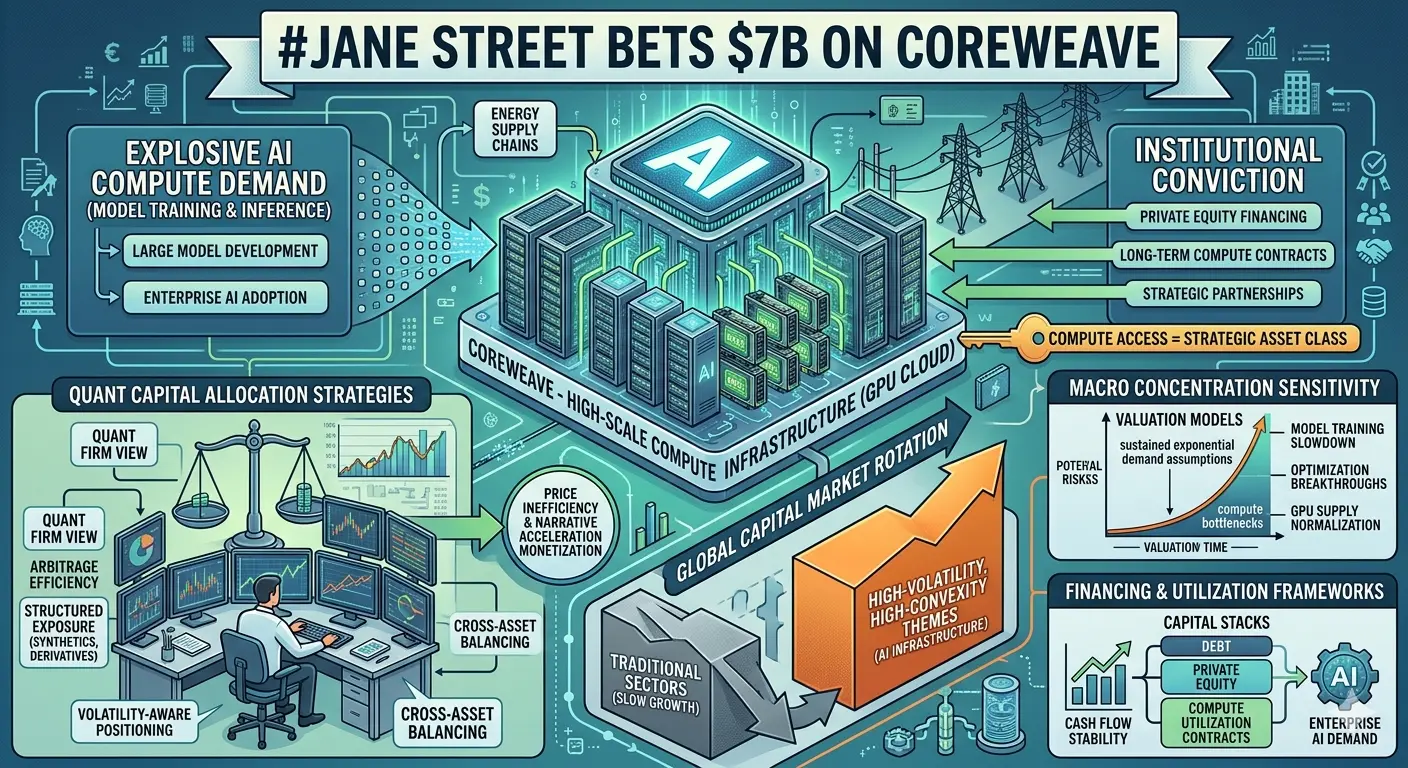
#JaneStreetBets$7BonCoreWeave has quickly evolved into a focal point for discussions across institutional trading desks, AI infrastructure analysts, and macro liquidity observers. Whether interpreted as a direct capital allocation, structured exposure, or derivatives-driven positioning, the implication is the same: high-frequency institutional capital is increasingly converging on the AI infrastructure layer rather than the AI application layer.
CoreWeave, originally known as a specialized GPU cloud infrastructure provider optimized for high-performance compute workloads, has emerged as one of
BlackRiderCryptoLord
#JaneStreetBets$7BonCoreWeave has quickly evolved into a focal point for discussions across institutional trading desks, AI infrastructure analysts, and macro liquidity observers. Whether interpreted as a direct capital allocation, structured exposure, or derivatives-driven positioning, the implication is the same: high-frequency institutional capital is increasingly converging on the AI infrastructure layer rather than the AI application layer.
CoreWeave, originally known as a specialized GPU cloud infrastructure provider optimized for high-performance compute workloads, has emerged as one of the most strategically relevant beneficiaries of the global AI buildout cycle. In a market environment where compute capacity has become the new oil of the digital economy, firms like CoreWeave are no longer viewed as niche service providers but as foundational infrastructure nodes in the AI supply chain.
Jane Street, as a highly sophisticated liquidity provider and quantitative trading institution, is often associated with arbitrage efficiency, structured exposure, and volatility-aware positioning rather than directional long-term bets in traditional equity narratives. Therefore, the emergence of a reported $7B scale exposure linked to CoreWeave—whether directly, synthetically, or through multi-layered instruments—signals something deeper than a simple investment thesis. It reflects the evolving intersection between quantitative capital allocation strategies and the explosive demand curve for AI compute infrastructure.
At the core of this narrative is a structural shift in global capital markets: AI is no longer just a thematic trade; it has become an infrastructure cycle comparable to cloud computing in the early 2010s or semiconductor expansion cycles in prior decades. The difference, however, is intensity. AI compute demand is scaling at a rate that is compressing traditional investment horizons. Capacity constraints, GPU shortages, and energy bottlenecks are forcing capital allocators to move earlier and more aggressively into upstream infrastructure providers.
CoreWeave’s positioning within this ecosystem is particularly significant. Unlike generalized hyperscalers, its architecture is optimized for GPU-intensive workloads, making it directly aligned with large-scale model training, inference pipelines, and distributed AI workloads. This specialization has created a supply-demand imbalance where compute availability itself becomes a strategic asset class. In such an environment, capital flows are increasingly driven not just by revenue growth potential but by access scarcity and utilization efficiency.
The reported association with Jane Street introduces an additional layer of interpretation. Quantitative firms of this scale do not typically engage in simple directional equity exposure without embedded hedging structures, liquidity arbitrage mechanisms, or cross-asset balancing strategies. If the exposure is real at scale, it likely reflects a broader multi-instrument view on AI infrastructure volatility, rather than a single outright equity position.
This distinction is critical because it reframes the narrative from “investment in CoreWeave” to “positioning around AI infrastructure volatility and pricing inefficiencies.” In modern markets, the most sophisticated players are not simply betting on winners; they are pricing the rate of change in narrative acceleration, liquidity expansion, and implied demand shocks across correlated assets such as GPUs, data center REITs, energy supply chains, and cloud service derivatives.
From a macro perspective, this also aligns with a broader rotation in capital markets. Traditional sectors with stable but slow growth are increasingly being deprioritized in favor of high-volatility, high-convexity themes such as AI infrastructure, defense-grade computing, and next-generation cloud networks. The result is a concentration of capital in a narrow band of companies that sit closest to compute bottlenecks.
However, this concentration introduces systemic sensitivity. When capital flows cluster into infrastructure-heavy AI plays, valuation models become increasingly dependent on sustained exponential demand assumptions. Any slowdown in model training intensity, optimization breakthroughs reducing compute requirements, or supply-side GPU normalization could significantly alter forward pricing expectations.
This is where institutional players like Jane Street become relevant to the narrative again. Their participation—if accurately interpreted—suggests that volatility itself is being monetized within this thematic. Instead of relying solely on directional appreciation, strategies may be structured around spread inefficiencies between compute demand expectations and realized capacity expansion timelines.
Another layer to consider is financing structure evolution. AI infrastructure firms often rely on complex capital stacks involving debt, private equity, long-term compute contracts, and strategic institutional partnerships. A large-scale positioning event at the $7B level implies confidence not just in equity appreciation but in the stability of underlying cash flow frameworks tied to compute utilization contracts and enterprise AI demand commitments.
At a systemic level, this narrative reinforces a broader truth about the current market cycle: AI is transitioning from a speculative technology theme into an industrial capital expenditure cycle. That transition fundamentally changes how valuation is constructed. Multiples are no longer purely sentiment-driven; they are increasingly anchored to utilization rates, hardware deployment cycles, and contracted compute demand visibility.
In this environment, CoreWeave becomes more than a company—it becomes a proxy for global AI compute saturation trends. And Jane Street, if truly positioned at scale within this ecosystem, becomes a signal of how deep institutional liquidity is beginning to embed itself within the AI infrastructure stack.
Ultimately, the significance of #JaneStreetBets$7BonCoreWeave is not in the headline magnitude alone, but in what it represents: the convergence of quantitative capital, infrastructure scarcity, and exponential compute demand cycles. It reflects a market where the most valuable asset is no longer data or software alone, but the physical and financial architecture required to sustain AI at scale.
As this cycle continues, the key question is no longer whether AI demand is real, but how efficiently global capital markets can finance and allocate compute infrastructure without creating destabilizing over-concentration. In that sense, this narrative is still in its early phases, and the most important pricing dynamics have likely not fully expressed themselves yet.
repost-content-media
  • Reward
  • Comment
  • Repost
  • Share
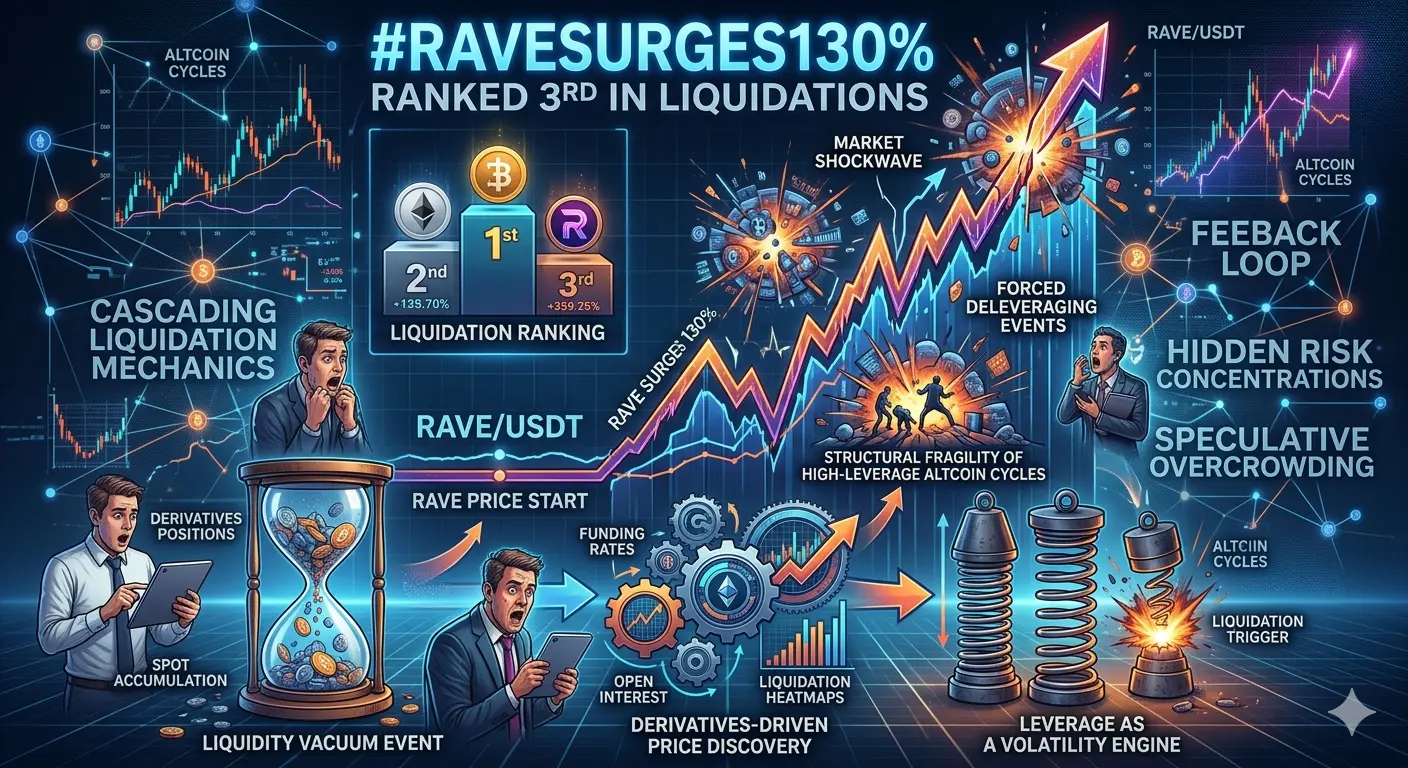
#RAVESurges130%Ranked3rdInLiquidations has rapidly become a focal point across crypto derivatives desks, on-chain analytics communities, and speculative trading circles tracking high-volatility altcoin movements. A 130% upward move in a compressed timeframe, combined with its ranking among the top liquidation events, signals not only aggressive directional momentum but also a structurally fragile positioning environment beneath the surface.
In modern crypto markets, sharp upward price expansion is rarely just a story of organic demand. Instead, it often reflects a layered interaction between s
BlackRiderCryptoLord
#RAVESurges130%Ranked3rdInLiquidations has rapidly become a focal point across crypto derivatives desks, on-chain analytics communities, and speculative trading circles tracking high-volatility altcoin movements. A 130% upward move in a compressed timeframe, combined with its ranking among the top liquidation events, signals not only aggressive directional momentum but also a structurally fragile positioning environment beneath the surface.
In modern crypto markets, sharp upward price expansion is rarely just a story of organic demand. Instead, it often reflects a layered interaction between spot accumulation, derivatives positioning, liquidity gaps, and cascading liquidation mechanics. The RAVE move fits squarely into this framework, where price acceleration is amplified by forced unwinds of leveraged short positions, thin order books, and reactive market-making adjustments.
At its core, this event highlights a recurring structural feature of the digital asset ecosystem: leverage is not just a trading tool, it is a volatility engine. When positioning becomes overly one-sided, especially in mid-cap or low-liquidity tokens, the market does not move in a smooth trend. It moves in discontinuous jumps driven by liquidation clusters and margin threshold triggers.
RAVE’s reported 130% surge indicates that multiple layers of short exposure were likely concentrated within a relatively tight price band. Once price breached key liquidation thresholds, cascading buy orders were triggered automatically as exchanges and lending protocols closed out undercollateralized positions. This creates a feedback loop: forced buying drives price higher, which triggers more liquidations, which in turn accelerates upward momentum.
The fact that RAVE is ranked third in liquidation intensity during this move suggests that the event was not isolated but part of a broader market-wide leverage reset. In such environments, capital is not simply flowing into an asset; rather, it is being forcibly repositioned by risk engines, margin systems, and automated deleveraging protocols.
To understand why such moves are becoming more frequent, it is necessary to zoom out to the current structure of crypto markets. Over the past cycle, the ecosystem has evolved into a highly derivatives-driven environment where perpetual futures volumes often exceed spot trading volumes by multiples. This creates a situation where price discovery is increasingly influenced by funding rates, open interest imbalances, and liquidation heatmaps rather than pure spot demand.
In this context, assets like RAVE—typically categorized as high-beta altcoins—become especially sensitive to positioning distortions. When speculative interest rises, traders often deploy high leverage to maximize exposure in short timeframes. While this amplifies upside during bullish phases, it also introduces extreme fragility when price moves against crowded positioning.
The 130% surge therefore should not be interpreted purely as organic appreciation. Instead, it is better understood as a liquidity vacuum event, where market depth was insufficient to absorb rapid order flow shifts, allowing price to move vertically rather than incrementally.
Another important dimension of this event is the role of liquidation ranking. Being ranked third in liquidations indicates that RAVE was not just experiencing price volatility in isolation, but was also one of the primary contributors to system-wide leverage reduction during the period. This implies a concentration of speculative capital in the asset prior to the move, followed by an abrupt unwinding.
Such ranking events are critical because they reveal hidden risk concentrations in the market. While price charts show movement, liquidation data reveals positioning. And positioning, in many cases, is a more accurate reflection of systemic risk than price itself.
From a market microstructure perspective, these events expose a key imbalance: liquidity provision is often insufficient during rapid directional moves. Market makers widen spreads, reduce size, or temporarily withdraw liquidity in response to volatility spikes. This creates air pockets where price can move rapidly with minimal resistance.
Once these air pockets form, liquidation engines take over as the dominant force in price formation. This is why the most violent moves in crypto are often seen not during slow accumulation phases, but during forced deleveraging phases where the market is effectively “clearing” excess leverage.
The RAVE surge also highlights an important behavioral pattern among retail and mid-tier leveraged traders: crowding into similar directional bets. In many cases, traders use similar technical signals, funding rate cues, or social sentiment indicators to enter positions. This synchronizes risk across the system, making liquidation cascades more likely when thresholds are breached.
In addition, the psychological dimension cannot be ignored. Rapid upward moves often trigger late-stage momentum chasing, where participants enter long positions after significant price appreciation has already occurred. This late liquidity is frequently the weakest, most overleveraged capital in the system, and becomes the final wave of fuel before volatility exhaustion or reversal.
However, not all liquidation-driven rallies end in immediate reversals. In some cases, forced deleveraging clears enough structural resistance to allow a new equilibrium price range to form. Whether RAVE transitions into consolidation or reversal will depend on whether spot demand can sustain price levels after derivatives-driven distortions normalize.
Another layer worth examining is the broader macro crypto environment. Markets characterized by high interest in altcoins, combined with uneven liquidity distribution across tokens, tend to produce these kinds of asymmetric moves. Capital rotation between majors and alts creates episodic liquidity surges, which amplify volatility in mid-cap assets disproportionately.
In such environments, liquidation events become almost cyclical in nature. Periods of calm leverage accumulation are followed by sharp volatility expansions, which then reset positioning before the next cycle begins. The RAVE event appears consistent with this repeating structural rhythm.
From a risk management perspective, the key takeaway is not the magnitude of the move itself, but the underlying leverage density it reveals. A 130% surge accompanied by top-tier liquidation ranking implies that prior market stability was more fragile than it appeared on surface-level volatility metrics.
For systematic traders and algorithmic strategies, events like this serve as recalibration signals. Models that incorporate open interest divergence, funding rate extremes, and liquidation cluster mapping will interpret such moves as evidence of latent instability rather than pure bullish strength.
For discretionary traders, the interpretation is more nuanced. While such moves can represent opportunity during early phases of liquidation cascades, they also carry elevated risk of mean reversion once forced flows exhaust themselves.
Ultimately, the significance of #RAVESurges130%Ranked3rdInLiquidations lies in what it reveals about the current structure of crypto markets: price is increasingly a derivative of leverage positioning rather than isolated demand. The market is not simply moving up or down; it is constantly transitioning between states of leverage expansion and leverage collapse.
As the ecosystem matures, these events may become even more pronounced due to deeper derivatives penetration and more sophisticated automated liquidation systems. At the same time, they will continue to serve as key indicators of systemic stress and speculative overcrowding.
In conclusion, the RAVE surge is not just a price event—it is a structural signal. It reflects the ongoing tension between liquidity, leverage, and market microstructure in a system where capital efficiency is constantly battling volatility amplification. Whether this marks the beginning of sustained upward repricing or a temporary liquidation-driven distortion will depend on how quickly positioning resets and whether fresh spot demand emerges to absorb the post-liquidation environment.
What remains clear is that in modern crypto markets, moves of this scale are never purely accidental. They are the visible outcome of invisible positioning imbalances finally resolving through forced market mechanics.
repost-content-media
  • Reward
  • Comment
  • Repost
  • Share
#GatePreIPOsLaunchesWithSpaceX
#GatePreIPOsLaunchesWithSpaceX:
Gate.com has officially launched its Pre-IPOs product line, and the debut project is none other than SpaceX — ticker symbol SPCX — marking a pivotal moment in how retail crypto users can access pre-public equity opportunities that were previously reserved exclusively for institutional investors and high-net-worth individuals with direct brokerage access to secondary private markets.
What Gate Pre-IPOs Actually Is
Pre-IPOs on Gate.com is a structured digital subscription mechanism that allows users to participate in early-stage own
XAI4,16%
GUSD-0,02%
BlackRiderCryptoLord
#GatePreIPOsLaunchesWithSpaceX
#GatePreIPOsLaunchesWithSpaceX:
Gate.com has officially launched its Pre-IPOs product line, and the debut project is none other than SpaceX — ticker symbol SPCX — marking a pivotal moment in how retail crypto users can access pre-public equity opportunities that were previously reserved exclusively for institutional investors and high-net-worth individuals with direct brokerage access to secondary private markets.
What Gate Pre-IPOs Actually Is
Pre-IPOs on Gate.com is a structured digital subscription mechanism that allows users to participate in early-stage ownership of high-profile companies before they list on traditional stock exchanges. The product issues asset certificates representing a claim on the underlying equity, which then enter pre-market trading on the platform in a fully unlocked format. This is not a synthetic derivative or a price-tracking token — it is a direct asset certificate backed by actual pre-IPO share exposure, distributed with 100% unlock post-subscription, meaning no vesting cliff or staggered release schedule that erodes early participant value.
Why SpaceX as the First Project
The choice of SpaceX as the inaugural Pre-IPOs project is a calculated signal. SpaceX is currently the world's most valuable private company, having filed confidential IPO paperwork with the U.S. Securities and Exchange Commission in early April 2026. Bloomberg News reported on April 2 that SpaceX and its advisers are targeting a valuation in excess of $2 trillion for the offering, which would make it the largest stock market listing in history — surpassing Saudi Aramco's 2019 IPO. SpaceX merged with Elon Musk's artificial intelligence startup xAI in a deal that valued the combined entity at approximately $1.25 trillion at the time of merger, and its Starlink satellite internet division alone is considered by analysts to be a multi-hundred-billion-dollar business unit. The implied valuation at which Gate is offering SPCX subscriptions is approximately $1.4 trillion, with a unit price of $590 per SPCX certificate. The total subscription pool is 33,900 SPCX, representing a total offering value of roughly $20 million.
Key Subscription Details
Subscription opens: April 20, 2026 at 18:00 UTC+8
Subscription closes: April 22, 2026 at 18:00 UTC+8
Asset certificate distribution: Expected before April 22, 2026 at 22:00 UTC+8 (ahead of original May 6 deadline)
Pre-market trading begins: April 24, 2026 at 18:00 UTC+8
Accepted currencies: USDT and GUSD (dual-currency subscription)
Unlock structure: 100% unlocked at distribution — no lockup period
Allocation follows an "average locked amount per hour" model, meaning users who enter the subscription earlier and maintain their committed amount for a longer duration receive proportionally higher allocation weight. This mechanism rewards genuine early commitment over last-minute capital deployment, which is an important structural distinction from lottery-based or flat-allocation systems used elsewhere.
The Access Gap Gate Is Addressing
SpaceX has historically been inaccessible to the average retail investor. Secondary market transactions in SpaceX shares typically require accredited investor status under U.S. securities law, a minimum investment threshold in the hundreds of thousands of dollars, and access to platforms or broker-dealers that facilitate private share transfers. This has concentrated exposure in VC funds, institutional portfolios, and funds such as the ARK Venture Fund or XOVR ETF — neither of which offers direct SPCX price exposure without fund-level dilution. Gate's Pre-IPOs product removes these friction points entirely. Any user with a funded Gate account can participate using stablecoins, with no minimum investment floor beyond the unit price per certificate.
VIP Airdrop Layer
Gate launched a parallel VIP-exclusive airdrop alongside the subscription window. Users at VIP 5 and above, as well as designated super agents, are eligible to receive SPCX rewards and additional free airdrops without committing subscription capital. This layer provides high-tier users incremental upside exposure to SPCX price movement in pre-market trading without additional subscription risk, functioning as a loyalty reward embedded within the broader product launch structure.
Structural Significance for the Platform
The launch of Pre-IPOs represents Gate's most significant product-category expansion into traditional finance since the introduction of its TradFi CFD offering. By bridging crypto-native capital with pre-public equity, Gate is building infrastructure for a convergence thesis that the broader market has been moving toward — crypto platforms as multi-asset gateways, not merely digital coin exchanges. The timing aligns with a period in which multiple trillion-dollar private companies (SpaceX, OpenAI, Anthropic, Klarna, and others) are approaching public markets simultaneously, creating a structural window for pre-IPO products to attract significant trading volume and user acquisition.
If the SpaceX IPO proceeds at a $2 trillion valuation and SPCX certificates were subscribed at the $1.4 trillion implied valuation, early subscribers would be looking at a meaningful mark-to-market gain purely from the IPO re-rating event — independent of any post-listing performance. That is the core value proposition, and it is a credible one, though post-IPO price action in large listings has historically been volatile and mean-reverting in the medium term, which is a risk factor worth accounting for before committing capital.
Final Takeaway
Gate Pre-IPOs launching with SpaceX is not a marketing gimmick — it is a structural product built around one of the most anticipated public listings in financial history. The mechanics are transparent, the underlying asset is real, the unlock is immediate, and the access barrier has been reduced to a stablecoin balance. Whether one views this as a pure trading opportunity or a long-term conviction position on the SpaceX IPO trajectory, the infrastructure Gate has deployed gives retail users a legitimate seat at the table for the first time
repost-content-media
  • Reward
  • Comment
  • Repost
  • Share
  • Reward
  • Comment
  • Repost
  • Share
#GatePreIPOsLaunchesWithSpaceX is catching serious attention across the crypto and investment world. But what does it actually mean? Let’s break it down in detail 👇
First, this campaign appears to be linked with , a well-known crypto exchange that often introduces innovative financial products. The term PreIPO refers to investments in companies before they go public, giving early investors a chance to potentially benefit from massive growth once the company launches its IPO.
Now comes the exciting part — the association with , the revolutionary aerospace company founded by . SpaceX has transf
post-image
  • Reward
  • Comment
  • Repost
  • Share
#GateSquareAprilPostingChallenge
🤖 AI Crypto Narrative — From Explosive Hype to Brutal Market Filtering
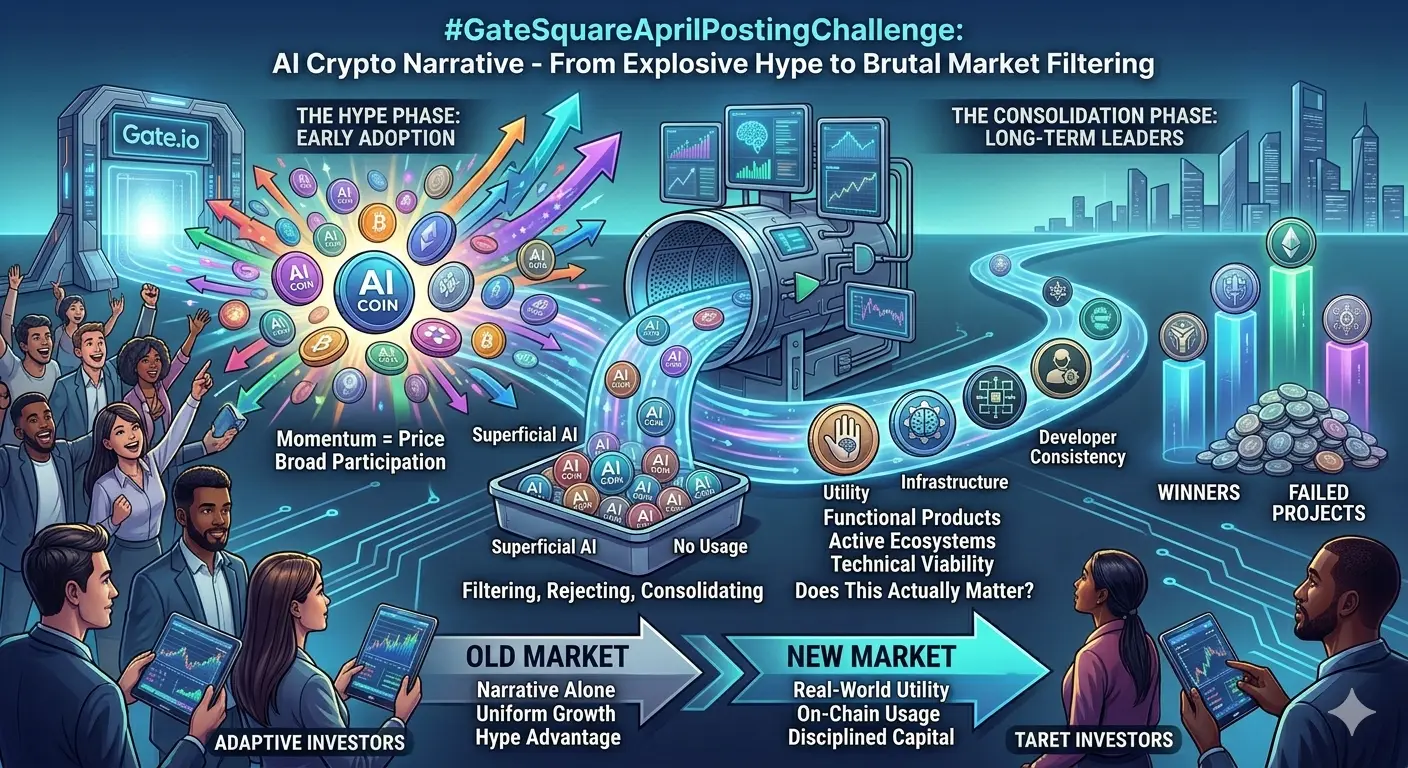
The AI + crypto narrative hasn’t disappeared — it has hardened. What was once a broad, hype-driven expansion phase has now transformed into a far more selective and unforgiving market environment. This is no longer a phase where everything labeled “AI” moves up together. It is a phase where the market actively filters, rejects, and consolidates.
The earlier stage was simple: attention created momentum, and momentum created price. But that structure has now broken. The market is evolving, an
BlackRiderCryptoLord
#GateSquareAprilPostingChallenge
🤖 AI Crypto Narrative — From Explosive Hype to Brutal Market Filtering
The AI + crypto narrative hasn’t disappeared — it has hardened. What was once a broad, hype-driven expansion phase has now transformed into a far more selective and unforgiving market environment. This is no longer a phase where everything labeled “AI” moves up together. It is a phase where the market actively filters, rejects, and consolidates.
The earlier stage was simple: attention created momentum, and momentum created price. But that structure has now broken. The market is evolving, and with that evolution comes a shift in how value is assigned.
📊 Market Shift — From Uniform Growth to Fragmentation
Recent behavior across AI tokens shows a clear structural transition:
• Price action is no longer consistent across the sector
• Strong rallies are increasingly short-lived
• Corrections are sharper and more frequent
• Liquidity rotates aggressively between narratives
• Correlation between AI projects is weakening
👉 This is not weakness — it is market maturation.
Instead of one unified trend, we now have fragmentation, where only specific projects capture capital at any given time.
🧠 End of Narrative-Only Advantage
During the early phase, being part of the “AI” category was enough. Branding, storytelling, and social traction could drive massive inflows.
Now, that advantage is fading.
Capital is becoming more disciplined and more analytical. The focus is shifting toward:
• Real-world utility
• On-chain usage and activity
• Technical infrastructure
• Product-market fit
• Developer consistency
👉 The narrative alone is no longer sufficient to sustain valuation.
⚖️ Volatility — A Feature, Not a Flaw
The increased volatility in AI tokens is not random — it reflects a deeper market dynamic:
• Retail participation remains driven by excitement
• Smart money is actively distributing into strength
• Liquidity is relatively thin compared to major assets
• Sentiment shifts rapidly between optimism and caution
This creates repeated cycles: 👉 Rapid expansion → aggressive profit-taking → sharp correction → capital rotation
Understanding this cycle is now critical for survival.
🔄 Capital Rotation — The New Market Behavior
The market is no longer loyal to a single narrative. Instead, it is constantly reallocating capital:
• AI, RWA, DePIN, and other sectors compete for attention
• Even within AI, sub-sectors rotate independently
• Traders are locking profits faster
• Holding without strategy is becoming increasingly risky
👉 Adaptability has replaced passive participation.
💡 Reality Check — Most Projects Won’t Survive
This phase is where the market starts enforcing discipline.
A large portion of AI crypto projects will struggle because:
• Their AI integration is superficial
• There is little to no real usage
• Demand is driven purely by speculation
• Development lacks depth or continuity
👉 The filtering process is already happening — quietly but aggressively.
🚀 What Defines the Winners Now
The projects that will endure this phase share common characteristics:
• Meaningful AI + blockchain integration
• Functional products with real adoption
• Active developer ecosystems
• Consistent on-chain engagement
• Long-term utility beyond market cycles
👉 The focus has shifted from visibility to viability.
🏦 Platform Dynamics — Strategic Positioning
Major exchanges like Gate.io are actively aligning with the AI narrative, increasing exposure, listings, and ecosystem visibility.
This reflects a broader trend: 👉 AI is transitioning from a temporary narrative into a core sector within crypto markets.
However, exposure alone does not guarantee sustainability. The underlying fundamentals remain the deciding factor.
🧩 Structural Evolution of the Narrative
Every major market narrative evolves through predictable stages:
• Hype Phase — Rapid attention and broad participation
• Expansion Phase — Accelerated growth and inflows
• Filtering Phase — Weak projects begin to fade
• Consolidation Phase — Strong players dominate
👉 AI crypto is currently in the filtering phase.
This is where differentiation becomes critical and where long-term leaders begin to separate from short-term hype.
🔥 Final Perspective
The AI crypto narrative is not weakening — it is becoming more precise, more selective, and more grounded in reality.
The easy phase is over.
The disciplined phase has begun.
👉 The market is no longer asking “Is this AI?”
👉 It is asking “Does this actually matter?”
Those who understand this shift will adapt.
Those who don’t will remain stuck chasing outdated momentum.
#AICrypto #CryptoTrends
repost-content-media
  • Reward
  • Comment
  • Repost
  • Share
#GatePreIPOsLaunchesWithSpaceX
Gate Pre-IPOs Launches With SpaceX — Retail Access to the Largest IPO in History Starts Now
For the first time in the history of capital markets, retail participants have a structured, transparent, and immediately liquid pathway into SpaceX before it goes public. Gate has officially launched its Pre-IPOs platform with SpaceX as the debut project — and the timing could not be more deliberate. SpaceX has confidentially filed IPO paperwork with the U.S. Securities and Exchange Commission. The roadshow is scheduled to launch the week of June 8, 2026. SpaceX plans to
BlackRiderCryptoLord
#GatePreIPOsLaunchesWithSpaceX
Gate Pre-IPOs Launches With SpaceX — Retail Access to the Largest IPO in History Starts Now
For the first time in the history of capital markets, retail participants have a structured, transparent, and immediately liquid pathway into SpaceX before it goes public. Gate has officially launched its Pre-IPOs platform with SpaceX as the debut project — and the timing could not be more deliberate. SpaceX has confidentially filed IPO paperwork with the U.S. Securities and Exchange Commission. The roadshow is scheduled to launch the week of June 8, 2026. SpaceX plans to host 1,500 retail investors at a major investor event on June 11. One of its lead underwriters — from a syndicate of 21 investment banks — told the group that retail demand will be something they have "never seen before." The company is targeting a valuation of $2 trillion, which would make this the largest initial public offering ever recorded in financial history. That is the backdrop. Gate saw the window and built the product before the window closes.
The Business Behind the Valuation
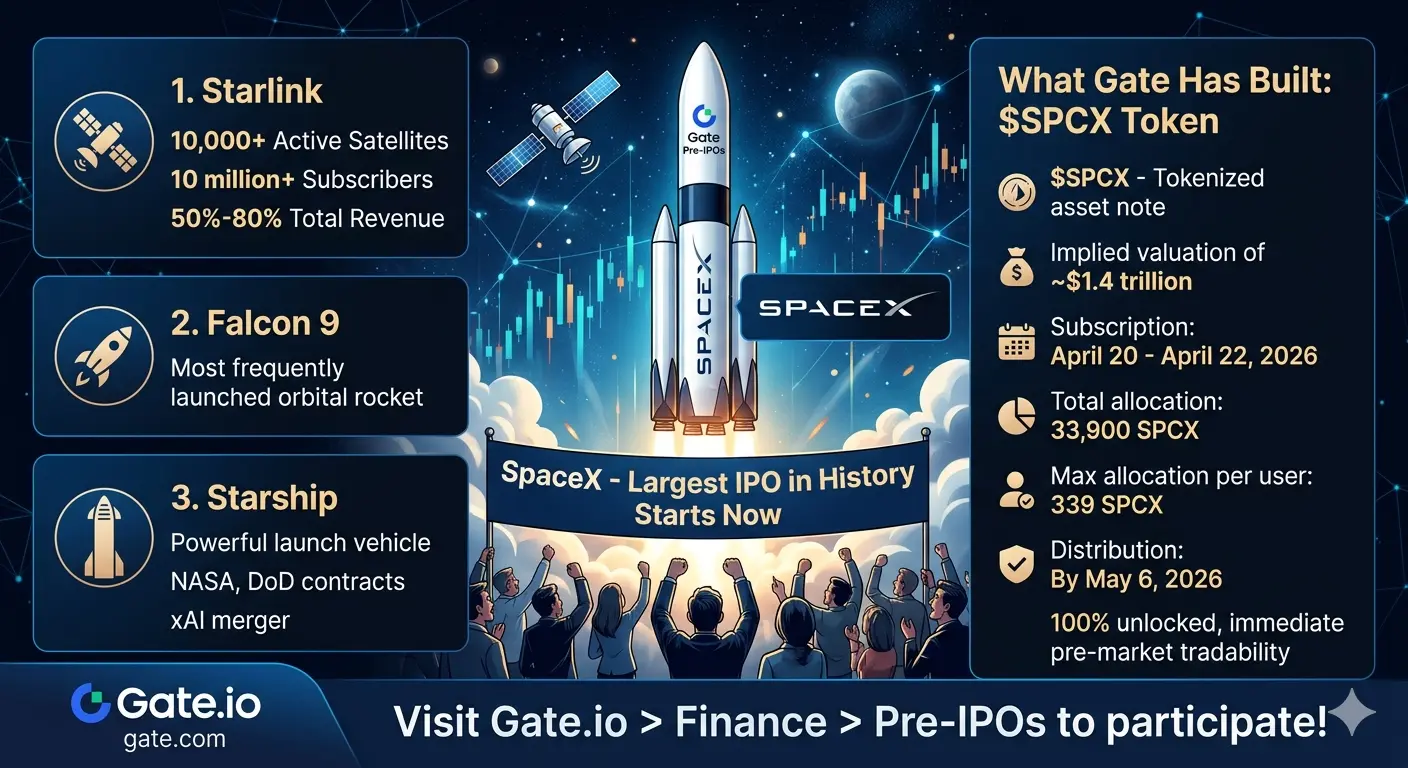
SpaceX is no longer a speculative aerospace startup. It is a mature, revenue-generating conglomerate operating across three distinct but interconnected pillars. Starlink, the satellite internet division, currently operates over 10,000 active satellites in low-Earth orbit and serves over 10 million subscribers globally. Starlink alone accounts for an estimated 50% to 80% of SpaceX's total revenue and is the primary driver of the $2 trillion valuation thesis. It has secured contracts under the U.S. government's Broadband Equity, Access and Deployment program to deliver service to 476,000 American locations, and its Starlink Mobile product is being positioned as a complement to terrestrial wireless networks — meaning its addressable market is not just rural broadband but urban mobile. Falcon 9 remains the most frequently launched orbital rocket in history, generating consistent revenue from commercial and government contracts. Starship, the most powerful launch vehicle ever constructed, is under active development with NASA, the Department of Defense, and private customers already in the pipeline. In February 2026, SpaceX merged with xAI, further expanding its footprint into artificial intelligence infrastructure. The combined entity is raising between $50 billion and $75 billion in the IPO — a number that reflects not ambition but current institutional appetite. This is not a company pitching a future. It is a company monetizing one.
What Gate Has Built: The Pre-IPOs Product
Gate's Pre-IPOs platform introduces $SPCX — a tokenized asset note that provides economic exposure to SpaceX's pre-IPO valuation. This is not a direct equity stake. It does not confer voting rights or dividends. What it does provide is structured, crypto-native exposure to SpaceX's valuation trajectory, with a clean unlock schedule, immediate pre-market tradability, and exit options both before and after the IPO. The mechanics are precise and worth understanding in full.
Subscription opens April 20, 2026, at 10:00 AM UTC and closes April 22, 2026, at 10:00 AM UTC — a 48-hour window. Total allocation is 33,900 SPCX tokens, each priced at $590. The total pool value is approximately $20 million. Subscriptions are accepted in USDT, which draws from a 70% allocation pool, and GUSD, which draws from a separate 30% pool with potential additional stable yield incentives for GUSD holders. Allocation is determined by a time-weighted mechanism based on your average hourly locked amount during the subscription period — meaning participants who commit earlier and hold longer receive priority. The maximum allocation per user is capped at 339 SPCX. All distributed tokens are 100% unlocked upon receipt — no vesting, no cliffs, no multi-month drip that leaves you holding an illiquid position during a moving market. Distribution is completed by May 6, 2026, at 10:00 AM UTC. From the moment of distribution, $SPCX supports 24/7 pre-market trading, transfers, and two exit paths: convert to a stock token post-IPO, or redeem for USDT at any point. At the $590 subscription price, the implied SpaceX valuation through $SPCX is approximately $1.4 trillion — a material discount relative to the $1.75 trillion to $2 trillion range currently being floated in institutional roadshow discussions. That discount represents the pre-IPO risk premium built into the product structure. It rewards participants who are willing to take on price discovery risk ahead of the listing date. VIP 5 and above users, along with Affiliate Ultras, are eligible for additional free airdrop allocations on top of their subscription — a structural advantage that meaningfully reduces the effective cost basis for qualifying participants. Gate's perpetual contract product — SPACEXUSDT USDT-M, with 1x to 10x leverage — is already live on Gate Stocks for those seeking derivative exposure rather than token ownership.
Why This Matters Beyond the Product
The Pre-IPOs launch with SpaceX is a statement about where the infrastructure of global capital allocation is moving. Pre-IPO investment has historically been the exclusive domain of institutional investors, venture capital funds, family offices, and accredited participants with relationships inside private placement networks. The barriers were not just financial — they were structural. Minimum ticket sizes, accreditation requirements, geographic restrictions, opacity around pricing, and multi-year lockup periods made meaningful retail participation functionally impossible in virtually every significant private company offering of the past decade. Gate has removed those barriers with a product that is accessible with USDT, priced transparently, fully liquid at distribution, and available to any verified user on the platform. The precedent this sets is important. If Gate builds a credible track record starting with SpaceX — the single highest-profile pre-IPO opportunity in the current market cycle — the pipeline of future Pre-IPO products becomes highly compelling. OpenAI is also preparing for a public listing. Other high-valuation private companies in AI, defense tech, and space infrastructure are on similar trajectories. A retail-accessible, crypto-native pre-IPO infrastructure layer, validated by the SpaceX debut, positions Gate at the intersection of traditional capital markets and crypto-native settlement in a way that very few exchanges globally are currently equipped to execute.
How to Participate
Navigate to gate.com, go to Finance, and select Pre-IPOs. Lock USDT or GUSD during the April 20 to April 22 subscription window. The time-weighted allocation mechanism means early commitment matters — do not wait until the final hours of the window if you want to maximize your position. Distribution completes by May 6. Pre-market trading begins immediately after distribution. You can hold through the IPO, convert to a stock token, or exit to USDT at any point based on your view of where SpaceX's public market valuation lands relative to the $590 entry price.
Risk Considerations
Pre-IPO instruments carry a category of risk that is structurally different from spot crypto or perpetual contracts. SpaceX has not yet priced its IPO. Its valuation target of $2 trillion is based on institutional discussions, not a final book-built price. The IPO timeline could shift. Macro conditions — including the ongoing pressure from the 2026 U.S.-Israeli conflict's impact on global oil markets and the broader IPO environment — have already caused Q1 2026 IPO volume to drop significantly. Regulatory scrutiny in both the aerospace and securities sectors remains a live variable. The SPCX token structure introduces platform and settlement risks distinct from traditional equity pre-IPO participation. None of these risks mean the opportunity should be dismissed. They mean participants should enter with a clear thesis, a defined position size, and an understanding of the exit mechanics available to them. The best outcomes in pre-IPO markets belong to participants who have done the fundamental work, not those who are allocating purely on narrative momentum.
The largest IPO in financial history is 60 days away. The subscription window on Gate opens in four days. The allocation is finite. The structure is transparent. The rest is your decision.
repost-content-media
  • Reward
  • Comment
  • Repost
  • Share
  • Pin