Mr_Randhawa

vip
Age 0 Yıl
Peak Tier 0
No content yet
#GateSquareAprilPostingChallenge
Deep Market Analysis, Trading Psychology & Smart Money Strategy Guide (April 2026)
The crypto market is once again entering a phase of uncertainty, opportunity, and transformation. April 2026 is not just another month—it is a battlefield of narratives, liquidity movements, institutional positioning, and retail emotions. If you truly want to win in this environment, you must go beyond surface-level analysis and start thinking like smart money.
This post is a complete deep-dive analysis of the current market structure, Bitcoin behavior, altcoin rotation, macro i
BTC0,7%
DEFI2,68%
Vortex_Kingvip
#GateSquareAprilPostingChallenge
Deep Market Analysis, Trading Psychology & Smart Money Strategy Guide (April 2026)
The crypto market is once again entering a phase of uncertainty, opportunity, and transformation. April 2026 is not just another month—it is a battlefield of narratives, liquidity movements, institutional positioning, and retail emotions. If you truly want to win in this environment, you must go beyond surface-level analysis and start thinking like smart money.
This post is a complete deep-dive analysis of the current market structure, Bitcoin behavior, altcoin rotation, macro influence, and advanced trading strategies that can help you survive and dominate the market.
1. Current Market Overview — Calm Before Expansion or Hidden Distribution?
The market right now is not clearly bullish or bearish. It is transitional.
Bitcoin is showing:
Periods of low volatility
Sudden spikes in liquidity grabs
Fake breakouts and breakdowns
This is a classic accumulation or distribution phase depending on higher timeframe confirmation.
Key Observations:
Liquidity is being engineered above highs and below lows
Retail traders are getting trapped in both directions
Large players are slowly positioning
This phase is dangerous for emotional traders but extremely profitable for those who understand structure.
2. Bitcoin Deep Analysis — The King Still Controls Everything
Bitcoin remains the heartbeat of the crypto market. Every altcoin move is still dependent on BTC direction.
Market Structure:
Higher timeframe: Neutral to slightly bullish
Mid timeframe: Range-bound
Lower timeframe: Highly volatile
Key Levels:
Resistance: Previous highs where liquidity sits
Support: Strong demand zones with unfilled orders
Smart money is doing three main things:
Creating fake breakouts
Inducing retail entries
Reversing price aggressively
This is called liquidity engineering.
3. Smart Money Concepts (ICT) — The Real Edge
To win in this market, you must understand how institutions think.
Core Concepts:
1. Liquidity Pools
These exist:
Above equal highs
Below equal lows
At obvious support/resistance
Price is attracted to liquidity like a magnet.
2. Order Blocks
These are zones where institutions place large orders.
Bullish order block → potential buy zone
Bearish order block → potential sell zone
3. Fair Value Gaps (FVG)
These are inefficiencies in price where the market tends to return.
They act as:
Entry zones
Continuation signals
4. High-Probability BTC Trading Setup
Here is a powerful setup used by professional traders:
Setup: Liquidity Sweep + Market Structure Shift
Step-by-step:
Identify equal highs or lows
Wait for price to sweep that liquidity
Look for a break of structure (BOS)
Enter on retracement to FVG or order block
Example Trade:
Entry: After liquidity sweep and confirmation
Stop Loss: Above/Below the sweep
Take Profit:
TP1: Nearest liquidity zone
TP2: Opposite range boundary
This setup filters out fake moves and aligns you with smart money.
5. Altcoin Market — Silent Opportunities
While Bitcoin is ranging, altcoins are quietly preparing for explosive moves.
Key Observations:
Many altcoins are at strong support
Volume is slowly increasing
Narratives are forming (AI, DeFi, RWA)
Strategy:
Accumulate during fear
Avoid chasing pumps
Focus on strong projects
Altcoins follow this cycle:
Accumulation
Expansion
Distribution
Collapse
Right now, many are in early accumulation.
6. Market Psychology — The Real Battle
Most traders lose not because of bad strategy, but because of bad psychology.
Common Mistakes:
Entering late (FOMO)
Exiting early (fear)
Overtrading
Ignoring risk management
Winning Mindset:
Think in probabilities, not certainty
Accept losses as part of the game
Focus on consistency
The market is designed to:
Trigger your emotions
Force bad decisions
Transfer money from impatient to patient traders
7. Risk Management — The Survival Weapon
Without risk management, even the best strategy will fail.
Golden Rules:
Risk only 1–2% per trade
Always use stop loss
Never revenge trade
Position Sizing:
Your trade size should depend on:
Account size
Stop loss distance
Risk tolerance
This ensures long-term survival.
8. Macro Influence — The Hidden Driver
Crypto does not move in isolation. It is heavily influenced by global events.
Key Factors:
Interest rates
Inflation
War tensions
Oil prices
When uncertainty rises:
Markets become volatile
Liquidity moves faster
Risk assets react sharply
Understanding macro helps you stay ahead.
9. Volatility Strategy — How to Trade Uncertain Markets
In volatile conditions, normal strategies fail. You need adaptive systems.
Strategy: Range Trading + Breakout Confirmation
In Range:
Buy at support
Sell at resistance
On Breakout:
Wait for confirmation
Avoid instant entries
Look for retest
This reduces false signals.
10. Chart-Based Visual Trading Guide (Conceptual)
Imagine this structure:
Price forms equal highs
Breaks above (liquidity grab)
Drops aggressively
Forms bearish structure
This is a trap for breakout traders.
Smart traders:
Wait
Observe
Enter after confirmation
11. Future Outlook — What Comes Next?
The market is preparing for a big move.
Two Possible Scenarios:
Bullish Case:
BTC breaks resistance
Strong volume follows
Altcoins explode
Bearish Case:
BTC fails at resistance
Drops to sweep lower liquidity
Panic selling occurs
Most Likely:
A liquidity sweep on both sides before real direction.
12. Final Strategy Blueprint
To succeed in April 2026:
Follow This System:
Identify liquidity
Wait for sweep
Confirm structure shift
Enter with discipline
Manage risk strictly
Avoid:
Random trades
Emotional decisions
Over-leverage
Conclusion
The crypto market is not random. It is a carefully engineered system driven by liquidity, psychology, and institutional behavior.
If you:
Understand smart money concepts
Control your emotions
Apply risk management
You can turn uncertainty into opportunity.
April 2026 is not just another trading period—it is a test of discipline, patience, and intelligence.
Those who adapt will win. Those who chase will lose.
Stay sharp. Stay patient. Trade like smart money.
VORTEX KING
VORTEX KING

repost-content-media
  • Reward
  • 2
  • Repost
  • Share
CryptoDiscoveryvip:
To The Moon 🌕
View More
#GateSquareAprilPostingChallenge
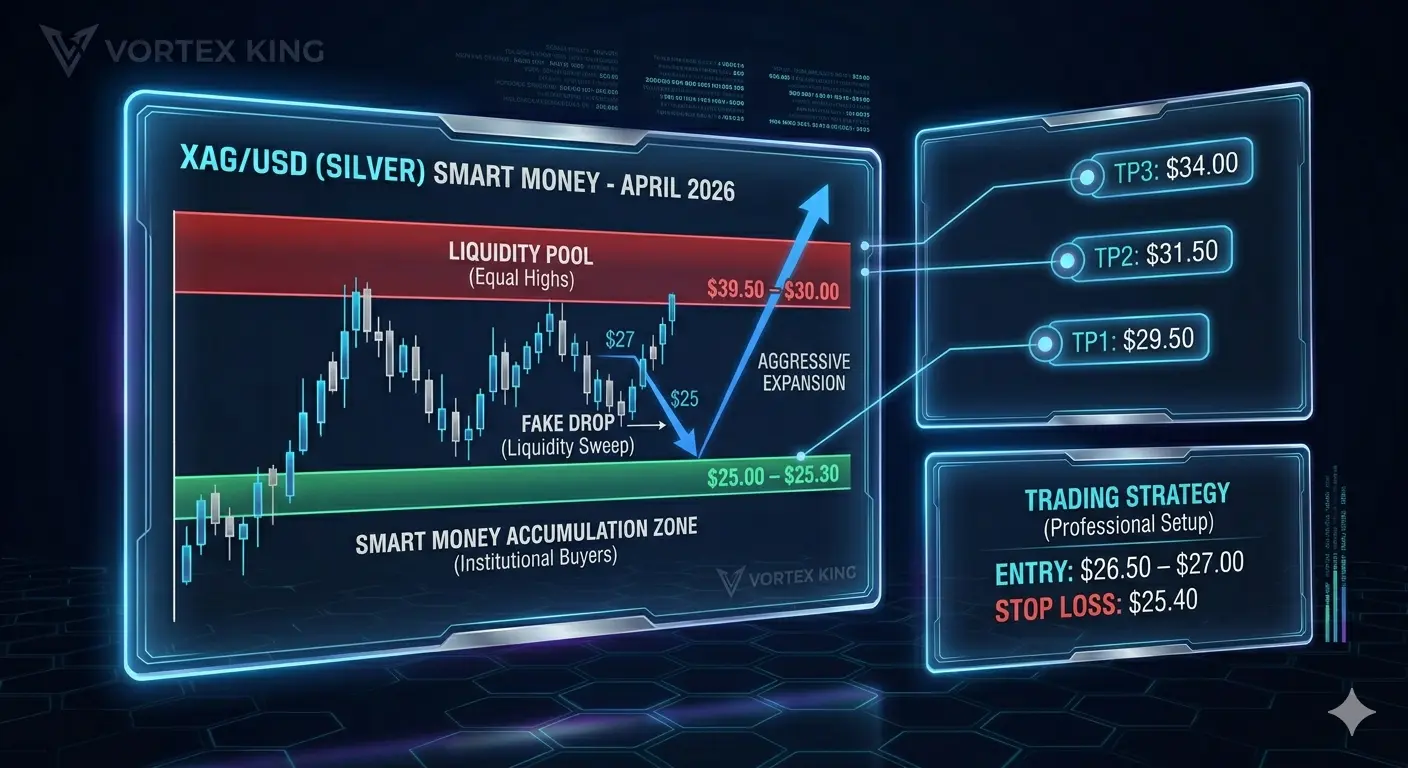
🪙 Silver (XAG/USD) Market Analysis — April 2026
Silver is one of the most dynamic assets in the global financial market. It sits at the intersection of precious metals, industrial demand, inflation hedging, and speculative trading. In April 2026, silver is experiencing a highly sensitive phase driven by macroeconomic uncertainty, monetary policy expectations, and global geopolitical tensions.
📊 Current Price Situation
As of early April 2026:
Silver Price (XAG/USD): ≈ $27 – $29 per ounce
Market structure: Sideways to slightly bullish consolidation
Volatility:
Vortex_Kingvip
#GateSquareAprilPostingChallenge
🪙 Silver (XAG/USD) Market Analysis — April 2026
Silver is one of the most dynamic assets in the global financial market. It sits at the intersection of precious metals, industrial demand, inflation hedging, and speculative trading. In April 2026, silver is experiencing a highly sensitive phase driven by macroeconomic uncertainty, monetary policy expectations, and global geopolitical tensions.
📊 Current Price Situation
As of early April 2026:
Silver Price (XAG/USD): ≈ $27 – $29 per ounce
Market structure: Sideways to slightly bullish consolidation
Volatility: Moderate but expanding
👉 Silver has recently rebounded from lower levels near $25 and is now testing upper resistance zones. The market is in a compression phase, which often leads to a strong breakout.
📉 Technical Structure Overview
🔹 Trend Analysis
Short-term (1D – 4H): Bullish consolidation
Mid-term (1W): Range-bound
Long-term: Gradual uptrend since 2023 lows
Silver is forming a base structure, indicating accumulation by institutional players.
📊 Key Support Levels
Support levels are critical zones where buyers step in:
🟢 Strong Support Zones:
$26.00 – $26.50
Major demand zone
Previous breakout retest area
$25.00 – $25.30
Psychological + structural support
High liquidity zone
$23.80 – $24.20
Long-term support
Smart money accumulation zone
👉 If price drops into these zones, expect buying pressure and reversals.
📈 Key Resistance Levels
Resistance zones where selling pressure appears:
🔴 Major Resistance Levels:
$29.50 – $30.00
Strong psychological resistance
Previous rejection area
$31.20 – $32.00
Breakout zone from 2021–2022 highs
$34.50+
Long-term macro resistance
Potential bull cycle expansion target
👉 A clean breakout above $30 can trigger a strong bullish rally.
🧠 Smart Money (ICT) Perspective
From an institutional trading viewpoint:
🔍 Liquidity Zones:
Equal highs near $30 → liquidity pool
Equal lows near $25 → stop hunt zone
💡 Market Behavior:
Price is likely to:
Sweep liquidity below $26 (fake drop)
Then push upward aggressively
👉 This is classic accumulation → manipulation → expansion cycle
🌍 Fundamental Analysis
Silver is not just a metal—it’s a hybrid asset influenced by multiple sectors:
🏦 1. Interest Rates & US Dollar
When interest rates fall → silver rises
Weak USD → bullish for silver
Current situation:
Markets expect rate cuts in 2026
USD showing signs of weakness
👉 This supports bullish silver outlook
⚡ 2. Industrial Demand
Silver is heavily used in:
Solar panels ☀️
Electric vehicles 🚗
Electronics 📱
Green energy expansion is boosting long-term demand.
👉 Industrial demand = strong fundamental backbone
🛢️ 3. Geopolitical Tensions
War and instability increase safe-haven demand.
Silver benefits alongside gold
Investors shift to metals during uncertainty
👉 Current global instability = bullish factor
📉 4. Inflation Hedge
Silver acts as protection against:
Currency devaluation
Inflation spikes
👉 With ongoing inflation concerns, silver remains attractive.
📊 Market Sentiment
🟢 Bullish Factors:
Weak USD
Rate cut expectations
Industrial demand growth
Institutional accumulation
🔴 Bearish Risks:
Strong USD rebound
Economic slowdown reducing industrial demand
Rejection at $30 resistance
🔮 Price Scenarios (Next Move)
🟢 Bullish Scenario
If silver breaks $30:
Target 1: $31.50
Target 2: $33.00
Target 3: $35.00+
👉 Momentum-driven rally likely
🔴 Bearish Scenario
If silver fails at resistance:
Drop to: $26.50
Possible deeper pullback: $25.00
👉 This would be a liquidity grab before upside
📊 Trading Strategy (Professional Setup)
📈 Buy Setup (Preferred)
Entry: $26.50 – $27.00
Stop Loss: $25.40
Take Profit:
TP1: $29.50
TP2: $31.50
TP3: $34.00
📉 Sell Setup (Counter-Trend)
Entry: $29.50 – $30.00
Stop Loss: $31.20
Take Profit:
TP1: $27.50
TP2: $26.00
🧩 Market Psychology
Retail traders:
Often sell at support
Buy at resistance
Institutions:
Do the opposite
👉 Current structure suggests:
Smart money accumulating below $28
Retail traders trapped in range
🧠 Deep Insight: Why Silver Moves Differently Than Gold
Factor
Silver
Gold
Volatility
High
Moderate
Industrial Use
High
Low
Speculation
High
Medium
Safe Haven
Medium
Very High
👉 Silver = Gold + Technology Demand
🚀 Long-Term Outlook (2026–2028)
Silver could enter a super cycle due to:
Green energy expansion
Supply shortages
Inflation persistence
📊 Long-Term Targets:
$35 (mid-term)
$40+ (bull cycle)
Extreme scenario: $50
⚠️ Risk Management
Always remember:
Silver is highly volatile
Fake breakouts are common
News-driven spikes can trap traders
👉 Use:
Proper stop-loss
Position sizing
Confirmation entries
🧾 Final Summary
Current Price: $27–$29
Trend: Bullish consolidation
Strong Support: $26 / $25
Resistance: $30 / $32
Outlook: Bullish if breakout happens
🏁 Final Verdict
Silver is currently in a high-probability accumulation phase. The market is preparing for a major move, and all signs suggest that upside potential outweighs downside risk in the medium term.
However, patience is key.
https://www.gate.com/announcements/article/50520
👉 The real move begins after breakout above $30
repost-content-media
  • Reward
  • Comment
  • Repost
  • Share
#GateSquareAprilPostingChallenge
🚀 Gate Square April Posting Challenge is highlighting a major shift in the digital world, where content creation, community engagement, and incentive-based participation are coming together to form what can be described as a new attention-driven economy. This model encourages users to create and share valuable content while earning rewards through meaningful engagement, signaling a move away from traditional social media systems where creators were rarely compensated directly. Instead, this emerging approach focuses on a simple idea: post, engage, and earn. I
post-image
  • Reward
  • Comment
  • Repost
  • Share
#GateSquareAprilPostingChallenge
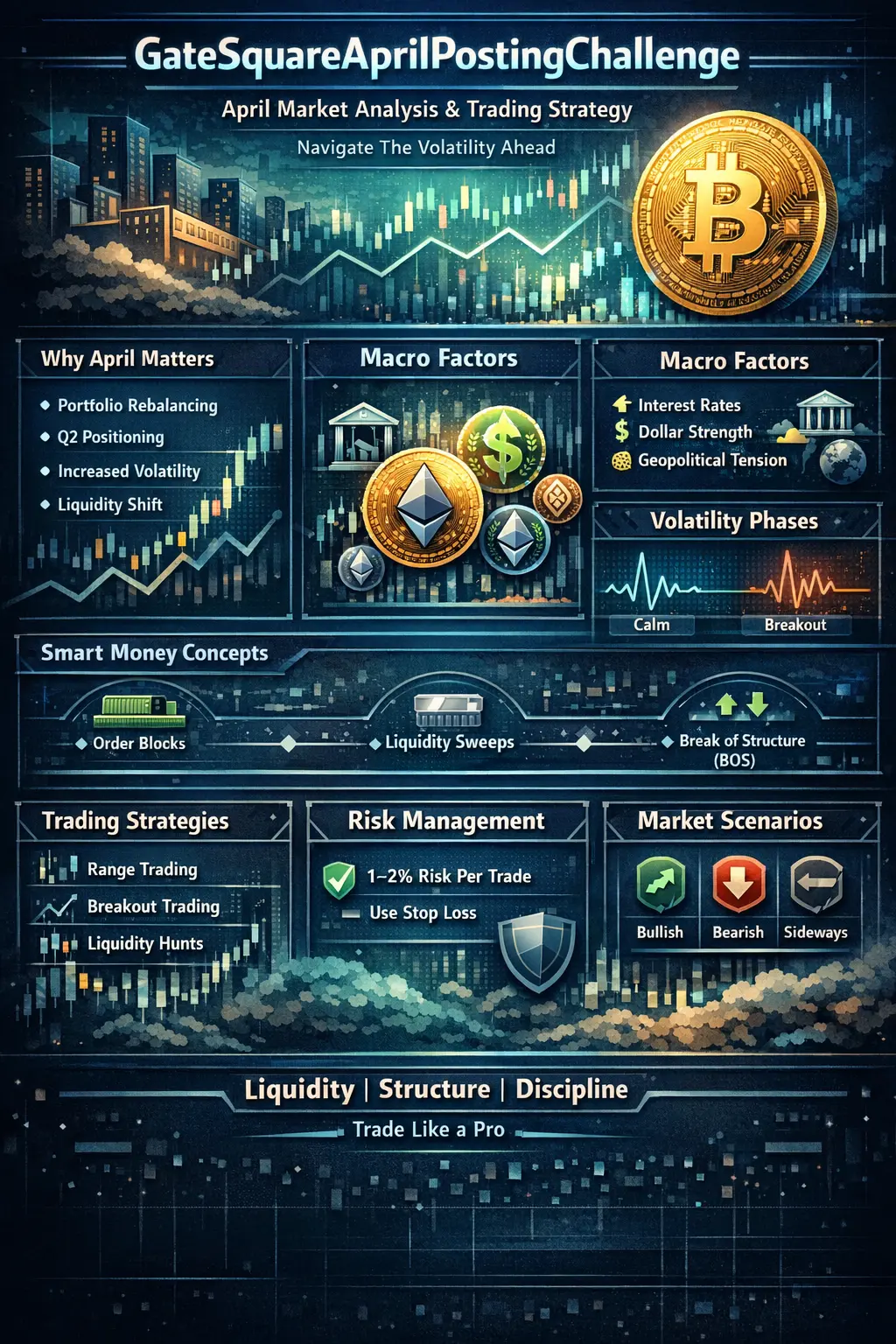
Deep Market Insight & High-Quality Gate Style Analysis
The crypto market is entering one of the most critical phases of 2026. Volatility is rising, liquidity is shifting, and narratives are changing faster than ever. In this environment, understanding structure—not just price—is the difference between consistent profit and emotional trading.
This post is designed as a Gate Square elite-level analysis, focusing on market structure, volatility behavior, macro influence, and actionable trading frameworks.
1. Market Psychology: Why April Matters
April has historic
BTC0,7%
ETH0,13%
Vortex_Kingvip
#GateSquareAprilPostingChallenge
Deep Market Insight & High-Quality Gate Style Analysis
The crypto market is entering one of the most critical phases of 2026. Volatility is rising, liquidity is shifting, and narratives are changing faster than ever. In this environment, understanding structure—not just price—is the difference between consistent profit and emotional trading.
This post is designed as a Gate Square elite-level analysis, focusing on market structure, volatility behavior, macro influence, and actionable trading frameworks.
1. Market Psychology: Why April Matters
April has historically been a transition month in financial markets. It sits between Q1 closing and new quarterly positioning by institutions.
During this period:
Portfolio rebalancing increases
Institutional capital reallocates
Market narratives reset
Liquidity shifts from weak hands to strong hands
For crypto specifically, April tends to reflect:
Post-Q1 profit-taking
Early positioning for Q2 narratives
Increased volatility due to low conviction zones
This makes April a “decision month”—where the market chooses direction.
2. Macro Environment Driving Crypto
Crypto does not move in isolation. The following macro factors are currently shaping market behavior:
2.1 Interest Rate Expectations
Central banks continue to control liquidity. When interest rates stay high:
Risk assets become less attractive
Capital moves to safer yields
Crypto faces pressure
When rates stabilize or decrease:
Liquidity flows back into crypto
Altcoins outperform
Risk appetite increases
2.2 Dollar Strength vs Weakness
A strong US dollar typically leads to:
Crypto corrections
Capital exiting risk assets
A weak dollar leads to:
BTC rallies
Increased altcoin speculation
2.3 Geopolitical Tension
Global instability often causes:
Short-term market fear
Sudden liquidity flushes
Safe-haven rotation
Interestingly, after panic events:
Crypto often rebounds strongly
Smart money accumulates at discounted levels
3. Bitcoin Market Structure
Bitcoin remains the core driver of the entire crypto ecosystem.
3.1 Key Structure Observations
Higher highs + higher lows = bullish trend
Lower highs + lower lows = bearish trend
Consolidation = accumulation or distribution
Currently, Bitcoin is in a volatile accumulation-distribution phase.
3.2 Liquidity Zones
The most important concept in modern trading is liquidity hunting.
Bitcoin tends to:
Sweep highs → trigger buy stop orders → reverse
Sweep lows → trigger sell stop orders → reverse
Smart traders watch for:
Equal highs (buy liquidity)
Equal lows (sell liquidity)
These are often targets before reversal.
3.3 Institutional Behavior
Institutions do not chase price. They:
Accumulate during fear
Distribute during euphoria
Watch for:
Low volatility before breakout
Sudden volume spikes
Fake breakouts (liquidity grabs)
4. Ethereum and Altcoin Behavior
Ethereum acts as a bridge between BTC dominance and altcoin expansion.
When Ethereum outperforms BTC:
Altcoins follow
Risk appetite increases
When BTC dominance rises:
Altcoins underperform
Liquidity flows into BTC
Altcoin Cycle Phases
BTC pumps first
ETH starts to follow
Large-cap altcoins rise
Mid-cap altcoins explode
Small caps enter mania phase
Understanding this rotation is critical for maximizing profits.
5. Volatility: The Engine of Profit
Volatility is not risk—it is opportunity.
Markets move in cycles of:
Compression (low volatility)
Expansion (high volatility)
5.1 Compression Phase
Tight price range
Low volume
Market indecision
This phase builds energy for a move.
5.2 Expansion Phase
Strong directional move
High volume
Break of structure
This is where most profits are made.
Trading Insight:
“Volatility precedes opportunity. Smart traders wait for compression, then act during expansion.”
6. Smart Money Concepts (SMC)
Modern trading revolves around understanding how smart money operates.
6.1 Order Blocks
These are areas where institutions previously:
Bought heavily (bullish order block)
Sold heavily (bearish order block)
Price often revisits these zones before continuing direction.
6.2 Break of Structure (BOS)
A break of structure confirms:
Trend continuation or reversal
If price breaks a key high:
Bullish trend confirmed
If price breaks a key low:
Bearish trend confirmed
6.3 Liquidity Sweeps
Markets often:
Move against retail traders
Trigger stop losses
Then reverse sharply
This is intentional.
7. Trading Strategy for April Market
Here is a structured approach for trading this environment:
Strategy 1: Range Trading (Low Volatility)
When the market is consolidating:
Buy near support
Sell near resistance
Avoid breakout chasing
Strategy 2: Breakout Trading (High Volatility)
When volatility expands:
Enter after breakout confirmation
Avoid early entries
Wait for retest
Strategy 3: Liquidity Hunting Setup
Steps:
Identify equal highs/lows
Wait for liquidity sweep
Enter reversal after confirmation
Strategy 4: Trend Following
Identify market trend
Trade pullbacks
Avoid counter-trend trades
8. Risk Management (Most Important Section)
Without risk management, no strategy works.
Golden Rules:
Risk only 1–2% per trade
Never over-leverage
Always use stop-loss
Protect capital first
Position Sizing Formula:
Risk = Account Size × Risk %
Example:
$1000 account
1% risk = $10 per trade
9. Emotional Control in Trading
Most traders fail not due to strategy—but psychology.
Common Mistakes:
Overtrading
Revenge trading
FOMO entries
Ignoring stop-loss
Professional Mindset:
Think in probabilities
Accept losses as part of the game
Focus on consistency, not wins
10. Market Scenarios for April
Bullish Scenario:
BTC holds support
Breaks resistance with volume
Altcoins rally strongly
Bearish Scenario:
BTC loses key support
Liquidity cascade occurs
Altcoins dump heavily
Sideways Scenario:
Tight consolidation
Low volatility
Market waiting for catalyst
11. Key Takeaways
April is a decision month
Liquidity drives price, not emotions
BTC dominates market direction
Volatility creates opportunity
Risk m
anagement is non-negotiable
Final Thoughts
The market is not random—it is structured.
Understanding:
Liquidity
Market structure
Volatility cycles
Institutional behavior
gives you a major edge.
Most traders focus on indicators.
Professionals focus on price action + liquidity.
Stay patient. Stay disciplined.
Let the market come to you.
all DETAILS ARE HERE
https://www.gate.com/announcements/article/50520
repost-content-media
  • Reward
  • Comment
  • Repost
  • Share
#GateSquareAprilPostingChallenge
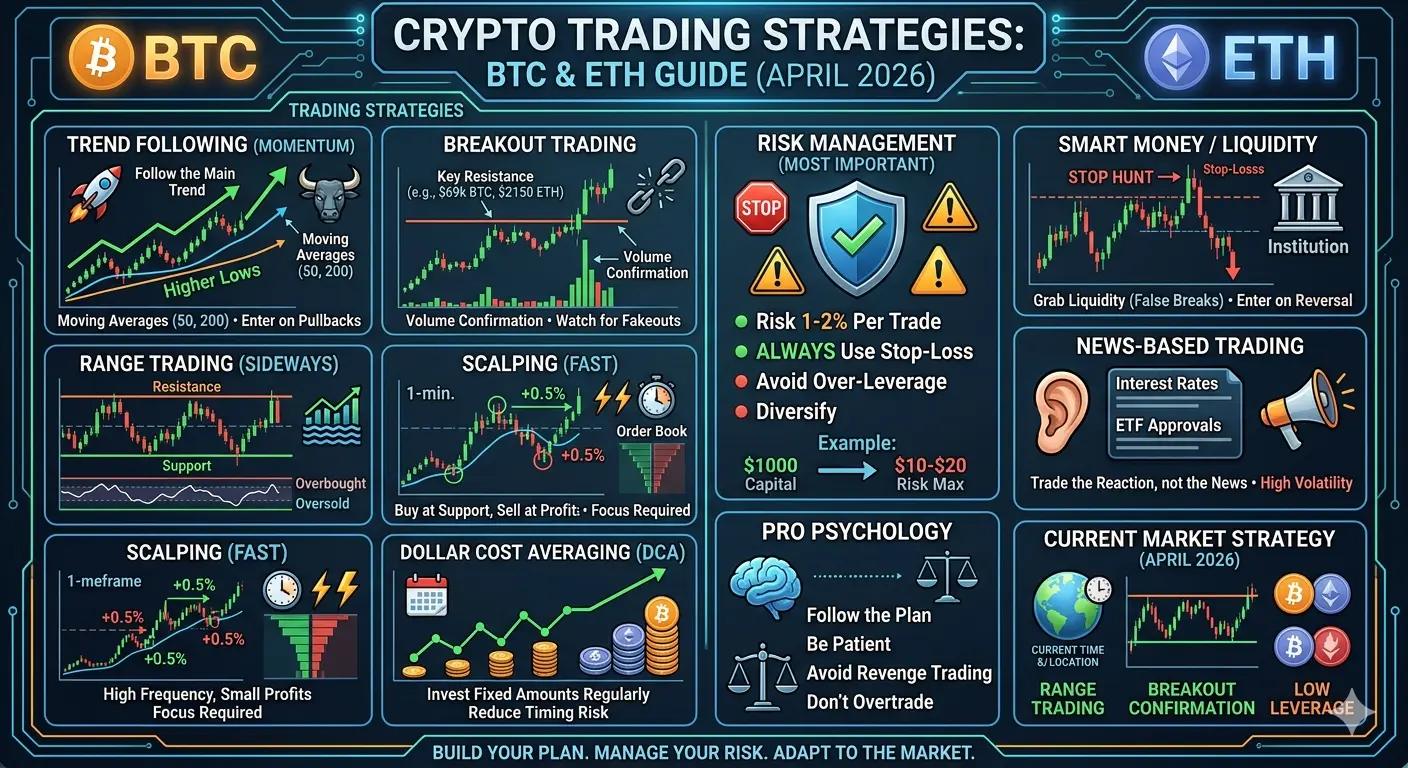
📊 Crypto Trading Strategies (BTC & ETH Focus)
🧠 1. Trend Following Strategy (Momentum Trading)
This is one of the most widely used strategies in crypto.
🔹 Concept:
“The trend is your friend”
Trade in the direction of the main market trend
🔹 How to Use:
Identify trend using:
Higher highs & higher lows → uptrend
Lower highs & lower lows → downtrend
Enter on pullbacks, not at peaks
🔹 Indicators:
Moving averages (50, 100, 200)
Trendlines
MACD
🔹 Example:
If Bitcoin (BTC) is trending upward and pulls back to support → buy the dip
If Ethereum (ETH) breaks resis
BTC0,7%
ETH0,13%
Vortex_Kingvip
#GateSquareAprilPostingChallenge
📊 Crypto Trading Strategies (BTC & ETH Focus)
🧠 1. Trend Following Strategy (Momentum Trading)
This is one of the most widely used strategies in crypto.
🔹 Concept:
“The trend is your friend”
Trade in the direction of the main market trend
🔹 How to Use:
Identify trend using:
Higher highs & higher lows → uptrend
Lower highs & lower lows → downtrend
Enter on pullbacks, not at peaks
🔹 Indicators:
Moving averages (50, 100, 200)
Trendlines
MACD
🔹 Example:
If Bitcoin (BTC) is trending upward and pulls back to support → buy the dip
If Ethereum (ETH) breaks resistance → follow breakout
🔹 Best For:
Swing traders
Medium-term traders
Strong trending markets
⚡ 2. Breakout Trading Strategy
🔹 Concept:
Trade when price breaks a key support or resistance level
🔹 How It Works:
Identify strong resistance (e.g., BTC near $69,000)
Wait for a confirmed breakout
Enter after breakout with volume confirmation
🔹 Key Tools:
Volume spikes
Bollinger Bands
Resistance zones
🔹 Example:
BTC breaks above resistance → bullish momentum may accelerate
ETH breaks above $2,150 → potential continuation move
🔹 Risk:
Fake breakouts (fakeouts) are common
Always use stop-loss
🔁 3. Range Trading Strategy (Sideways Markets)
🔹 Concept:
Trade between support and resistance when the market is not trending
🔹 How It Works:
Buy near support
Sell near resistance
🔹 Example:
BTC moving between $64k–$72k
ETH moving between $1,900–$2,200
🔹 Indicators:
RSI (overbought/oversold)
Support/resistance zones
🔹 Best For:
Low volatility markets
Experienced traders
📉 4. Short Selling Strategy (Bear Market)
🔹 Concept:
Profit when price goes down
🔹 How It Works:
Sell high → buy back lower
🔹 Example:
If BTC fails resistance → short the market
If ETH breaks support → bearish continuation
🔹 Indicators:
Bearish divergence
Downtrend confirmation
🔹 Risk:
Unlimited loss if price rises
Use strict stop-loss
💰 5. Scalping Strategy (Fast Trading)
🔹 Concept:
Make small profits from quick trades
🔹 Characteristics:
Very short timeframes (1–5 minutes)
Multiple trades per day
Small profit targets
🔹 Tools:
RSI
Order book
Support/resistance micro-levels
🔹 Example:
Enter trade on small dip
Exit after 0.5%–1% profit
🔹 Best For:
Active traders
High focus required
⏳ 6. Swing Trading Strategy
🔹 Concept:
Hold trades for several days to weeks
🔹 How It Works:
Enter at support
Exit at resistance
🔹 Example:
Buy BTC during dip
Hold until next resistance zone
🔹 Tools:
Daily & 4H charts
Moving averages
Trend structure
🔹 Best For:
Part-time traders
Lower stress strategy
📈 7. Dollar Cost Averaging (DCA)
🔹 Concept:
Invest fixed amounts regularly regardless of price
🔹 How It Works:
Buy BTC or ETH weekly/monthly
Smooth out volatility
🔹 Example:
Invest $100 every week in BTC
🔹 Benefits:
Reduces timing risk
Ideal for long-term holders
🧠 8. Smart Money / Liquidity Strategy
🔹 Concept:
Follow where big players (institutions) move the market
🔹 Key Idea:
Markets move to grab liquidity (stop-loss hunting)
🔹 How to Use:
Identify liquidity zones:
Above resistance
Below support
Wait for fake moves, then enter
🔹 Example:
BTC spikes above resistance → triggers stop-losses → then drops
Smart traders short at liquidity traps
📊 9. News-Based Trading
🔹 Concept:
Trade based on market-moving news
🔹 Examples:
Interest rate decisions
ETF approvals
Geopolitical events
🔹 Strategy:
Trade the reaction, not the news itself
Markets often overreact first
🔹 Risk:
High volatility
Requires experience
🧩 10. Multi-Timeframe Strategy
🔹 Concept:
Analyze multiple timeframes before entering
🔹 How It Works:
Daily chart → trend
4H chart → structure
1H/15M → entry
🔹 Benefit:
Reduces false signals
Improves accuracy
⚖️ Risk Management (MOST IMPORTANT)
No strategy works without risk control.
🔹 Rules:
Never risk more than 1–2% per trade
Always use stop-loss
Avoid over-leveraging
Diversify trades
🔹 Example:
If your capital is $1000:
Risk per trade = $10–$20 max
🧠 Pro Trading Psychology
Avoid revenge trading
Follow your plan strictly
Don’t overtrade
Be patient — good setups come to you
📌 Best Strategy Combination (Recommended)
For BTC & ETH traders:
👉 Trend Following + Breakout + Risk Management
This combination:
Captures big moves
Reduces fake trades
Works in most market conditions
🔮 Current Market Strategy (April 2026 Context)
Based on current conditions:
Market is range-bound with volatility
BTC → neutral bias
ETH → slightly stronger
👉 Best Strategy Right Now:
Range trading
Breakout confirmation
Low leverage
Short-term cautious trading
📊 Final Takeaway
There is no “perfect” strategy
The best traders adapt to market conditions
Risk management is more important than entry strategy
BTC & ETH require different timing but similar discipline
repost-content-media
  • Reward
  • Comment
  • Repost
  • Share
#Web3SecurityGuide
#Web3SecurityGuide
🔐 Web3 Security Guide — How to Protect Your Crypto in a World Full of Threats
🌍 Introduction: The Reality of Web3 Security
Web3 is powerful. It gives users full control over their assets, identity, and financial freedom. But this power comes with a serious responsibility — you are your own bank.
There is no customer support to reverse transactions. No authority to recover stolen funds. No reset button.
And in 2026, the situation is even more intense:
Hacks are more sophisticated
Scammers are more convincing
Smart contract exploits are increasing
Social
Vortex_Kingvip
#Web3SecurityGuide
#Web3SecurityGuide
🔐 Web3 Security Guide — How to Protect Your Crypto in a World Full of Threats
🌍 Introduction: The Reality of Web3 Security
Web3 is powerful. It gives users full control over their assets, identity, and financial freedom. But this power comes with a serious responsibility — you are your own bank.
There is no customer support to reverse transactions. No authority to recover stolen funds. No reset button.
And in 2026, the situation is even more intense:
Hacks are more sophisticated
Scammers are more convincing
Smart contract exploits are increasing
Social engineering attacks are rising fast
👉 The truth is simple:
Most crypto losses don’t happen because of bad projects — they happen because of poor security habits.
This guide will take you deep into:
Real threats in Web3
How attacks actually happen
Proven protection strategies
Advanced security mindset
⚠️ The Biggest Threats in Web3 Today
1. 🔗 Phishing Attacks (Most Common)
Phishing is the #1 way people lose funds.
Attackers create:
Fake websites (identical to real ones)
Fake airdrops
Fake wallet popups
Fake customer support
👉 You connect your wallet… approve a transaction… and your funds are gone.
Example attack flow:
You click a Twitter/X link
It looks like a legit airdrop
You connect your wallet
You sign a malicious contract
Funds drained instantly
2. 🧠 Social Engineering
This is psychological hacking.
Scammers trick you by:
Pretending to be support agents
Offering “investment opportunities”
Creating urgency (FOMO)
Building trust over time
👉 They don’t hack your wallet.
👉 They hack your mind.
3. 📜 Smart Contract Exploits
Even big projects can have vulnerabilities.
Common issues:
Reentrancy attacks
Flash loan exploits
Logic errors in contracts
Poor audits
👉 Billions of dollars have been lost due to smart contract bugs.
4. 🦠 Malware & Keyloggers
If your device is compromised, nothing is safe.
Malware can:
Capture your keystrokes
Steal seed phrases
Replace wallet addresses
Control your browser
5. 🔓 Private Key & Seed Phrase Exposure
Your seed phrase = your entire wallet.
If someone gets it: 👉 They own everything. No recovery.
Common mistakes:
Saving seed in phone notes
Taking screenshots
Sending via email
Storing in cloud
6. 🧾 Rug Pulls & Fake Projects
Not all threats are technical.
Some projects are designed to:
Gain trust
Build hype
Collect liquidity
Disappear
👉 This is very common in DeFi and meme coins.
🧠 Core Security Principle
👉 In Web3: Trust nothing. Verify everything.
🛡️ Essential Security Practices (Must Follow)
🔐 1. Use Hardware Wallets
Hardware wallets store private keys offline.
Benefits:
Protection from malware
Safer transaction signing
Isolation from internet
👉 If you hold serious funds, this is non-negotiable.
🔑 2. Protect Your Seed Phrase Like Gold
Best practices:
Write it on paper (not digital)
Store in multiple secure locations
Never share with anyone
Never enter on random websites
👉 Even “support teams” should NEVER ask for it.
🌐 3. Verify URLs Carefully
Before connecting wallet:
Check domain spelling
Avoid shortened links
Bookmark official sites
👉 One small typo = total loss.
🧾 4. Read Transactions Before Signing
Many users blindly click “Approve”.
Big mistake.
Check:
Token approvals
Contract permissions
Spending limits
👉 Unlimited approvals are dangerous.
🔍 5. Use Wallet Permission Tools
Regularly revoke access to:
Old dApps
Suspicious contracts
👉 This reduces attack surface.
📱 6. Separate Wallets (Very Important)
Use multiple wallets:
Main Wallet (Cold Storage) → Long-term holdings
Trading Wallet → Daily use
Testing Wallet → New projects
👉 Never mix everything in one wallet.
💻 7. Secure Your Device
Basic but critical:
Use antivirus
Keep software updated
Avoid pirated apps
Don’t install random extensions
📡 8. Avoid Public Wi-Fi
Public networks are risky.
If necessary:
Use VPN
Avoid wallet transactions
🧠 9. Control Your Emotions
Most hacks exploit:
Greed
Fear
Urgency
👉 If something feels rushed or “too good to be true”… it is.
⚔️ Advanced Security Strategies (Pro Level)
🧩 Multi-Signature Wallets
Used by professionals and DAOs.
Requires multiple approvals to execute transactions.
👉 Even if one key is compromised, funds are safe.
🔒 Air-Gapped Systems
Extreme security method:
Dedicated offline device
Never connected to internet
👉 Used by whales and institutions.
🧠 Smart Contract Awareness
Before interacting:
Check audits
Research team
Analyze tokenomics
Look for red flags
🕵️ On-Chain Monitoring
Track:
Wallet activity
Large transfers
Suspicious behavior
👉 Early detection = protection.
📉 Real Lessons from Major Hacks
History teaches everything.
Common patterns:
Lack of audits
Poor access control
Over-trust in systems
Ignoring warning signs
👉 Most hacks were preventable.
🧭 Security Mindset: Think Like a Hacker
Ask yourself:
What if this site is fake?
What permissions am I giving?
What happens if I lose this wallet?
👉 This mindset alone will save you.
🚨 Red Flags You Must Never Ignore
“Guaranteed profits”
“Limited time offer”
Unknown team
No audit reports
Suspicious token approvals
Fake social media accounts
📊 Future of Web3 Security
Security is evolving fast.
Trends in 2026:
AI-based threat detection
Better wallet UX warnings
Decentralized identity systems
On-chain reputation tracking
👉 But attackers are also evolving.
💡 Final Thoughts
Web3 is freedom.
But freedom without security = risk.
👉 The difference between winners and losers in crypto is not just strategy…
👉 It’s security discipline.
🔥 Final Message
Stay alert
Stay educated
Stay disciplined
Because in Web3…
👉 You are your own bank.
You are your own security system.
VORTEX KING 👑
VORTEX KING 🔥
repost-content-media
  • Reward
  • Comment
  • Repost
  • Share
#GoogleQuantumAICryptoRisk
⚠️ Google Quantum AI Warning — Is Crypto in Danger? Full Deep Analysis
🌍 Introduction: A Silent Threat Bigger Than Hacks
In 2026, one of the biggest warnings came not from hackers…
not from regulators…
👉 but from Google Quantum AI
They released research showing:
👉 Future quantum computers may break crypto security faster than expected
This is not hype.
This is not a rumor.
This is a scientific warning backed by real data.
And if you understand this properly…
👉 you will realize this could be the biggest risk in crypto history
🧠 What Di
BTC0,7%
ETH0,13%
Vortex_Kingvip
#GoogleQuantumAICryptoRisk
⚠️ Google Quantum AI Warning — Is Crypto in Danger? Full Deep Analysis
🌍 Introduction: A Silent Threat Bigger Than Hacks
In 2026, one of the biggest warnings came not from hackers…
not from regulators…
👉 but from Google Quantum AI
They released research showing:
👉 Future quantum computers may break crypto security faster than expected
This is not hype.
This is not a rumor.
This is a scientific warning backed by real data.
And if you understand this properly…
👉 you will realize this could be the biggest risk in crypto history
🧠 What Did Google Actually Say?
Let’s break it down in simple English.
Google researchers found:
Crypto security (Bitcoin, Ethereum) uses elliptic curve cryptography (ECC)
Quantum computers can break this using Shor’s algorithm
Earlier, we thought it needed millions of qubits
Now Google says:
👉 Only around 1,200 logical qubits may be enough
👉 That’s a 20x reduction in difficulty
⏳ Timeline Shock (VERY IMPORTANT)
Earlier belief:
👉 Quantum threat = 2035–2040
Now Google suggests:
👉 It could happen around 2029
Some experts even say:
👉 10% chance by 2032
💣 The Real Danger: What Happens If This Becomes Reality?
Let’s imagine this scenario clearly.
🔓 Step-by-Step Attack
You send Bitcoin
Your public key becomes visible
Quantum computer targets it
Private key is calculated
Funds are stolen
👉 Time needed:
⚡ Possibly under 10 minutes
📊 How Much Crypto Is Already at Risk?
This is shocking:
👉 Around 6.9 million BTC already vulnerable
Why?
Because:
Old wallets exposed public keys
Early users reused addresses
👉 That’s billions of dollars at risk
⚠️ Why Crypto Is More Vulnerable Than Banks
This is a very deep insight.
🏦 Traditional Finance (Banks)
Can upgrade systems privately
Central control
Fast updates
🌐 Crypto (Blockchain)
Decentralized
No central authority
Requires community agreement
👉 This makes upgrades slow and complex
🧠 The Core Problem
Crypto security depends on math problems like:
Elliptic curve
Discrete logarithm
👉 These are hard for normal computers
BUT…
👉 For quantum computers = easy
🧬 “Harvest Now, Decrypt Later” Attack
This is already happening.
Hackers can:
Collect encrypted blockchain data today
Store it
Wait for quantum computers
Break it in future
👉 Your funds may be safe today…
👉 but not tomorrow
⚔️ AI + Quantum = Double Threat
This is even more dangerous.
🤖 AI Role
Smarter phishing attacks
Automated hacking
Better key extraction
⚛️ Quantum Role
Break encryption
Destroy wallet security
👉 Together:
💀 Ultimate cyber weapon �
arXiv
📉 Market Reality: Why Crypto Has NOT Crashed Yet?
Good question.
Because:
👉 Quantum computers do NOT exist at required level yet
Current reality:
Still experimental
Not strong enough for real attack
💡 Important Insight
👉 This is a future risk — not immediate collapse
But…
👉 Markets move before events happen
🚨 Biggest Risk for Bitcoin & Ethereum
🔶 Bitcoin Risk
Uses older cryptography
Slow upgrades
Many exposed wallets
👉 HIGH risk if no upgrade
🔷 Ethereum Risk
More flexible
Active development
Faster upgrades
👉 Better position than Bitcoin
🛡️ Solution: Post-Quantum Cryptography (PQC)
This is the future.
🔐 What is PQC?
👉 New encryption methods
👉 Resistant to quantum attacks
Examples:
Lattice-based cryptography
Hash-based signatures
👉 These are designed to survive quantum era �
Wikipedia
⚙️ But There Is a Problem…
Upgrading crypto is NOT easy.
❌ Challenges
Requires network-wide updates
Hard forks needed
Community agreement required
Time-consuming
👉 Some upgrades can take YEARS
🧭 What Crypto Industry Is Doing
🔧 Developers Actions
Researching quantum-resistant upgrades
Testing new cryptography
Preparing migration plans
🏢 Big Tech Actions
Google pushing awareness
Governments preparing standards
Security agencies warning
📊 Future Scenarios
🟢 Bullish Scenario
If:
Crypto upgrades to PQC successfully
Security improves
👉 Then:
🚀 Crypto becomes stronger than ever
🔴 Bearish Scenario
If:
No upgrades
Delays continue
👉 Then:
💥 Massive loss of trust
💥 Market crash possible
🧠 Smart Investor Strategy
✅ 1. Don’t Panic
This is NOT immediate danger.
✅ 2. Stay Informed
Follow:
Tech updates
Security upgrades
Developer activity
✅ 3. Watch Key Signals
Quantum breakthroughs
Crypto upgrade proposals
Government regulations
✅ 4. Diversify Risk
Don’t depend on one asset.
💣 Hidden Truth Most People Ignore
👉 This is not just crypto risk
This affects:
Banks
Internet security
Emails
Military systems
👉 Entire digital world
🔥 Final Deep Insight
Crypto is facing its biggest test:
👉 Can decentralization adapt fast enough?
Because:
👉 Technology is evolving faster than systems
🚨 Final Message
Quantum threat is REAL
Timeline is getting closer
Preparation is critical
💡 Final Conclusion
👉 Google’s warning is not fear — it’s a wake-up call
Crypto is not ending…
👉 But it MUST evolve
🔥 Closing Line
👉 The next bull run will not just be about price…
👉 It will be about security evolution
VORTEX KING 👑
VORTEX KING 🔥
repost-content-media
  • Reward
  • Comment
  • Repost
  • Share
#AreYouBullishOrBearishToday?
📊 Market Direction Deep Analysis — Bullish or Bearish Right Now? Full Breakdown for Smart Traders
🌍 Introduction: The Most Important Question in Trading
Every trader, every investor, every institution is asking one simple question:
👉 “Is the market bullish or bearish today?”
It sounds simple…
But in reality, this is one of the hardest questions in crypto.
Because markets are not just numbers.
They are a mix of:
Global economics
Institutional behavior
Liquidity flows
Trader psychology
News and narratives
👉 If you answer this question correctly, you can make mo
Vortex_Kingvip
#AreYouBullishOrBearishToday?
📊 Market Direction Deep Analysis — Bullish or Bearish Right Now? Full Breakdown for Smart Traders
🌍 Introduction: The Most Important Question in Trading
Every trader, every investor, every institution is asking one simple question:
👉 “Is the market bullish or bearish today?”
It sounds simple…
But in reality, this is one of the hardest questions in crypto.
Because markets are not just numbers.
They are a mix of:
Global economics
Institutional behavior
Liquidity flows
Trader psychology
News and narratives
👉 If you answer this question correctly, you can make money.
👉 If you answer it wrong, you lose.
So this post is not giving a simple answer like “bullish” or “bearish.”
👉 This is a deep analysis of the current market structure, so you understand what is really happening.
🧠 Understanding Market Direction (Before Answering)
Before deciding bullish or bearish, we must understand:
👉 Markets move in layers, not in straight lines.
📊 3 Levels of Market Direction
Short-Term (Intraday / Daily)
Mid-Term (Weeks)
Long-Term (Months / Cycle)
👉 The market can be:
Bullish long-term
Bearish short-term
At the same time.
📉 Current Market Structure (2026 Reality)
Right now, the crypto market is in a complex phase.
Not fully bullish.
Not fully bearish.
👉 It is a transition phase.
🔍 What Does This Mean?
Big players are active
Retail traders are confused
Price is moving in ranges
Breakouts are failing
Fake signals are increasing
👉 This is NOT a trending market.
👉 This is a liquidity hunting market.
⚔️ The Battle: Bulls vs Bears
🐂 Bulls (Buyers)
Bulls believe:
Market will go higher
Institutional money is coming
Crypto adoption is growing
Long-term trend is upward
🐻 Bears (Sellers)
Bears believe:
Market is overvalued
Macroeconomic risks are high
Liquidity is weak
Corrections are coming
👉 Right now, both sides are strong.
That’s why:
👉 Market is moving sideways and confusing traders.
📊 Technical Analysis: What Charts Are Saying
📉 Trend Analysis
No strong trend dominance
Price making:
Higher lows (bullish sign)
But also failing highs (bearish sign)
👉 This creates a range-bound structure
🧱 Support & Resistance Behavior
Support levels are holding (bullish)
Resistance levels are rejecting (bearish)
👉 This confirms:
👉 Market is in consolidation phase
📊 Volume Analysis
Volume is inconsistent
No strong breakout volume
👉 This shows:
👉 Lack of conviction in the market
🌍 Macro Factors Influencing Market
🏦 Global Economy
Interest rates still uncertain
Inflation pressure exists
Liquidity not fully strong
👉 This limits bullish momentum
🛢️ Oil & War Impact
Rising geopolitical tensions
Oil price fluctuations
👉 Creates uncertainty
🏛️ Regulation Pressure
Governments increasing control
Stablecoin regulation tightening
👉 Mixed impact on market
🧠 Market Psychology Right Now
😐 Sentiment = Neutral / Confused
Not extreme fear
Not extreme greed
👉 This is dangerous zone.
Why?
Because:
👉 Market can move sharply in either direction
💣 Retail Behavior
Chasing pumps
Panic selling dips
👉 This creates volatility
🐋 Smart Money Behavior
Accumulating slowly
Taking profits at resistance
👉 Playing both sides
⚠️ Fake Signals Everywhere
This is the most important part.
🚨 Bull Trap
Price breaks resistance
Traders buy
Price reverses down
🚨 Bear Trap
Price breaks support
Traders sell
Price reverses up
👉 Current market = Trap market
📊 Scenario Analysis (What Can Happen Next)
🟢 Bullish Scenario
If:
Resistance breaks with strong volume
Macro conditions improve
Institutional buying increases
👉 Then:
🚀 Market can enter strong uptrend
🔴 Bearish Scenario
If:
Support breaks
Panic selling starts
Liquidity drops
👉 Then:
📉 Sharp correction possible
⚖️ Most Likely Scenario (Current)
👉 Continued sideways movement
Range trading
Fake breakouts
High volatility
🧠 Smart Trader Strategy (VERY IMPORTANT)
📊 1. Don’t Be Extreme
Don’t say:
👉 “Market is 100% bullish”
👉 “Market is 100% bearish”
👉 Stay flexible
⚔️ 2. Trade the Range
Buy near support
Sell near resistance
🛑 3. Use Risk Management
Small position sizes
Always use stop loss
🧘 4. Control Emotions
Avoid FOMO
Avoid panic
🧠 5. Wait for Confirmation
Big money is made when:
👉 Trend becomes clear
💣 Hidden Truth Most Traders Miss
👉 Market is designed to confuse you
When you feel confident → danger
When you feel fear → opportunity
🔥 Final Answer: Bullish or Bearish Today?
👉 Short-Term: Neutral / Range (Trap Market)
👉 Mid-Term: Slightly Bullish
👉 Long-Term: Bullish (Structure Intact)
💡 Final Deep Insight
👉 This is not a market to gamble
👉 This is a market to survive and prepare
Because:
👉 Big move is coming…
👉 But direction is not confirmed yet
🚨 Final Message
Stay patient
Stay disciplined
Stay flexible
🔥 Closing Line
👉 Don’t predict the market…
👉 Understand it…
👉 Adapt to it…
👉 And then profit from it
VORTEX KING 👑
VORTEX KING 🔥
repost-content-media
  • Reward
  • Comment
  • Repost
  • Share
#OilPricesRise
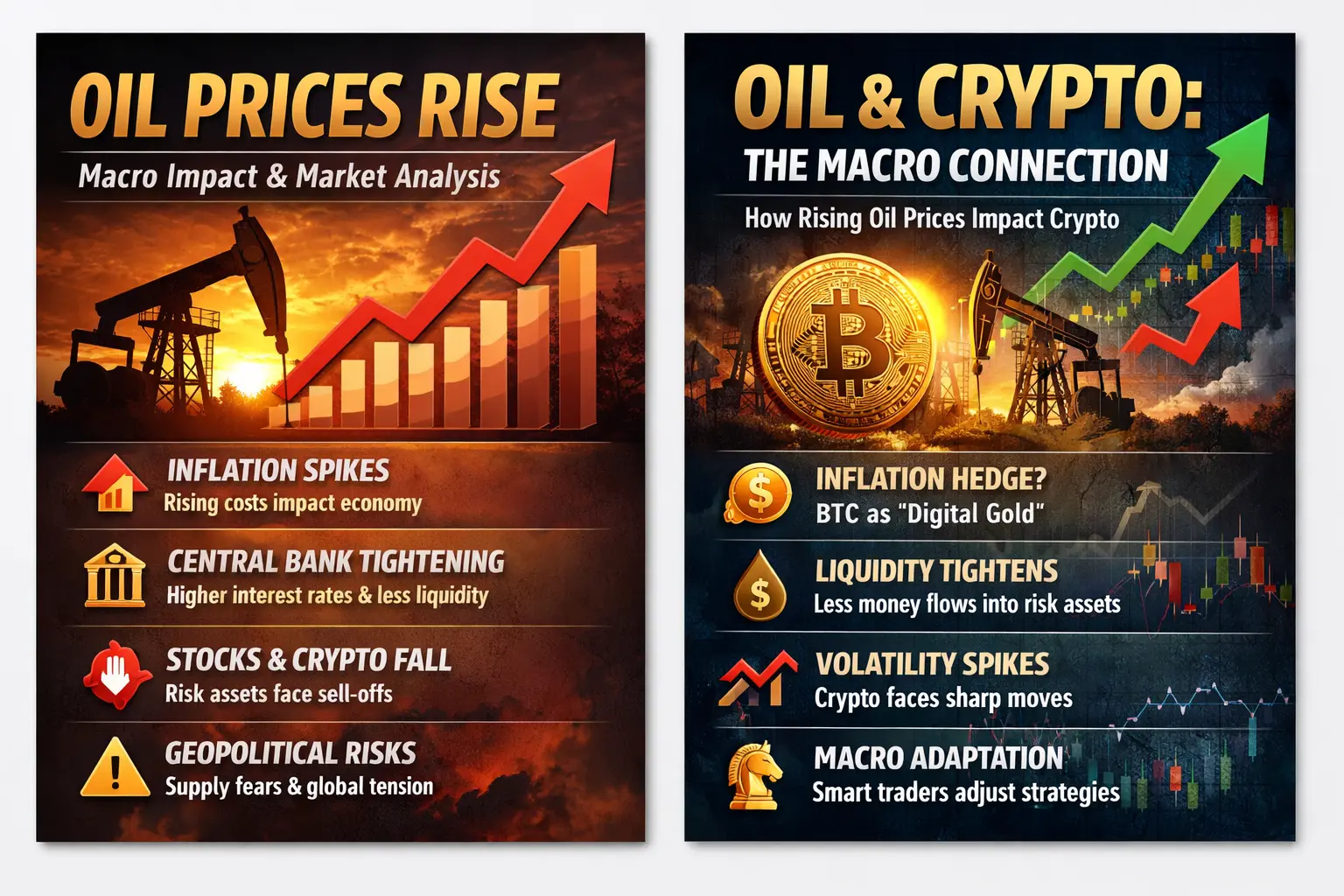
#OilPricesRise
Deep Macro, Supply-Demand, Geopolitics & Crypto Market Impact Analysis
Oil price movements are not random.
They are one of the strongest signals of global macro stress, liquidity shifts, and geopolitical tension.
When oil rises, it affects:
Inflation
Interest rates
Corporate profits
Risk appetite
And indirectly—crypto markets
This is not just an energy story.
👉 It is a global financial system story.
🌍 PART 1 — WHY OIL PRICES RISE
🧠 1. Supply-Side Constraints
Oil prices (e.g., Crude Oil) rise when supply is restricted.
Key factors:
Production cuts by major prod
BTC0,7%
Vortex_Kingvip
#OilPricesRise
#OilPricesRise
Deep Macro, Supply-Demand, Geopolitics & Crypto Market Impact Analysis
Oil price movements are not random.
They are one of the strongest signals of global macro stress, liquidity shifts, and geopolitical tension.
When oil rises, it affects:
Inflation
Interest rates
Corporate profits
Risk appetite
And indirectly—crypto markets
This is not just an energy story.
👉 It is a global financial system story.
🌍 PART 1 — WHY OIL PRICES RISE
🧠 1. Supply-Side Constraints
Oil prices (e.g., Crude Oil) rise when supply is restricted.
Key factors:
Production cuts by major producers
Geopolitical tensions in oil-producing regions
Sanctions on exporting countries
Refinery or transportation disruptions
👉 Reduced supply + stable demand = higher prices
📈 2. Demand Strength
Oil demand increases when:
Global economy is growing
Industrial activity rises
Travel and transportation increase
👉 Strong demand pushes prices upward
⚠️ 3. Geopolitical Risk Premium
Markets price in risk.
When conflict or instability rises:
Oil supply becomes uncertain
Traders price in potential disruption
👉 This creates a “risk premium” in oil prices
📊 PART 2 — MACRO ECONOMIC IMPACT
🔥 1. Inflation Pressure
Oil is a core input in:
Transportation
Manufacturing
Agriculture
When oil rises:
👉 Cost of goods increases → inflation rises
🏦 2. Central Bank Response
Central banks react to rising inflation by:
Increasing interest rates
Tightening liquidity
👉 Higher rates = pressure on risk assets
📉 3. Impact on Global Growth
High oil prices can:
Slow economic growth
Reduce consumer spending
Increase business costs
👉 This creates a drag on global markets
📊 PART 3 — IMPACT ON FINANCIAL MARKETS
📉 1. Stock Market Reaction
Equities may react negatively because:
Costs increase for companies
Profit margins shrink
Economic uncertainty rises
🟡 2. Gold Reaction
Gold (e.g., Gold) may:
Rise as a hedge against inflation
Attract safe-haven demand
But:
👉 Behavior depends on real interest rates
₿ 3. Crypto Market Reaction
Crypto assets like Bitcoin (e.g., Bitcoin) react in complex ways:
🟢 Bullish Scenario
Rising oil → inflation hedge narrative
Bitcoin viewed as “digital gold”
Capital flows into BTC
🔴 Bearish Scenario
Rising oil → higher interest rates
Liquidity tightens
Risk assets fall
👉 Crypto is caught between:
Inflation hedge
And risk asset behavior
🔄 PART 4 — CAPITAL FLOW DYNAMICS
🧠 1. Liquidity Tightening
Higher oil prices can lead to:
Central bank tightening
Reduced liquidity
Less speculative capital
👉 This affects crypto first
🔁 2. Capital Rotation
When oil rises:
Capital moves into energy sector
Moves away from speculative assets
👉 Risk assets may underperform
📊 3. Sector Rotation
Investors may:
Increase exposure to energy stocks
Reduce exposure to tech and crypto
👉 Market structure shifts
⚙️ PART 5 — TRADING IMPACT & STRATEGY
🧠 1. Understanding Correlation
Oil and crypto are not directly correlated, but:
👉 They are linked through liquidity and macro conditions
📉 2. Bearish Crypto Scenario (Oil Rising + Tight Liquidity)
If oil rises and central banks tighten:
BTC may face resistance
Altcoins may underperform
Volatility increases
👉 Strategy:
Trade defensively
Focus on capital preservation
🟢 3. Bullish Crypto Scenario (Oil Rising + Inflation Narrative)
If oil rises due to inflation:
BTC can benefit as hedge
Long-term investors accumulate
Narrative strengthens
👉 Strategy:
Accumulate on dips
Focus on strong assets
⚠️ 4. Volatility Opportunities
Oil spikes often create:
Market uncertainty
Rapid price swings
👉 Opportunities:
Breakout trades
Liquidity sweeps
Mean reversion setups
📊 PART 6 — SUPPORT & RESISTANCE THINKING
📈 Oil Resistance Zones
Previous highs
Supply zones
Geopolitical resolution points
📉 Oil Support Zones
Production cost levels
Demand zones
Strategic reserves impact
👉 Traders watch these levels to anticipate:
Breakouts
Reversals
Trend continuation
🧱 PART 7 — KEY RISK FACTORS
⚠️ 1. Demand Shock
Economic slowdown
Reduced consumption
👉 Can quickly reverse oil uptrend
⚠️ 2. Supply Recovery
Increased production
Resolution of geopolitical issues
👉 Can cause sharp oil declines
⚠️ 3. Central Bank Aggression
Higher interest rates
Liquidity tightening
👉 Risk assets suffer
🧠 PART 8 — MARKET SENTIMENT ANALYSIS
📊 1. Fear vs Inflation Narrative
Oil rising creates two competing narratives:
Fear (economic slowdown)
Inflation hedge (asset protection)
👉 Market direction depends on which dominates
🧠 2. Smart Money Behavior
Institutional investors:
Hedge inflation
Adjust portfolios early
Move capital strategically
👉 Retail often reacts late
🔑 KEY TAKEAWAYS
Oil prices rise due to supply constraints, demand strength, or geopolitical risk
Rising oil increases inflation and central bank pressure
Risk assets (stocks, crypto) are affected through liquidity changes
Bitcoin may act as both risk asset and inflation hedge
Market direction depends on macro balance between growth and inflation
🧠 FINAL STRATEGIC INSIGHT
Oil is not just an energy commodity.
👉 It is a global macro signal
When oil rises:
Inflation rises
Liquidity tightens
Markets become more volatile
And in this environment:
👉 The smartest traders do not guess direction
👉 They adapt to macro conditions
🏁 Closing Thought
Oil price increases are not just about barrels and supply.
👉 They are about the cost of the entire global economy
And the traders who understand this:
👉 Can anticipate shifts before they happen
👉 And position themselves with precision
repost-content-media
  • Reward
  • Comment
  • Repost
  • Share
#GateSquareAprilPostingChallenge
Deep Market Insight & High-Quality Gate Style Analysis
The crypto market is entering one of the most critical phases of 2026. Volatility is rising, liquidity is shifting, and narratives are changing faster than ever. In this environment, understanding structure—not just price—is the difference between consistent profit and emotional trading.
This post is designed as a Gate Square elite-level analysis, focusing on market structure, volatility behavior, macro influence, and actionable trading frameworks.
1. Market Psychology: Why April Matters
April has historic
BTC0,7%
ETH0,13%
Vortex_Kingvip
#GateSquareAprilPostingChallenge
Deep Market Insight & High-Quality Gate Style Analysis
The crypto market is entering one of the most critical phases of 2026. Volatility is rising, liquidity is shifting, and narratives are changing faster than ever. In this environment, understanding structure—not just price—is the difference between consistent profit and emotional trading.
This post is designed as a Gate Square elite-level analysis, focusing on market structure, volatility behavior, macro influence, and actionable trading frameworks.
1. Market Psychology: Why April Matters
April has historically been a transition month in financial markets. It sits between Q1 closing and new quarterly positioning by institutions.
During this period:
Portfolio rebalancing increases
Institutional capital reallocates
Market narratives reset
Liquidity shifts from weak hands to strong hands
For crypto specifically, April tends to reflect:
Post-Q1 profit-taking
Early positioning for Q2 narratives
Increased volatility due to low conviction zones
This makes April a “decision month”—where the market chooses direction.
2. Macro Environment Driving Crypto
Crypto does not move in isolation. The following macro factors are currently shaping market behavior:
2.1 Interest Rate Expectations
Central banks continue to control liquidity. When interest rates stay high:
Risk assets become less attractive
Capital moves to safer yields
Crypto faces pressure
When rates stabilize or decrease:
Liquidity flows back into crypto
Altcoins outperform
Risk appetite increases
2.2 Dollar Strength vs Weakness
A strong US dollar typically leads to:
Crypto corrections
Capital exiting risk assets
A weak dollar leads to:
BTC rallies
Increased altcoin speculation
2.3 Geopolitical Tension
Global instability often causes:
Short-term market fear
Sudden liquidity flushes
Safe-haven rotation
Interestingly, after panic events:
Crypto often rebounds strongly
Smart money accumulates at discounted levels
3. Bitcoin Market Structure
Bitcoin remains the core driver of the entire crypto ecosystem.
3.1 Key Structure Observations
Higher highs + higher lows = bullish trend
Lower highs + lower lows = bearish trend
Consolidation = accumulation or distribution
Currently, Bitcoin is in a volatile accumulation-distribution phase.
3.2 Liquidity Zones
The most important concept in modern trading is liquidity hunting.
Bitcoin tends to:
Sweep highs → trigger buy stop orders → reverse
Sweep lows → trigger sell stop orders → reverse
Smart traders watch for:
Equal highs (buy liquidity)
Equal lows (sell liquidity)
These are often targets before reversal.
3.3 Institutional Behavior
Institutions do not chase price. They:
Accumulate during fear
Distribute during euphoria
Watch for:
Low volatility before breakout
Sudden volume spikes
Fake breakouts (liquidity grabs)
4. Ethereum and Altcoin Behavior
Ethereum acts as a bridge between BTC dominance and altcoin expansion.
When Ethereum outperforms BTC:
Altcoins follow
Risk appetite increases
When BTC dominance rises:
Altcoins underperform
Liquidity flows into BTC
Altcoin Cycle Phases
BTC pumps first
ETH starts to follow
Large-cap altcoins rise
Mid-cap altcoins explode
Small caps enter mania phase
Understanding this rotation is critical for maximizing profits.
5. Volatility: The Engine of Profit
Volatility is not risk—it is opportunity.
Markets move in cycles of:
Compression (low volatility)
Expansion (high volatility)
5.1 Compression Phase
Tight price range
Low volume
Market indecision
This phase builds energy for a move.
5.2 Expansion Phase
Strong directional move
High volume
Break of structure
This is where most profits are made.
Trading Insight:
“Volatility precedes opportunity. Smart traders wait for compression, then act during expansion.”
6. Smart Money Concepts (SMC)
Modern trading revolves around understanding how smart money operates.
6.1 Order Blocks
These are areas where institutions previously:
Bought heavily (bullish order block)
Sold heavily (bearish order block)
Price often revisits these zones before continuing direction.
6.2 Break of Structure (BOS)
A break of structure confirms:
Trend continuation or reversal
If price breaks a key high:
Bullish trend confirmed
If price breaks a key low:
Bearish trend confirmed
6.3 Liquidity Sweeps
Markets often:
Move against retail traders
Trigger stop losses
Then reverse sharply
This is intentional.
7. Trading Strategy for April Market
Here is a structured approach for trading this environment:
Strategy 1: Range Trading (Low Volatility)
When the market is consolidating:
Buy near support
Sell near resistance
Avoid breakout chasing
Strategy 2: Breakout Trading (High Volatility)
When volatility expands:
Enter after breakout confirmation
Avoid early entries
Wait for retest
Strategy 3: Liquidity Hunting Setup
Steps:
Identify equal highs/lows
Wait for liquidity sweep
Enter reversal after confirmation
Strategy 4: Trend Following
Identify market trend
Trade pullbacks
Avoid counter-trend trades
8. Risk Management (Most Important Section)
Without risk management, no strategy works.
Golden Rules:
Risk only 1–2% per trade
Never over-leverage
Always use stop-loss
Protect capital first
Position Sizing Formula:
Risk = Account Size × Risk %
Example:
$1000 account
1% risk = $10 per trade
9. Emotional Control in Trading
Most traders fail not due to strategy—but psychology.
Common Mistakes:
Overtrading
Revenge trading
FOMO entries
Ignoring stop-loss
Professional Mindset:
Think in probabilities
Accept losses as part of the game
Focus on consistency, not wins
10. Market Scenarios for April
Bullish Scenario:
BTC holds support
Breaks resistance with volume
Altcoins rally strongly
Bearish Scenario:
BTC loses key support
Liquidity cascade occurs
Altcoins dump heavily
Sideways Scenario:
Tight consolidation
Low volatility
Market waiting for catalyst
11. Key Takeaways
April is a decision month
Liquidity drives price, not emotions
BTC dominates market direction
Volatility creates opportunity
Risk m
anagement is non-negotiable
Final Thoughts
The market is not random—it is structured.
Understanding:
Liquidity
Market structure
Volatility cycles
Institutional behavior
gives you a major edge.
Most traders focus on indicators.
Professionals focus on price action + liquidity.
Stay patient. Stay disciplined.
Let the market come to you.
all DETAILS ARE HERE
https://www.gate.com/announcements/article/50520
repost-content-media
  • Reward
  • Comment
  • Repost
  • Share
  • Pin