GateUser-0ab08321

vip
Age 0.5 Yıl
Peak Tier 0
No content yet
#EthereumMarketAnalysis
Comprehensive Ethereum (ETH) Market Analysis
Current Market Status
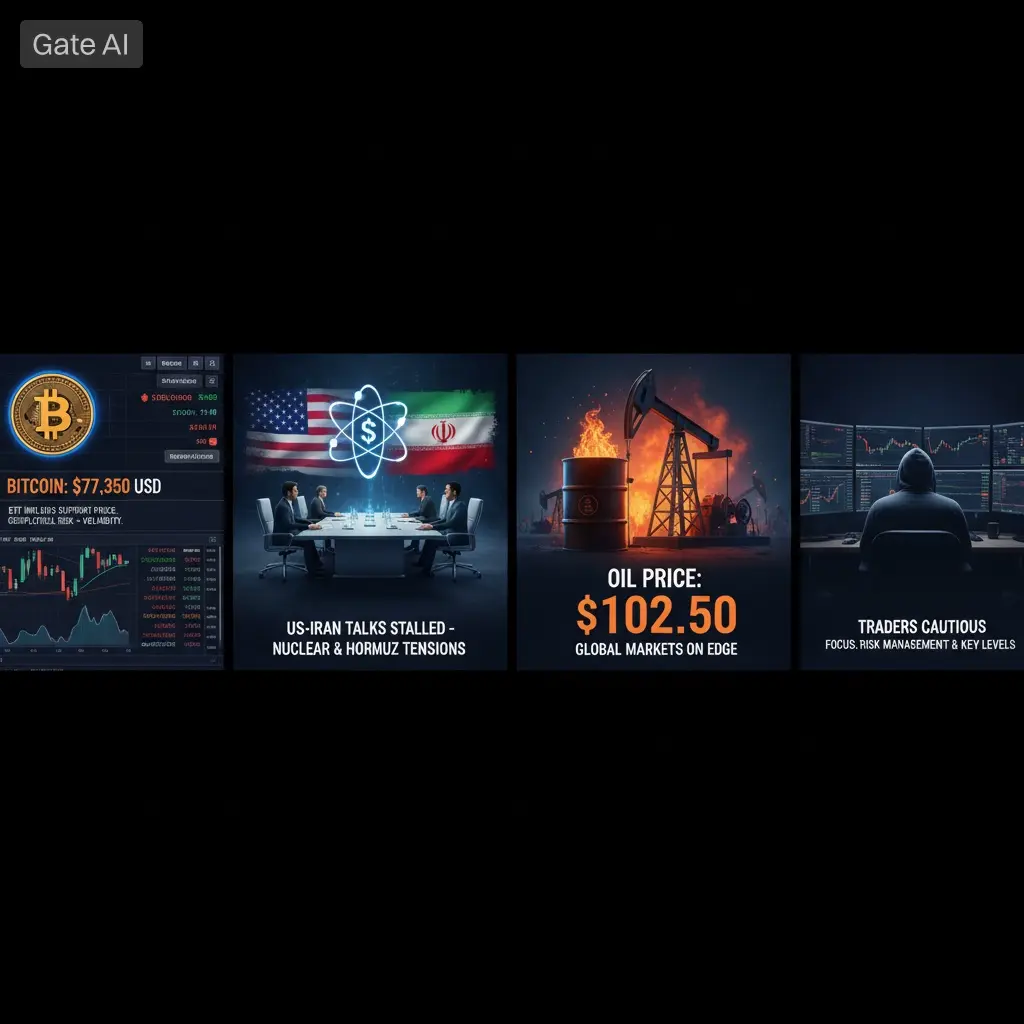
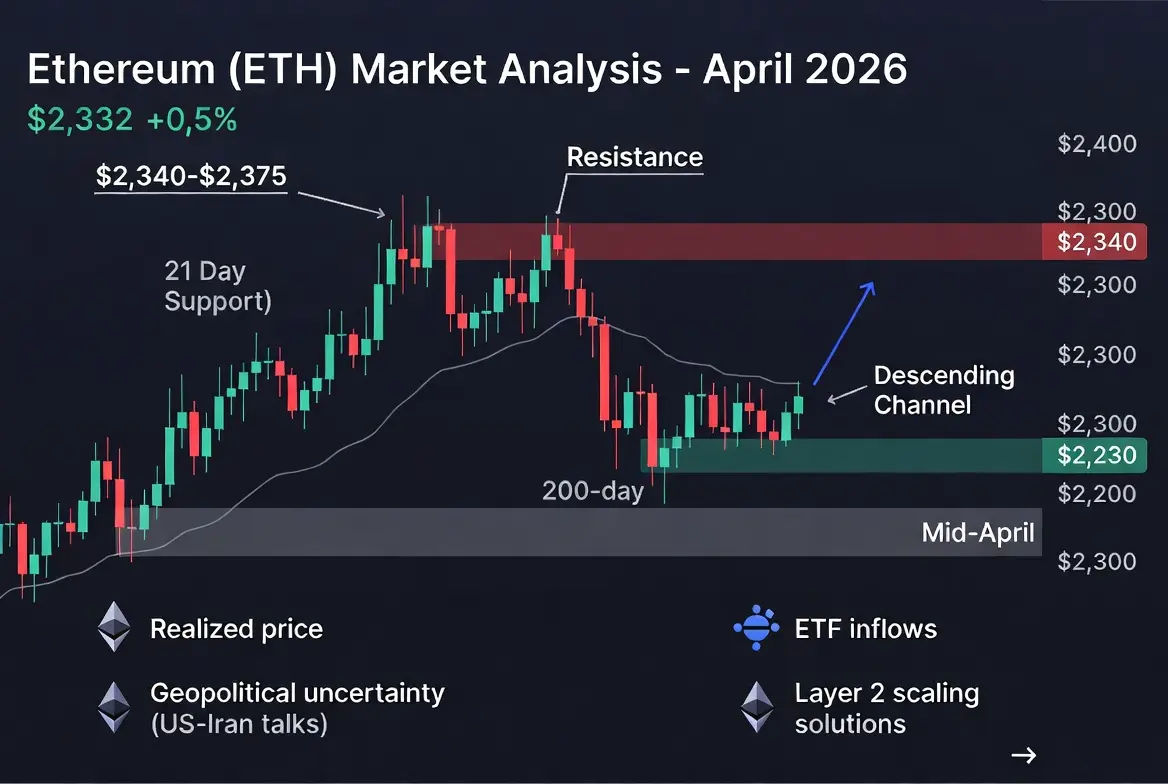
Ethereum is currently trading around $2,332, showing modest positive movement with a 0.53% gain over the past 24 hours. The price has been consolidating within a narrow range between $2,301 and $2,337, reflecting a period of indecision as market participants await clearer directional catalysts. Trading volume remains healthy at approximately $113 million in 24-hour quote volume, indicating sustained interest despite the sideways price action.
US-Iran Peace Talks and Geopolitical Impact
The stalled US-Ir
ETH-3,52%
BTC-2,3%
AAVE0,16%
ARB-3,61%
HighAmbition
#EthereumMarketAnalysis
Comprehensive Ethereum (ETH) Market Analysis
Current Market Status
Ethereum is currently trading around $2,332, showing modest positive movement with a 0.53% gain over the past 24 hours. The price has been consolidating within a narrow range between $2,301 and $2,337, reflecting a period of indecision as market participants await clearer directional catalysts. Trading volume remains healthy at approximately $113 million in 24-hour quote volume, indicating sustained interest despite the sideways price action.
US-Iran Peace Talks and Geopolitical Impact
The stalled US-Iran peace negotiations represent a significant overhang on risk assets including Ethereum. Recent reports indicate that talks in Islamabad ended without breakthrough, with Iran blaming US naval blockades for the impasse. This geopolitical uncertainty has created a risk-off environment where institutional capital tends to retreat from high-beta assets like cryptocurrencies.
The connection between these talks and ETH valuation operates through multiple channels. First, successful negotiations would likely reduce oil prices and inflationary pressures, potentially allowing central banks to maintain or lower interest rates. Lower rates generally benefit crypto markets by reducing the opportunity cost of holding non-yielding assets and improving liquidity conditions. Conversely, failed talks or escalating tensions could trigger safe-haven flows into traditional assets while pressuring risk-on positions.
Recent market behavior suggests crypto may be developing resilience to geopolitical shocks. During the latest Iran-related flare-up, Bitcoin and Ethereum showed more muted reactions compared to traditional markets like oil and equities. This divergence could indicate that crypto holders who were inclined to sell on geopolitical headlines have already exited, or that spot ETF inflows are providing a more stable demand floor than previous cycles dominated by futures-driven volatility.
Technical Analysis and Key Levels
From a technical perspective, Ethereum faces immediate resistance at $2,340-$2,375, which aligns with the 21-period simple moving average and the upper band of a descending trend channel that formed in mid-April. Support levels are clustered around $2,300, $2,230 (near the 200-period EMA), and $2,180 at the lower band of the descending channel.
The price structure shows ETH trading below its 21 SMA while remaining within a descending trend channel, suggesting near-term weakness. However, the realized price around $2,340 has been acting as dynamic support, and holding above this level could signal potential for macro expansion. A decisive break below $2,230 would invalidate the bullish structure and potentially target $1,845, while a sustained move above $2,375 could open the path toward $2,900 resistance.
Factors Impacting Ethereum
Multiple fundamental factors are currently influencing Ethereum's price trajectory. On the positive side, institutional adoption continues through spot ETF inflows and increased staking participation. Major institutions like Grayscale and BitMine have expanded their ETH holdings, while the DeFi ecosystem shows resilience with initiatives like Aave's DeFi United raising substantial ETH for risk mitigation.
Technological developments also support the bull case. The Pectra upgrade has improved network efficiency, while Layer 2 scaling solutions including Arbitrum, Optimism, and Base are processing millions of transactions daily at reduced costs. Uniswap V4 Hooks and privacy proposals like EIP-8182 demonstrate ongoing innovation within the ecosystem.
Conversely, bearish pressures include tightening liquidity conditions, negative funding rates in derivatives markets, and rising Bitcoin dominance which often correlates with ETH underperformance. The broader DeFi sector faces systemic risk concerns following recent security incidents, though community responses like the DeFi United initiative show the ecosystem's capacity for collaborative problem-solving.
Trading Strategy Recommendations
For active traders, the current environment suggests a cautious approach with clear risk management parameters. Short-term traders might consider short positions if ETH rejects at the $2,375 resistance level, targeting $2,300 and potentially $2,230 on breaks below the ascending trend channel. Stop-losses should be placed above $2,400 to protect against false breakouts.
Long-term position traders may find accumulation opportunities on any dips toward the $2,200-$2,300 range, particularly if the price holds above the 200 EMA. The confluence of realized price support and long-term technical structure suggests this zone could represent favorable risk-reward entry points for multi-month positions.
Risk management remains paramount given the geopolitical overhang. Position sizing should reflect the elevated uncertainty, with traders prepared for potential volatility spikes if US-Iran talks show meaningful progress or deterioration. Monitoring funding rates, perpetual swap premiums, and options market skew can provide early signals of shifting sentiment.
Outlook and Conclusion
Ethereum sits at a critical juncture where near-term technical weakness contrasts with longer-term fundamental strength. The stalled US-Iran negotiations create uncertainty that could persist until diplomatic clarity emerges, potentially capping upside until resolved. However, the ecosystem's institutional adoption, technological progress, and demonstrated resilience to geopolitical shocks suggest underlying support.
Traders should remain flexible, prepared to adjust positions based on both technical breaks and geopolitical developments. The $2,230-$2,375 range defines the current battleground, with breaks in either direction likely to establish the next significant trend. Patience and disciplined risk management will be essential until clearer directional signals emerge from both technical patterns and macro developments.
repost-content-media
  • Reward
  • Comment
  • Repost
  • Share
#rsETHAttackUpdate
A Defining Shock for DeFi in 2026
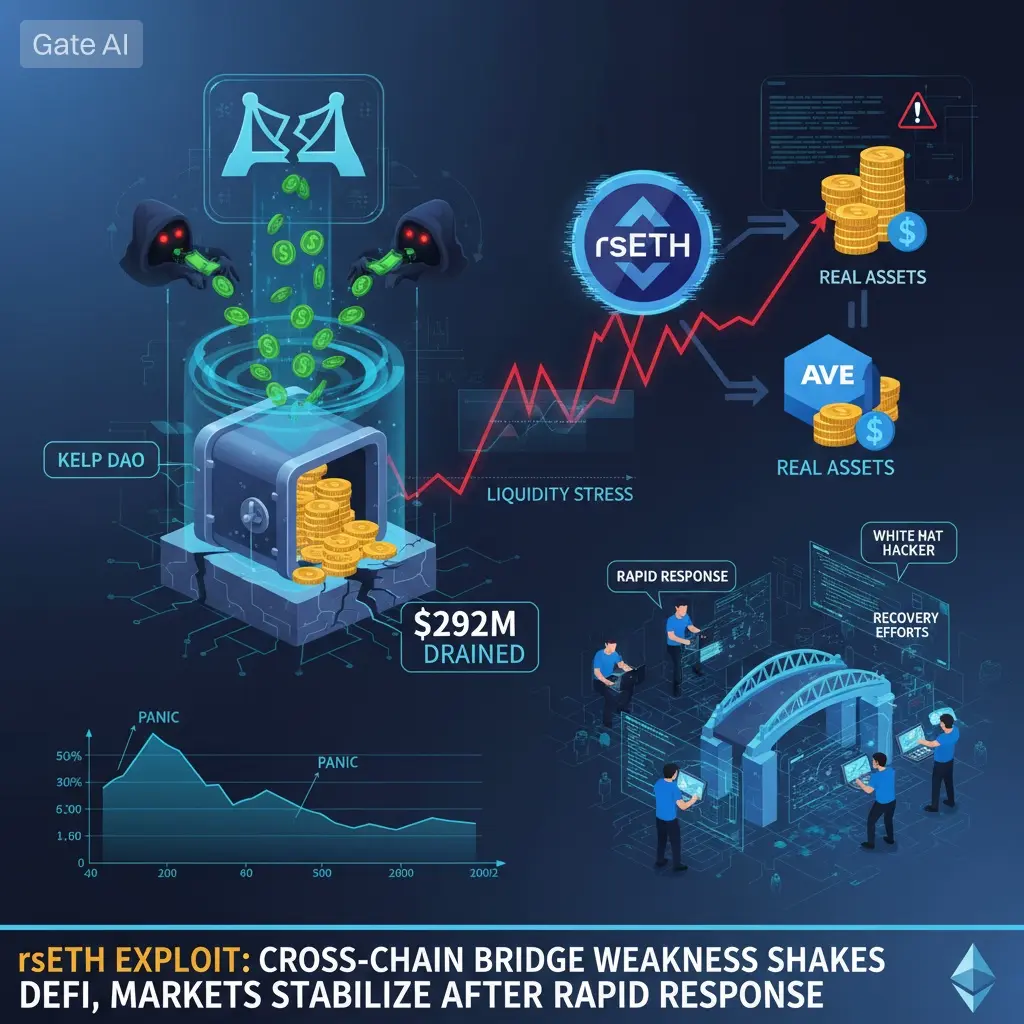
The rsETH exploit on April 18, 2026, didn’t just hit one protocol—it exposed a critical structural weakness across the entire decentralized finance ecosystem. What initially appeared to be an isolated bridge issue quickly evolved into a systemic liquidity crisis affecting lending markets, restaking protocols, and cross-chain infrastructure.
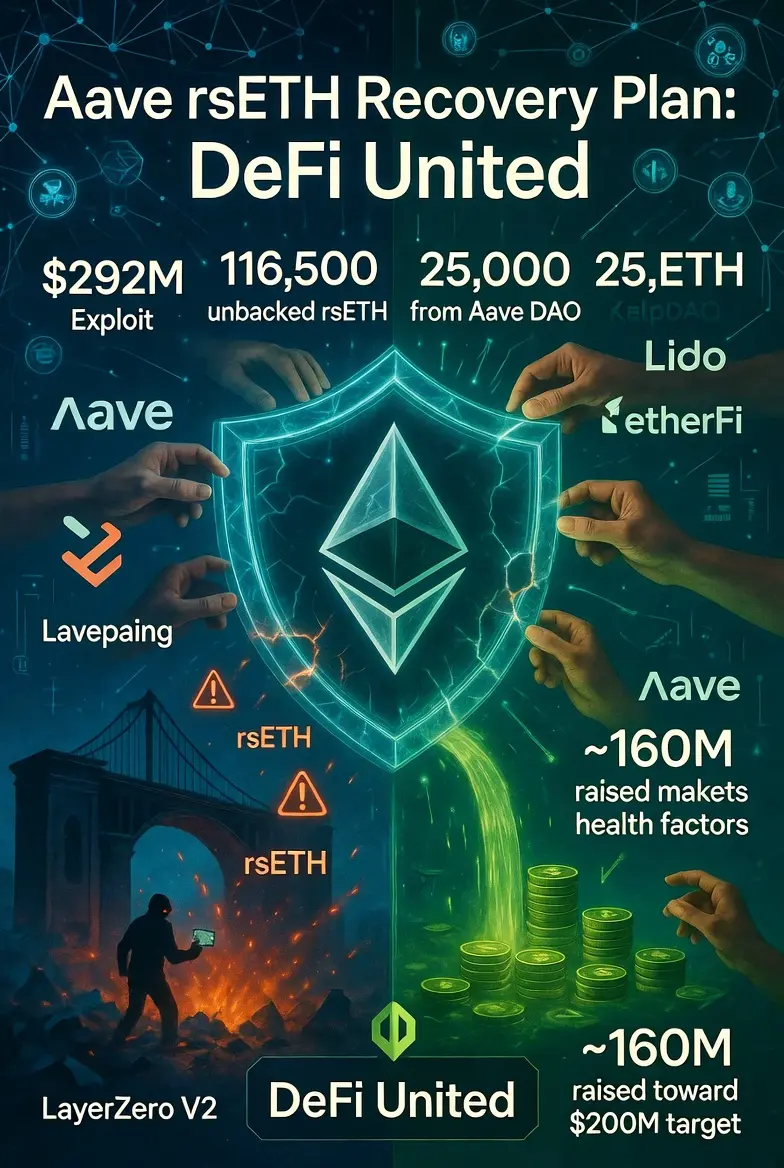
At the center of this crisis was Kelp DAO, which suffered a devastating loss of approximately $292 million, making it the largest DeFi exploit of 2026 so far. The attackers drained 116,500 rsETH tokens,
ZRO-5,95%
ETH-3,52%
HighAmbition
#rsETHAttackUpdate
A Defining Shock for DeFi in 2026
The rsETH exploit on April 18, 2026, didn’t just hit one protocol—it exposed a critical structural weakness across the entire decentralized finance ecosystem. What initially appeared to be an isolated bridge issue quickly evolved into a systemic liquidity crisis affecting lending markets, restaking protocols, and cross-chain infrastructure.
At the center of this crisis was Kelp DAO, which suffered a devastating loss of approximately $292 million, making it the largest DeFi exploit of 2026 so far. The attackers drained 116,500 rsETH tokens, representing nearly 18% of the total circulating supply, immediately destabilizing confidence in liquid restaking assets.
Root Cause: Not a Smart Contract Bug, But Infrastructure Failure
Unlike many previous exploits, this attack did not originate from a flaw in smart contracts or lending logic. Instead, it targeted a weaker layer—cross-chain communication infrastructure powered by LayerZero Version 2.
The most critical vulnerability was the 1-of-1 verifier setup, meaning only a single validator was responsible for confirming cross-chain messages. This created a dangerous single point of failure in an otherwise decentralized system.
Step-by-Step Attack Breakdown
The attack was highly coordinated and executed with precision:
Attack initiated at Ethereum block 24,908,285
Target: Bridge route between Unichain and Ethereum
Attackers compromised two RPC nodes
Malicious software replaced legitimate node infrastructure
Simultaneous denial-of-service attacks disabled clean nodes
System was forced to rely on compromised data feeds
This allowed attackers to forge a fake cross-chain message, tricking the bridge into releasing real assets on Ethereum without any backing.
The result:
➡️ 116,500 rsETH minted out of thin air
➡️ Sent directly to attacker-controlled wallets
➡️ Logs erased, malware self-deleted
This wasn’t just hacking—it was infrastructure manipulation at a deep level.
Exploitation Phase: Turning Fake Assets Into Real Liquidity
Once the attackers had unbacked rsETH, they moved rapidly to extract value.
They deposited around 89,567 rsETH into lending protocols like Aave V3, primarily on Ethereum and Arbitrum.
From there, they borrowed:
~82,650 WETH
Additional wstETH positions
Total borrowed value: ~$236 million
These positions were engineered with extremely tight health factors (1.01–1.03), making liquidation difficult and prolonging systemic stress.
Immediate Market Reaction: Liquidity Crisis Unfolds
Although Aave was not directly hacked, it became the primary shock absorber.
Key Impacts:
100% utilization reached in multiple WETH pools
Borrow rates adjusted downward to stabilize liquidity
rsETH collateral frozen across 11 deployments
Loan-to-value (LTV) ratios set to zero
This triggered a cascade:
Massive withdrawals across DeFi
Total Value Locked (TVL) dropped $5B–$10B+
“Bank-run” behavior spread across protocols
A notable withdrawal of ~$154 million, reportedly linked to Justin Sun, intensified panic sentiment.
Price Impact Across the Market
Ethereum (ETH)
Dropped 2%–3.7%
Traded near $2,300–$2,380
Decline driven by sentiment and liquidity stress—not protocol failure
Bitcoin (BTC)
Held relatively stable around $78,980
Acted as a risk-off safe haven within crypto
AAVE Token
Fell 16%–20%
Traded between $95–$105
Reflected direct exposure to lending ecosystem risk
Bad Debt Scenarios: Systemic Risk Quantified
Analysts modeled multiple outcomes:
Scenario 1: Distributed Loss Model
Bad debt: ~$123.7 million
Implies ~15% depeg in rsETH
Scenario 2: Isolated L2 Loss Model
Bad debt: ~$230 million
Severe impact on:
Arbitrum: up to 27% shortfall
Base: ~23%
Mantle: extreme cases up to 71%
Aave-specific exposure
Estimated between $177M–$200M
Rapid Response: DeFi Coordination in Action
Despite the scale of the attack, response speed was critical.
Kelp DAO Actions
Emergency pause activated within 46 minutes
Prevented additional $95M–$100M loss
Halted minting and bridging
Recovery Efforts – “DeFi United”
Industry-wide collaboration to restore backing
Key contributions:
Arbitrum recovered 30,000+ ETH
Mantle proposed 30,000 ETH credit facility
Aave DAO considered 25,000 ETH support
Contributions from Lido, EtherFi, Golem Foundation
Total pledged: ➡️ 43,500+ ETH (~$100M+)
Security Attribution and Investigation
Lazarus Group was identified with high confidence as the attacker.
This aligns with previous high-profile crypto exploits, reinforcing a growing trend:
➡️ Nation-state actors targeting DeFi infrastructure
➡️ Focus shifting from smart contracts to off-chain systems
Key Lessons for DeFi and Cross-Chain Systems
This exploit revealed several critical weaknesses:
1. Single Verifier = Systemic Risk
Decentralization must extend beyond smart contracts into validation layers.
2. RPC Node Security is Critical
Attackers didn’t break code—they corrupted data sources.
3. Cross-Chain Complexity Multiplies Risk
Operating across 20+ chains introduces exponential attack surfaces.
4. Liquidity Layer is Fragile
Even safe protocols like Aave can face stress under extreme conditions.
Market Psychology: Fear, Liquidity, and Trust
The exploit triggered three key psychological phases:
Shock Phase – Immediate panic and withdrawals
Liquidity Crunch – Borrowing pressure and frozen markets
Stabilization – Governance actions and recovery pledges
Interestingly, no widespread retail wallet losses occurred. The damage was protocol-level, not user-level—an important distinction that helped prevent deeper panic.
Current Status (Late April 2026)
Gradual unfreezing of assets underway
Governance votes determining final loss distribution
rsETH partially stabilized but still under scrutiny
Security upgrades being implemented across bridges
Forward Outlook: What Comes Next?
Short-Term
Continued volatility in ETH-linked assets
Tight liquidity conditions persist
DeFi TVL recovery will be gradual
Mid-Term
Mandatory multi-verifier bridge standards
Increased audits of infrastructure layers
Higher risk premiums on restaking assets
Long-Term
Stronger, more resilient cross-chain systems
Institutional confidence returns with safeguards
DeFi evolves toward security-first architecture
Final Takeaway
The rsETH exploit was not just another hack—it was a stress test for the entire DeFi ecosystem.
Despite:
$292M drained
$200M+ bad debt risk
Billions in liquidity shifts
The system did not collapse.
Instead, it coordinated, adapted, and began recovery.
That’s the real story here:
➡️ DeFi is fragile—but resilient
➡️ Interconnected—but responsive
➡️ Risky—but evolving fast
repost-content-media
  • Reward
  • Comment
  • Repost
  • Share
#US-IranTalksStall
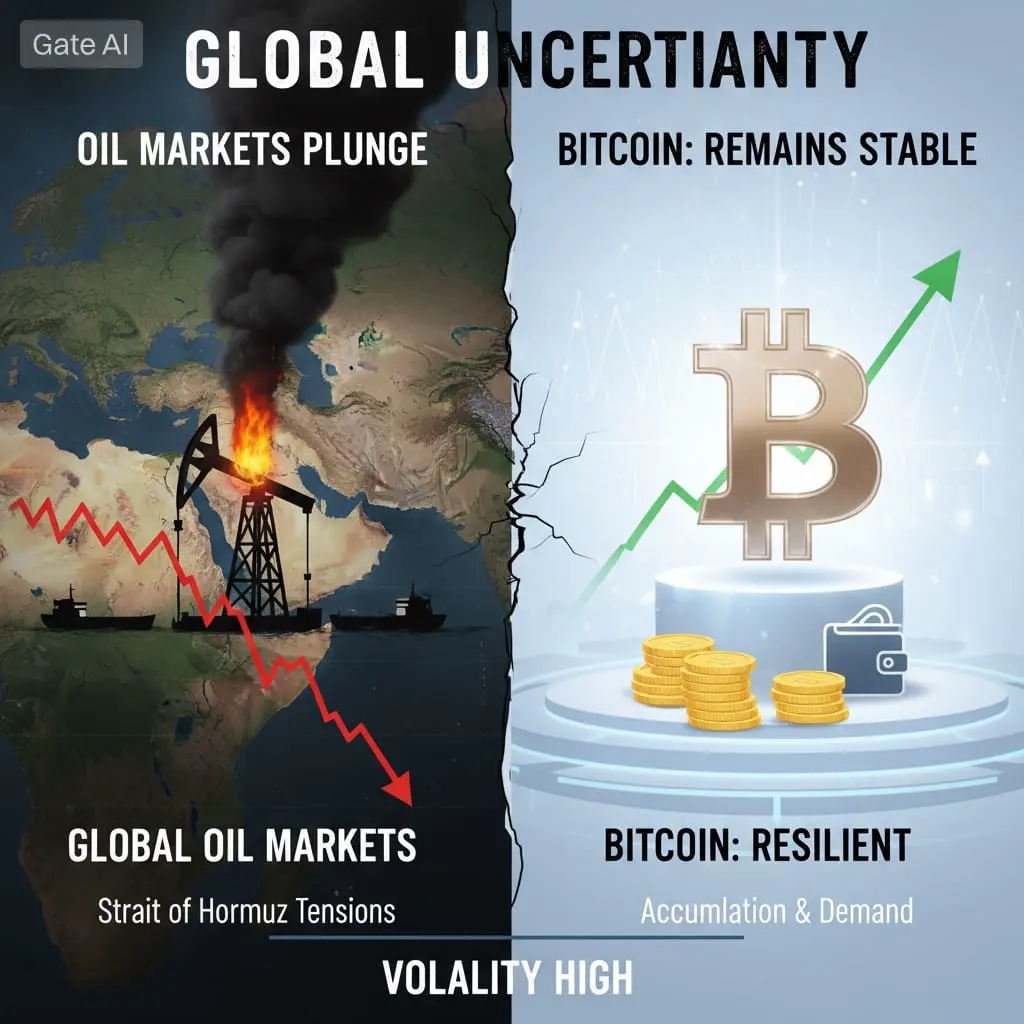
The negotiations between the United States and Iran have reached a critical deadlock, with President Trump extending the ceasefire indefinitely while diplomatic progress remains frozen. This prolonged uncertainty is sending ripple effects across global financial markets—especially oil and cryptocurrency.
Current Status of US-Iran Negotiations
Talks between Washington and Tehran have stalled after multiple failed rounds. A planned diplomatic meeting in Pakistan was canceled, signaling deeper friction behind the scenes. While the ceasefire remains in place, both sides have op
BTC-2,3%
HighAmbition
#US-IranTalksStall
The negotiations between the United States and Iran have reached a critical deadlock, with President Trump extending the ceasefire indefinitely while diplomatic progress remains frozen. This prolonged uncertainty is sending ripple effects across global financial markets—especially oil and cryptocurrency.
Current Status of US-Iran Negotiations
Talks between Washington and Tehran have stalled after multiple failed rounds. A planned diplomatic meeting in Pakistan was canceled, signaling deeper friction behind the scenes. While the ceasefire remains in place, both sides have openly hinted that military escalation is still on the table.
At the core of the dispute are Iran’s nuclear limitations and US demands that Tehran considers unacceptable. Meanwhile, the US naval blockade in the Strait of Hormuz continues to be a major flashpoint. Iran views this as a violation of the ceasefire, while the US maintains it as a strategic necessity following Iran’s earlier closure of the Strait in February 2025.
Oil Market Shock: A Global Energy Crisis
The Strait of Hormuz handles nearly 20 million barrels of oil per day, making it one of the most critical chokepoints in the global energy system. Its disruption has triggered one of the largest supply shocks in modern history.
Oil could surge toward $120–$130 per barrel if disruptions persist
Short-term spikes already pricing in risk premium
LNG markets under pressure with Europe potentially hitting €100/MWh
Energy firms are preparing for a prolonged disruption, with some forecasts suggesting normalization may not occur until late 2026.
Inflation & Recession Risk Rising
Higher oil prices directly feed into inflation. Fuel costs are already pushing CPI upward, tightening financial conditions globally.
Key risks:
Persistent inflation → delayed rate cuts
Reduced consumer spending
Slower global growth
Increased probability of stagflation scenario
If oil sustains above $110+, global recession fears will intensify significantly.
Bitcoin Market Overview
Bitcoin is currently trading around $79,000–$80,000, showing resilience despite macro uncertainty.
Performance snapshot:
24h: +2%
7D: +3–4%
30D: +20% recovery
Key support: $77,000
Resistance: $80,000–$82,000
Momentum remains bullish on lower
timeframes, but daily indicators signal caution:
Overbought conditions (CCI, Williams %R)
Bearish divergence on MACD
Increasing volume suggests strong participation
BTC vs Traditional Markets: Correlation Shift
Bitcoin’s correlation with equities has increased significantly:
S&P 500 correlation ~0.5
Nasdaq correlation ~0.52
This shows BTC is behaving more like a risk asset rather than a traditional safe haven during geopolitical stress.
However, an important shift is visible:
Each geopolitical shock triggers smaller BTC sell-offs
Institutional demand (ETF flows) is acting as a price floor
Market is increasingly absorbing bad news faster
Strait of Hormuz Impact on BTC
The oil crisis affects Bitcoin indirectly:
Higher energy costs → mining pressure
Macro uncertainty → risk-off sentiment
Liquidity conditions → dominant driver of BTC price
Despite this, BTC is holding strong due to:
Institutional accumulation
Reduced panic selling
Strong spot demand
This suggests Bitcoin is evolving—not purely as a hedge, but as a liquidity-driven macro asset.
Key Trading Levels & Strategy
Short-term outlook:
Bullish Scenario
Break above $80K → targets $82K–$85K
Strong ETF inflows support continuation
Bearish Scenario
Lose $77K → downside toward $74K–$75K
Triggered by escalation or macro sell-off
Strategy insights:
Avoid chasing highs (overbought conditions)
Focus on pullbacks for entries
Keep position sizing tight due to volatility
Scenario Analysis
1. Diplomatic Breakthrough
Strait reopens
Oil drops below $100
Inflation eases
Risk assets rally
BTC likely pushes toward $85K+
2. Conflict Escalation
Oil spikes toward $130
Markets enter risk-off mode
BTC may dip short-term
But downside likely limited due to strong structural demand
Big Picture Insight
This crisis is reshaping how Bitcoin reacts to global events.
Previously:
BTC = panic sell asset
Now:
BTC = liquidity + institutional flow driven
The shrinking sell-offs show one thing clearly:
weak hands are already out.
Conclusion
The US-Iran stalemate is more than a geopolitical issue—it’s a macro catalyst affecting oil, inflation, and global markets simultaneously
Oil faces direct supply shock
Global economy faces inflation pressure
Bitcoin shows surprising resilience
While uncertainty remains high, one trend is becoming clear:
Bitcoin is maturing into a more stable, institutionally supported asset.
Traders should stay alert, manage risk carefully, and watch both geopolitical headlines + key BTC levels closely—because the next move could be fast and decisive.
repost-content-media
  • Reward
  • Comment
  • Repost
  • Share
#USMilitaryMaduroBettingScandal
The US Military Maduro Betting Scandal:
Introduction
The cryptocurrency world was shaken in late April 2026 when news broke about a US Army soldier who allegedly used classified military intelligence to profit on Polymarket, a crypto-based prediction market platform. This case represents one of the most significant intersections between government secrecy, military operations, and decentralized finance ever recorded. The scandal involves Master Sergeant Gannon Ken Van Dyke, a Special Forces soldier with 18 years of service, who allegedly turned insider knowled
HighAmbition
#USMilitaryMaduroBettingScandal
The US Military Maduro Betting Scandal:
Introduction
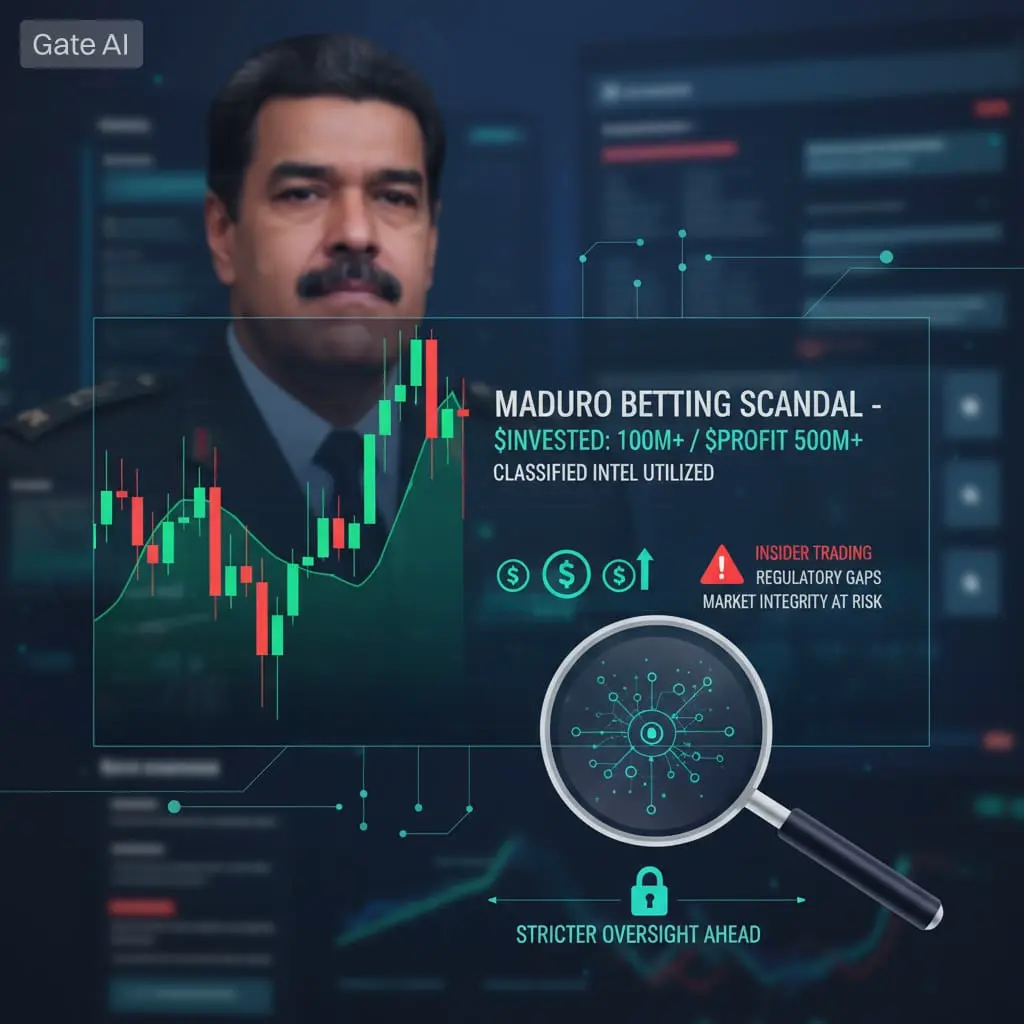
The cryptocurrency world was shaken in late April 2026 when news broke about a US Army soldier who allegedly used classified military intelligence to profit on Polymarket, a crypto-based prediction market platform. This case represents one of the most significant intersections between government secrecy, military operations, and decentralized finance ever recorded. The scandal involves Master Sergeant Gannon Ken Van Dyke, a Special Forces soldier with 18 years of service, who allegedly turned insider knowledge of a top-secret military operation into over 400,000 US dollars in profits.
The Operation: Absolute Resolve
To understand the full scope of this scandal, we must first examine the military operation at its center. Operation Absolute Resolve was a US Special Forces raid conducted in January 2026 that successfully captured Venezuelan President Nicolas Maduro and his wife from their residence in Caracas. The operation was executed without casualties and represented a major foreign policy victory for the United States. Van Dyke, as an active-duty Green Beret stationed at Fort Bragg, held Sensitive Compartmented Information clearance and was deeply involved in both the planning and execution phases of this mission.
The Betting Scheme
The timeline of events reveals a calculated approach to exploiting classified information. Beginning around December 8, 2025, Van Dyke participated in mission planning while simultaneously preparing his financial strategy. On December 26, 2025, he created a Polymarket account under the username Burdensome-Mix. Between December 30 and January 2, 2026, just hours before the actual raid, he purchased over 436,000 Yes shares of the Maduro Out by January 31, 2026 contract.
The scale of his betting was substantial. He placed approximately 13 separate bets totaling around 33,000 US dollars. When the raid succeeded and Maduro was captured, these positions yielded profits exceeding 409,000 US dollars, representing a return of over 1,100 percent on his initial investment. The timing was remarkably precise, with his largest purchases occurring in the critical window immediately preceding the military action.
The Cover-Up Attempts
What makes this case particularly serious are the alleged efforts to conceal the activity. Prosecutors claim Van Dyke requested Polymarket delete his account around January 6, 2026, falsely claiming he had lost access to the associated email address. Additionally, he allegedly transferred most of his winnings to a foreign cryptocurrency vault before moving them to a newly created online brokerage account. These actions suggest awareness that the trading was improper and illegal.
Legal Charges and Implications
Van Dyke faces five felony charges including commodities fraud, wire fraud, and unlawful use of nonpublic government information. This marks the first major insider trading prosecution involving prediction markets, setting a significant legal precedent. The Commodity Futures Trading Commission has asserted primary regulatory authority over prediction markets, identifying event contracts as swaps or derivatives under their jurisdiction. CFTC Chairman Michael Selig stated clearly that anyone engaging in fraud, manipulation, or insider trading will face the full force of the law.
The case has prompted immediate regulatory responses. New York Governor Kathy Hochul signed an executive order banning state employees from insider trading on prediction market platforms, making her the third governor to take such action. This reflects growing concern about government officials exploiting nonpublic information for personal gain.
Reactions from Key Stakeholders
The scandal generated widespread reactions across political, military, and crypto communities. FBI Director Kash Patel condemned the betrayal of fellow soldiers and national security for personal profit. President Donald Trump, when asked about the case, made his now-famous remark that the world is somewhat of a casino while questioning whether Van Dyke had bet on success or failure of the operation.
Polymarket itself released a statement emphasizing that insider trading has no place on their platform and noted they had tipped off federal authorities about suspicious trading activity. This suggests the platform's surveillance systems, while detecting unusual patterns, were not able to prevent the trades from occurring.
Impact on Cryptocurrency Markets
The scandal has sent ripples through the cryptocurrency ecosystem with several significant implications. First, it has intensified scrutiny of prediction markets as a category. These platforms, which allow users to bet on real-world events using cryptocurrency, have experienced explosive growth but now face serious questions about their vulnerability to insider exploitation.
The regulatory trajectory has shifted dramatically. Polymarket announced updated market integrity rules across both its decentralized platform and its CFTC-regulated US exchange. These changes amplify requirements governing insider trading and market manipulation, including prohibitions on spoofing, wash trading, fictitious transactions, self-dealing, front-running, and disruptive practices. The platform now operates three-level surveillance including partnerships with trade surveillance specialists, real-time monitoring control desks, and regulatory service agreements.
For traders and investors in the crypto space, this case introduces new risk factors. The precedent established here means that trading on nonpublic information in prediction markets is now clearly established as illegal activity subject to federal prosecution. This extends beyond military operations to any material nonpublic information that could affect market outcomes.
What Traders Are Thinking
The trading community has reacted with a mixture of concern, cynicism, and calls for clearer regulation. Many experienced traders recognize that information asymmetry has always existed in markets, but the brazen nature of this case using classified military intelligence represents a new level of violation.
Professional traders are now reassessing their exposure to prediction markets. The risk of regulatory crackdown has increased substantially, with many anticipating stricter Know Your Customer requirements and enhanced surveillance. Some traders who previously viewed prediction markets as a frontier opportunity are now treating them with greater caution.
Institutional investors are particularly concerned about reputational risk. The association of cryptocurrency with illegal activity, even when platforms cooperate with authorities, reinforces negative perceptions among traditional finance participants. This could slow institutional adoption of crypto-based financial products.
Retail traders have shown divided reactions. Some express outrage at the betrayal of public trust, while others view the case as evidence that insiders always find ways to profit. Social media discussions reveal significant debate about whether prediction markets can ever truly be fair when information asymmetries are so pronounced.
Broader Market Implications
Beyond prediction markets specifically, this scandal affects the entire cryptocurrency ecosystem. It provides ammunition to critics who argue that crypto enables illicit activity, despite the transparent blockchain trail that actually facilitated detection in this case. The incident may accelerate calls for comprehensive cryptocurrency regulation in the United States.
The case also highlights the tension between decentralized finance principles and regulatory compliance. While crypto markets pride themselves on being permissionless and censorship-resistant, the Maduro betting scandal demonstrates that real-world legal frameworks still apply. Platforms must balance user privacy with surveillance capabilities to detect and prevent illegal activity.
Lessons and Future Outlook
Several key lessons emerge from this scandal. First, the notion that cryptocurrency transactions are anonymous has been further debunked. The blockchain trail enabled investigators to trace Van Dyke's activities despite his attempts at concealment. Second, prediction markets require robust surveillance systems to maintain integrity and regulatory compliance. Third, the intersection of government secrets and financial markets creates unique vulnerabilities that existing regulations may not adequately address.
Looking forward, we can expect continued regulatory evolution. The CFTC has reaffirmed its authority to police illegal trading practices on prediction market platforms and has committed to investigating and prosecuting violations. State-level actions are likely to expand, with more governors expected to issue executive orders restricting government employee participation in these markets.
For legitimate traders and investors, the path forward requires heightened awareness of legal boundaries. Trading on material nonpublic information has always been illegal in traditional markets, and this case establishes that the same standards apply to crypto-based prediction markets. Due diligence and compliance considerations must now be central to any prediction market strategy.
Conclusion
The US Military Maduro Betting Scandal represents a watershed moment for cryptocurrency regulation and prediction market integrity. It demonstrates that even in decentralized systems, illegal activity leaves traces and faces consequences. The case has prompted immediate regulatory responses, increased surveillance measures, and significant soul-searching within the trading community.
For the broader crypto market, this scandal serves as a reminder that innovation must coexist with compliance. As prediction markets and other crypto-based financial products mature, they will inevitably face greater scrutiny and regulation. The challenge for the industry is to develop systems that prevent abuse while preserving the benefits of decentralized, transparent markets.
Traders must now navigate an environment where the rules are becoming clearer but the stakes for violations are higher than ever. The Maduro case will likely be studied for years as a defining example of how not to trade, and how the cryptocurrency ecosystem responds to serious ethical and legal breaches.
repost-content-media
  • Reward
  • Comment
  • Repost
  • Share
#CryptoMarketsRiseBroadly
Comprehensive Analysis of the Broad Crypto Market Rise
The cryptocurrency market is experiencing a significant upward momentum with Bitcoin and Ethereum leading the charge, supported by strong institutional inflows and positive market sentiment across multiple sectors. Here is a detailed step-by-step breakdown of the current market conditions, the extent of the rise, and future projections.
Step One: Bitcoin's Dominant Performance and Institutional Adoption
Bitcoin has demonstrated remarkable strength with a 24-hour gain of 1.99 percent, currently trading at approxim
BTC-2,3%
ETH-3,52%
WEN3,3%
HighAmbition
#CryptoMarketsRiseBroadly
Comprehensive Analysis of the Broad Crypto Market Rise
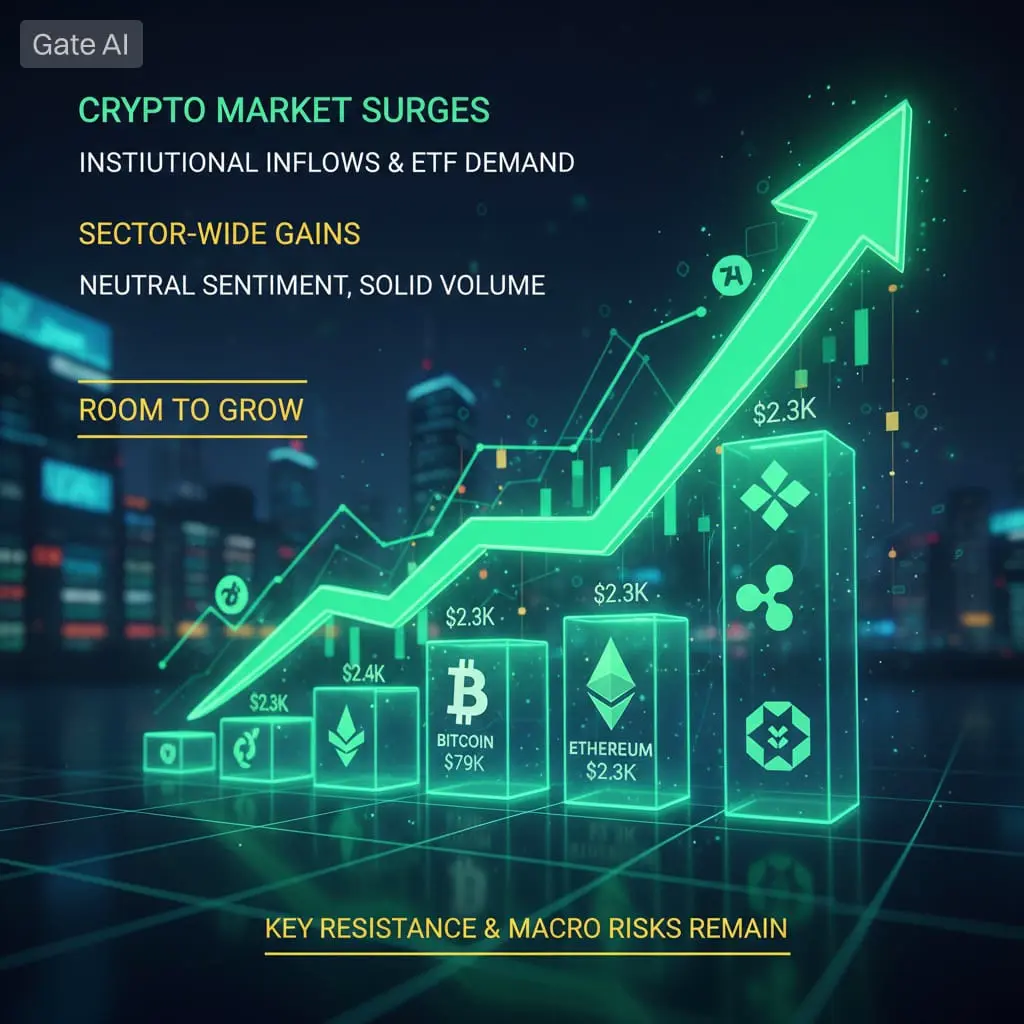
The cryptocurrency market is experiencing a significant upward momentum with Bitcoin and Ethereum leading the charge, supported by strong institutional inflows and positive market sentiment across multiple sectors. Here is a detailed step-by-step breakdown of the current market conditions, the extent of the rise, and future projections.
Step One: Bitcoin's Dominant Performance and Institutional Adoption
Bitcoin has demonstrated remarkable strength with a 24-hour gain of 1.99 percent, currently trading at approximately 79,063 USDT after reaching a daily high of 79,477 USDT. The most significant driver behind this rally is the continuous institutional accumulation. United States spot Bitcoin ETFs have recorded nine consecutive days of net inflows, with major financial giants like BlackRock consistently absorbing supply. Long-term holder positions have surged by 69 percent, indicating a fundamental shift from retail speculation to institutional permanent allocation. The Coinbase premium index has maintained positive territory for eighteen straight days, reflecting sustained buying pressure from American investors. On-chain data reveals that whales are accelerating their accumulation, and the market structure has transitioned from extreme pessimism to strong FOMO sentiment, signaling a new phase of supply restructuring and power transfer.
Step Two: Ethereum's Breakthrough and Ecosystem Developments
Ethereum has outperformed Bitcoin with a more substantial 24-hour increase of 3.21 percent, trading at 2,387 USDT after touching a daily peak of 2,404 USDT. The breakthrough above the 2,400 USDT resistance level marks a significant technical achievement. United States spot Ethereum ETFs recorded inflows of 23.4 million USDT yesterday, demonstrating continued institutional interest. Major asset managers including BlackRock, Grayscale, and BitMine are actively increasing their Ethereum positions, with Grayscale staking an additional 102,400 ETH and BitMine's staking scale rising to 3.5878 million ETH. The upcoming Glamsterdam upgrade and the advancement of EIP-8182 privacy proposals are adding fundamental value. Furthermore, the DeFi ecosystem is recovering through the DeFi United collaborative rescue initiative, which has already raised over 100,000 ETH, restoring confidence in the broader Ethereum ecosystem.
Step Three: Market-Wide Gainers and Sector Rotation
The broad market rise extends well beyond the top two cryptocurrencies. Analysis of the top gainers reveals impressive performances across diverse sectors. WEN leads the pack with an extraordinary 68.82 percent surge, followed by Crypto Burger at 36.22 percent and OKZOO at 34.72 percent. Infrastructure and protocol tokens like Naoris Protocol and Infinity Ground have climbed 31.48 percent and 31.46 percent respectively. Even established DeFi tokens such as Lido DAO have posted gains exceeding 22 percent. This widespread appreciation indicates healthy sector rotation rather than isolated speculation, with AI-related tokens, infrastructure protocols, and DeFi assets all participating in the upward movement.
Step Four: Market Capitalization and Volume Analysis
The top ten cryptocurrencies by market capitalization collectively represent over 1.9 trillion USDT in value. Bitcoin maintains its dominance with a market cap of approximately 1.58 trillion USDT, while Ethereum holds around 288 billion USDT. Trading volumes remain robust, with Bitcoin recording over 382 million USDT in 24-hour volume and Ethereum exceeding 250 million USDT. These substantial volume figures confirm that the current rise is supported by genuine buying interest rather than low-liquidity manipulation.
Step Five: Fear and Greed Index and Market Sentiment
The current Fear and Greed Index stands at 47, classified as neutral territory. This reading suggests that while optimism is building, the market has not yet reached extreme greed levels that typically precede corrections. The neutral sentiment provides room for further upward movement before psychological resistance emerges. The transition from the recent fearful conditions to neutral sentiment reflects improving market confidence without the euphoria that often signals market tops.
Step Six: Future Rise Probability and Percentage Projections
Based on technical analysis and fundamental indicators, several scenarios emerge for potential further gains. Bitcoin faces critical resistance at the 80,000 USDT psychological level. A successful breakout above this threshold could trigger a move toward 85,000 USDT, representing an additional 7.5 percent gain from current levels. The confluence of ETF inflows, institutional adoption, and favorable regulatory developments in the United States, Japan, and Czech Republic supports this bullish scenario.
Ethereum shows stronger momentum with potential to reach 2,500 USDT in the near term, representing approximately 4.7 percent upside. The combination of staking growth, upgrade anticipation, and DeFi recovery provides multiple catalysts. If the broader altcoin season materializes, mid-cap and small-cap tokens could see gains ranging from 15 to 30 percent as capital rotates from majors to higher-beta assets.
Step Seven: Risk Factors and Considerations
Despite the positive outlook, several risks warrant attention. The market has risen rapidly, and profit-taking could trigger short-term corrections. Macroeconomic factors including Federal Reserve policy decisions and global liquidity conditions remain influential. Additionally, while institutional inflows are strong, any reversal in ETF flows could dampen sentiment. Traders should monitor the 77,500 USDT support level for Bitcoin and 2,300 USDT for Ethereum as critical downside thresholds.
Conclusion
The current broad crypto market rise represents a fundamentally driven uptrend supported by institutional adoption, technological improvements, and improving regulatory clarity. Bitcoin and Ethereum have posted gains of approximately 2 to 3 percent in the past 24 hours, with the potential for additional 5 to 10 percent gains in the coming weeks if resistance levels are breached. The Fear and Greed Index at neutral levels suggests room for further appreciation before reaching overheated conditions. Diversified participation across AI tokens, infrastructure protocols, and DeFi assets indicates healthy market breadth rather than concentrated speculation. Investors should maintain awareness of support levels while recognizing that the current trend has fundamental backing from institutional flows and ecosystem developments.
repost-content-media
  • Reward
  • Comment
  • Repost
  • Share
#比特币Breaks79K
🚨 Bitcoin Breaks $79K: Full Market Analysis, Liquidity Flow & Institutional Shift (April 2026)
Bitcoin has officially broken above the $79,000 level, marking one of the most important psychological and structural milestones of the current cycle. This breakout is not just a price movement—it represents a broader shift in global liquidity conditions, institutional participation, and macroeconomic positioning. However, despite the bullish momentum, the market is still operating in a high-volatility, liquidity-sensitive environment where sharp pullbacks remain possible.
🌍 1. Geopo
BTC-2,3%
HighAmbition
#比特币Breaks79K
🚨 Bitcoin Breaks $79K: Full Market Analysis, Liquidity Flow & Institutional Shift (April 2026)
Bitcoin has officially broken above the $79,000 level, marking one of the most important psychological and structural milestones of the current cycle. This breakout is not just a price movement—it represents a broader shift in global liquidity conditions, institutional participation, and macroeconomic positioning. However, despite the bullish momentum, the market is still operating in a high-volatility, liquidity-sensitive environment where sharp pullbacks remain possible.
🌍 1. Geopolitical Relief Boosting Risk Assets
One of the key drivers behind Bitcoin’s recent strength is the improvement in global risk sentiment. Easing geopolitical tensions, particularly discussions around US–Iran diplomatic progress, have reduced uncertainty across global markets. When geopolitical risk decreases, capital typically rotates back into risk assets such as equities and cryptocurrencies.
This shift has created a short-term environment where investors are more willing to allocate capital into Bitcoin, supporting upward momentum across the crypto sector.
🏦 2. Institutional Accumulation Driving Structural Demand
A major force behind this rally is continuous institutional accumulation. Large financial players are not just entering the market—they are consistently building positions over time.
A key example is aggressive accumulation strategies by Michael Saylor, whose company continues to purchase Bitcoin at scale, reducing available supply in the market. Alongside this, ETF inflows and corporate adoption are expanding steadily.
This institutional participation is important because it creates a structural buy-side liquidity base, meaning that dips are increasingly being absorbed rather than causing deep corrections.
💸 3. Macro Environment: Inflation vs Tight Liquidity
The broader macroeconomic environment remains mixed. The policy stance of the Federal Reserve continues to keep interest rates elevated, limiting liquidity expansion in traditional financial markets.
At the same time, inflation remains persistent, which supports Bitcoin’s narrative as a store-of-value and currency debasement hedge.
This creates a unique market condition:
High interest rates = liquidity pressure (bearish factor)
High inflation = Bitcoin demand support (bullish factor)
👉 Result: A conflicted but structurally bullish environment
📊 4. Price Structure & Key Liquidity Zones
Bitcoin’s breakout above $79K is occurring within a clearly defined liquidity structure.
🔑 Key Levels:
Resistance Zone: $80,000 (major liquidity cluster)
Support Zone: $74,000 – $73,000 (previous consolidation base)
Deep Support: $70,000 (macro accumulation zone)
📈 Market Movement Insight:
Recent rally strength: +12% to +20% expansion phase
Expected volatility range: 5%–10% intraday swings
Current phase: Liquidity expansion, not trend completion
⚡ 5. Smart Money Behavior & Market Psychology
The current structure shows a clear imbalance between different market participants:
🧠 Retail Traders:
Entering late due to FOMO
Increasing leverage exposure near highs
Reacting emotionally to breakout levels
🏦 Institutional Players:
Accumulating on dips
Avoiding chasing price
Building long-term positions strategically
📉 Market Makers:
Targeting liquidity above $80K
Engineering volatility to trigger stop-loss clusters
Creating short-term fake breakouts and pullbacks
👉 This creates a repeating structure: Breakout → Liquidity Trap → Pullback → Re-accumulation
📉 6. Technical Market Reality
While the trend appears bullish, internal signals suggest caution:
Momentum is showing early exhaustion
Overbought conditions are present on multiple timeframes
Bearish divergence signals are forming
Price efficiency is declining
👉 Interpretation: The market can still move higher, but not in a straight-line rally
Short-term consolidation or a corrective move is statistically likely.
🔄 7. Possible Market Scenarios
📈 Scenario A: Bullish Continuation
If Bitcoin breaks and holds above $80,000:
Momentum accelerates again
Liquidity expands upward
Price targets shift toward $85K → $90K → potential all-time highs
👉 Requires strong volume confirmation and sustained inflows
📉 Scenario B: Healthy Pullback (Highly Probable Short-Term)
If rejection occurs at $80,000:
Price retraces toward $74K–$75K
Liquidity gets reset and absorbed
Market enters a new accumulation phase
👉 This would be a normal bullish correction, not trend reversal
🧠 8. Market Sentiment Overview
Current sentiment across the market is divided:
Retail investors: Strong bullish bias and FOMO
Institutions: Controlled accumulation strategy
Smart money: Waiting for liquidity sweeps before aggressive positioning
👉 This imbalance typically leads to sharp volatility events
⚖️ 9. Final Market Interpretation
Bitcoin above $79K represents:
A structurally bullish trend 📈
A liquidity-driven breakout ⚡
A technically stretched market condition ⚠️
A transition phase, not final expansion yet
The $80K level is now the most important battleground in the market. Whether Bitcoin breaks or rejects this level will determine the next major directional phase.
🔥 FINAL CONCLUSION
Bitcoin is currently in a:
“Liquidity Expansion Phase with Short-Term Exhaustion Risk”
Meaning:
Long-term trend remains bullish
Short-term volatility is increasing
Key resistance at $80K will define next move
Pullbacks remain healthy and necessary for continuation
📢 ENGAGEMENT QUESTION:
What do you think will happen next?
🔵 Bitcoin breaks $80K and enters a new expansion phase
🔴 Bitcoin rejects $80K and retests $74K liquidity zone
Drop your view below 👇
repost-content-media
  • Reward
  • Comment
  • Repost
  • Share
#WHCADinnerShootingIncident
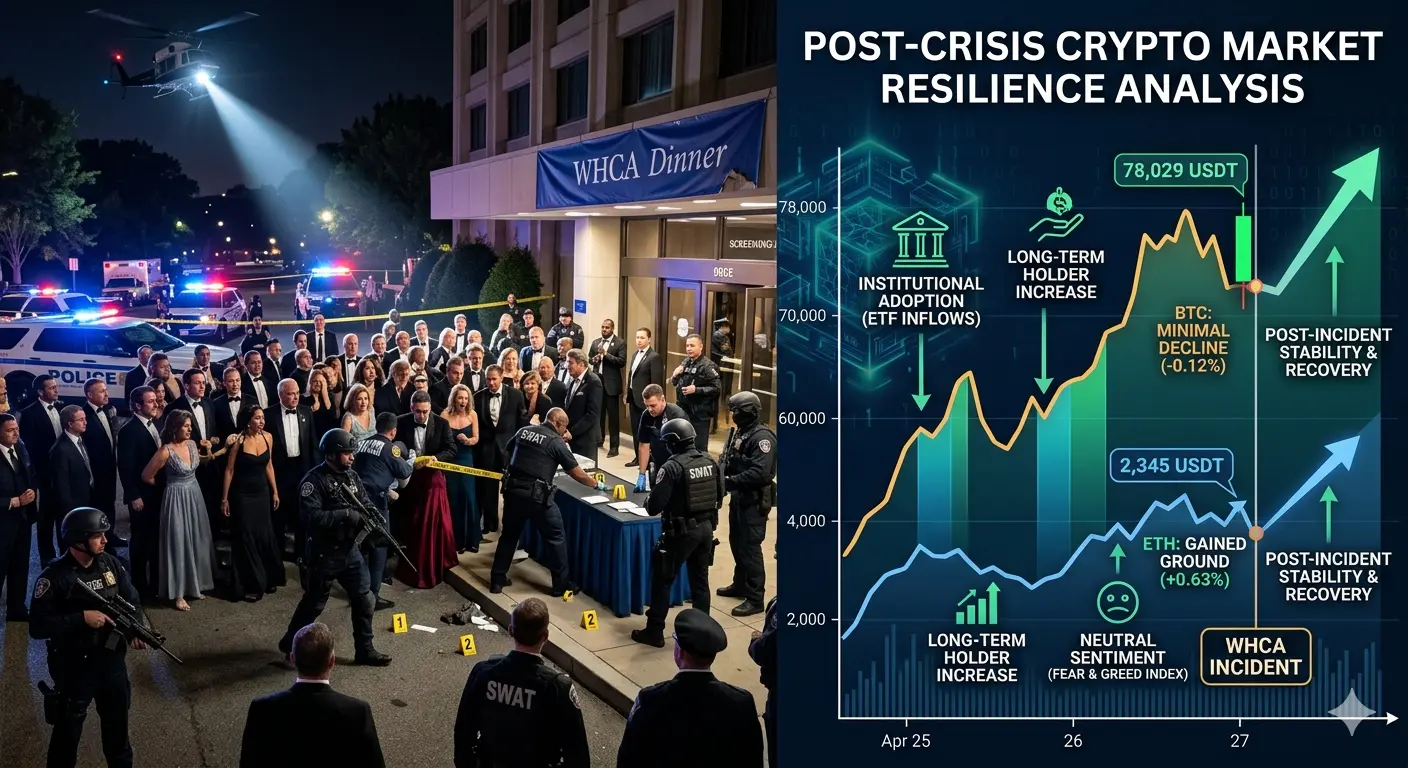
WHCA Dinner Shooting Incident:
The White House Correspondents Association dinner on April 25, 2026, became the center of global attention when a shooting incident occurred during the event, creating chaos and raising serious questions about political security in the United States. President Donald Trump, who was attending the annual gala with First Lady Melania Trump, was evacuated from the stage by Secret Service agents after gunfire erupted near the main security screening area at the Washington Hilton in Washington DC.
The incident unfolded when 31-year-old Col
HighAmbition
#WHCADinnerShootingIncident
WHCA Dinner Shooting Incident:
The White House Correspondents Association dinner on April 25, 2026, became the center of global attention when a shooting incident occurred during the event, creating chaos and raising serious questions about political security in the United States. President Donald Trump, who was attending the annual gala with First Lady Melania Trump, was evacuated from the stage by Secret Service agents after gunfire erupted near the main security screening area at the Washington Hilton in Washington DC.
The incident unfolded when 31-year-old Cole Tomas Allen allegedly attempted to breach security with multiple weapons, including a shotgun. According to reports, the suspect was trying to force entry into the ballroom where hundreds of guests, including cabinet members, high-ranking lawmakers, and celebrities, were gathered. The shooter reportedly intended to target Trump and administration officials, attempting to shoot as many people as possible. An officer was shot during the incident but was saved by a bulletproof vest. While some reports suggest the shooter was killed, others indicate charges were filed.
The immediate aftermath saw President Trump being rushed to safety by Secret Service agents who surrounded him on stage before escorting him and Vice President JD Vance away from the venue. The chaos that ensued included guests taking cover under tables as armed security agents and SWAT teams rushed the ballroom floor. In the days following the incident, Trump suggested in a 60 Minutes interview that he was targeted because he makes the biggest impact, comparing himself to assassinated President Abraham Lincoln. He expressed hope to reschedule the event, emphasizing its importance to democratic traditions.
The reactions from prominent figures highlighted the gravity of the situation. Elon Musk commented that they are willing to die to kill the democratically elected president, while former President Obama called to reject violence in democracy. Various officials offered prayers and support, and the incident sparked widespread discussion about the state of political discourse and security in America.
This attack represents another chapter in the troubling trend of political violence targeting American leaders. It comes at a time when political polarization has reached unprecedented levels, and the security apparatus faces increasing challenges in protecting high-profile officials. The fact that a suspect armed with multiple weapons could get so close to the president and other top officials raises serious questions about security protocols and intelligence failures.
Crypto Market Analysis: Current Position and Future Trajectory
In the wake of this political turmoil, the cryptocurrency market has demonstrated remarkable resilience, with Bitcoin currently trading around 78,029 USDT, showing a minimal decline of just 0.12 percent over the past 24 hours. Ethereum has actually gained ground, trading at approximately 2,345 USDT with a positive movement of 0.63 percent. This stability in the face of significant geopolitical uncertainty speaks volumes about the maturation of the crypto market and its evolving relationship with traditional risk assets.
The broader market context reveals several positive indicators that suggest crypto is well-positioned to weather political storms. The Fear and Greed Index currently sits at 47, indicating a neutral sentiment that has recovered from previous fear territory. This shift from fear to neutral represents a significant psychological improvement for market participants. The recent data shows that Bitcoin spot ETFs recorded inflows of 824 million US dollars last week, marking the fourth consecutive week of positive flows. BlackRocks IBIT alone attracted 733 million US dollars, bringing its total historical inflows to 65.37 billion US dollars.
Institutional adoption continues to accelerate, with major players like BlackRock, Grayscale, and BitMine consistently accumulating positions. Grayscale recently staked an additional 102,400 ETH, while BitMines staking position has grown to 3.5878 million ETH. This institutional confidence provides a strong foundation for the market, creating natural support levels even during periods of uncertainty.
The technical picture for Bitcoin shows the cryptocurrency hovering just below the critical 80,000 USDT resistance level, with recent highs touching 79,477 USDT. The support level around 77,770 USDT has held firm, suggesting that buyers are stepping in at lower levels. Market structure analysis indicates a transition from extreme pessimism to strong FOMO, with long-term holders increasing their positions by 69 percent. This supply restructuring represents a fundamental shift in market dynamics, moving from retail speculation toward institutional permanent allocation.
Ethereum presents an equally compelling narrative, with the cryptocurrency breaking above the 2,400 USDT level in recent sessions. The upcoming Glamsterdam upgrade, combined with EIP-8182 privacy proposals and the DeFi United rescue initiative that has raised over 100,000 ETH, creates multiple catalysts for continued appreciation. The fact that Ethereum spot ETFs recorded inflows of 23.4 million US dollars yesterday demonstrates sustained institutional interest.
Looking ahead, the crypto market appears positioned for several potential scenarios depending on how political developments unfold. In the short term, markets may experience increased volatility as investors digest the implications of the assassination attempt and any subsequent policy responses. However, the fundamental drivers of crypto adoption remain intact, and any dip could present buying opportunities for long-term investors.
The medium-term outlook remains constructive, supported by several structural factors. First, the continued institutionalization of Bitcoin through ETF products creates persistent demand that absorbs selling pressure. Second, the regulatory environment, while still evolving, has shown signs of stabilization with the current administration maintaining a relatively crypto-friendly stance. Third, technological developments across major networks continue to expand utility and user adoption.
Bitcoins path forward likely involves testing the 80,000 USDT resistance level in the coming weeks. A successful breakout above this psychological barrier could open the door for a move toward 85,000 USDT and potentially higher levels. Support remains well-established around the 75,000 to 77,000 USDT zone, where institutional buying has consistently emerged.
For Ethereum, the technical setup appears even more bullish, with the cryptocurrency having broken out of its recent consolidation range. The next major resistance lies around 2,500 USDT, with a successful breach potentially targeting the 2,800 USDT level. The combination of staking yields, ETF flows, and upcoming network upgrades creates a compelling value proposition for both institutional and retail investors.
The broader altcoin market has shown selective strength, with projects demonstrating real utility and adoption outperforming speculative tokens. This rotation toward quality reflects a maturing market where fundamentals increasingly drive price action rather than pure speculation.
Risk factors remain present, including potential regulatory crackdowns, macroeconomic headwinds from Federal Reserve policy, and geopolitical tensions that could trigger broader risk-off sentiment. However, the crypto markets demonstrated ability to absorb shocks like the WHCA dinner shooting incident suggests increasing resilience and independence from traditional market correlations.
In conclusion, while political violence and uncertainty create near-term volatility, the cryptocurrency market underlying fundamentals remain strong. Institutional adoption continues apace, technological innovation proceeds rapidly, and regulatory clarity gradually improves. For investors with appropriate risk tolerance and time horizons, current levels may represent attractive entry points, particularly if any political-induced selloffs create temporary dislocations. The key remains focusing on projects with genuine utility, strong communities, and clear paths to sustainable value creation, while maintaining appropriate position sizing and risk management discipline in an inherently volatile asset class.
repost-content-media
  • Reward
  • Comment
  • Repost
  • Share
#IranProposesHormuzStraitReopeningTerms
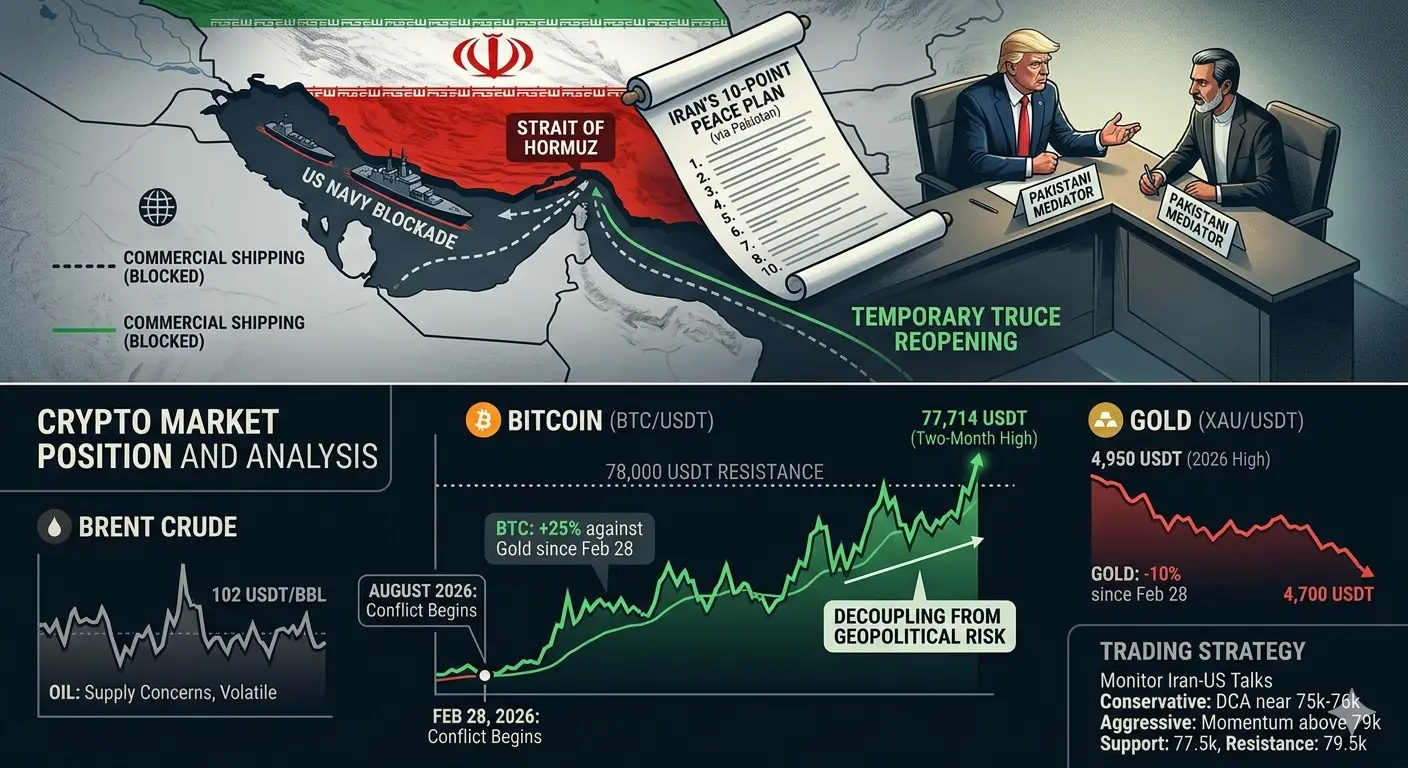
Iran's Hormuz Strait Reopening Terms and US Response
Iran has proposed a workable10-point peace plan to the United States through Pakistani mediators, with the primary focus on resolving the crisis over the Strait of Hormuz and the US naval blockade. The proposal suggests postponing nuclear negotiations to a later stage, prioritizing the reopening of the strait and lifting of the blockade first. This represents a significant shift in Iran's diplomatic approach, as Tehran initially reopened the strait temporarily following a US-brokered10-day truce betwe
BTC-2,3%
ETH-3,52%
HighAmbition
#IranProposesHormuzStraitReopeningTerms
Iran's Hormuz Strait Reopening Terms and US Response
Iran has proposed a workable10-point peace plan to the United States through Pakistani mediators, with the primary focus on resolving the crisis over the Strait of Hormuz and the US naval blockade. The proposal suggests postponing nuclear negotiations to a later stage, prioritizing the reopening of the strait and lifting of the blockade first. This represents a significant shift in Iran's diplomatic approach, as Tehran initially reopened the strait temporarily following a US-brokered10-day truce between Israel and Lebanon, but then warned it could close the waterway again if the US Navy blockade of Iranian ports continued.
President Trump has described Iran's proposal as a workable basis for negotiation and has pulled back on his threats to widen attacks for a two-week period. However, the situation remains highly volatile. Despite multiple ceasefire agreements and extended deadlines, the strait remains effectively closed to most commercial shipping. Nearly80 percent of oil and gas executives surveyed by the Federal Reserve Bank of Dallas believe the strait will not fully reopen until August2026 or later.
The key sticking point is Iran's demand for the US to end its naval blockade of Iranian ports, while the US insists on complete, immediate, and safe opening of the strait without conditions. Iran has explicitly stated that its acceptance of a ceasefire does not mean an end to the war, and the country has threatened military action if the US blockade continues.
Will the US Agree to Iran's Terms?
The likelihood of a comprehensive agreement remains uncertain. While Trump has shown willingness to negotiate and has delayed military action multiple times, significant gaps remain between the two sides. The US is demanding unconditional reopening of the strait, while Iran wants the blockade lifted as a precondition. Pakistan's mediation efforts have helped narrow some differences, but splits remain on core issues. The extended ceasefire provides a window for talks, but both sides continue to test each other's resolve with military posturing and conditional offers.
Crypto Market Position and Analysis
The cryptocurrency market has shown remarkable resilience and even bullish momentum amid this geopolitical uncertainty. Bitcoin has surged approximately25 percent against gold since the conflict began on February28,2026, while gold itself experienced a10 percent decline during the same period. This marks a significant shift in the traditional safe-haven narrative, with Bitcoin outperforming gold during a major geopolitical crisis.
Current market data shows Bitcoin trading around77,714 USDT, having broken above the78,000 level to reach a two-month high following news of the strait reopening. The cryptocurrency has recovered substantially from its February2026 lows around63,000 USDT, when the US-Iran war outbreak rattled global risk appetite. Technical indicators suggest mixed signals, with daily charts showing bullish momentum but short-term timeframes indicating potential overbought conditions and possible pullback risks.
Gold prices have retreated from their2026 highs near4,950 USDT per ounce to current levels around4,696 to4,726 USDT, representing a consolidation phase after a blistering40 percent surge between late2025 and early2026. Oil markets remain volatile with Brent crude trading around99 to104 USDT per barrel and WTI at approximately94 to101 USDT, reflecting persistent supply concerns despite diplomatic efforts.
Trading Strategy and Next Steps
For cryptocurrency traders, the current environment presents both opportunities and risks. Bitcoin's decoupling from traditional safe-haven assets like gold suggests growing institutional acceptance and maturity of the asset class. The technical outlook shows support levels around77,500 USDT and resistance near79,500 USDT. A break above80,000 USDT could trigger significant short liquidations and drive prices toward the84,000 USDT CME gap level.
Risk management remains paramount given the geopolitical uncertainty. Traders should monitor developments in the Iran-US negotiations closely, as any breakdown in talks could trigger renewed volatility across all risk assets. The extended ceasefire deadline provides a temporary stability window, but the fundamental issues remain unresolved.
For conservative investors, dollar-cost averaging into Bitcoin positions during pullbacks toward the75,000 to76,000 USDT range may offer favorable entry points. More aggressive traders might consider momentum plays above79,000 USDT with tight stop losses. Diversification into Ethereum and other major altcoins could provide additional upside exposure while managing single-asset risk.
The broader macro environment, including Federal Reserve policy decisions and the ongoing leadership succession uncertainty, will also influence crypto market direction in the coming weeks. Institutional flows into Bitcoin ETFs have remained strong, with BlackRock and other major players continuing significant accumulation, which provides underlying support for prices even during periods of geopolitical stress.
repost-content-media
  • Reward
  • Comment
  • Repost
  • Share
#CrudeOilPriceRose
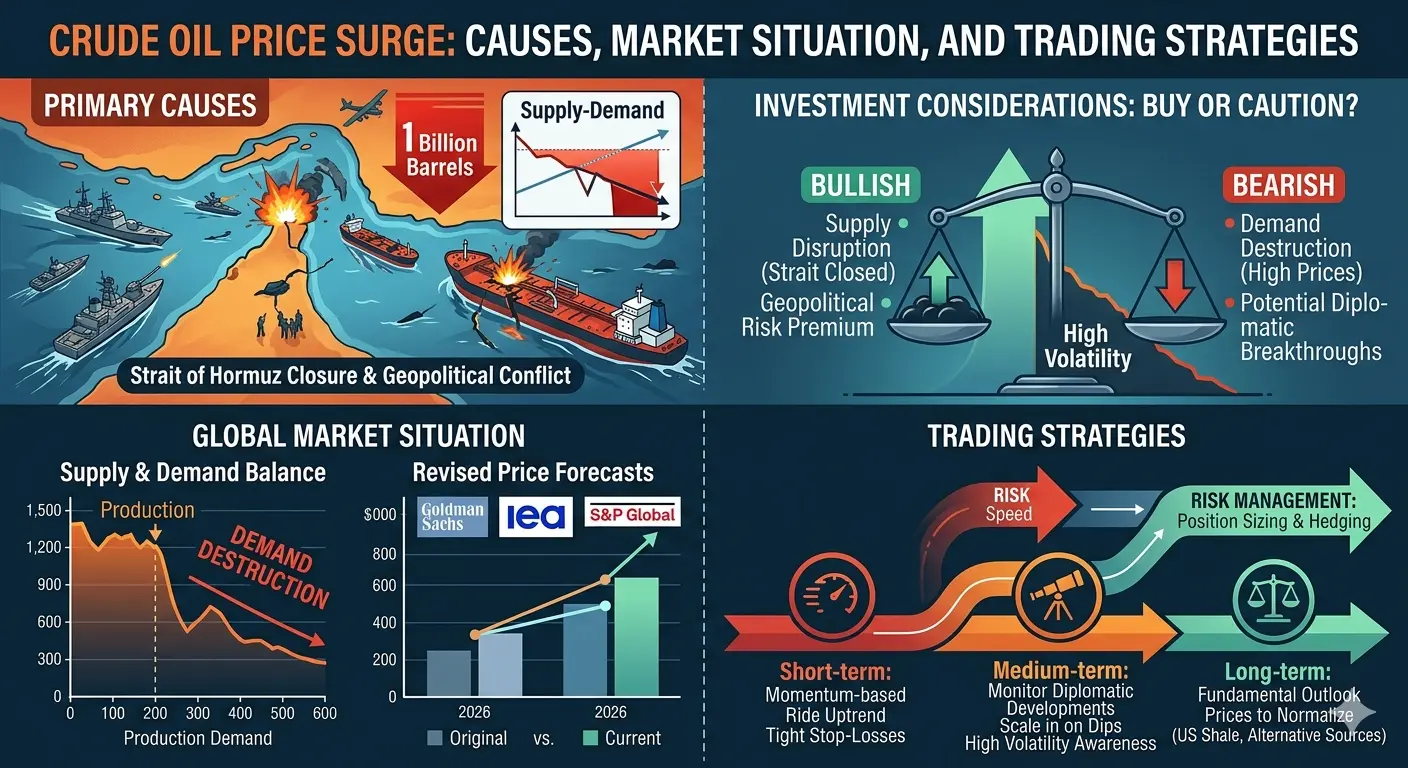
Crude Oil Price Surge: Causes, Global Market Situation, and Trading Strategy Analysis
The global crude oil market is experiencing one of the most significant price rallies in recent years, with Brent crude trading above $100 per barrel and West Texas Intermediate (WTI) hovering near $95-100. This surge represents a dramatic reversal from earlier forecasts that predicted oil prices would remain subdued in the $50-70 range throughout 2026.
Primary Causes Behind the Oil Price Rally
The most critical factor driving current oil prices is the geopolitical crisis in the Middle Eas
HighAmbition
#CrudeOilPriceRose
Crude Oil Price Surge: Causes, Global Market Situation, and Trading Strategy Analysis
The global crude oil market is experiencing one of the most significant price rallies in recent years, with Brent crude trading above $100 per barrel and West Texas Intermediate (WTI) hovering near $95-100. This surge represents a dramatic reversal from earlier forecasts that predicted oil prices would remain subdued in the $50-70 range throughout 2026.
Primary Causes Behind the Oil Price Rally
The most critical factor driving current oil prices is the geopolitical crisis in the Middle East, specifically the closure of the Strait of Hormuz. This strategic waterway normally handles approximately 20% of global oil shipments, making it one of the most important chokepoints in the world energy supply chain. Since late February 2026, the Strait has experienced severe disruptions due to military conflicts, effectively cutting off a substantial portion of global oil supply.
According to recent estimates, the ongoing disruption has removed approximately 12-13 million barrels per day from global supply, accumulating to nearly 1 billion barrels in total supply losses. This represents the largest single supply disruption in modern oil market history, surpassing even the shocks experienced during previous major conflicts.
Goldman Sachs has described this as the largest oil supply shock on record, prompting multiple revisions to their price forecasts. The bank initially projected Brent to average around $70 per barrel for 2026 but has since raised forecasts significantly, now expecting Brent to average $90 per barrel in the fourth quarter of 2026, up from a previous outlook of $80.
Global Market Situation Analysis
The supply shock has fundamentally altered the supply-demand balance that analysts had anticipated for 2026. OPEC had initially forecast a balanced market with demand for OPEC+ crude averaging 43 million barrels per day, closely matching production levels. However, the Strait of Hormuz disruption has created a massive supply deficit that is forcing rapid market adjustments.
The International Energy Agency (IEA) has reported that global oil demand is on track for its sharpest monthly decline in five years as high prices begin to destroy demand. This phenomenon, known as demand destruction, occurs when elevated prices force consumers and industries to reduce consumption or seek alternatives.
Major financial institutions have significantly revised their outlooks. S&P Global Ratings raised its WTI and Brent crude oil price assumptions by $15 per barrel for the remainder of 2026. Fitch Ratings elevated its 2026 annual average Brent crude forecast to $70 per barrel from $63, assuming the Strait of Hormuz remains effectively closed for approximately one month before flows recover.
Investment Considerations: Should You Buy Oil?
The decision to invest in oil at current levels requires careful consideration of multiple factors. On the bullish side, the supply disruption shows no immediate signs of resolution. Diplomatic efforts between the United States and Iran have stalled, with peace talks remaining elusive. SEB chief commodities analyst Bjarne Schieldrop estimates that for every week beyond May 1 that the Strait remains constrained, implied average prices for the rest of the year should move up by roughly $5 per barrel as global inventories erode by approximately 100 million barrels per week.
However, several bearish factors warrant caution. The current price levels have already factored in significant geopolitical risk premium. If diplomatic breakthroughs occur and the Strait reopens, prices could experience sharp corrections. Additionally, demand destruction is already evident as high prices impact consumption patterns. The EIA forecasts that Brent crude prices will eventually fall below $80 per barrel in the third quarter of 2026 and around $70 per barrel by year-end as supply conditions normalize.
Trading Strategy Recommendations
For traders considering oil positions, a nuanced approach is essential given the extreme volatility and uncertainty.
Short-term traders might consider momentum-based strategies, riding the current uptrend while maintaining strict risk management protocols. The market has demonstrated strong upward momentum with Brent crude climbing roughly 12% in recent weeks. However, given the potential for rapid reversals on diplomatic developments, tight stop-losses are crucial.
Medium-term traders should monitor diplomatic developments closely. Any breakthrough in U.S.-Iran talks could trigger significant profit-taking and price corrections. The current ceasefire deadline and subsequent negotiations will be critical inflection points. Traders might consider scaling into positions on any significant dips while maintaining awareness that volatility will remain elevated.
Long-term investors should focus on the fundamental supply-demand outlook. While current prices are elevated due to temporary disruptions, the longer-term outlook suggests prices will normalize as supply chains adjust and alternative sources come online. U.S. shale production capacity remains substantial, and other producers may increase output to capture higher prices.
Risk management is paramount in the current environment. Position sizing should reflect the elevated volatility, with smaller positions than normal to account for potential $10-15 daily price swings. Diversification across different energy assets or using options strategies to hedge directional risk may be prudent.
Conclusion
The crude oil market is navigating uncharted territory with the largest supply disruption in modern history. While current price levels reflect genuine supply constraints, they also embed significant geopolitical risk premium that could quickly evaporate. Traders and investors should approach the market with caution, maintaining flexibility to adjust positions as the diplomatic situation evolves. The coming weeks will be critical as ceasefire deadlines approach and diplomatic efforts continue, making active monitoring essential for anyone with exposure to energy markets.
repost-content-media
  • Reward
  • Comment
  • Repost
  • Share
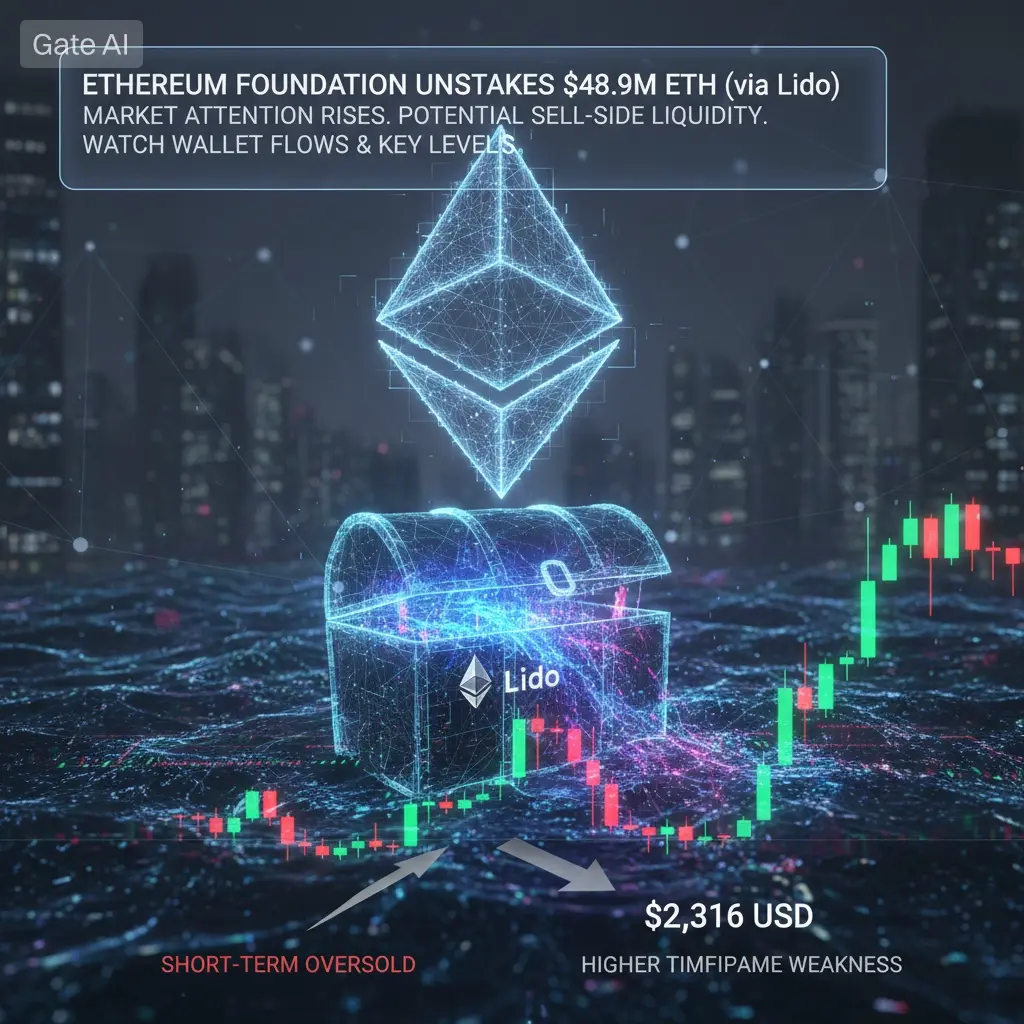
#EthereumFoundationUnstakes$48.9METH
Ethereum Foundation Unstakes $48.9M ETH - Complete Analysis for Traders
The Ethereum Foundation has unstaked approximately $48.9 million worth of ETH through Lido, according to on-chain data from Arkham Intelligence. This significant movement has caught the attention of the entire crypto market and is currently trading near $2,316. Let me break down what this means for traders and the broader cryptocurrency ecosystem.
Understanding the Event
When we talk about unstaking, we are referring to the process where staked ETH is converted back into liquid assets.
ETH-3,52%
ARKM-5,72%
HighAmbition
#EthereumFoundationUnstakes$48.9METH
Ethereum Foundation Unstakes $48.9M ETH - Complete Analysis for Traders
The Ethereum Foundation has unstaked approximately $48.9 million worth of ETH through Lido, according to on-chain data from Arkham Intelligence. This significant movement has caught the attention of the entire crypto market and is currently trading near $2,316. Let me break down what this means for traders and the broader cryptocurrency ecosystem.
Understanding the Event
When we talk about unstaking, we are referring to the process where staked ETH is converted back into liquid assets. The Ethereum Foundation had previously locked these funds in staking contracts through Lido, one of the largest liquid staking protocols. By unstaking, they have essentially moved these assets from a locked state to a liquid state, which means they now have the flexibility to transfer, sell, or redeploy these funds as they see fit.
The Ethereum Foundation is the non-profit organization that oversees the development and maintenance of the Ethereum blockchain. They hold a substantial treasury of ETH, which they use for funding development, research, grants, and operational expenses. When they make moves like this, the market pays close attention because it can signal their intentions regarding the future direction of the project and their financial strategy.
Market Impact and Price Implications
The immediate concern for traders is whether this unstaking will translate into selling pressure. Currently, ETH is trading around $2,316, having experienced a slight decline of about 0.68 percent over the past 24 hours. The technical analysis shows some interesting patterns. On the 15-minute timeframe, we are seeing oversold conditions with RSI at 23.80 and Williams R at -95.64, which typically suggests a potential for short-term bounce. However, on the daily timeframe, there are concerning signals including MACD and RSI bearish divergences, which indicate that the upward momentum might be weakening.
The key support level to watch is around $2,175, while resistance sits at $2,476. If the Ethereum Foundation decides to sell any portion of this unstaked ETH, it could add significant selling pressure to the market. However, it is important to note that unstaking does not necessarily mean immediate selling. The Foundation may be preparing funds for operational expenses, developer grants, or strategic partnerships.
Why Did They Unstake
The Ethereum Foundation has not provided an official statement explaining this move, which has led to various speculations in the market. Some analysts suggest this could be part of regular treasury management, where they are converting staked assets to cover operational costs. Others speculate it might be preparation for funding upcoming Ethereum upgrades or ecosystem development initiatives.
Historically, the Ethereum Foundation has unstaked ETH before without causing major market dumps. They tend to be strategic about their movements and often spread out any sales over time to minimize market impact. Traders should remember that the Foundation holds a significant treasury, and occasional rebalancing is normal for any large organization.
Social Sentiment and Market Psychology
The social media sentiment around this event shows mixed reactions. On X, there are approximately 392 posts related to ETH in the past three days, representing a nearly threefold increase in discussion volume compared to the previous period. This indicates heightened attention from the community. The fear and greed index sits at 47, which is in neutral territory, suggesting that while traders are watching this development, they have not yet panicked.
The positive sentiment stands at 54 percent versus 26 percent negative, which shows that despite this potentially bearish news, the community remains relatively optimistic. This could be because many traders view this as a routine treasury management move rather than a signal of lack of confidence in ETH.
Trading Strategies for Different Scenarios
For short-term traders, this event creates both opportunities and risks. If you are a scalper or day trader, the increased volatility around this news could provide trading opportunities. The current oversold conditions on lower timeframes might offer a short-term bounce play, but you should be cautious about the bearish divergences on higher timeframes.
For swing traders, the key is to watch whether the Foundation actually moves these funds to exchanges or if they remain in their wallets. If you see on-chain data showing transfers to exchange addresses, that would be a stronger bearish signal. Currently, the market is in a wait-and-see mode, waiting for any official announcement from the Foundation about their intentions.
For long-term holders, this event should not fundamentally change your thesis unless you believe the Foundation is losing confidence in their own project, which seems unlikely given their ongoing development efforts and the upcoming Ethereum upgrades. The unstaked amount, while significant at $48.9 million, represents only a small fraction of the total ETH market cap, which is approximately $280 billion.
Risk Management Considerations
The most important thing for traders right now is to manage risk appropriately. The daily trading volume for ETH is around $305 million, so a $48.9 million potential sale represents a meaningful but not catastrophic portion of daily volume. However, in thin order book conditions, especially on weekends or during low liquidity periods, even smaller sales can move prices significantly.
Traders should consider setting stop losses below the key support level of $2,175. If that level breaks with volume, it could trigger a cascade of liquidations and further downside. On the upside, a break above $2,476 with strong volume would invalidate the bearish scenario and could lead to a test of higher levels.
What to Watch Next
There are several key things traders should monitor in the coming days. First, keep an eye on the Ethereum Foundation wallet addresses for any movement of these unstaked funds. Second, watch for any official statement from the Foundation explaining their intentions. Third, monitor the funding rates and open interest in perpetual futures, as these can give early signals of market positioning.
The order book depth data shows that approximately $1,022 is needed to move prices by five points on Polymarket, indicating relatively thin liquidity. This means price swings could be more pronounced than usual, creating both opportunities and risks for active traders.
Long-term Perspective
Despite this short-term uncertainty, the fundamentals of Ethereum remain strong. The network continues to process billions of dollars in transaction volume daily, and the ecosystem of decentralized applications, DeFi protocols, and NFT platforms continues to grow. The upcoming upgrades to the Ethereum network, including improvements to scalability and efficiency, should provide long-term value accrual to ETH holders.
The fact that the Foundation is managing their treasury actively is actually a positive sign of financial responsibility. Organizations that simply hold all their assets without any management often run into liquidity issues during market downturns. By maintaining a portion of their holdings in liquid form, the Foundation ensures they can continue funding development regardless of market conditions.
Final Thoughts for Traders
This event serves as a reminder that in cryptocurrency markets, large holders and foundations can significantly impact short-term price action. However, the long-term trajectory of ETH will be determined by network adoption, technological development, and macroeconomic factors rather than single treasury management decisions.
For traders, the key is not to panic but to have a plan. If you are long ETH, consider whether your position size is appropriate for your risk tolerance given this new information. If you are considering entering a position, the current uncertainty might present a better entry point if prices decline further, but be prepared for volatility.
repost-content-media
  • Reward
  • Comment
  • Repost
  • Share
#AaveLaunchesrsETHRecoveryPlan
🚨 DeFi’s Biggest Test in 2026: How rsETH Shocked the Market — and Why It Didn’t Break It
On April 18, 2026, the DeFi ecosystem faced a high-impact crisis that had the potential to trigger widespread instability across lending markets. A vulnerability in KelpDAO’s LayerZero V2 bridge allowed an attacker to mint approximately $292 million worth of unbacked rsETH, instantly creating a severe imbalance between supply and collateral backing.
This was not just another exploit. This was a real-time stress test of DeFi’s infrastructure, liquidity models, and risk manag
AAVE0,16%
STETH-3,1%
ETH-3,52%
ZRO-5,95%
HighAmbition
#AaveLaunchesrsETHRecoveryPlan
🚨 DeFi’s Biggest Test in 2026: How rsETH Shocked the Market — and Why It Didn’t Break It
On April 18, 2026, the DeFi ecosystem faced a high-impact crisis that had the potential to trigger widespread instability across lending markets. A vulnerability in KelpDAO’s LayerZero V2 bridge allowed an attacker to mint approximately $292 million worth of unbacked rsETH, instantly creating a severe imbalance between supply and collateral backing.
This was not just another exploit. This was a real-time stress test of DeFi’s infrastructure, liquidity models, and risk management systems.
⚠️ What Happened — The Core Breakdown
The attacker exploited a weak 1-of-1 verifier setup, forged cross-chain data, and minted 116,500 rsETH without any corresponding burn. A large portion of these assets was then deployed into Aave V3 as collateral, allowing the attacker to borrow significant liquidity in WETH and stETH.
This pushed positions to extremely fragile health factors near liquidation levels and exposed Aave to potential bad debt scenarios reaching up to $230 million if rsETH lost its peg.
A critical point many missed is that Ethereum mainnet rsETH remained backed. The real issue was isolated to L2-minted tokens, where the backing ratio dropped sharply to nearly 26 percent, creating a shortfall exceeding 112,000 rsETH.
⚡ Aave’s Response — Precision Under Pressure
Within hours, Aave executed one of the most disciplined responses seen in DeFi:
All rsETH markets were frozen
Loan-to-Value was set to zero
Borrowing activity was halted
Risk exposure was immediately contained
There was no delay, no confusion, and no system failure. The protocol operated exactly as designed, proving that mature DeFi systems are capable of handling extreme scenarios without collapsing.
🤝 DeFi United — The Turning Point
Instead of triggering panic across the ecosystem, the situation evolved into a coordinated recovery effort known as DeFi United.
Major protocols including Lido, LayerZero, and EtherFi aligned capital and strategy to stabilize the system.
Over $160 million has already been raised toward a $200 million recovery target, supported by DAO treasuries, ecosystem partners, and direct contributions from key figures such as Stani Kulechov.
This level of coordination highlights a fundamental shift in DeFi. Competing protocols can become partners when systemic stability is at risk.
📊 Market Impact & Price Context (Late April 2026)
The market reacted with initial volatility but recovered faster than expected:
DeFi TVL dropped by approximately $13 billion
rsETH temporarily depegged under pressure
Ethereum remained stable between $2,300 and $2,400
AAVE declined briefly before rebounding toward the $91–$95 range
This recovery suggests that confidence in strong protocols remains intact, even during high-stress events.
🧠 Deeper Insights Most Traders Overlook
This incident revealed structural truths that every serious participant should understand.
Cross-chain bridges remain one of the most vulnerable layers in DeFi, especially when validation mechanisms are weak. A single point of failure in verification can cascade into multi-protocol risk.
Collateral quality matters more than ever. Not all yield-bearing assets carry the same risk, even if they appear similar on the surface.
Liquidity can disappear faster than expected during stress conditions. What looks safe in normal markets can become fragile under pressure.
🔥 My Perspective — This Was Evolution, Not Failure
Comparing this to centralized collapses like FTX highlights a critical difference.
Centralized systems tend to hide risk until it is too late. When failure occurs, it is sudden and irreversible.
DeFi operates in the open. Risks are visible, responses are immediate, and solutions are collaborative.
This event did not weaken DeFi. It exposed inefficiencies and forced improvements, which is exactly how resilient systems evolve.
🎯 Key Takeaways for Traders & Investors
DeFi is proving to be antifragile, meaning it strengthens through stress rather than breaking under it.
Aave has reinforced its position as a leading protocol by managing risk effectively in a real-world crisis scenario.
Traders should pay closer attention to collateral structures, bridge security, and leverage exposure rather than focusing only on yields.
Opportunities emerge during volatility, but only for those who understand the underlying risks.
🚀 What Comes Next
The next phase will focus on restoring rsETH backing, reopening bridges, and normalizing market conditions. If the recovery plan continues to execute successfully, this event could become a defining moment that increases institutional confidence in DeFi.
The long-term trajectory remains intact, but the standards for security and risk management are now significantly higher.
💬 Final Thought
This was not just a crisis. It was a demonstration of how decentralized systems respond under pressure.
DeFi did not collapse.
DeFi coordinated.
DeFi adapted.
And most importantly, DeFi proved it can recover.
repost-content-media
  • Reward
  • Comment
  • Repost
  • Share
#比特币Breaks79K
📢 Gate Square | Apr 27 Polymarket Challenge: What’s BTC’s Target Price Today?
Bitcoin Price Analysis: Will BTC Break Through $80,000 Amid Geopolitical Uncertainty?
Bitcoin has once again captured the market's attention as it tests the critical $80,000 resistance level following a weekend rally driven by shifting geopolitical dynamics. The cryptocurrency surged above $79,000 during Asian trading hours on Monday, fueled by a combination of risk-on sentiment and institutional accumulation, before settling around the $77,800 level as traders assess whether the momentum can sustain
HighAmbition
#比特币Breaks79K
📢 Gate Square | Apr 27 Polymarket Challenge: What’s BTC’s Target Price Today?
Bitcoin Price Analysis: Will BTC Break Through $80,000 Amid Geopolitical Uncertainty?
Bitcoin has once again captured the market's attention as it tests the critical $80,000 resistance level following a weekend rally driven by shifting geopolitical dynamics. The cryptocurrency surged above $79,000 during Asian trading hours on Monday, fueled by a combination of risk-on sentiment and institutional accumulation, before settling around the $77,800 level as traders assess whether the momentum can sustain a push toward the psychological $80,000 barrier.
The weekend's price action was significantly influenced by two major geopolitical developments that created a complex risk environment for traditional and digital assets alike. First, an alarming security incident occurred at the White House Correspondents' Dinner where an armed assailant attempted to breach a security checkpoint, raising concerns about political stability and security vulnerabilities at high-profile events. Second, and perhaps more impactful for market sentiment, news emerged regarding renewed discussions around a ceasefire agreement between the United States and Iran, with negotiations reportedly back on the table after previous setbacks.
These developments created a unique market dynamic where traditional safe-haven assets saw mixed flows while Bitcoin benefited from both risk-on rotation and its growing status as a non-sovereign store of value. The cryptocurrency's ability to maintain gains above $79,000 during early Monday trading suggests that institutional and whale investors are viewing the current geopolitical uncertainty as a catalyst rather than a deterrent for digital asset allocation.
From a technical analysis perspective, Bitcoin faces a formidable challenge at the $80,000 level. According to options market data analyzed by crypto analysts, $80,000 represents the first effective resistance level for BTC, characterized by high call open interest, positive gamma exposure, and relatively low implied volatility. This confluence of technical factors creates a scenario where market makers' dynamic hedging activities could generate selling pressure as prices approach this threshold. The options data reveals approximately 7,200 BTC in call open interest at the $80,000 strike, creating a substantial wall that bulls must overcome.
However, the technical picture becomes more nuanced when examining what lies beyond the $80,000 barrier. Should Bitcoin successfully breach this level and approach $82,000, the market structure shifts dramatically. At this higher level, there exists a larger concentration of negative gamma exposure totaling approximately 4,644 BTC, which could trigger a rapid transition from suppressed volatility to an amplified volatility regime. This suggests that a clean break above $80,000 could potentially accelerate price action toward $83,000 to $84,000 in relatively short order, with some bullish projections eyeing the $100,000 psychological milestone if momentum sustains.
The funding rate dynamics across perpetual futures markets add another layer of complexity to the current setup. Bitcoin perpetual contract funding rates have remained in negative territory, indicating that short sellers are paying long holders to maintain their positions. This unusual condition during a price rally suggests that a significant short squeeze could be building, which would amplify any breakout above key resistance levels. Market data from Coinglass indicates that if Bitcoin were to breach $81,342, approximately $7.66 billion in cumulative short positions across major centralized exchanges would face liquidation pressure, creating a potential cascade effect that could drive prices substantially higher.
Institutional flows have provided additional support for the bullish thesis. Strategy, the company formerly known as MicroStrategy and led by Bitcoin advocate Michael Saylor, recently added 34,164 BTC to its holdings between April 13-19, 2026, at an average purchase price of approximately $25.4 billion. This acquisition brings the company's total Bitcoin holdings to over 800,000 BTC, valued at approximately $61.56 billion. Such institutional accumulation at current price levels signals continued confidence in Bitcoin's long-term value proposition and provides a demand floor that could absorb selling pressure near resistance levels.
On-chain data reveals additional evidence of strategic positioning by large market participants. A prominent whale known by the moniker "Set 10 Big Goals" has placed a substantial buy order for 397.718 BTC at $77,686.50, representing approximately $30.89 million in notional value. This significant limit order placement suggests that sophisticated investors view the current price levels as attractive entry points, providing support for any potential pullbacks. Additionally, a major Bitcoin short seller who had been holding a 170 BTC position worth approximately $13.26 million recently closed their position at $77,893, securing a modest profit of around $41,000. This short covering activity removes some of the overhead supply that could have capped price advances.
The macroeconomic calendar for the upcoming week presents several catalysts that could influence Bitcoin's trajectory. Market participants are closely monitoring the Federal Open Market Committee (FOMC) interest rate decision scheduled for April 29, alongside major technology earnings reports from Microsoft, Amazon, Meta, and Google. The following day brings Apple's earnings report, U.S. Q1 GDP data, and March PCE inflation figures. These events collectively represent significant potential volatility drivers that could either support or derail Bitcoin's attempt to breach the $80,000 level.
From a strategic trading perspective, the current market structure presents both opportunities and risks for position management. For long position holders, the question of whether to maintain exposure or take profits at current levels depends heavily on individual risk tolerance and time horizon. The technical setup suggests that a confirmed daily close above $80,000 would validate the bullish breakout thesis and potentially open the path toward substantially higher prices. However, the presence of significant options resistance and the potential for geopolitical developments to shift rapidly create downside risks that cannot be ignored.
The risk-reward profile for new long entries at current levels appears asymmetrical, with limited upside to the $80,000 resistance zone versus meaningful downside potential if momentum stalls. Traders considering fresh positions might benefit from waiting for either a confirmed breakout above $80,000 with strong volume confirmation or a pullback toward the $76,000 to $77,000 support zone where risk-adjusted entry opportunities may present themselves.
For those already holding long positions, partial profit-taking strategies could be considered to lock in gains while maintaining upside exposure through retained core positions. Setting trailing stops below the $77,000 level would protect against significant downside while allowing participation in any breakout scenario. Alternatively, hedging strategies using options could provide downside protection without requiring full position liquidation.
The broader market context supports a cautiously optimistic view for Bitcoin's near-term prospects. The cryptocurrency has demonstrated resilience in the face of macroeconomic headwinds and has benefited from the ongoing regulatory evolution in the United States. SEC Chairman Paul Atkins, who assumed office in April 2025, has reportedly shifted enforcement priorities away from the aggressive stance of his predecessor, creating a more constructive regulatory environment for digital asset innovation and adoption.
In conclusion, Bitcoin stands at a critical juncture as it tests the $80,000 resistance level against a backdrop of geopolitical uncertainty and institutional accumulation. The technical setup suggests that a breakout above this level could trigger accelerated price appreciation toward $83,000 to $84,000, with the potential for even more substantial gains if momentum sustains. However, traders should remain cognizant of the risks posed by options market dynamics, potential geopolitical reversals, and the upcoming macroeconomic catalysts that could introduce volatility. For long position holders, maintaining exposure while implementing risk management protocols appears prudent, while new entrants might benefit from patience as the market resolves the current resistance challenge. The path forward will likely be determined by whether institutional demand can overcome the technical selling pressure at $80,000 and whether geopolitical developments continue to favor risk-on asset allocation.
repost-content-media
  • Reward
  • Comment
  • Repost
  • Share
#US-IranTalksStall
US-Iran Nuclear Talks Stall:
Why Are The Talks Stalled?
The negotiations between the United States and Iran have reached a complete deadlock due to multiple interconnected factors:
1. Fundamental Disagreement on Nuclear Enrichment
The core sticking point centers on the duration of Iran's nuclear enrichment freeze. Iran insists on maintaining its nuclear program sovereignty while the US demands comprehensive dismantling. Iranian hardliners, particularly within the IRGC (Islamic Revolutionary Guard Corps), view any negotiations under current conditions as granting the US a "
HighAmbition
#US-IranTalksStall
US-Iran Nuclear Talks Stall:
Why Are The Talks Stalled?
The negotiations between the United States and Iran have reached a complete deadlock due to multiple interconnected factors:
1. Fundamental Disagreement on Nuclear Enrichment
The core sticking point centers on the duration of Iran's nuclear enrichment freeze. Iran insists on maintaining its nuclear program sovereignty while the US demands comprehensive dismantling. Iranian hardliners, particularly within the IRGC (Islamic Revolutionary Guard Corps), view any negotiations under current conditions as granting the US a "low-cost victory" that violates Iran's declared red lines.
2. US Naval Blockade of Iranian Ports
President Trump ordered a naval blockade of Iran's ports in response to Iran's closure of the Strait of Hormuz since February 28, 2026. Iran considers this blockade a violation of the ceasefire agreement, while the US maintains it as necessary pressure. This blockade has hardened Iranian negotiating positions significantly.
3. Internal Iranian Power Struggle
There is reported infighting within Iran's leadership. Hardline elements led by figures like Vahidi oppose negotiations entirely, viewing them as having "no present value." IRGC-affiliated outlets argue that discussing the Strait of Hormuz would signal doubt over Iranian sovereignty. Meanwhile, Foreign Minister Araghchi reportedly believes participation offers little benefit and amounts to a "death sentence" for the talks under current Supreme Leader orders.
4. The "No Deal-No War" Limbo
Tehran has warned that talks may stall in a dangerous limbo where neither war nor peace prevails. The fragile two-week ceasefire expired recently, with both sides expressing readiness to resume hostilities. Pakistan-mediated talks failed to materialize after Iran pulled out of the second round.
5. Trump's Hardline Stance
President Trump cancelled a planned trip to Pakistan for negotiations, stating "we have all the cards, they have none." He has refused to lift the Hormuz blockade until a comprehensive deal is agreed, creating a chicken-and-egg situation where neither side will move first.
The Strait of Hormuz Crisis
The Strait of Hormuz represents the world's most critical oil chokepoint:
Global Significance: Approximately one-fifth of global oil supply and LNG flows through this narrow waterway
Current Status: Effectively closed due to the standoff, with tankers blocked from passage
Iran's Position: Claims full sovereignty over the strait and opposes any negotiations that would question this
US Response: Naval blockade preventing Iranian shipping, creating a counter-blockade situation
According to Baker Hughes and Dallas Fed surveys, nearly 80% of oil executives believe the strait will not reopen until August 2026 or later. This prolonged closure scenario is driving persistent risk premiums in oil markets.
Oil Market Impact and Price Forecasts
Current Oil Prices:
Brent Crude: Trading above $104-107 per barrel
WTI Crude: Around $101-102 per barrel
Price Increase: Oil has climbed roughly 12% recently, on pace for the biggest weekly gain since early March 2026
Why Oil Prices Are Surging:
1. Supply Disruption Risk: The Strait of Hormuz closure threatens nearly 20% of global oil supply
2. Shipping Cost Explosion: The Breakwave Tanker Shipping ETF has surged over 600% year-to-date as freight rates skyrocket
3. Refined Fuel Crisis: Diesel and jet fuel prices have rocketed to over $200 at times, showing demand destruction in Asian markets
4. Geopolitical Risk Premium: Markets pricing in sustained uncertainty
Price Forecasts:
Goldman Sachs: Estimates oil price increases ranging from $1-15 per barrel depending on disruption duration; warns prices can rise significantly above fair-value during high geopolitical uncertainty
EIA Forecast: Brent to fall below $90/b in Q4 2026 and average $76/b in 2027 (highly dependent on Hormuz reopening)
J.P. Morgan: Expects Brent averaging around $60/b in 2026 (bearish scenario assuming resolution)
Bloomberg Economics: For oil around $110/barrel, projects marked boost to inflation and blow to growth
ANZ: Expects Brent above $90/barrel in 2026, ending year at $88 due to supply loss
Key Risk: If Iran escalates and oil pushes toward $75-80 (currently already above $100), institutions will likely flip into full risk-off mode, triggering broader market selloffs.
Bitcoin Market Volatility Analysis
Current BTC Status:
Price: $77,517 (as of latest data)
24-hour change: +0.08%
7-day performance: +2.21%
30-day performance: +16.78%
How Geopolitical Tensions Are Affecting BTC:
1. Correlation with Oil
Bitcoin has shown a notable inverse correlation with oil price spikes. When oil started ripping higher in early 2026, BTC dropped fast from above $105K into the mid-$90Ks. The pattern is clear: oil moves first, BTC reacts second.
2. Resilience Factor
Interestingly, Bitcoin has proven more resilient than oil and equities to recent Iran-related flare-ups. The modest 1.6% pullback in BTC during the latest escalation stood against a 5.7% jump in Brent and 1.2% drop in European equity futures. Shrinking BTC sell-offs with each Iran shock suggest crypto may have largely priced in geopolitical tail risk.
3. Institutional Flows Support
US spot Bitcoin ETFs have seen 8 consecutive days of inflows exceeding $2 billion total, with weekly inflows near $1 billion - the highest since mid-January. Strategy (MicroStrategy) purchased 34,164 BTC for approximately $254 million at an average price of $74,395, bringing total holdings to 815,061 BTC. This institutional demand provides a floor.
4. Fear and Greed Index
Current reading of 33 indicates fear territory, but with 66% positive sentiment versus 17% negative, there is underlying bullish conviction.
Technical Levels to Watch:
Support: $74,000 - $73,000 range
Resistance: $78,000 (recently breached), next target $80,000
Daily SAR indicates bearish trend but 15-minute and 4-hour charts show mixed signals with MACD底背离 (bottom divergence) suggesting potential reversal
BTC Forecast:
If oil stays contained below $110, BTC can stabilize and potentially rally toward $80K-$88K. However, if oil breaks above $110-120 on full Hormuz closure, expect BTC to retest $70K-$73K support. The ETF bid has become a more reliable floor than futures-driven weekend gaps.
Trading Strategy Recommendations
For Conservative Traders:
1. Risk Management Priority
Reduce position sizes by 20-30% during high geopolitical uncertainty
Maintain 40-50% cash reserves for dip-buying opportunities
Set stop-losses at $72,000 for long BTC positions
2. Hedging Approach
Consider put options on BTC at $70K strike for protection
Allocate 10-15% to gold as traditional safe haven (currently $4,713/oz)
Dollar-cost average rather than lump sum entries
For Aggressive Traders:
1. Volatility Plays
Trade range-bound strategies between $73K-$78K
Use grid trading bots to capture oscillations
Consider longing oil proxies (energy ETFs) while shorting risk assets if tensions escalate
2. Breakout Strategies
Long BTC on confirmed break above $78,500 with target $82K
Short BTC on break below $73,000 with target $68K
Monitor oil price as leading indicator for crypto moves
Key Levels to Watch:
Oil:
Bullish above $110 (Hormuz closure extended)
Bearish below $95 (talks progress)
Bitcoin:
Critical support: $73,000-$74,000
Major resistance: $78,000-$80,000
Breakout target: $88,000 (probability currently low at 1% for April 20-26 window)
General Tips:
1. Watch Oil First: Oil prices lead, BTC follows. Monitor Brent crude as your primary geopolitical risk gauge.
2. ETF Flows Matter: Track US spot Bitcoin ETF daily flows. Sustained inflows above $200M/day support price floors.
3. Avoid Weekend Gaps: Geopolitical developments often occur weekends when crypto trades but traditional markets closed. Be cautious holding large positions over weekends.
4. Dollar Strength: Geopolitical instability drives dollar strength (DXY), which typically pressures BTC. Monitor DXY above 104 as bearish for crypto.
5. Time Horizon: If you're a long-term holder, these dips below $75K present accumulation opportunities. If trading short-term, respect the volatility and use tight stops.
6. News Sensitivity: Any headline about "Hormuz reopening" or "talks resume" will cause immediate moves. Have alerts set for major news sources.
Summary: The Complete Picture
The US-Iran talks are stalled due to irreconcilable differences on nuclear enrichment, compounded by the US naval blockade and internal Iranian power struggles. The Strait of Hormuz remains effectively closed, with 80% of industry experts expecting no reopening before August 2026. This is driving oil prices above $104-107 with forecasts ranging from $76-$110 depending on resolution timeline.
Bitcoin has shown surprising resilience, trading around $77,500 with institutional ETF inflows providing support. However, the correlation with oil means that if crude breaks significantly higher on escalation, BTC will likely face pressure toward $70K-$73K support.
Traders should prioritize risk management, maintain cash reserves for opportunities, use oil as a leading indicator, and set alerts for any breakthrough in negotiations. The current environment favors patient, defensive positioning with readiness to act quickly on any resolution news.
repost-content-media
  • Reward
  • Comment
  • Repost
  • Share
#BTCMarketAnalysis
Bitcoin is currently trading around $77,680, after recently touching highs near $79,500 and failing to break the major $80,000 psychological resistance. This rejection is not just a simple pullback; it reflects a combination of technical pressure, liquidity barriers, and cautious market sentiment that is shaping the current market structure.
The $78,000 to $80,000 zone has become one of the most important resistance areas in the market right now. This region aligns with previous highs formed in late January and early February, which means a large number of traders previousl
BTC-2,3%
BlackRiderCryptoLord
#BTCMarketAnalysis
Bitcoin is currently trading around $77,680, after recently touching highs near $79,500 and failing to break the major $80,000 psychological resistance. This rejection is not just a simple pullback; it reflects a combination of technical pressure, liquidity barriers, and cautious market sentiment that is shaping the current market structure.
The $78,000 to $80,000 zone has become one of the most important resistance areas in the market right now. This region aligns with previous highs formed in late January and early February, which means a large number of traders previously entered positions here. As price revisits this zone, many of those participants are exiting their positions at breakeven or small profit, creating strong selling pressure. At the same time, volume profile analysis shows the Point of Control (POC) near $80,500, meaning this is where the highest trading activity occurred historically. Such levels often act as magnets for price but also require strong momentum to break through.
Liquidity data further strengthens this bearish pressure in the short term. There are heavy sell walls stacked between $80,000 and $84,000, indicating that even if Bitcoin manages to break $80K, it will not be an easy continuation. Without sustained institutional inflows and strong spot demand, any breakout attempt may face quick rejection.
Another critical signal comes from the derivatives market. Funding rates remain negative despite price moving upward toward $79K. This is an unusual divergence because, in strong bullish trends, funding typically turns positive. The current situation suggests that spot buyers are pushing the price up, while leveraged traders are either cautious or actively shorting the market. This creates a fragile rally structure where upward movement lacks strong conviction and can reverse quickly if buying pressure slows down.
At the macro level, geopolitical developments have become the dominant driver of Bitcoin’s recent price action. The temporary ceasefire between the United States and Iran triggered a strong risk-on move, pushing Bitcoin from the low $70,000 range to nearly $79,000 within a short time. This move was supported by approximately $1.4 billion in institutional inflows, highlighting how quickly sentiment can shift when global tensions ease. Additionally, the rally caused over $330 million in short liquidations, creating a chain reaction of forced buying that accelerated the upward move.
However, the situation remains unstable. Reports of renewed tensions, including the seizure of an Iranian cargo vessel, caused Bitcoin to briefly fall below $74,000, showing how sensitive the market currently is to geopolitical headlines. While temporary stability has returned, the lack of a permanent resolution keeps uncertainty high.
🔍 Scenario Breakdown:
🔴 Bearish Scenario (Geopolitical Escalation):
If tensions rise again or the ceasefire collapses, markets may shift into risk-off mode. In this case, Bitcoin could drop toward $73,000 – $70,000, especially as CME gaps remain open in that range. Initially, BTC may move in correlation with equities to the downside before stabilizing.
🟢 Bullish Scenario (De-escalation & Stability):
If peace talks progress and uncertainty fades, Bitcoin could break above $80,000 with strong momentum. This could open the path toward $82,000 – $84,000, and in an extended rally, the $90,000 – $100,000 range could come into focus as institutional demand strengthens.
📊 Inflation & Federal Reserve Influence:
Recent CPI data has shown signs of easing inflation, which supports risk assets like Bitcoin. Lower inflation increases the likelihood of future interest rate cuts, which improves liquidity conditions and supports bullish momentum.
However, risks still remain. Core inflation is still relatively sticky, and any unexpected increase could push the Federal Reserve to maintain higher interest rates for longer. This would reduce liquidity and potentially slow down Bitcoin’s upward movement.
In addition, discussions around potential Federal Reserve leadership changes and policy direction are adding another layer of uncertainty that traders must monitor closely.
📈 Trading Strategies:
Bullish Breakout Strategy:
Wait for a confirmed breakout above $78,300 – $79,000 with strong volume and rising open interest.
Targets: $80K → $82K → $84K
Stop Loss: Below $76,200 or $75,500
Confirmation: Funding turning positive + strong spot demand
Bearish Rejection Strategy:
Look for rejection signals near $79K – $80K (e.g., long wicks, bearish divergence).
Targets: $76K → $73.5K → $71K
Stop Loss: Above $80K
Range Trading Strategy:
Market is currently range-bound, so traders can:
Buy near $75,100 – $73,600
Sell near $78,600+
Avoid $76K – $78K zone due to choppy movement
📦 On-Chain & Market Structure:
On-chain data continues to show strong long-term confidence:
+303,000 BTC accumulated by long-term holders
-290,000 BTC reduced by short-term holders
This indicates a shift from weak hands to strong hands, which is typically a bullish sign for the long-term trend.
Institutional participation is also increasing, with major players and corporations continuing to accumulate Bitcoin, reinforcing the broader bullish structure.
⚠️ Risk Management:
The current market environment is highly sensitive and driven by external factors. Traders should:
Use proper position sizing
Avoid over-leveraging
Wait for confirmation before entering trades
Stay updated on geopolitical and macro developments
🔮 Final Outlook:
Bitcoin remains in a larger uptrend, but is currently facing a strong resistance barrier. The $80,000 level is the key trigger point for the next major move.
A strong breakout above this level could lead to rapid upside expansion, while repeated rejection may push price back toward the $70,000 support region.
In this phase, patience and discipline are more important than aggressive trading. The market is offering opportunities, but only to those who can manage risk and adapt quickly to changing conditions.
  • Reward
  • Comment
  • Repost
  • Share
#Gate13thAnniversaryLive
Gate 13th Anniversary Live Carnival: Thirteen Years of Innovation, One Global Celebration
Gate marks its 13th anniversary with a month-long live streaming celebration running from April 20 to May 20, 2026. Founded in 2013, the platform has grown into a cornerstone of the digital asset ecosystem, serving over 50 million users worldwide with access to 4,500+ trading pairs. This milestone event brings together streamers, traders, and community members through an immersive live experience designed to reward participation and celebrate collective achievement.
The anniversa
BlackRiderCryptoLord
#Gate13thAnniversaryLive
Gate 13th Anniversary Live Carnival: Thirteen Years of Innovation, One Global Celebration
Gate marks its 13th anniversary with a month-long live streaming celebration running from April 20 to May 20, 2026. Founded in 2013, the platform has grown into a cornerstone of the digital asset ecosystem, serving over 50 million users worldwide with access to 4,500+ trading pairs. This milestone event brings together streamers, traders, and community members through an immersive live experience designed to reward participation and celebrate collective achievement.
The anniversary theme centers on connection and shared success. Participants can earn rewards up to $100 through active engagement, including limited-edition anniversary gift boxes unlocked through task completion rather than random chance. Daily red packet drops, check-in bonuses, and mega prize pools run throughout the event period, creating continuous opportunities for community members to benefit from the celebration.
The official launch banquet streamed on April 20, featuring insights from Gate leadership including CEO Dr. Han and CBO Kevin Lee. Executive discussions covered platform strategy, industry trends, and the roadmap for multi-asset expansion bridging traditional finance with digital assets. The event highlighted Gate's push into AI-driven trading tools through GateAI initiatives, reinforcing its position at the intersection of emerging technology and financial infrastructure.
For content creators, the Live Carnival offers homepage exposure, traffic boosts, and leaderboard-based prizes. Streamers can apply through Gate Live to participate in the reward program, with dedicated support for building audience engagement during the anniversary period. Viewers benefit from interactive features including daily draws with physical gold tickets as prizes, creating tangible value beyond digital rewards.
The Red Bull F1 Station represents the second major activation, where users complete boarding missions to unlock time capsules and share in million-dollar prize pools. Tasks include watching anniversary content, experiencing Gate AI features, and registering for WCTC Season 8. Continued participation through trading, investing, and VIP upgrades generates additional draw entries, rewarding sustained engagement across the platform ecosystem.
Gate's 13-year journey reflects the evolution of cryptocurrency from niche technology to mainstream financial infrastructure. The platform's commitment to security, liquidity, and innovation has established it as a trusted venue for both retail and institutional participants. This anniversary celebration acknowledges that growth while positioning Gate for the next phase of development in Web3 infrastructure and AI-enhanced trading.
The Live Carnival runs through May 20, 2026. Participation requires active engagement with Gate Live streams and completion of designated tasks. Rewards distribute based on verified activity, with physical prizes subject to standard verification procedures. Full terms and conditions available through official Gate channels.
#Gate13thAnniversary #GateLive
repost-content-media
  • Reward
  • Comment
  • Repost
  • Share
#美伊谈判陷入僵局
US-Iran Ceasefire on Shaky Ground: Will Hormuz Blockade Trigger Global Oil Shock?
The US-Iran ceasefire announced by President Trump is already showing cracks. Iran has seized two cargo vessels in the Strait of Hormuz and reimposed transit restrictions, citing "breaches of trust" by Washington. Tehran demands its permission for ships to cross, while Trump claims "total control" over the waterway. With Iran's top negotiator reportedly resigning and the IRGC tightening its grip, the ceasefire appears more like a temporary pause than a path to peace.
Hormuz Blockade Risk: High and Risi
BlackRiderCryptoLord
#美伊谈判陷入僵局
US-Iran Ceasefire on Shaky Ground: Will Hormuz Blockade Trigger Global Oil Shock?
The US-Iran ceasefire announced by President Trump is already showing cracks. Iran has seized two cargo vessels in the Strait of Hormuz and reimposed transit restrictions, citing "breaches of trust" by Washington. Tehran demands its permission for ships to cross, while Trump claims "total control" over the waterway. With Iran's top negotiator reportedly resigning and the IRGC tightening its grip, the ceasefire appears more like a temporary pause than a path to peace.
Hormuz Blockade Risk: High and Rising
A fifth of global oil and LNG transits through Hormuz. The strait is now effectively at a standstill, with tanker traffic near historic lows. Both sides have resorted to ship seizures during the ceasefire. Asian shipowners may test the waters first, but Western commercial fleets remain sidelined. If negotiations collapse entirely, a full blockade becomes a realistic scenario, cutting off millions of barrels daily from global markets.
Oil and Market Outlook if Conflict Escalates
Brent has already breached $104/barrel on negotiation jitters. Should Hormuz close completely, oil could spike toward $120-130 range as supply disruption dwarfs current strategic reserve releases. Energy-intensive sectors and import-dependent economies face immediate pressure. Risk assets would likely selloff as inflation expectations resurge, complicating central bank policy trajectories. Safe havens and energy exporters stand to benefit in the short term.
The next 48-72 hours are critical. Without a unified Iranian proposal or renewed mediator engagement, this ceasefire risks becoming the calm before a much larger storm.
repost-content-media
  • Reward
  • Comment
  • Repost
  • Share
#CryptoMarketSeesVolatility
WCTC S8 Global Trading Challenge - Gate 13th Anniversary Edition
Gate.io celebrates its 13th anniversary with the most ambitious trading competition of 2026. The WCTC Season 8 Global Trading Challenge has officially launched, featuring a massive prize pool of up to 8,000,000 USDT distributed across multiple competitive tracks designed for traders of all levels.
Event Timeline
The competition runs in structured phases to maximize participation opportunities. Pre-registration opened on April 14, 2026, and the official competition period spans from April 23 to May 20,
SWAP-1,09%
BlackRiderCryptoLord
#CryptoMarketSeesVolatility
WCTC S8 Global Trading Challenge - Gate 13th Anniversary Edition
Gate.io celebrates its 13th anniversary with the most ambitious trading competition of 2026. The WCTC Season 8 Global Trading Challenge has officially launched, featuring a massive prize pool of up to 8,000,000 USDT distributed across multiple competitive tracks designed for traders of all levels.
Event Timeline
The competition runs in structured phases to maximize participation opportunities. Pre-registration opened on April 14, 2026, and the official competition period spans from April 23 to May 20, 2026. The team competition is split into two distinct halves, with rankings resetting between phases to give participants multiple chances at victory.
Prize Pool Structure
The 8 million USDT prize pool is strategically allocated across four main categories. The Team Competition offers up to 3.6 million USDT, making it the largest single track. Individual traders can compete for up to 2 million USDT through the Individual Competition. The 1v1 Champion PK battle format features 1.6 million USDT in prizes for head-to-head matchups. Additionally, bonus events and livestream activities contribute a fixed 800,000 USDT reward pool regardless of participant numbers.
Dynamic Prize Scaling
The prize pool operates on a dynamic unlock mechanism based on valid trader participation. Starting from a baseline of 850,000 USDT, the pool scales progressively with more participants, reaching the full 8 million USDT when 500,000 or more valid traders join. A valid trader is defined as any participant who completes at least 10,000 USDT in trading volume during the competition period.
Eligible Markets
Participants can trade across Gate.io's comprehensive ecosystem. All USDT-margined spot trading pairs, ETFs, and flash swap options qualify. The futures category includes all USDT-margined perpetual contracts. Additionally, Gate's TradFi trading pairs are fully eligible, allowing participants to diversify strategies across traditional and digital asset markets.
Competition Formats
The Team Competition runs in two phases, with teams competing based on total trading volume and total profit metrics. The top 20 teams from each phase advance to prize distribution, and rankings reset between phases to create fresh opportunities. Individual Competition allows solo traders to compete on personal performance metrics. The 1v1 Champion PK format enables direct competitive matchups between selected participants.
Participation Requirements
Both new and existing Gate.io users are eligible to register. Team formation is permitted during the registration phase, allowing traders to collaborate strategically. All participants must complete identity verification to qualify for prize distribution. The competition welcomes individual traders, team players, and those seeking direct competitive matchups.
Strategic Opportunities
With multiple tracks available, participants can optimize their approach based on personal trading styles. Volume-focused traders may excel in team competitions where aggregate metrics matter. Profit-oriented traders can leverage their risk management skills in individual rankings. The 1v1 format suits competitive traders who thrive in direct matchup scenarios.
Risk Management Considerations
While the prize pool presents significant opportunities, participants should approach the competition with disciplined risk management. The requirement of 10,000 USDT minimum volume to qualify as a valid trader ensures meaningful participation without encouraging excessive trading. Participants should trade within their risk tolerance and avoid over-leveraging to chase volume metrics.
Getting Started
Registration remains open through the competition period. New users can complete KYC verification and immediately join any competition track. Existing users can leverage their current trading strategies while competing for additional rewards. The multi-phase structure ensures that late entrants still have opportunities to compete effectively.
Additional Anniversary Events
Gate's 13th anniversary celebration extends beyond the trading competition. The GATE GALA 13 anniversary dinner at Rosewood Hong Kong brought together global partners. The Gate 13 Blue Carpet Ceremony featured the unveiling of the F1 Red Bull team display car. The Racing the Future outdoor exhibition at K11 MUSEA waterfront promenade runs from April 18-24, showcasing the intersection of technology, racing, and digital assets.
Platform Advantages
Gate.io's 13-year track record provides a stable foundation for this competition. With over 50 million users and support for more than 4,500 trading pairs, the platform offers the liquidity and infrastructure necessary for high-volume competitive trading. The unified account system enables seamless movement between spot, futures, and TradFi markets without complex transfers.
Long-term Value
Beyond immediate prize opportunities, participation in WCTC S8 offers strategic benefits. Top performers gain visibility within the trading community. Team participants build networks with like-minded traders. The competitive environment sharpens trading skills applicable to regular market activities. VIP status upgrades from competition performance provide ongoing fee advantages.
Final Thoughts
The WCTC S8 Global Trading Challenge represents Gate.io's commitment to rewarding active traders while celebrating platform milestones. With 8 million USDT at stake and multiple paths to victory, the competition accommodates diverse trading approaches. Whether you prioritize volume, profitability, or direct competition, the structured prize distribution ensures meaningful opportunities for dedicated participants.
Registration is ongoing. Evaluate your trading strategy, select your preferred competition track, and position yourself for a share of the 8 million USDT prize pool. The competition rewards preparation, discipline, and execution.
Trade responsibly. Compete strategically. Celebrate Gate's 13th anniversary with performance that matters.
#WCTCS8 #Gate13thAnniversary
repost-content-media
  • Reward
  • Comment
  • Repost
  • Share
#WCTCTradingKingPK
WCTC S8 Trading Competition: My Journey Begins
The 8th season of Gate's World Crypto Trading Competition is now live, and I have officially joined the battle. With a prize pool reaching up to 7.2 million USDT across Team Trading Contest, Solo Trading Contest, and Champions Showdown, this is not just another trading event—it is a global stage where strategy meets execution.
I have registered for the Team Trading Contest, and here is why this approach makes sense. The competition rewards valid trading volume, which includes Spot, ETF, Convert (at 150% multiplier), Futures, an
BlackRiderCryptoLord
#WCTCTradingKingPK
WCTC S8 Trading Competition: My Journey Begins
The 8th season of Gate's World Crypto Trading Competition is now live, and I have officially joined the battle. With a prize pool reaching up to 7.2 million USDT across Team Trading Contest, Solo Trading Contest, and Champions Showdown, this is not just another trading event—it is a global stage where strategy meets execution.
I have registered for the Team Trading Contest, and here is why this approach makes sense. The competition rewards valid trading volume, which includes Spot, ETF, Convert (at 150% multiplier), Futures, and TradFi (at 10% multiplier). By pooling resources with a team, we unlock higher prize tiers as more traders join and meet the 10,000 USDT minimum volume threshold. The first 30 team leaders whose teams reach 50 members will share an additional 3,000 USDT bonus. My team is currently building momentum, and every new member strengthens our position.
For those considering participation, understanding the ROI calculation is critical. In Classic Spot Mode, your return is calculated against your initial futures and TradFi assets plus transfers. In Unified Account Mode, the calculation includes your total initial assets plus deposits. This distinction matters because it affects how you allocate capital across different account types. I have opted for Unified Account Mode for better capital efficiency, allowing me to manage margin across positions without fragmentation.
My strategy for WCTC S8 focuses on three pillars: risk management, volume optimization, and consistent execution. First, I never risk more than 3% of my competition capital on a single trade. The goal is longevity—staying in the game long enough for probabilities to work in your favor. Second, I prioritize trading pairs that contribute most to volume calculations. Futures trading counts at full value, making it efficient for volume building. Third, I maintain daily activity rather than chasing explosive one-day returns. The competition rewards sustained performance, and the Champions Showdown specifically tracks ROI over time.
The 1v1 PK battles have been particularly engaging. Matching against individual traders in real-time creates a different psychological dynamic compared to regular trading. You are not just reading the market; you are reading your opponent's likely moves. I have found that patience pays off in these battles—waiting for clear setups rather than forcing trades just to participate. My recent PK match lasted 45 minutes before a clear trend emerged, and the disciplined wait resulted in a favorable outcome.
For team leaders, the opportunity extends beyond personal trading. Building an active team requires communication, strategy sharing, and mutual support. I have been sharing market analysis with my team members daily, helping newer traders understand volume requirements and risk parameters. This collaborative approach not only improves individual performance but strengthens the entire team's standing.
The competition runs until May 6, 2026, giving participants ample time to build volume and refine strategies. Rewards distribution occurs within 15 business days after the event concludes, with vouchers available in the Vouchers section. Physical rewards like the WCTC commemorative T-shirts will be airdropped via Gate Shop and must be claimed within the valid period.
What distinguishes WCTC from other trading competitions is the multi-track structure. Whether you excel at solo trading, team coordination, or high-stakes championship rounds, there is a path for you. The Solo Contest appeals to independent traders who prefer full control over their decisions. The Team Contest rewards collective effort and community building. The Champions Showdown is for those who have proven themselves and want to compete at the highest level.
I will be documenting my WCTC S8 journey through regular updates, sharing both successes and lessons learned. Trading competitions are excellent environments for accelerated learning because they force discipline and accountability. Every decision has consequences, and the leaderboard does not lie.
To fellow participants: focus on what you can control. You cannot dictate market movements, but you can control your position sizing, your entry timing, and your emotional response to volatility. The traders who succeed in WCTC are not necessarily those with the highest risk tolerance, but those with the most consistent process.
My team is currently ranked in the middle tier, and we are pushing for top 100 placement. The next phase involves increasing daily trading volume while maintaining positive returns. It is a delicate balance—aggressive enough to compete, conservative enough to survive.
For those still considering joining: the registration remains open, and the prize pool grows as more valid traders participate. The minimum requirement is 20,000 USDT in total trading volume to qualify for rewards, which is achievable with proper planning. Do not let the large numbers intimidate you—every trader starts somewhere, and competitions like this are how you accelerate your growth.
I will share my team performance screenshot in the coming days as we approach key milestones. The competition is heating up, and the energy among participants is palpable. This is what trading communities are built for—pushing each other to perform at higher levels while maintaining sportsmanship and respect.
To victory, and to the lessons learned along the way.
#WCTCTradingKingPK #WCTCS8 #GateTradingCompetition
repost-content-media
  • Reward
  • Comment
  • Repost
  • Share
#IntelandTexasInstrumentsSurge
Semiconductor Giants Intel and Texas Instruments Deliver Explosive Rally: A Deep Dive into Q1 2026 Earnings
The semiconductor sector witnessed a historic surge on April 23, 2026, as two legacy chipmakers, Intel Corporation and Texas Instruments, delivered earnings reports that shattered Wall Street expectations and reignited investor enthusiasm for the analog and foundry segments of the chip industry. Both stocks posted double-digit gains, with Intel soaring approximately 20% and Texas Instruments jumping 19%, marking one of the most significant trading sessions
BlackRiderCryptoLord
#IntelandTexasInstrumentsSurge
Semiconductor Giants Intel and Texas Instruments Deliver Explosive Rally: A Deep Dive into Q1 2026 Earnings
The semiconductor sector witnessed a historic surge on April 23, 2026, as two legacy chipmakers, Intel Corporation and Texas Instruments, delivered earnings reports that shattered Wall Street expectations and reignited investor enthusiasm for the analog and foundry segments of the chip industry. Both stocks posted double-digit gains, with Intel soaring approximately 20% and Texas Instruments jumping 19%, marking one of the most significant trading sessions for the sector in recent memory.
Intel's Dramatic Turnaround Story
Intel's first-quarter 2026 results represent a pivotal moment in the company's ongoing transformation under CEO Lip-Bu Tan, who took the helm in early 2025. The chipmaker reported revenue of $13.58 billion, comfortably exceeding analyst expectations of $12.42 billion, while adjusted earnings per share of 29 cents demolished the consensus estimate of merely 1 cent. This represents a remarkable 7.2% year-over-year revenue increase, breaking a troubling pattern of declines in five of the past seven quarters.
The market reaction has been extraordinary. Intel's stock has now appreciated over 80% year-to-date in 2026, building upon an already impressive 84% gain in 2025. This remarkable rally has been fueled by multiple catalysts, including substantial backing from the Trump administration, which transformed the U.S. government into Intel's largest shareholder as part of a strategic initiative to reshore chip manufacturing. Additional investments from Nvidia and SoftBank have further bolstered confidence in Intel's turnaround narrative.
Perhaps the most significant development is Intel's renewed relevance in the artificial intelligence landscape. The company's data center business emerged as the star performer, with revenue climbing 22% to $5.1 billion. This growth is particularly noteworthy as it reflects a fundamental shift in AI infrastructure requirements. While Nvidia's GPUs have dominated the AI revolution thus far, the emergence of agentic workloads is driving renewed demand for central processing units, Intel's traditional stronghold.
CEO Lip-Bu Tan articulated this shift with conviction during the earnings call: "The CPU is reinserting itself as the indispensable foundation of the AI era. This isn't just our wishful thinking, it's what we hear from our customers." This sentiment was validated by Google's commitment to utilize multiple generations of Intel CPUs for AI workloads in its data centers, announced shortly after the launch of Intel's Xeon 6+ data center processors in March.
Intel's foundry business also demonstrated meaningful progress, with revenue rising 16% year-over-year to $5.4 billion. The company's 18A process node, manufactured at its new Arizona facility, represents a technological achievement comparable to TSMC's 2-nanometer node. While yield challenges persist and Intel remains the primary customer for its 18A fabs, the company is aggressively advancing its next-generation 14A technology, with multiple customers actively evaluating the platform.
The strategic partnership with Elon Musk's Terafab project adds another dimension to Intel's growth narrative. Intel's involvement in designing, fabricating, and packaging ultra-high-performance chips for SpaceX, xAI, and Tesla positions the company at the center of some of the most ambitious technology projects of our time. Musk's confirmation that Tesla plans to use Intel's 14A process for vehicle, robotics, and orbital datacenter applications provides a tangible roadmap for Intel's foundry ambitions.
Texas Instruments' Record-Breaking Performance
Texas Instruments delivered an equally impressive performance, with its stock posting its best single-day gain since the dot-com era of 2000. The analog chip specialist reported first-quarter revenue of $4.83 billion, representing robust 19% year-over-year growth and significantly exceeding the $4.53 billion analyst consensus. Earnings per share of $1.68 crushed expectations of $1.27, demonstrating the company's operational leverage and pricing power.
The forward guidance was equally compelling. Texas Instruments projected second-quarter revenue between $5 billion and $5.4 billion, implying 17% growth at the midpoint, with EPS guidance of $1.77 to $2.05. CEO Haviv Ilan expressed unprecedented confidence in the company's positioning: "We are prepared. If the market wants to grow at the same rate as Q1, we mentioned 19% year over year, we are ready. If it wants to accelerate, we are ready as well."
The driving force behind this optimism is the explosive growth in Texas Instruments' data center segment, where revenue surged approximately 90% year-over-year. While the company doesn't manufacture the advanced processors that grab headlines, its analog chips perform critical functions in AI infrastructure, including power regulation and signal conversion. As hyperscalers like Meta and Amazon accelerate data center construction, Texas Instruments has emerged as an essential supplier to the AI buildout.
The industrial segment also contributed significantly, with 30% year-over-year growth reflecting a broader resurgence in industrial automation and aerospace/defense applications, the latter representing over $1 billion in annual revenue for the company.
Texas Instruments' strategic positioning extends beyond immediate financial performance. The company's $60 billion investment in three new U.S. fabrication plants, combined with its agreement to acquire Silicon Laboratories for $7.5 billion, demonstrates a long-term commitment to expanding manufacturing capacity and diversifying into wireless and connectivity chips. Apple's commitment to manufacturing critical foundation semiconductors for iPhones at Texas Instruments' Utah and Texas facilities validates the company's technological capabilities and manufacturing excellence.
Investment Implications and Market Context
The simultaneous rallies in Intel and Texas Instruments reflect a broader reassessment of semiconductor investment opportunities beyond the AI GPU leaders that have dominated market attention. Both companies represent value-oriented plays on the AI infrastructure buildout, offering exposure to the data center expansion without the premium valuations attached to Nvidia and AMD.
Intel trades at approximately 126 times forward earnings, a multiple that reflects investor optimism about the company's turnaround but also demands flawless execution. The Street consensus price target of around $51 has already been surpassed, suggesting that analysts may need to revise their models to account for the company's improving trajectory.
Texas Instruments benefits from a more established profitability profile and a diverse customer base spanning industrial, automotive, consumer electronics, and data center applications. The company's analog chip portfolio provides essential components that competitors struggle to replicate, creating durable competitive advantages.
For investors seeking exposure to the semiconductor sector's continued expansion, both Intel and Texas Instruments offer distinct risk-reward profiles. Intel represents a higher-risk, higher-reward turnaround story with significant upside potential if the foundry business achieves scale and the Terafab partnership delivers on its promises. Texas Instruments offers a more conservative approach, leveraging its established market position and analog chip expertise to capture steady growth from the AI infrastructure buildout.
The convergence of government support, private sector partnerships, and fundamental business improvements suggests that the semiconductor renaissance may have broader beneficiaries than initially assumed. As the AI revolution enters its next phase, the companies powering the physical infrastructure of computation are finally receiving the market recognition they deserve.
repost-content-media
  • Reward
  • Comment
  • Repost
  • Share
#OpenAIReleasesGPT-5.5
OpenAI has officially unveiled GPT-5.5 on April 23, 2026, marking a significant leap in artificial intelligence capabilities. Positioned as "our smartest model yet," GPT-5.5 introduces a new class of intelligence specifically engineered for complex professional workflows, coding tasks, research operations, and data-intensive analysis. This release represents OpenAI's most ambitious step toward truly autonomous AI agents capable of handling multi-part, messy real-world tasks through persistent planning, tool utilization, and adaptive problem-solving.
**Core Capabilities
BlackRiderCryptoLord
#OpenAIReleasesGPT-5.5
OpenAI has officially unveiled GPT-5.5 on April 23, 2026, marking a significant leap in artificial intelligence capabilities. Positioned as "our smartest model yet," GPT-5.5 introduces a new class of intelligence specifically engineered for complex professional workflows, coding tasks, research operations, and data-intensive analysis. This release represents OpenAI's most ambitious step toward truly autonomous AI agents capable of handling multi-part, messy real-world tasks through persistent planning, tool utilization, and adaptive problem-solving.
**Core Capabilities and Architecture**
GPT-5.5 distinguishes itself through agentic behavior patterns that enable it to navigate ambiguity, verify work quality, and persist until task completion. The model demonstrates exceptional performance in agentic coding and computer use scenarios, including large-scale codebase implementation, refactoring, debugging, and testing. It matches GPT-5.4's latency benchmarks while achieving superior token efficiency, delivering state-of-the-art intelligence at approximately half the computational cost on coding evaluation indexes.
The model excels across multiple domains: knowledge work involving complex data analysis and document processing, comprehensive online research capabilities, sophisticated software operation, and early-stage scientific research applications. Notable benchmark achievements include 82.7% on Terminal-Bench 2.0, 58.6% on SWE-Bench Pro, 73.1% on Expert-SWE internal testing, 78.7% on OSWorld-Verified tasks, 51.7% on FrontierMath Tier 1-3 problems, and 25.0% on GeneBench biological analysis.
**Real-World Performance Demonstrations**
OpenAI showcased GPT-5.5's practical capabilities through several compelling demonstrations. The model successfully built and tested a complete 3D WebGL application featuring Artemis II mission data, merged complex code branches containing hundreds of changes within approximately 20 minutes, and re-architected collaborative markdown editor comment systems across 12-diff stacks. In research applications, GPT-5.5 analyzed over 71,000 pages of tax documentation—work that typically requires weeks of human effort—and performed gene-expression analysis on 28,000 genes for comprehensive research reports. The model even created an algebraic-geometry visualization application in just 11 minutes.
**Access Tiers and Pricing Structure**
GPT-5.5 is rolling out across multiple access levels. ChatGPT Plus, Pro, Business, and Enterprise subscribers receive immediate access, with GPT-5.5 Pro available for Pro, Business, Enterprise, and Edu plan holders. Free tier users remain limited to GPT-5.3 Instant. Context window capabilities extend up to 400,000 tokens for Pro and Edu tiers in Codex and Pro plans (272K input plus 128K output), with 256,000 tokens standard for paid tiers.
API pricing reflects the model's enhanced capabilities: gpt-5.5 is priced at $5 per million input tokens and $30 per million output tokens with 1 million context, while gpt-5.5-pro commands $30 per million input and $180 per million output. Batch and Flex processing options offer 50% cost reduction, with Priority processing at 2.5x standard rates. Rate limits are unlimited for Pro, Business, and Enterprise tiers with abuse protection guardrails, while Plus subscribers face weekly limits on manual GPT-5.5 Thinking selection.
**Safety Framework and Risk Assessment**
OpenAI has implemented comprehensive safety measures for GPT-5.5, rating the model "High" risk for biological/chemical and cybersecurity applications—indicating amplification of existing harm pathways without reaching "Critical" classification. The release includes OpenAI's strongest safeguards to date, featuring Trusted Access protocols for cybersecurity applications and a Bio Bug Bounty program offering $25,000 for universal jailbreak identification on five biological safety questions in Codex Desktop, open through June 22, 2026. Extensive red-teaming efforts focused specifically on misuse reduction and safety enhancement.
**Market Position and Competitive Landscape**
This rapid release follows GPT-5.4's March 2026 launch, demonstrating OpenAI's accelerated development cycle. GPT-5.5 narrowly outperforms Anthropic's Claude Mythos Preview on Terminal-Bench 2.0 evaluations, positioning OpenAI competitively against major rivals in the large language model space. Industry observers note this release significantly narrows the gap between AI assistance and autonomous agent capabilities, potentially reshaping workflows across software development, research, and knowledge-intensive industries.
**Future Development Trajectory**
OpenAI has outlined plans for API expansion, accelerated cyber defense applications, and enhanced government partnerships leveraging GPT-5.5's capabilities. The model's emphasis on agentic behaviors suggests future iterations will increasingly focus on autonomous task completion rather than simple query-response interactions. Healthcare applications remain on GPT-5.4 for stability, indicating OpenAI's cautious approach to high-stakes deployment domains.
The cryptocurrency and blockchain development community should particularly note GPT-5.5's enhanced coding capabilities and large-scale codebase management features, which could significantly accelerate smart contract development, protocol auditing, and decentralized application creation. As AI-assisted development becomes increasingly sophisticated, the barrier to entry for complex blockchain projects continues to lower while code quality and security standards potentially rise.
repost-content-media
  • Reward
  • Comment
  • Repost
  • Share
  • Pin