ALEXKHAN

vip
Age 1.5 Yıl
Peak Tier 0
No content yet
#特朗普释放停战信号
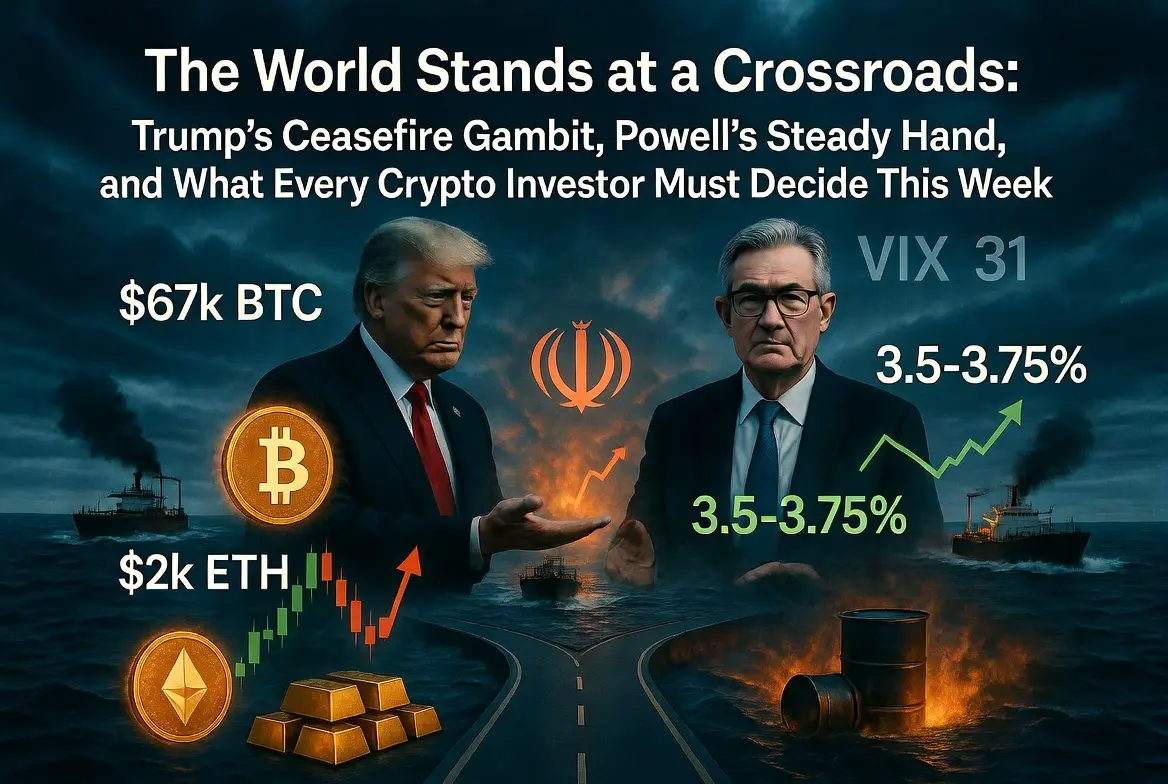
The World Stands at a Crossroads: Trump's Ceasefire Gambit, Powell's Steady Hand, and What Every Crypto Investor Must Decide This Week
Gate Plaza Hot Topic Deep Dive | Week of March 31 – April 2
Opening: A Market That Cannot Catch Its Breath
Three forces are colliding at once — a war in the Middle East that shook the Strait of Hormuz, a Federal Reserve chairman who just told the world "we're not panicking," and a president who is simultaneously threatening Iran and offering it an off-ramp. Each of these stories matters on its own. Together, they create one of the most consequential
HighAmbitionvip
#特朗普释放停战信号
The World Stands at a Crossroads: Trump's Ceasefire Gambit, Powell's Steady Hand, and What Every Crypto Investor Must Decide This Week
Gate Plaza Hot Topic Deep Dive | Week of March 31 – April 2
Opening: A Market That Cannot Catch Its Breath
Three forces are colliding at once — a war in the Middle East that shook the Strait of Hormuz, a Federal Reserve chairman who just told the world "we're not panicking," and a president who is simultaneously threatening Iran and offering it an off-ramp. Each of these stories matters on its own. Together, they create one of the most consequential weeks for global markets in recent memory.
Bitcoin is trading around $67,874, down a modest 0.31% in 24 hours but still nursing a -24.5% wound over 90 days. Ethereum sits at $2,095, slightly more resilient in the short term with a +1.7% weekly gain. The numbers alone do not tell the full story. What matters this week is the direction, and that direction depends heavily on how each of the three stories below resolves.
Topic 1: Can Trump's "Ceasefire Signal" Actually Calm the US-Iran Situation?
Background: From "Worst Nightmare" to "Present"
As of late March 2026, the United States and Iran have been in an active military confrontation for weeks. The Strait of Hormuz — the narrow waterway through which roughly 20% of the world's oil supply travels — has been effectively disrupted. Analysts at Reuters recorded the steepest upward revision to annual oil price forecasts in their polling history, with some projections raising the possibility of oil testing its 2008 record of $147 per barrel if the Strait remains closed for an extended period.
Then, on Monday March 30, two things happened almost simultaneously. First, Trump posted on social media that Iran had allowed 10 oil tankers through the Strait of Hormuz as a "present" to the United States. He extended his pause on attacking Iranian energy infrastructure to April 6, giving talks more room to breathe. He simultaneously warned Iranian negotiators to "get serious soon, before it is too late." Second, Iran's response was measured but firm. A senior Iranian official called the US peace proposal "one-sided and unfair." Tehran stated it would end the war on its own terms and timeline — not Washington's.
Analysis: Ceasefire Signal or Negotiating Theater?
The honest answer is: both, and neither side can afford to blink completely. Trump is dealing with a domestic political and economic trap. Oil above $100 per barrel is a tax on every American household. Markets are pricing in recession risk. The VIX fear index hit 31 on Hormuz-related supply fears. A prolonged war with no resolution damages his economic legacy far more than a negotiated exit would.
Iran, on the other hand, has survived enormous punishment and faces internal pressure. With over 3.2 million civilians displaced and international criticism mounting, Tehran cannot sustain an open-ended conflict either. The "10 tankers as a present" gesture is not accidental — it is a low-cost signal of goodwill that tests Washington without formally committing to anything.
The realistic scenario for this week is fragile de-escalation, not full ceasefire. Trump's April 6 deadline creates urgency without guaranteeing resolution. If talks progress, markets will price in oil relief, risk-on assets recover, and crypto catches a bid. If the deadline passes without progress, expect fresh volatility. The Strait remains the single most important variable in global asset pricing right now.
Bottom line on Topic 1: The ceasefire signal is real but conditional. Treat the April 6 energy infrastructure pause deadline as the next critical date to watch.
Topic 2: Powell's Dovish "Hold Steady" — What Does It Actually Mean for Crypto?
What Powell Actually Said
On Monday March 30, Federal Reserve Chairman Jerome Powell spoke at Harvard University in what may be one of his final public appearances before his term expires in May. His message was clear and deliberate:
Inflation expectations remain "well anchored" despite rising energy prices driven by the Iran war.
The current federal funds rate range of 3.5%–3.75% is "a good place" to hold.
The Fed should "look past" short-term oil price shocks, just as it has done historically.
There is no need to hike rates now; officials should focus on stable prices and low unemployment.
The market reaction was immediate. Rate hike odds for December 2026 dropped from over 50% as recently as Friday to just 2.2% after Powell's comments, according to CME FedWatch. Bond yields fell. The teetering bond market got a lifeline.
The Complicated Reality for Crypto
Here is where the discussion gets nuanced. Powell's comments were genuinely dovish in one narrow sense: he killed the rate hike narrative for now. That is unambiguously positive for risk assets on paper
But here is the complication: oil refused to cooperate. WTI crude continued its surge even as Powell spoke. US stocks gave up their early gains — the Nasdaq closed down 0.75%, the S&P 500 down 0.4%. Bitcoin, which had rallied on Powell's words, also gave up most of its gains by end of day.
What this tells us is that the market is currently running two competing scripts:
Script A (Dovish Fed = Risk On): Lower rate hike probability = cheaper money = flows into growth and speculative assets = crypto benefits. This script worked beautifully in 2020–2021. It is the script crypto investors are most familiar with.
Script B (Oil Shock = Risk Off): Sustained high oil prices feed into broader inflation, compress consumer spending, raise recession risk, and force institutional investors to reduce exposure across all risk assets including crypto. Under this script, it does not matter that Powell is holding steady — the macro damage from $100+ oil is already occurring.
Right now, Script B is winning on a day-to-day basis, but Script A is winning the expectation game. The crypto market is not in a free-fall, but it is also not running away. Bitcoin's 90-day performance of -24.5% reflects the weight of both scripts fighting each other.
The key unlock for Script A to take full control is a resolution of the Iran situation that brings oil back below $90. If that happens — and Powell stays on hold — crypto likely stages a meaningful recovery. Until then, expect range-bound choppiness with sharp moves in both directions on any geopolitical headline.
Powell handed crypto a crucial piece of support by neutralizing rate hike fears. But the oil shock is doing damage that monetary policy alone cannot fix. Watch oil, not just the Fed.
Topic 3: Gold, Oil, or Crypto — Where Should You Allocate This Week?
This is the most practical question of the three, and it deserves a candid breakdown rather than cheerleading for any single asset.
Oil: The Momentum Trade With a Very Short Shelf Life
Oil is the clear momentum winner of the past month. Crude has surged to multi-year highs, and the Iran war fundamentally disrupted the Strait of Hormuz in ways that have no quick fix even if a ceasefire is announced. Analysts at Rystad Energy noted that "the oil market did not underreact — it absorbed" the Hormuz shock, suggesting prices are not purely speculative.
However, oil at these levels is also the most ceasefire-sensitive asset on the board. A credible peace deal — or even just a reliable reopening of the Strait — could trigger a sharp reversal. Commodities analysts at AOL Finance noted that "even if the war were called off, markets may not revert to where they were," but the risk of a sudden 15–20% downside on a positive headline is very real for oil longs right now.
Risk profile: High momentum, high reversal risk. Not a set-and-forget position.
Gold: The "Safe Haven" That Has Been Surprisingly Quiet
Precious metals have actually underperformed the S&P 500 since the start of the Iran conflict — a surprising result given that wars usually send gold surging. The explanation is that gold performs best when inflation fears combine with currency instability and sovereign debt stress. Right now, while oil is driving energy inflation, the US dollar has held relatively firm, and the US Treasury market — though stressed — has not broken.
Tokenized gold, available on platforms like Gate's TradFi suite (XAUUSD pairs), offers an additional advantage: it trades around the clock, including weekends, meaning it telegraphs Monday risk sentiment before traditional markets open. That real-time pricing capability makes tokenized gold particularly useful as a geopolitical hedge during a week like this one.
Risk profile: Moderate. Better hedge than momentum play. Worth holding as portfolio insurance while the Iran situation remains unresolved.
Crypto: The Most Asymmetric Bet at the Table
Bitcoin at $67,874 and Ethereum at $2,095 are sitting in positions that are objectively beaten up — BTC is down nearly 24.5% over 90 days, ETH down over 32%. That is the bad news. The good news is that beaten-up assets in historically undervalued zones with a positive macro catalyst (dovish Fed) tend to offer the most asymmetric upside when the environment shifts.
Crypto's specific advantage in this moment is that it is not oil, and not gold. It carries its own narrative — institutional adoption, ETF inflows, on-chain accumulation by long-term holders — that is partially independent of the Iran story. The risk is that if the Iran situation deteriorates severely and oil spikes toward $130+, the macro shock could force broad risk-off selling that hits crypto regardless of its fundamentals.
Ethereum has quietly outperformed Bitcoin on the 30-day timeframe (+5.6% vs -0.67%), which is worth noting. ETH's sensitivity to sentiment shifts may cut both ways, but it suggests altcoins are not dead — they are waiting for a catalyst.
Risk profile: Highest asymmetry, highest volatility. Best suited for those who believe a de-escalation catalyst is coming within 2–4 weeks.
Strategic Outlook for Crypto: Scenarios in Paragraph Form
Looking ahead, crypto investors should consider three key scenarios:
In a bullish scenario, a credible Iran ceasefire occurs, the Strait of Hormuz fully reopens, oil drops sharply, and Script A (dovish Fed = risk-on) dominates. Bitcoin could break toward $72K+, with altcoins also surging in a positive, high-conviction flow.
In the base case, talks remain fragile with no clear resolution. Oil stays elevated, and risk assets trade range-bound. Bitcoin is likely to consolidate between $65K and $70K, experiencing high volatility as traders respond to headline-driven swings. Ethereum and other altcoins may mirror these movements, with upside capped until clarity emerges.
In the bearish case, negotiations collapse, the Strait is effectively blocked, and oil spikes toward $120+ per barrel. Script B dominates, risk-off sentiment surges, and Bitcoin tests the $60K support zone, while Ethereum drops toward its multi-week lows. Crypto in this environment would face amplified macro and geopolitical pressure, with institutional capital retreating temporarily.
The most probable outcome at this moment is the base case. However, the upcoming April 6 deadline set by Trump for Iranian negotiators is pivotal — it may provide clarity and trigger a sharp market reaction depending on progress.
Final Word: The Real Discussion Starter
Gate Plaza's three questions this week are not separate conversations — they are the same conversation viewed from three angles. The ceasefire question determines the oil question, the oil question determines whether Powell's dovish stance translates into actual market relief, and that combined outcome determines which asset wins the week.
The most honest answer to "which sector do you heavily invest in this week" is this: size your positions for base case, hedge for bear case, and leave dry powder for the bull case. The week ahead will not be boring.
repost-content-media
  • Reward
  • 1
  • Repost
  • Share
HighAmbitionvip:
thnxx for the update
#AprilMarketOutlook
1. The Big Picture — Where Are We Right Now?
March closed with BTC posting its first green month of 2026, a slim +1.62% candle after five consecutive red months. The relief rally topped near $74,500 in mid-March before fading back to the $66K–$68K corridor. As of April 1st, BTC sits at $68,159 — up only 0.85% in 24 hours, barely holding the range.
The market has printed a textbook bottoming signal pattern: every bounce weaker than the last, long liquidations totaling $451 million in a single 24-hour window, and spot ETFs registering 13 consecutive days of net negative flow
HighAmbitionvip
#AprilMarketOutlook
1. The Big Picture — Where Are We Right Now?
March closed with BTC posting its first green month of 2026, a slim +1.62% candle after five consecutive red months. The relief rally topped near $74,500 in mid-March before fading back to the $66K–$68K corridor. As of April 1st, BTC sits at $68,159 — up only 0.85% in 24 hours, barely holding the range.
The market has printed a textbook bottoming signal pattern: every bounce weaker than the last, long liquidations totaling $451 million in a single 24-hour window, and spot ETFs registering 13 consecutive days of net negative flow before a slight reversal. Yet institutions are not stopping their buys. That divergence is the dominant theme for April.
2. Bitcoin (BTC) — The Institutional Tug-of-War
Current Price: $68,159 | 24h: +0.85% | 7d: -0.96% | 30d: -0.25% | 90d: -24.26%
What Institutions Are Doing:
Strategy (Michael Saylor) purchased 1,607+ BTC via STRC preferred stock in a single day — the STRC IPO raised the equivalent of 250+ BTC in buying power within its first 25 minutes of trading. MetaPlanet secured $255 million in financing with a mandate to buy over 3,800 BTC. Twenty One Capital has become the second-largest publicly listed BTC holder in U.S. equities, overtaking MARA. BlackRock / IBIT transferred 634 BTC to Coinbase Prime — worth noting alongside the ongoing mixed ETF flow picture. Coinbase + Fannie Mae + Better Home launched Bitcoin-backed mortgages, allowing homebuyers to use BTC or USDC as collateral for down payments without selling — a genuinely new real-world use case that is getting traction.
Technical Outlook:
BTC is showing tentative signs of a short-term bottom, but momentum remains fragile. Daily moving averages remain in bearish alignment, while RSI and other momentum indicators suggest there is still room for the price to drift lower before a confirmed oversold condition. Short-term divergences point to potential bounce attempts, but overall the trend favors cautious accumulation rather than aggressive buying.
Key Levels to Watch:
Critical support sits at $65,996, with structural support near $60,000. Resistance is expected between $70,000–$72,000, while the March high at $74,500 remains a key upside target.
Hot Topic — Quantum Computing Risk:
Google published research suggesting its optimization algorithm reduces Bitcoin encryption difficulty by 20x. The crypto community responded in hours — Bitcoin developers are already testing BIP-360, a post-quantum signature scheme. This is not an immediate threat, but it will be a recurring headline through April.
Sentiment:
54% bullish discussion vs. 32% bearish on social media — net positive, but the overall market fear index screams otherwise. Loud bulls exist, but real selling pressure remains quiet yet significant.
3. Ethereum (ETH) — Contradictory Signals, Elevated Risk
Current Price: $2,110 | 24h: +2.48% | 7d: +2.43% | 30d: +6.43% | 90d: -32.48%
ETH is technically outperforming BTC on the 24-hour and 30-day timeframes — but the structural picture is messier.
What's Moving ETH:
Bitmine now holds 4.73 million ETH — 3.92% of total supply — with 70% staked. Ethereum Foundation executed its largest-ever staking operation: 22,517 ETH (-$46.25M) in one move. Aave V4 launched on mainnet, advancing real-world asset (RWA) and structured credit, strengthening the DeFi ecosystem base. On the other side, BlackRock sold $141.6M in ETH via ETHA in a single day; net ETF flows were negative for most of late March.
Technical Outlook:
ETH has formed a short-term double-top pattern, and daily indicators show bearish alignment. Short-term momentum appears overextended, increasing the risk of a pullback. ETH/BTC continues to hover near multi-year lows, suggesting capital is favoring BTC over ETH. Combined liquidation risk across exchanges exceeds $1 billion, placing ETH in a highly volatile zone where cascading liquidations could occur. Despite some institutional accumulation, structural downside risk remains significant.
Sentiment:
Bearish-leaning: 48% negative vs. 38% positive discussion. Discussion volume almost doubled in 3 days — rising chatter, but it is not optimistic chatter.
4. Solana (SOL) — Structurally Weak, But Liquidity Inflow Signals
Current Price: $83.48 | 24h: +0.10% | 7d: -3.52% | 90d: -36.90%
SOL is the clearest underperformer in the large-cap group right now, with volume showing "panic selling" characteristics — price dropping alongside elevated volume.
What's Worth Watching:
Galaxy Digital launched SOL staking via GalaxyOne with up to 6.5% APY, zero commission, targeting retail users. Circle minted $750M+ USDC on Solana in a 24-hour period — an unusual and significant velocity of stablecoin issuance on-chain. This is typically a precursor to increased on-chain activity. SOL ETF flows were the only ones to stay modestly positive in the week of March 23–27, while BTC and ETH ETFs bled outflows.
Technical Outlook:
SOL is showing strong bearish momentum, with daily averages aligned to the downside. Short-term indicators suggest some early divergence that could signal a minor recovery, but overall the trend remains negative. RSI indicates there is room to fall further, and any bounce attempts are likely to be weak without additional liquidity inflows or macro catalysts.
Sentiment:
Sentiment is split (45% bearish vs. 39% bullish). Discussion volume stable but subdued.
5. XRP — Quiet Relative Strength Amid Ripple's Corporate Expansion
Current Price: $1.343 | 24h: +1.58% | 7d: -1.32% | 90d: -33.05%
XRP is quietly showing relative strength — the only major spot ETF to post net inflows in the week of March 23–27 while BTC, ETH, and SOL all bled outflows.
Fundamental Developments:
Ripple acquired Hidden Road and GTreasury in a -$4B combined strategic expansion. Ripple joined Singapore's MAS BLOOM project — piloting RLUSD for automated cross-border trade settlement. Goldman Sachs reported holding $152M in XRP ETF positions — yet the price did not pop meaningfully, suggesting strong overhead selling pressure. Ripple launched AI-driven security for the XRP Ledger — proactive infrastructure work.
Technical Outlook:
XRP daily averages are still bearish, but RSI shows slight oversold conditions. Short-term momentum is showing small-scale recovery signals. Overall, XRP demonstrates resilience relative to other major coins, supported by strategic institutional inflows.
Sentiment:
Net daily sentiment: 42% bullish vs. 31% bearish — XRP community remains one of the more resilient on social media.
6. Macro Drivers — The External Pressure Cooker
These are the forces that will shape April regardless of what any individual coin does:
Geopolitics:
The US-Iran conflict is keeping oil elevated. Higher energy prices feed into inflation expectations, which pushes back Fed rate cut timelines. Tighter-for-longer monetary policy is structurally negative for risk assets including crypto.
US Bond Market:
The 10-year Treasury yield is pressing toward 4.5% — its highest since mid-2025. Every basis point higher makes risk-free returns more attractive relative to volatile assets. BTC and equities feel this.
Non-Farm Payrolls — April 3:
This is the single biggest macro event of the first week of April. A stronger-than-expected print tightens rate cut expectations further and risks pushing BTC below the $65,994 support level. A weak print triggers a risk-on relief move toward $68,970+. Every trader is watching this number.
BTC + ETH Options Expiry: -$15.5B:
Already passed (March 27), but the aftermath is still visible in price structure. The expiry acted as a magnet, pulling price down to $65,700 temporarily. Clean resolution of that expiry should reduce structured selling pressure through April.
BTC-Tech Stock Correlation:
BTC continues to trade like a high-beta version of Nasdaq. When tech sells off — as it has been — BTC follows. This correlation is a risk to monitor all month.
Quantum Development Updates:
BTC developers continue rolling out BIP-360 testing in response to quantum computing headlines. Monitoring the progress of these updates will remain critical for investor confidence, as any delays or vulnerabilities could feed into negative sentiment and volatility. Investors should view these developments as part of the broader macro and technical landscape.
7. Three Scenarios for April
Bullish Case:
NFP comes in soft, the Fed signals a May cut, ETF flows reverse positive, and BTC reclaims $72K–$74K. Altcoins, led by ETH and XRP, see catch-up trades. The institutional accumulation floor holds and the market builds a proper base.
Neutral Case:
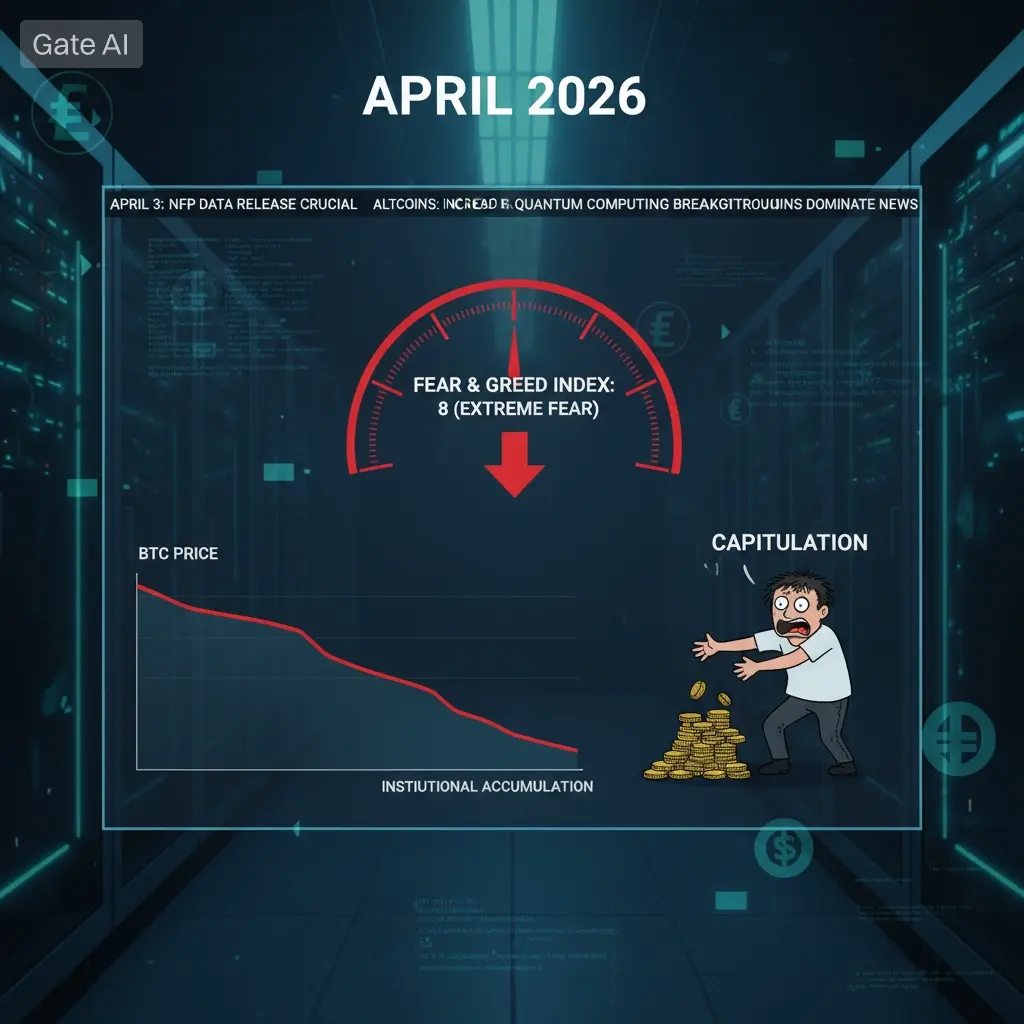
BTC consolidates between $65K and $72K through most of April. Choppy, range-bound, low conviction. ETF flows stay mixed. Macro noise keeps a lid on upside but institutional buying prevents a deeper breakdown. The Fear & Greed Index inches from 8 toward 20–25.
Bearish Case:
NFP is strong, rate-cut hopes pushed to Q3 or later, ETF outflows resume, and geopolitical escalation adds a risk-off shock. BTC loses $65,994 cleanly and tests the high-$50Ks. Altcoins follow with amplified moves (-15% to -25%).
8. What to Actually Watch in April
Investors should watch several key catalysts in April. The US Non-Farm Payrolls report on April 3 remains the single most important macro trigger, as its strength or weakness will directly influence rate cut expectations and risk appetite. Fed communications throughout the month will continue to shape the broader trajectory of BTC and altcoins. Spot ETF daily flow data provides a real-time proxy for institutional demand, while BTC support at $65,994 and ETH support at $1,900 serve as critical floors. USDC velocity on Solana may indicate on-chain activity translating to price movement. Daily geopolitical headlines, particularly oil and Iran developments, will feed directly into inflation expectations and Fed timeline shifts. Finally, BTC quantum development updates, particularly progress on BIP-360, must be monitored closely as any delays could amplify volatility or investor uncertainty.
Bottom Line
April 2026 opens with the market at an inflection point. The Fear & Greed Index at 8 historically sits near bottoms — but "near" can still mean weeks of grinding before any confirmed reversal. The split between institutional players quietly accumulating and retail investors capitulating is as wide as it has been all year. BTC is the clearest safe harbor in this environment; altcoins carry significantly more downside risk if the macro backdrop deteriorates. The NFP print on April 3 is the first real fork in the road.
repost-content-media
  • Reward
  • 1
  • Repost
  • Share
HighAmbitionvip:
2026 GOGOGO 👊
#四月行情预测
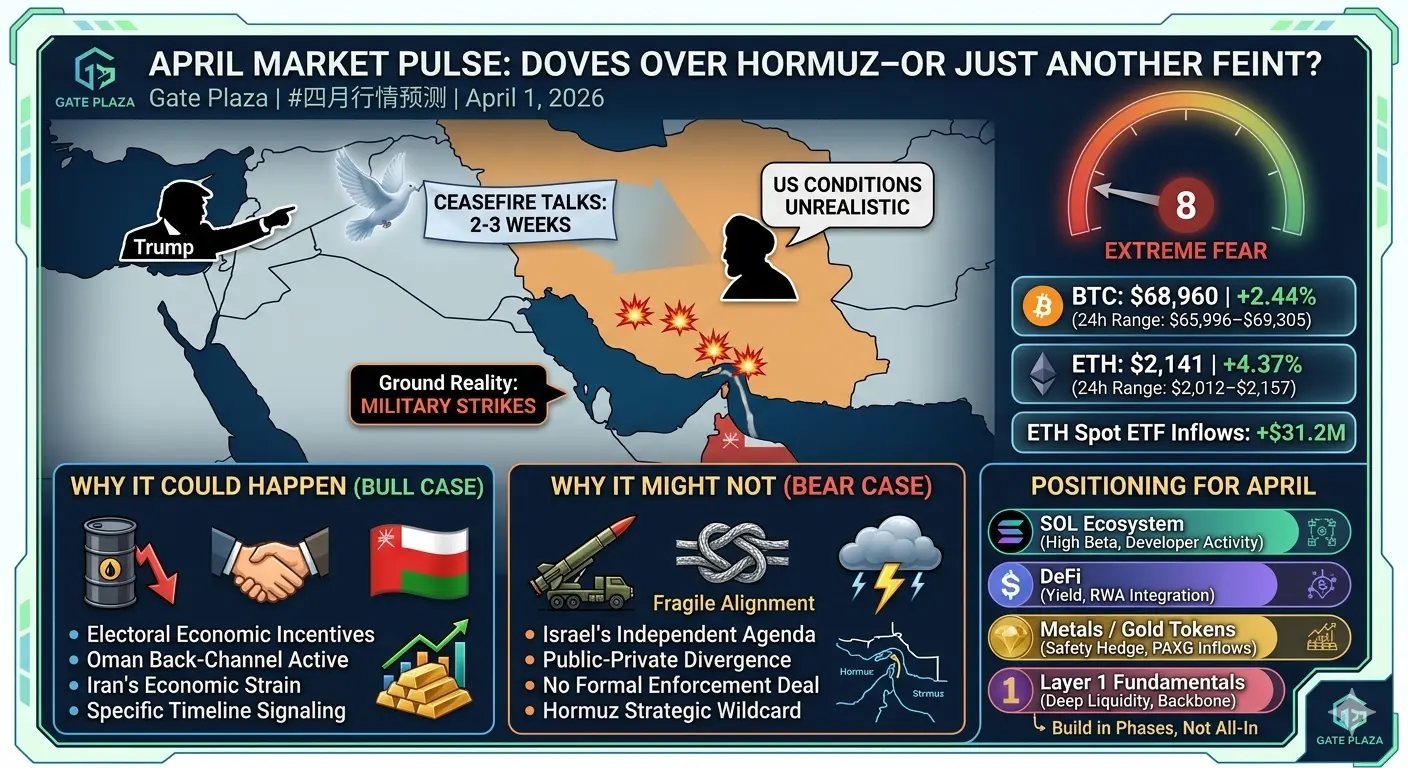
April Market Pulse: Doves Over Hormuz — Or Just Another Feint?
Gate Plaza | April 1, 2026
The Setup: What Actually Happened This Week
April opened with a geopolitical plot twist nobody scripted cleanly, and more importantly, one that forced global markets into an immediate repricing of expectations rather than confirmed outcomes, which is why the reaction across crypto, equities, and commodities was both aggressive and synchronized. Trump and his Secretary of State Rubio signaling that the US-Iran war could be "near its end" was not treated as mere rhetoric by markets — instead, it w
HighAmbitionvip
#四月行情预测
April Market Pulse: Doves Over Hormuz — Or Just Another Feint?
Gate Plaza | April 1, 2026
The Setup: What Actually Happened This Week
April opened with a geopolitical plot twist nobody scripted cleanly, and more importantly, one that forced global markets into an immediate repricing of expectations rather than confirmed outcomes, which is why the reaction across crypto, equities, and commodities was both aggressive and synchronized. Trump and his Secretary of State Rubio signaling that the US-Iran war could be "near its end" was not treated as mere rhetoric by markets — instead, it was interpreted as a high-probability shift in geopolitical trajectory, especially with a scheduled national address reinforcing the seriousness of the signal.
However, beneath this optimism lies a far more complex and unstable structure that traders cannot afford to ignore, because the reality on the ground and the narrative in headlines are currently diverging in a way that historically leads to volatility spikes rather than sustained stability.
Iran's Foreign Ministry, as recently as March 30: Called US ceasefire conditions "excessive, unrealistic and unreasonable" — and issued its own counter-demands instead of accepting the US framework, which indicates that while diplomatic channels may be open, alignment on terms is still significantly distant and unresolved.
On the ground, April 1: Israel conducted over 800 strike sorties against Iranian targets using 16,000 munitions, while Iranian forces attacked a Kuwaiti oil tanker in Dubai port and Houthi forces remain active, clearly demonstrating that military escalation has not paused but is instead continuing at scale despite the emergence of ceasefire narratives.
The diplomatic channel: Iran's Foreign Minister confirmed receiving direct messages from US envoy Steve Witkoff but explicitly stated these do not constitute "negotiations," reinforcing the idea that communication exists without commitment, which is often the most fragile stage of any potential de-escalation process.
So the situation is this: both sides are talking about talking, while simultaneously escalating kinetically, which in practical terms means markets are currently trading on expectations of peace while the underlying reality remains one of active conflict and strategic positioning rather than resolution.
Question 1: Can the US and Iran Actually Ceasefire This Month?
Verdict: Possible, but structurally fragile — do not price in peace as a certainty.
The ceasefire optimism is real but rests on thin ice, because what we are witnessing is not a finalized agreement but an early-stage negotiation posture where incentives are aligned but execution risk remains extremely high.
Why it could happen:
Trump has electoral and economic incentives to close the war quickly, because prolonged geopolitical instability directly impacts oil prices, inflation expectations, and overall market confidence, all of which feed back into domestic political narratives and economic performance metrics.
The "2-3 weeks" timeline from the Trump camp is specific, and specificity in geopolitical signaling often suggests internal planning and preliminary alignment rather than vague positioning, which increases the probability that active efforts toward de-escalation are underway behind closed doors.
Oman, a historically neutral intermediary, is actively facilitating back-channel dialogue between Washington and Tehran, and this channel has historically proven effective in bridging communication gaps when official diplomatic relations are strained or non-existent.
Iran's economy is severely strained, and sustained military engagement under economic pressure creates internal incentives to seek de-escalation even if public rhetoric remains resistant.
Why it might not:
Iran's public posture and its private channel are two different things right now, and this divergence creates uncertainty because negotiations that are not publicly aligned can collapse quickly if political or strategic pressure shifts.
Israel has its own timeline and objectives that do not necessarily align with a US-brokered ceasefire, and continued aggressive strikes suggest that regional actors may not synchronize with a broader de-escalation framework.
A ceasefire without a formal deal — which Trump hinted at ("winding down even without a deal") — introduces structural fragility, because informal arrangements lack enforcement mechanisms and are highly sensitive to sudden provocations.
The Strait of Hormuz remains the wildcard, and any disruption in this critical energy corridor would immediately reprice oil markets, inflation expectations, and global risk sentiment, cascading directly into crypto and equity volatility.
Bottom line for traders: The ceasefire narrative is a tailwind for April, not a foundation, and while it can support upward momentum in risk assets, it should not be treated as a stable base case without hedging against rapid reversals.
Question 2: Bullish or Bearish on Crypto This Month?
My read: Cautiously bullish with a hard eye on the Fear & Greed Index — which is sitting at 8 (Extreme Fear) right now.
Let me give you the actual data as of April 1:
BTC: $68,960 | +2.44% in 24h | 24h range: $65,996 – $69,305
ETH: $2,141 | +4.37% in 24h | 24h range: $2,012 – $2,157
Fear & Greed Index: 8 — Extreme Fear
A Fear & Greed reading of 8 is historically one of the most powerful contrarian buy signals in crypto, not because it guarantees a bottom, but because it reflects a state where market participants have largely exhausted their willingness to sell, creating conditions where even moderate buying pressure can trigger outsized upward moves.
The bull case for April:
Geopolitical de-escalation premium is only partially priced in, meaning that if the ceasefire narrative holds or even stabilizes without full resolution, risk assets including crypto can continue to grind higher as uncertainty decreases incrementally rather than disappearing entirely.
Institutional accumulation is happening underneath the retail panic, and entities like Strategy, MetaPlanet, and Fidelity tend to accumulate during periods of fear rather than strength, which provides a structural support layer beneath current price levels.
BTC closed March green (+1.62%) after six consecutive monthly losses, and such shifts often act as psychological and technical inflection points where trend-following capital begins to re-enter the market gradually.
ETH spot ETFs saw $31.2M net inflows at the end of March, with BlackRock ETHA leading, signaling that institutional interest is not only returning but doing so selectively and strategically rather than broadly and impulsively.
The bear case to respect:
Long-term holder SOPR below 1 indicates that even high-conviction investors are realizing losses, which reflects underlying stress within the market structure rather than simple short-term panic.
BTC spot ETFs have had 13 consecutive days of negative premium and net outflows, showing that institutional demand has not yet fully flipped into a sustained inflow trend.
A ceasefire breakdown or a Hormuz incident could instantly trigger a macro risk-off environment, leading to rapid deleveraging across crypto markets.
$69,300 is the immediate resistance to watch, and repeated failures at this level suggest that without strong volume confirmation, upward momentum may struggle to sustain itself.
My April stance: Leaning bullish, building positions in phases, not all-in, because while the risk-reward favors upside in a fear-driven environment, the presence of unresolved macro risk requires disciplined exposure rather than aggressive positioning.
Question 3: Which Sectors Are Worth Early Positioning in April?
Based on both the macro backdrop and live sector performance data, here are the sectors I am watching most closely:
1. Metals / Gold-Linked Tokens (Rank #5 in 24h Gainers)
Why: PAXG is up 2.25% today with $81.8M in 24h inflows, and this reflects not just price appreciation but a broader capital shift toward safety-linked assets as investors hedge against geopolitical uncertainty and macro instability, especially in an environment where traditional safe havens and digital representations of them begin to converge in investor portfolios.
Risk: If a genuine ceasefire materializes rapidly, safe-haven demand can unwind just as quickly, leading to sharp reversals in metals-linked assets.
2. DeFi (Rank #3 in 24h Gainers, +2.64%)
Why: DeFi is structurally positioned to benefit from any crypto market recovery because it represents the yield-generating and utility-driven layer of the ecosystem, where protocols like Aave V4 are not just evolving technologically but also expanding into real-world asset integration, creating a bridge between traditional finance and decentralized systems that becomes increasingly valuable in recovery phases.
Risk: DeFi assets carry higher beta, meaning they amplify both upward and downward movements, making them more sensitive to macro-driven reversals.
3. SOL Ecosystem (Rank #2 in 24h Gainers, +4.32%)
Why: The Solana ecosystem continues to demonstrate strong internal momentum driven by developer activity, trading volume, and ecosystem expansion, which positions it as a high-beta growth segment that tends to outperform during recovery phases due to its speed, scalability, and strong retail engagement.
Risk: High volatility remains the defining characteristic of this sector, making it highly responsive to both positive and negative market shifts.
4. Layer 1 Fundamentals (Rank but highest absolute volume at $1.44B)
Why: Layer 1 assets remain the backbone of the crypto ecosystem, and their high trading volume reflects deep liquidity and strong institutional interest, which typically makes them the primary beneficiaries of sustained capital inflows during broader market recoveries.
Risk: These assets require more consistent macro stability to maintain upward trends compared to shorter-cycle, narrative-driven sectors.
5. Exchange Tokens / GT (Rank +2.38%)
Why: Exchange tokens benefit directly from increased market activity, as higher trading volumes translate into higher fee generation and stronger utility demand, creating a feedback loop where platform growth supports token value, especially in early-stage recovery environments.
My Overall April Framework
Macro Variable
Current State
April Implication
US-Iran War
Active, ceasefire signals emerging
Binary risk — rally or reversal
Fear & Greed
8 (Extreme Fear)
Contrarian buy signal
BTC Monthly
First green candle after 6 red
Momentum shift signal
ETH ETF Flows
Re-entering positive
Institutional re-engagement
Institutional Accumulation
Ongoing (Strategy, Fidelity, MetaPlanet)
Structural floor
Key BTC Resistance
-$69,300
Watch for breakout confirmation
April could be the month the market finally transitions out of prolonged weakness, but this transition is unlikely to be smooth, as it depends heavily on external macro developments that can shift rapidly and without warning.
The ceasefire narrative is the jet fuel, but fuel alone does not guarantee sustained flight — it requires stable conditions, which are not yet fully present.
My personal positioning: Tilting long on BTC and ETH, adding selective exposure to DeFi and SOL for higher upside potential, while maintaining 20-25% in stablecoins to remain flexible and responsive to sudden market changes, ensuring the ability to capitalize on both pullbacks and breakout confirmations.
repost-content-media
  • Reward
  • 1
  • Repost
  • Share
HighAmbitionvip:
good information
#GoogleQuantumAICryptoRisk
Introduction: The Wake-Up Call Nobody Expected
On March 31, 2026, Google’s Quantum AI research team released a whitepaper that shook the cryptocurrency world. The paper didn’t claim quantum computers can break Bitcoin today — but it revealed something arguably more alarming: breaking Bitcoin’s encryption requires far fewer quantum resources than previously thought. The industry is now assessing the clock and the risk seriously.
Point 1 — What Did Google Actually Publish?
Google’s whitepaper outlined a much more efficient implementation of Shor’s Algorithm, which can
BTC-0,67%
ETH-0,93%
SOL0,67%
HighAmbitionvip
#GoogleQuantumAICryptoRisk
Introduction: The Wake-Up Call Nobody Expected
On March 31, 2026, Google’s Quantum AI research team released a whitepaper that shook the cryptocurrency world. The paper didn’t claim quantum computers can break Bitcoin today — but it revealed something arguably more alarming: breaking Bitcoin’s encryption requires far fewer quantum resources than previously thought. The industry is now assessing the clock and the risk seriously.
Point 1 — What Did Google Actually Publish?
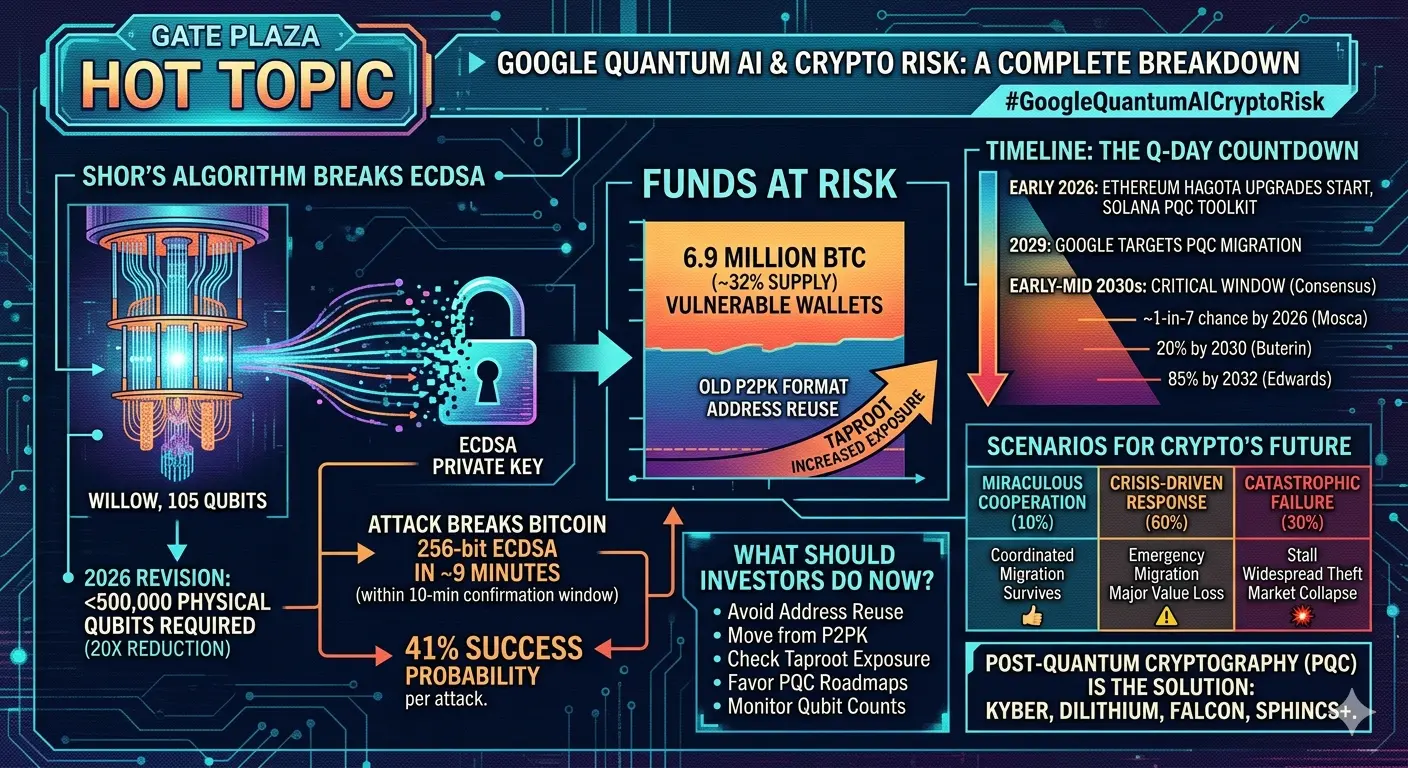
Google’s whitepaper outlined a much more efficient implementation of Shor’s Algorithm, which can theoretically break elliptic curve cryptography (ECC):
2019 estimate: ~20 million physical qubits needed to break Bitcoin.
2026 revision: <500,000 physical qubits — 20× reduction.
Practical attack: 1,200–1,450 logical qubits + 70–90 million quantum gates could break Bitcoin’s 256-bit ECDSA in minutes.
This is peer-reviewed research from one of the world’s leading quantum computing teams — not science fiction.
Point 2 — What is ECDSA and Why Does It Matter?
ECDSA (Elliptic Curve Digital Signature Algorithm) secures almost every major blockchain, including Bitcoin, Ethereum, and Solana:
Private keys sign transactions; public keys are mathematically derived.
Classical computers cannot reverse the math.
A quantum computer running Shor’s Algorithm can derive private keys from public keys, giving an attacker full control of the wallet.
Point 3 — The Real-Time Attack Scenario: 9 Minutes to Steal Bitcoin
Google’s paper modeled real-time transaction attacks:
Bitcoin transactions expose the public key until confirmed (~10 minutes).
A quantum attack could break ECDSA in ≈9 minutes, within that window.
Success probability: ~41% — meaning 4 out of 10 transactions could be hijacked.
At institutional volumes, the risk is enormous.
Point 4 — 6.9 Million BTC Already at Risk
Approximately 6.9 million BTC (~32% of supply) sits in wallets with permanently exposed public keys:
Spending from older wallet formats (P2PK) exposes public keys.
Reused addresses remain vulnerable permanently.
Ethereum: ~20.5 million dormant wallets could also be at risk.
Even without real-time attacks, these funds are theoretically exposed once quantum computers reach sufficient scale.
Point 5 — Bitcoin’s Taproot Upgrade Made Things Worse
Ironically, Bitcoin’s Taproot upgrade increased public key visibility for many transaction types, expanding quantum exposure rather than reducing it. The whitepaper flagged Taproot wallets as a larger pool of vulnerable addresses.
Point 6 — The Q-Day Timeline: When Could This Happen?
Google’s current processor, Willow, has 105 physical qubits. Practical attacks need hundreds of thousands. While not imminent, the timeline is compressed:
Charles Edwards (Capriole Investments): 85% chance of Q-Day by 2032.
Vitalik Buterin: 20% chance of quantum break before 2030.
Michele Mosca: ~1-in-7 chance by 2026 (conservative estimate).
Bloomberg: Google targets post-quantum migration completion by 2029.
Consensus: early-to-mid 2030s is the critical window.
Point 7 — The Impact on the Crypto Market
Short-term (now–2028):
Market FUD cycles increase with quantum news.
Long-term holdings priced with quantum risk discounts.
Chains without PQC plans face valuation pressure.
Medium-term (2029–2032):
Chains with post-quantum migration attract premium.
Leaks of partial quantum breakthroughs could trigger panic sell-offs.
6.9M BTC at risk represents hundreds of billions of dollars in potential pressure.
Long-term (2032+):
Successful migration preserves network security and trust.
Failure to migrate risks catastrophic protocol failure (~30% probability according to JBBA).
Point 8 — What Are Ethereum and Bitcoin Doing About It?
Ethereum:
Post-Quantum Team formed Jan 2026.
EIP-8141 allows accounts to switch to quantum-resistant signatures.
Migration underway via upgrades codenamed Hegota.
Bitcoin:
Governance is conservative; migration requires broad consensus.
Hard fork/soft fork needed — politically challenging.
Solana:
Developing quantum-resistant vaults using Winternitz hash-based signatures.
Layer 1 migration toolkit expected by March 2026 end.
Point 9 — What is Post-Quantum Cryptography (PQC)?
PQC algorithms are designed to resist quantum attacks:
CRYSTALS-Kyber — encryption
CRYSTALS-Dilithium — digital signatures
FALCON — compact digital signatures
SPHINCS+ — hash-based signatures
As of early 2026, 24/26 top blockchains still rely on quantum-vulnerable schemes like ECDSA or Ed25519.
Point 10 — Three Scenarios for Crypto’s Future
Scenario 1 — Miraculous Cooperation (10%)
Coordinated 5–7 year migration; short-term capacity drops but blockchain survives.
Scenario 2 — Crisis-Driven Response (60%)
Stalemate leads to rapid 2–3 year emergency migration.
Major value loss; some smaller chains fail, largest survive.
Scenario 3 — Catastrophic Failure (30%)
Migration stalls; quantum attack triggers widespread theft.
Market collapse; existential threat to blockchain networks.
Point 11 — What Should Crypto Investors Do Now?
Avoid address reuse; every transaction should use fresh addresses.
Move funds from old P2PK wallets.
Understand Taproot wallets’ higher exposure.
Favor chains with active PQC roadmaps (Ethereum, Solana).
Monitor announcements approaching 500k–1M qubits.
Do not panic-sell — current processors are far below practical thresholds.
Conclusion: Not a Drill
Google’s Quantum AI paper made it clear: quantum risk is no longer theoretical — it is an engineering problem with a timeline. Crypto’s long-term survival depends on which projects act decisively now.
The technology is not here yet, but the urgency is real.
repost-content-media
  • Reward
  • 1
  • Repost
  • Share
HighAmbitionvip:
thnxx for the update
#GateOfficiallyIntegratesPolymarket
What Happened — The Core Development
Gate.io has officially moved beyond being just a traditional exchange by integrating Polymarket, effectively merging spot trading, derivatives, and real-world event speculation into a unified ecosystem, which signals a broader shift in how trading platforms are evolving from simple execution venues into full-scale financial intelligence hubs where users are not only trading assets but actively participating in forecasting global outcomes.
This integration reduces the friction that previously existed between centralized e
HighAmbitionvip
#GateOfficiallyIntegratesPolymarket
What Happened — The Core Development
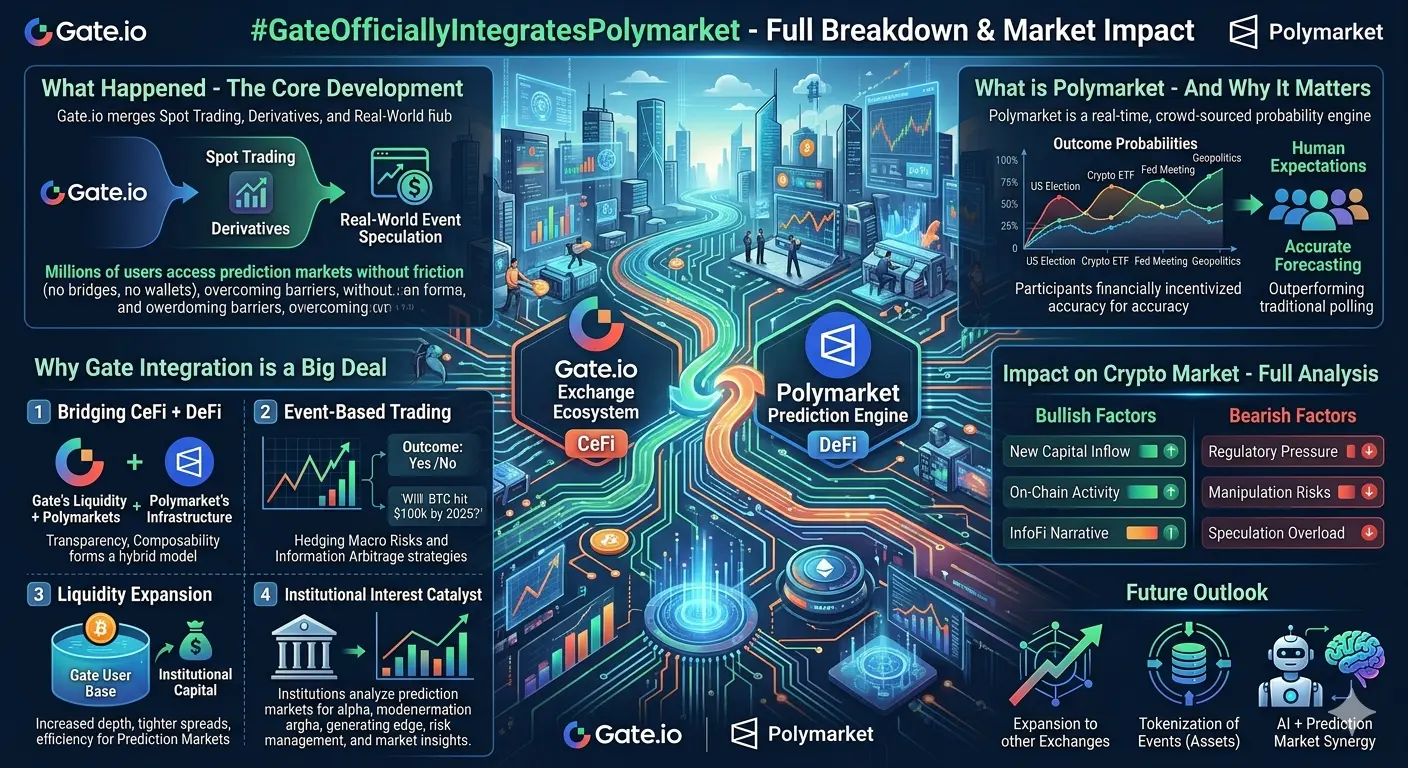
Gate.io has officially moved beyond being just a traditional exchange by integrating Polymarket, effectively merging spot trading, derivatives, and real-world event speculation into a unified ecosystem, which signals a broader shift in how trading platforms are evolving from simple execution venues into full-scale financial intelligence hubs where users are not only trading assets but actively participating in forecasting global outcomes.
This integration reduces the friction that previously existed between centralized exchanges and decentralized applications, meaning users no longer need to navigate wallets, bridges, or complex on-chain processes, and can instead access prediction markets directly, which dramatically increases accessibility and lowers the barrier to entry for millions of users who were previously excluded from this segment.
What is Polymarket — And Why It Matters
Polymarket operates as a real-time, crowd-sourced probability engine, where every price represents a consensus-driven likelihood of an event occurring, turning markets into live data feeds of human expectations across politics, economics, geopolitics, and crypto, making it far more than just a betting platform and instead positioning it as a powerful tool for extracting sentiment and predictive intelligence.
What makes it particularly important is that, unlike traditional polling or analyst forecasts, Polymarket participants are financially incentivized to be correct, which historically has resulted in prediction markets often being more accurate than conventional forecasting methods, especially in high-stakes or uncertain scenarios.
Why Gate Integration is a Big Deal
1. Bridging CeFi + DeFi Narratives
This integration represents a structural convergence where centralized finance provides liquidity, scale, and user experience, while decentralized systems provide transparency, composability, and innovation, creating a hybrid model that captures the strengths of both worlds and eliminates many of their individual weaknesses.
As a result, users gain seamless access to decentralized prediction infrastructure without sacrificing the ease-of-use associated with centralized platforms, which could significantly accelerate adoption and bring prediction markets into the mainstream for the first time.
2. New Trading Layer — “Event-Based Trading”
The introduction of event-based trading fundamentally changes how participants engage with markets, shifting the focus from price speculation alone to outcome-based positioning, where traders can directly express views on whether something will happen rather than how much an asset will move.
This opens the door to entirely new strategies, such as hedging macro risks, arbitraging information gaps, or positioning based on geopolitical developments, effectively transforming trading into a multidimensional activity where data interpretation becomes as important as capital allocation.
3. Liquidity Expansion Across Markets
By connecting Gate’s large and active user base with Polymarket’s infrastructure, this integration injects significant liquidity into prediction markets, which historically have struggled with depth and efficiency, leading to tighter spreads, more accurate pricing, and reduced opportunities for manipulation.
Higher liquidity also enhances confidence among participants, which in turn attracts more capital, creating a positive feedback loop that strengthens the overall market structure.
4. Institutional Interest Catalyst
Institutions are constantly searching for alternative data sources and edge-generating mechanisms, and prediction markets offer exactly that by providing real-time insights into collective expectations, which can be used to inform trading decisions across multiple asset classes.
With easier access via Gate, institutions may begin to integrate prediction market data into their models, potentially leading to increased capital inflows and further legitimizing this sector within the broader financial ecosystem.
Impact on Crypto Market — Full Analysis
Bullish Factors
1. New Capital Inflow Channel
This integration introduces crypto to a wider audience that may not be interested in traditional trading but is highly engaged with global events, effectively expanding the user base and bringing in fresh liquidity that can spill over into other parts of the market.
2. Increased On-Chain Activity
As more users interact with prediction markets, underlying blockchain activity increases, leading to higher transaction volumes, greater stablecoin usage, and overall growth in decentralized infrastructure, which are all key indicators of a healthy and expanding ecosystem.
3. Strong Narrative Shift
Markets are heavily driven by narratives, and the rise of prediction markets aligns with broader themes such as InfoFi and real-world integration, which can generate significant speculative momentum as traders rotate capital into sectors perceived as the “next big thing.”
Bearish
1. Regulatory Pressure
Prediction markets operate in a gray area in many jurisdictions, especially when tied to political or sensitive real-world events, meaning increased visibility could attract regulatory scrutiny that might limit growth or impose restrictions.
2. Market Manipulation Risks
While increased liquidity helps, there is still potential for large players to influence market probabilities, particularly in niche or low-volume events, which could distort signals and reduce reliability if not properly mitigated.
3. Short-Term Speculation Overload
The gamified nature of prediction markets may encourage excessive short-term speculation, which can amplify volatility and distract from longer-term investment strategies, potentially leading to unstable market conditions.
What Traders Are Thinking Right Now
Traders are increasingly viewing prediction markets as a source of alpha, using them not just for speculation but as a tool to gauge sentiment and anticipate market movements, with many integrating this data into their broader trading frameworks alongside technical and fundamental analysis.
There is also growing excitement around the idea that prediction markets could become a leading indicator for macro trends, giving early signals on events that may impact traditional and crypto markets alike.
Future Outlook — What Comes Next
1. Expansion to Other Exchanges
If this integration proves successful, it is highly likely that other major exchanges will follow suit, leading to a competitive race to incorporate prediction markets and further accelerating adoption across the industry.
2. Tokenization of Events
The evolution of prediction markets may lead to fully tokenized event assets that can be traded, collateralized, or integrated into DeFi protocols, unlocking new layers of financial innovation and composability.
3. AI + Prediction Market Synergy
The combination of AI-driven analytics with prediction market data could create highly sophisticated tools capable of identifying patterns, forecasting outcomes, and optimizing trading strategies in ways that were previously not possible.
Final Verdict — Market Impact Summary
This integration represents a significant step toward a future where markets are driven not just by price action but by information, probabilities, and real-world outcomes, fundamentally reshaping the trading landscape and introducing new dimensions of participation and strategy.
In the short term, it is likely to generate hype and increased activity, while in the medium to long term, it has the potential to establish prediction markets as a core component of the crypto ecosystem, influencing how traders, institutions, and platforms interact with financial data.
Bottom Line
The integration of Gate and Polymarket is more than just a feature launch; it is a signal that the industry is moving toward a more interconnected, data-driven, and reality-linked financial system where the boundaries between trading, forecasting, and information are becoming increasingly blurred, potentially redefining the very nature of markets in the years to come.
repost-content-media
  • Reward
  • Comment
  • Repost
  • Share
#GateSquareAIReviewer!
Gate AI: The Ultimate Crypto Trading Intelligence Ecosystem
March 2026 | Gate.com Market Insights
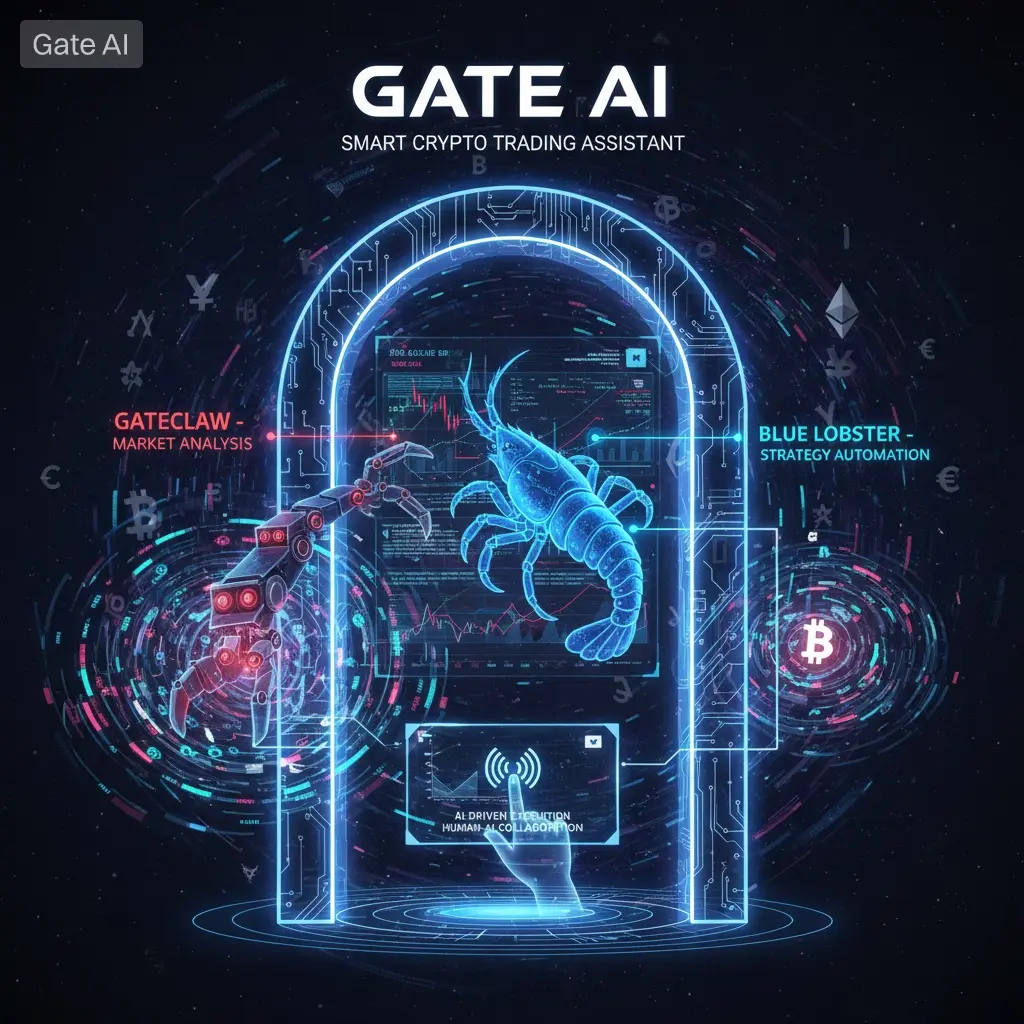
In today’s high-speed cryptocurrency markets, information is king, speed is power, and precision is survival. Gate AI has emerged as a revolutionary solution, combining advanced artificial intelligence, deep market analytics, and automated strategy execution into a single, integrated ecosystem. With the support of Blue Lobster and GateClaw, Gate AI is transforming how traders—both novice and professional—interact with markets, execute strategies, and manage portfolios.
Gate
BTC-0,67%
ETH-0,93%
HighAmbitionvip
#GateSquareAIReviewer!
Gate AI: The Ultimate Crypto Trading Intelligence Ecosystem
March 2026 | Gate.com Market Insights
In today’s high-speed cryptocurrency markets, information is king, speed is power, and precision is survival. Gate AI has emerged as a revolutionary solution, combining advanced artificial intelligence, deep market analytics, and automated strategy execution into a single, integrated ecosystem. With the support of Blue Lobster and GateClaw, Gate AI is transforming how traders—both novice and professional—interact with markets, execute strategies, and manage portfolios.
Gate AI: More Than an Assistant, It’s a Trading Partner
Gate AI is not just a chatbot; it is a full-spectrum trading companion capable of managing every aspect of a trader’s workflow. It allows conversational market analysis, where traders can ask questions such as “What is the trend for BTC this week?” or “Which altcoins are showing bullish signals?” and receive instant, detailed, and context-aware answers. Gate AI also handles smart fund management with one-click fund transfers across wallets, exchanges, or sub-accounts using natural language commands, minimizing friction in asset movement. Beyond this, it provides event and news intelligence by monitoring global events, economic announcements, and regulatory developments, analyzing their potential impact on crypto prices in real time. Gate AI further assists in portfolio optimization, suggesting rebalancing strategies, risk allocation, and hedging opportunities based on historical performance and projected trends. By centralizing information, insight, and execution, Gate AI allows traders to operate faster, with fewer errors, and with continuous access to actionable intelligence, turning complex market data into actionable trading decisions.
Blue Lobster: AI-Driven Strategy Automation
Blue Lobster is the engine that converts intelligence into action. It allows traders to create sophisticated strategies without writing a single line of code, making strategy design accessible for both beginners and professionals. Backtesting and simulation are core features, enabling users to evaluate performance, volatility, and drawdowns over historical data before executing real trades.
Once strategies are live, Blue Lobster dynamically adjusts trades in real time based on market volatility, liquidity, and trend signals. Risk management and discipline are built into the system, with automated stop-loss, take-profit, and position sizing functions to prevent emotional decision-making. By combining AI insights with automated execution, Blue Lobster transforms trading ideas into real-world performance, ensuring that strategies are both precise and adaptive in the rapidly evolving crypto market.
GateClaw: The Analytical Powerhouse
GateClaw complements Gate AI by providing deep market intelligence. It offers real-time market monitoring across BTC, ETH, altcoins, DeFi tokens, and NFTs, giving traders a comprehensive view of global market activity. GateClaw analyzes volatility and trends, detecting momentum shifts and potential breakout opportunities. It also provides event impact scenarios, using AI to forecast how macroeconomic events, political developments, or policy changes may influence crypto asset prices. Sentiment analysis is another key component, integrating social media, news, and on-chain signals to identify shifts in market sentiment before they reflect in price action. GateClaw ensures that traders not only see the market but understand it at multiple levels—short-term, medium-term, and long-term—enabling informed, proactive decision-making.
Human + AI Collaboration: The Future of Trading
Gate AI is designed to amplify human decision-making, not replace it. The combination of AI efficiency and human intuition is a key differentiator. Gate AI digests vast datasets, highlighting trends and patterns that would take humans hours to analyze. It provides strategic insights, actionable recommendations, and potential trade opportunities, while allowing traders to apply judgment, experience, and market context. Blue Lobster executes trades automatically, adjusting to market conditions in real time, while humans supervise risk, manage exceptions, and intervene when necessary. Continuous feedback loops allow Gate AI to learn from both market outcomes and human input, improving predictive accuracy over time. This collaboration allows traders to operate at speeds, precision, and scale that would otherwise be impossible, combining the strengths of machine intelligence with human expertise.
Trading Workflow with Gate AI
A typical trader session using Gate AI might begin with a morning market briefing, where Gate AI summarizes overnight market moves, highlights significant news, and identifies potential trading opportunities. Next, traders can design or refine strategies in Blue Lobster, testing them through simulations before deploying them in live markets. Execution is handled automatically, with Blue Lobster adjusting trades in real time according to market signals. Throughout the day, Gate AI provides live monitoring, alerts on key price levels, risk metrics, and emerging market patterns. At the end of the day, traders receive a detailed portfolio review, including P&L reports, risk assessments, and actionable suggestions for rebalancing. This workflow transforms trading from a reactive, stressful process into a proactive, intelligent, and streamlined operation.
Market Analysis Enhanced by AI
Gate AI functions as a market intelligence engine, offering insights that go far beyond execution. It tracks global liquidity flows, price correlations across crypto and traditional assets, and identifies overbought or oversold conditions using AI-driven indicators. It can detect emerging altcoin trends before mainstream adoption, and forecasts market behavior using probabilistic models, improving timing and risk-adjusted returns. Essentially, Gate AI provides traders with the equivalent of hundreds of analysts working around the clock, delivering insights in real time, and enabling smarter, faster decisions in volatile markets.
Key Benefits of Gate AI Ecosystem
Gate AI’s ecosystem delivers multiple advantages. Its conversational AI enables instant, contextual market answers. Blue Lobster ensures automated strategy execution, reducing emotional trading and enhancing discipline. GateClaw provides deep analytical insights, trend detection, and risk assessment. Multi-device access allows seamless trading across web, app, and desktop platforms. Most importantly, the human + AI synergy balances speed, precision, and judgment, giving traders a decisive edge. Collectively, these features improve efficiency, reduce errors, and enhance trading performance across all market conditions.
The Future: AI-Integrated Trading
Gate AI represents a paradigm shift in cryptocurrency trading, introducing an era where humans and AI collaborate seamlessly. By combining Gate AI, Blue Lobster, and GateClaw, traders gain a complete edge: instant access to market intelligence, AI-powered strategy development, automated execution, and adaptive risk management—all while retaining human oversight. Whether you are a beginner seeking guided trading or a professional managing a complex portfolio, Gate AI provides a game-changing advantage. The ecosystem ensures that trading becomes faster, smarter, and more disciplined, marking the future of crypto markets as a partnership between humans and intelligent machines.
repost-content-media
  • Reward
  • Comment
  • Repost
  • Share
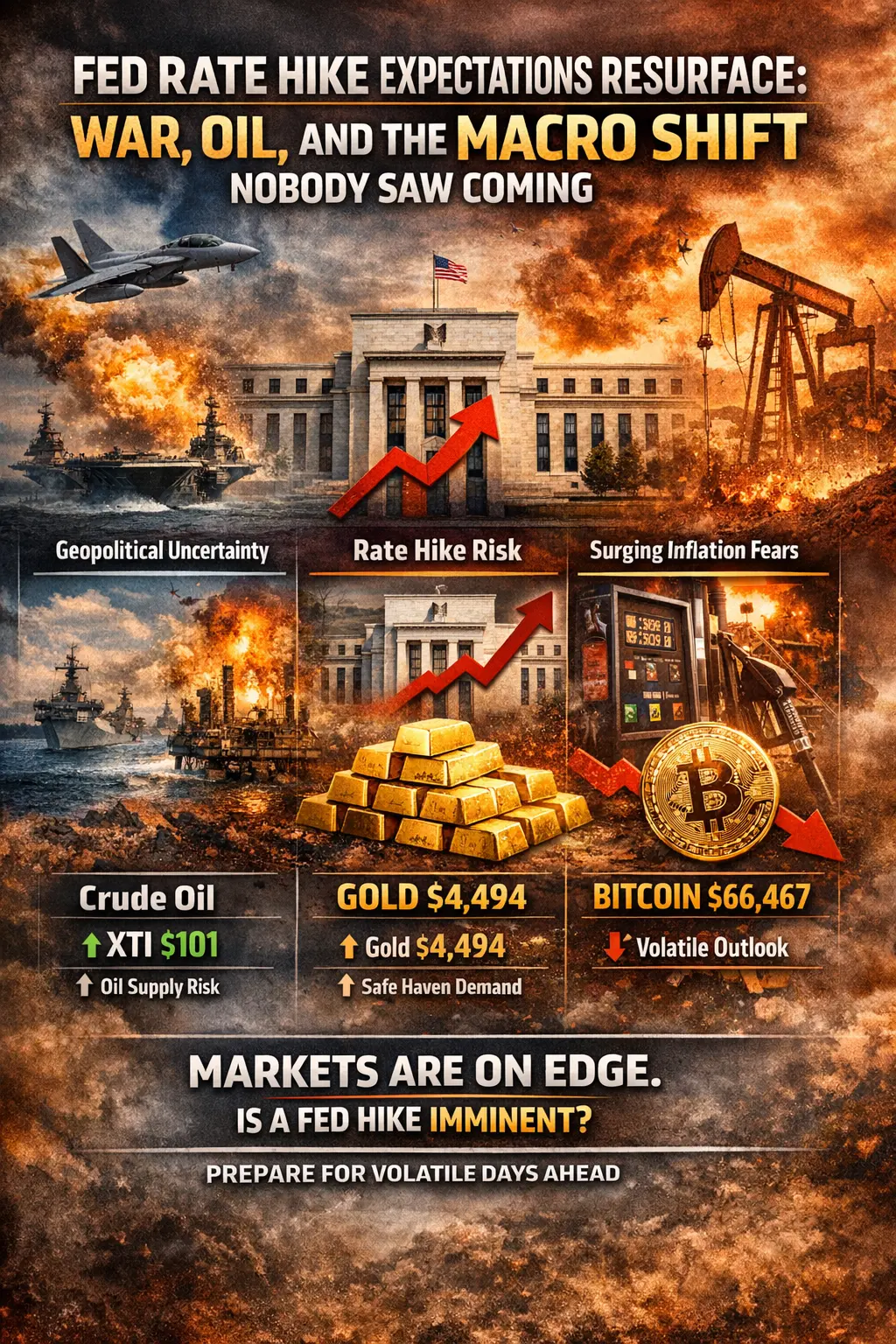
#FedRateHikeExpectationsResurface
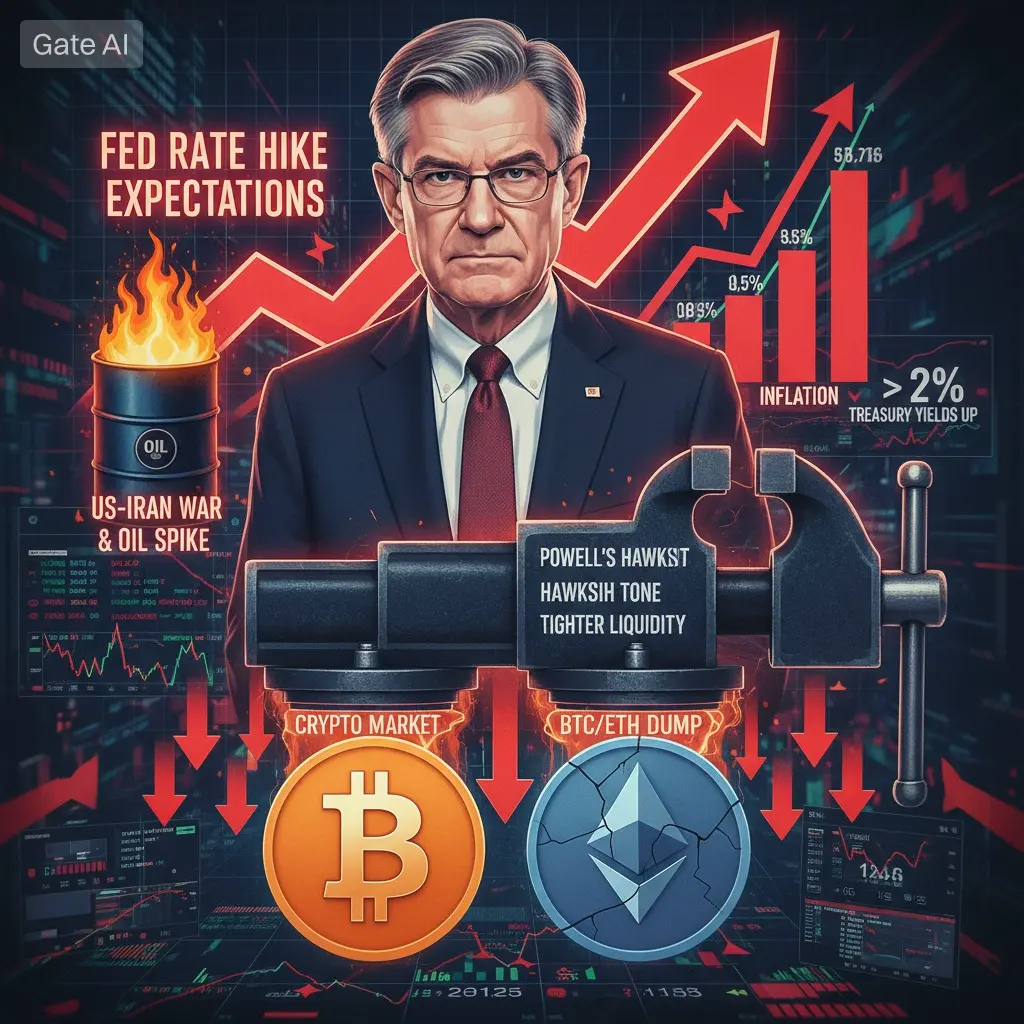
The Federal Reserve currently maintains its benchmark interest rate at 3.50%–3.75%, unchanged since the March 18, 2026 meeting. After three consecutive cuts in late 2025, the Fed paused to assess the economic landscape. At that time, markets were pricing multiple rate cuts throughout 2026, expecting continued support to sustain growth and manage inflation. However, recent developments have caused a dramatic shift in expectations, with traders now considering the possibility of a rate hike later this year.
The resurgence of rate hike expectations is driven by
HighAmbitionvip
#FedRateHikeExpectationsResurface
The Federal Reserve currently maintains its benchmark interest rate at 3.50%–3.75%, unchanged since the March 18, 2026 meeting. After three consecutive cuts in late 2025, the Fed paused to assess the economic landscape. At that time, markets were pricing multiple rate cuts throughout 2026, expecting continued support to sustain growth and manage inflation. However, recent developments have caused a dramatic shift in expectations, with traders now considering the possibility of a rate hike later this year.
The resurgence of rate hike expectations is driven by multiple interconnected factors. First and foremost is the US-Iran war, which began on February 28, 2026, when the US and Israel launched coordinated strikes on Iran. This geopolitical event sent crude oil prices soaring by roughly 50%, leading to sharp spikes in US gasoline prices and creating widespread supply chain uncertainty. Historically, oil shocks have a direct influence on inflation, and this sudden surge prompted markets to reconsider the pace of monetary policy tightening.
Inflation itself remains a persistent concern. US inflation has stayed above the Fed’s 2% target for five consecutive years, without a decisive period of cooling. Even prior to the Iran conflict, inflation was already considered “sticky,” particularly in sectors such as housing, energy, and food. The oil shock now compounds an already elevated baseline, increasing the likelihood that the Fed may take action to curb price pressures sooner than previously expected. Adding to this, Trump-era tariffs on imports from Canada, Mexico, and China continue to push prices higher, contributing an estimated 0.5–1% to US inflation through 2026. These tariffs have acted as a structural floor, preventing inflation from fully normalizing, which keeps pressure on policymakers to respond.
Financial markets have picked up on these dynamics rapidly. Treasury yields have risen sharply, sending a clear signal about investor expectations. The 2-year Treasury yield now sits 27 basis points above the Fed Funds Rate, a classic indicator that the market anticipates tightening rather than cuts. The 3-year yield has increased by 53 basis points since early March 2026, while the 1-year yield has fully priced out any rate cuts for the year. When short-term yields exceed the policy rate, it signals that the market believes the Fed may be “behind the curve,” increasing the likelihood of a policy adjustment.
Adding to the market signals, Fed Chair Jerome Powell has subtly shifted his language, placing greater emphasis on inflation risks over employment risks. Fed Governors Christopher Waller and Stephen Miran have been vocal in their hawkish dissent, reinforcing the impression that the Fed is now more concerned about runaway prices than potential job market weakness. This marks a stark contrast to the cautious tone held just weeks ago, when market participants were largely expecting cuts to support growth.
The cumulative effect of these signals has triggered a rapid reassessment in market probabilities. Just a few weeks ago, markets assigned near-zero probability to a Fed hike in 2026. Today, investors are pricing a better-than-50% chance of a hike as early as July 2026, with September expectations around 75%. Meanwhile, expectations for rate cuts have collapsed dramatically, from 72% at the end of 2025 to effectively negative. This sharp reversal reflects the speed at which geopolitical events, sticky inflation, and Treasury yields can reshape macroeconomic sentiment.
According to Bank of America economist Aditya Bhave, an actual Fed rate hike in 2026 would require three specific conditions. First, the labor market must remain stable, with unemployment below 4.5%—current estimates hover between 4.3% and 4.5%. Second, the Iran oil shock must transmit into core inflation, not just headline energy prices. Third, Jerome Powell must remain as Fed Chair, ensuring continuity and credibility in policy decisions. If these conditions are met, the Fed could move from a pause to tightening, a scenario that traders are now monitoring closely.
Major banks have nuanced views on the likelihood of hikes. J.P. Morgan currently expects no cuts in 2026, with the next possible hike occurring in 2027. Bank of America still sees cuts slightly more probable than hikes but acknowledges that conditions for a 2026 hike are now being tracked closely. Wall Street Journal analysts have highlighted in headlines that the Fed’s next move could be a hike, while Bloomberg reports that traders have lifted bets on a hike this year to 50%, reflecting the dramatic shift in sentiment.
The implications for the crypto market are significant. Historically, rising rate expectations are bearish for risk assets, and crypto is no exception. Higher rates increase the opportunity cost of holding non-yielding assets like Bitcoin and Ethereum, as US Treasuries and other fixed-income instruments become more attractive. A stronger US dollar, often resulting from higher rates, places additional pressure on cryptocurrencies priced in USD. Furthermore, tighter monetary conditions reduce overall market liquidity, which contrasts with the loose liquidity that drove the 2023–2024 crypto bull run. Traders who previously benefited from expected rate cuts may now face headwinds from reduced risk appetite and potential short-term volatility.
The macro-financial interaction is multi-layered: BTC and ETH may come under downward pressure, altcoins could see sharper declines due to heightened risk-off sentiment, and stablecoins may experience increased inflows as investors seek safety. Leveraged positions and margin trades in crypto markets could also face liquidations if prices fall rapidly in response to macro-driven selling.
In conclusion, the combination of the Iran War oil shock, persistent inflation, tariff-driven price floors, and rising Treasury yields has flipped the narrative. Market focus has shifted from “how many rate cuts will the Fed deliver?” to “could the next Fed move actually be a hike?” This is one of the fastest macro expectation reversals in recent memory. Crypto traders, risk asset investors, and policymakers alike are now watching closely, as even small signals from the Fed or bond markets could trigger large swings across global financial and crypto markets.
repost-content-media
  • Reward
  • Comment
  • Repost
  • Share
#TrumpExtendsStrikeDelay10Days
THE CORE EVENT — A DELAY THAT MOVED GLOBAL MARKETS
Donald Trump has officially extended the deadline for potential strikes on Iran’s energy infrastructure by another 10 days, pushing the critical decision point to April 6, 2026 (8 PM ET). This marks the second extension within a week, first by 5 days and now by 10, signaling a deliberate pattern of pressure followed by temporary relief. The announcement came at a highly sensitive moment, right after the S&P 500 recorded a sharp -1.7% decline, its biggest drop in weeks. Markets immediately reacted, with US future
HighAmbitionvip
#TrumpExtendsStrikeDelay10Days
THE CORE EVENT — A DELAY THAT MOVED GLOBAL MARKETS
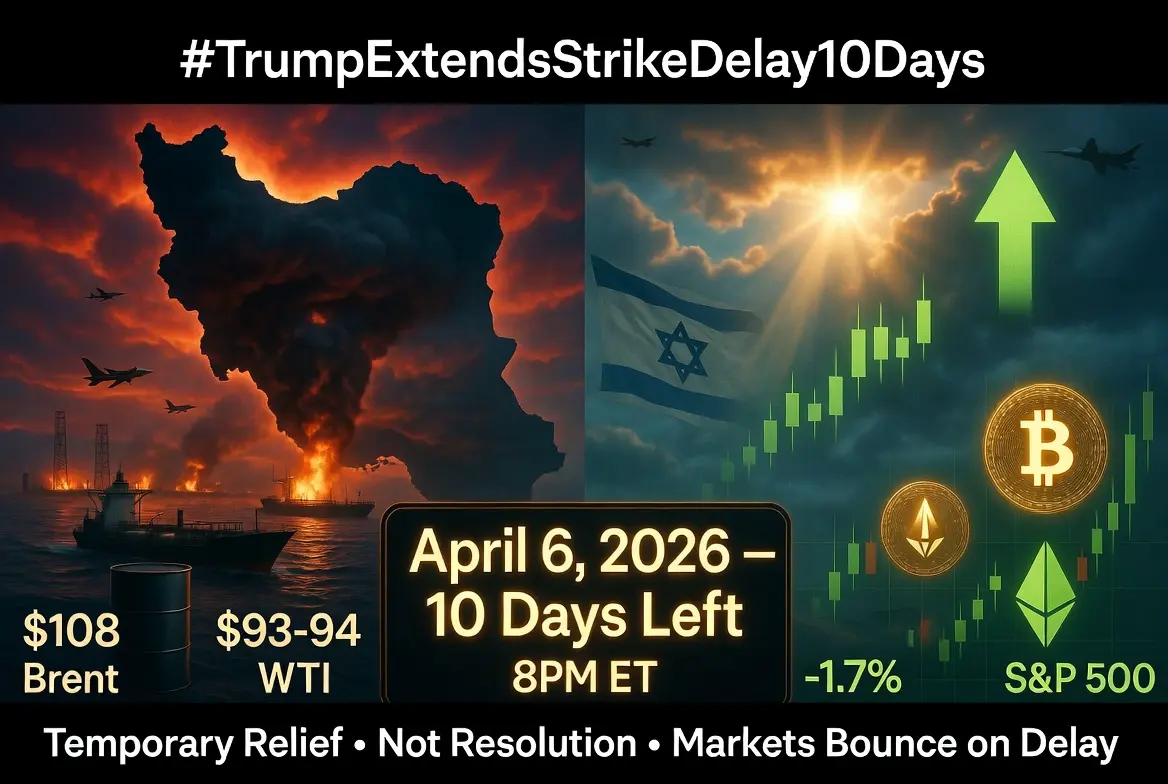
Donald Trump has officially extended the deadline for potential strikes on Iran’s energy infrastructure by another 10 days, pushing the critical decision point to April 6, 2026 (8 PM ET). This marks the second extension within a week, first by 5 days and now by 10, signaling a deliberate pattern of pressure followed by temporary relief. The announcement came at a highly sensitive moment, right after the S&P 500 recorded a sharp -1.7% decline, its biggest drop in weeks. Markets immediately reacted, with US futures turning positive, oil pulling back slightly, and crypto staging a rapid recovery. This was not just a geopolitical move — it was a market-moving trigger.
THE BACKGROUND — WHY THIS CRISIS ESCALATED
This situation originates from the ongoing US-Israel conflict with Iran under “Operation Epic Fury,” where nearly 8,000 targets have already been struck. Iran’s restriction of the Strait of Hormuz — a route responsible for roughly 20% of global oil flow — triggered panic across energy markets. In response, Trump threatened to completely destroy Iran’s power infrastructure unless the Strait was fully reopened. Although Iran allowed limited ship passage, it stopped short of full compliance, keeping tensions extremely high. This partial response created a fragile middle ground — enough to delay escalation, but not enough to resolve it.
DIPLOMACY VS REALITY — TALKS OR STRATEGY?
Trump claims negotiations are progressing “very well,” supported by envoy Steve Witkoff’s statement that Iran is seeking an exit strategy. Behind the scenes, Pakistan has played a quiet but critical role by delivering a 15-point US peace proposal to Iran, acting as a mediator. However, Iran publicly denies any negotiations, calling Trump’s delay a tactic to stabilize markets and buy time. This contradiction suggests a dual-layer game: diplomatic signals behind closed doors, and aggressive rhetoric in public. For markets, this creates confusion — and volatility.
ISRAEL FACTOR — THE BIGGEST UNKNOWN
While the US has paused, Israel has not. Prime Minister Netanyahu has confirmed that strikes on Iran will continue regardless of Trump’s extension, and new attacks on Tehran have already been reported. This creates a dangerous divergence in strategy. Even if the US seeks temporary de-escalation, continued Israeli operations could trigger retaliation from Iran at any moment. For traders, this means the situation cannot be viewed as a true pause — it is an unstable, partial slowdown with ongoing escalation risk.
MARKET REACTION — FEAR, RELIEF, AND LIQUIDITY SHIFTS
Before the extension, global markets were under heavy pressure. The S&P 500 dropped -1.7%, Asian markets sold off sharply, and oil surged aggressively, with Brent crude reaching $108 per barrel and WTI climbing to $93. The International Energy Agency described the situation as worse than the 1970s oil crisis, highlighting the severity of the supply shock. Immediately after Trump’s announcement, sentiment flipped. Oil prices eased, with WTI dropping -1.3%, while equity futures rebounded.
In crypto, the reaction was even more aggressive. Bitcoin surged from the $66K region back above $71K within a short window, Ethereum rebounded toward $2,150, and altcoins followed with strong upward momentum. This move was driven by short liquidations and a sudden shift in sentiment from extreme fear to rapid optimism. Liquidity flooded back into the market as traders repositioned for a potential de-escalation scenario.
THE REAL MOTIVE — MARKET PRESSURE OR STRATEGIC TIMING?
A growing narrative suggests that this delay was not purely diplomatic. Political voices, including a Democratic senator, argue that Trump responded directly to market pressure rather than negotiation progress. The timing supports this theory — the extension was announced minutes after a major stock market decline. Even Iran’s officials claim the move was designed to calm financial markets. Meanwhile, US Treasury Secretary Bessent defended the broader strategy, stating that escalation can sometimes be necessary to force de-escalation. The pattern is becoming clear: deadlines are used as leverage, and extensions are deployed when market stress peaks.
GLOBAL RESPONSE — RISING INTERNATIONAL PRESSURE
World leaders are increasingly concerned. Germany has expressed direct opposition to targeting energy infrastructure, NATO has warned about lack of coordination, and China has emphasized that civilian facilities must not be attacked. The UK has added pressure by summoning Iran’s ambassador, while Ukraine claims Russia is supporting Iran with intelligence. This is no longer a regional conflict — it is evolving into a complex global geopolitical network, increasing systemic risk across all markets.
MARKET OUTLOOK — HIGH VOLATILITY ZONE UNTIL APRIL 6
Short-term relief is real, but stability is not. If the April 6 deadline results in a deal and the Strait of Hormuz fully reopens, oil could fall sharply from $108 toward $80, providing major relief to inflation and risk assets. In that scenario, crypto could see another strong rally, with Bitcoin holding above $71K and pushing higher.
However, downside risks remain significant. Iran continues to deny negotiations, Israel is actively striking, and the war has already disrupted global energy flows. Any escalation — especially attacks on infrastructure or further missile exchanges — could send oil back above $110, triggering another wave of selling in equities and crypto. The fact that the S&P 500 still closed down -1.7% despite the extension shows markets are not fully convinced.
FINAL VERDICT — TEMPORARY RELIEF, NOT RESOLUTION
This 10-day extension is not a solution — it is a pause within an active conflict. Markets have reacted positively in the short term, with oil easing, stocks stabilizing, and crypto rebounding sharply. However, the underlying risks remain unchanged. Israel continues its operations, Iran maintains its aggressive stance, and the global energy system is still under pressure.
Between now and April 6, markets will be driven by headlines, not fundamentals. Every statement, every strike, and every political move can shift sentiment instantly. This is a high-risk, high-volatility environment where liquidity moves fast and reactions are sharp.
In one line: Trump delayed the strike, markets bounced, crypto surged, oil cooled slightly — but the war is still active, and April 6 remains the real decision point that will define the next major move.
repost-content-media
  • Reward
  • Comment
  • Repost
  • Share
#FedRateHikeExpectationsResurface
The past week has delivered extreme geopolitical and macroeconomic tension, and traders are asking: what does this mean for oil, gold, BTC, and the Fed’s policy trajectory? Here is my full, structured analysis of the three key questions dominating the market discussion on Gate Square. This is a deep-dive look at the facts, prices, volumes, and probabilities, integrating geopolitical developments, macro trends, and technical context for investors and traders alike.
Trump Pauses Strikes for 10 Days — Real Negotiations or Time for a Ground Operation?
The honest
BTC-0,67%
HighAmbitionvip
#FedRateHikeExpectationsResurface
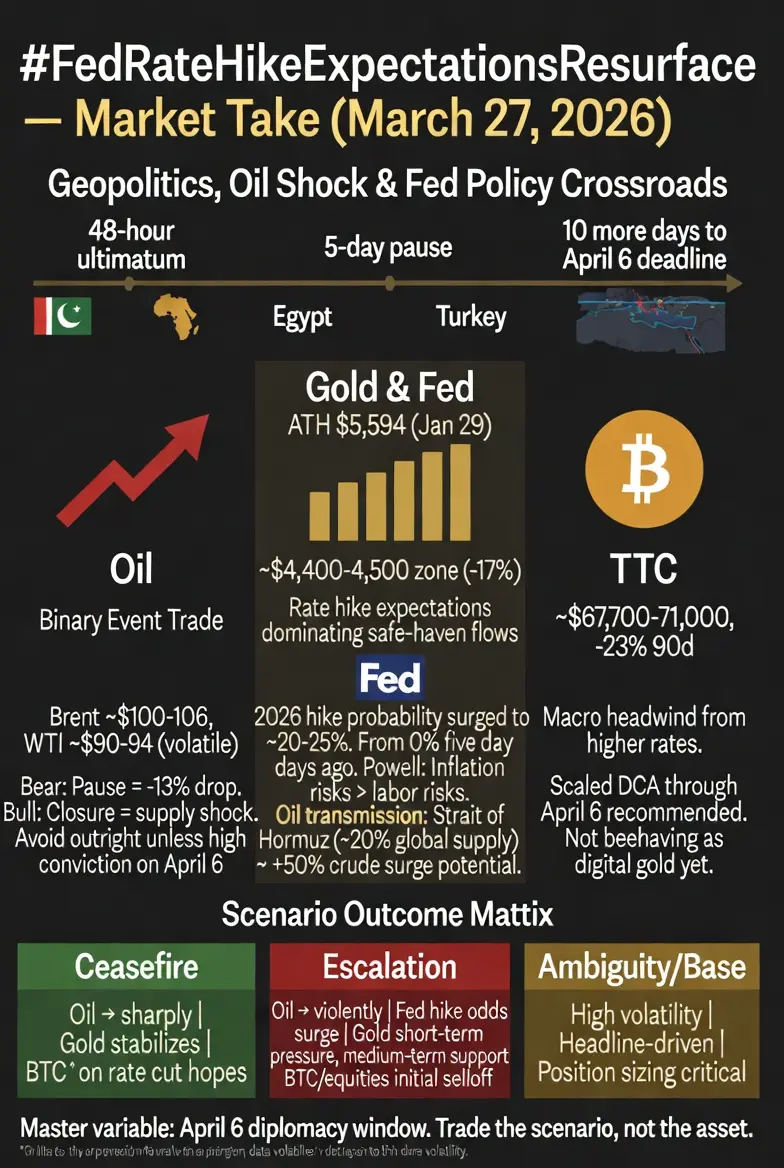
The past week has delivered extreme geopolitical and macroeconomic tension, and traders are asking: what does this mean for oil, gold, BTC, and the Fed’s policy trajectory? Here is my full, structured analysis of the three key questions dominating the market discussion on Gate Square. This is a deep-dive look at the facts, prices, volumes, and probabilities, integrating geopolitical developments, macro trends, and technical context for investors and traders alike.
Trump Pauses Strikes for 10 Days — Real Negotiations or Time for a Ground Operation?
The honest answer is: it is probably both, and that ambiguity is the entire point.
Here’s what the timeline and facts show:
Trump first issued a 48-hour ultimatum demanding Iran reopen the Strait of Hormuz. That evolved into a 5-day pause, and now it has been extended again to 10 more days, setting April 6 as the next deadline.
The stated reason is that Pakistan, Egypt, and Turkey have stepped in as mediators and presented Washington’s 15-point ceasefire proposal to Tehran.
The critical tension:
Iran’s official position: They are not negotiating at all. Iran’s ambassador to Pakistan stated publicly: “No direct or indirect negotiations have taken place between the two countries so far.”
Trump’s position: He claims talks are going “very well,” that Iran is speaking through “the right people,” and that Tehran even allowed 10 oil tankers through the Strait as a goodwill gesture.
Both cannot fully be true. What is likely happening is back-channel signaling through intermediaries, allowing both sides to explore options without officially committing to negotiations — politically necessary for Iran’s leadership domestically.
Strategic reading: The 10-day pause is also operational:
U.S. military posture is maintained while interceptor and supply logistics (reportedly running low for both the U.S. and Israel) are replenished.
A diplomatic off-ramp is assessed. If April 6 passes without a deal, a military option becomes politically and operationally credible because diplomacy was attempted publicly.
Bottom line on Q1: This is structured coercive diplomacy, not purely genuine negotiation. The pause keeps Iran uncertain, oil markets nervous, and Trump’s maximum pressure strategy alive without immediate escalation costs. This creates volatility in commodities and risk assets while markets price both outcomes.
If Tensions Escalate, Could the Fed Be Forced Into Aggressive Rate Hikes?
This is the most consequential macro question currently, and the answer is conditionally yes — with markets already signaling it.
Observed market changes:
Five days ago, Fed options markets implied 0% probability of a 2026 hike.
As of March 20, Reuters reported market pricing for a September hike surged to 75%, with better-than-even odds of a July hike.
Polymarket’s 2026 Fed hike probability jumped to 24%.
The 2-year Treasury yield, a key liquidity and rate expectation proxy, has already moved higher, signaling repricing.
Transmission mechanism from Iran war to Fed:
Strait of Hormuz controls ~20% of global oil supply. Partial disruption sends crude prices higher → energy, transport, core CPI rise.
Crude prices have surged ~50% from pre-conflict levels, according to Reuters.
Fed Chair Powell has signaled a pivot: he does not consider labor market risks greater than inflation risks. Several Fed officials were already weighing a potential rate hike due to persistent inflation above the 2% target for five consecutive years.
Bank of America economist Aditya Bhave outlines three conditions for a Fed hike:
Labor market remains stable (unemployment below 4%, no sharp rise)
Inflation re-accelerates toward 3.5%+
Inflation expectations de-anchor
Condition one holds today.
Conditions two and three could be triggered by sustained conflict and elevated oil prices.
Counter-scenario: A genuine ceasefire and falling oil prices ease inflation pressures → Fed stays on hold or eventually considers cuts. This explains mid-week gold rally +3% on diplomacy optimism.
Bottom line on Q2: Escalation (e.g., U.S. strikes on Iranian energy infrastructure) likely triggers a Fed rate hike cycle. Ceasefire kills that scenario. Markets currently trade in ambiguous, high-volatility conditions — impacting equities, commodities, gold, BTC, and USD liquidity.
How Would You Position Oil, Gold, and BTC Right Now?
Now we get to actionable positioning. Each asset reacts differently under the current geopolitical-macro overlay.
Oil — Extreme Event Risk, Not a Trend Trade
Oil is directly exposed to geopolitical risk, creating asymmetric risk profiles:
Bear case (near-term):
Each pause extension triggers oil sharp retracements.
Example: 5-day pause → oil dropped 13% in one session.
Ceasefire success or full Strait reopening could drive retracement.
Bull case:
Post-April 6, if talks collapse and U.S. strikes resume, particularly targeting Iranian energy infrastructure, supply shock scenario emerges.
Oil prices could spike violently — headline-driven upside risk.
Positioning logic: Oil is a binary event trade, not a trend trade.
Longs: exposed to diplomatic upside moves.
Shorts: exposed to escalation.
Most investors should avoid outright exposure unless they have high conviction on April 6 outcome or employ defined-risk structures.
Gold — Tactical Dip Despite War Pressures
Spot gold: ~$4,558 (down ~17% from Jan 29 all-time high of $5,594).
Dynamics:
Bullish: War → inflation → safe-haven demand.
Bearish: Higher rate expectations → higher real yields → reduces appeal of non-yielding assets.
Observation: Rate expectations currently dominate, pushing dollar stronger → near-term pressure.
Structural bull case:
JP Morgan calls the -17% flush “historically a tactical dip to buy.”
Gold up 46% YoY. Central bank buying, de-dollarization flows, and persistent above-target inflation remain medium-term tailwinds.
Positioning logic: Buy dips with 3–6 month horizon, tolerate short-term drawdowns from rate repricing.
BTC — Complicated Correlation, Clear Macro Headwind
BTC: $67,745, down 3% past 24 hours, down 23% over 90 days.
Reality check: BTC has not surged as a safe-haven. Rate expectations are creating risk-off pressure, especially given BTC’s correlation with equities.
Scenario dynamics:
Fed hikes materialize: Dollar strengthens → liquidity tightens → BTC likely down further.
Ceasefire & rate cuts possible: Lower rates → weaker dollar → BTC could rally sharply.
Conflict escalates: BTC likely sells off alongside equities; recovery depends on narrative re-pricing as store of value.
Positioning logic: BTC is best approached with scaled accumulation, dollar-cost averaging through April 6. Avoid lump-sum bets; macro headwinds remain.
The Big Picture — Everything Connects to April 6
The master variable: Iran diplomacy outcome. Asset behavior resolves differently based on scenario:
Ceasefire:
Oil falls sharply
Gold dips short-term, stabilizes structurally
BTC benefits from renewed risk appetite & potential rate cuts
Escalation:
Oil spikes violently
Fed hike probability surges
Gold faces short-term pressure but medium-term fundamentals remain supportive
BTC & equities see initial selloff
Prolonged ambiguity (base case):
Elevated volatility persists
Headline-driven trading dominates
No clear trend; defined-risk entries matter most
Trading framework: Trade the scenario, not just the asset. Use position sizing discipline, defined-risk structures, and scenario-based thinking. April 6 is the geopolitical clock — market participants must navigate headline volatility while preparing for either sharp reversals or sustained trend moves.
Conclusion:
The market sits at a crossroads of geopolitics, oil supply shocks, and Fed policy uncertainty. Prices, liquidity, and volumes across oil, gold, and BTC are now headline-sensitive and macro-sensitive, creating asymmetric opportunities and risks. Strategic patience and scenario-based positioning remain the most actionable approach for the coming weeks.
repost-content-media
  • Reward
  • Comment
  • Repost
  • Share
#GateSquareAIReviewer
GateSquare AI Reviewer & AI Trading Tools — Human + AI Powering Smarter Decisions
The evolution of digital platforms and trading technologies has reached a pivotal point. Today, success is no longer measured simply by volume or visibility—it is about value, precision, and actionable intelligence. Gate Square’s AI Reviewer and AI-powered trading tools exemplify this transformation, showing how the combination of AI efficiency and human judgment can elevate both content creation and financial decision-making.
Gate Square AI Reviewer: Redefining Content Quality with Human +
HighAmbitionvip
#GateSquareAIReviewer
GateSquare AI Reviewer & AI Trading Tools — Human + AI Powering Smarter Decisions
The evolution of digital platforms and trading technologies has reached a pivotal point. Today, success is no longer measured simply by volume or visibility—it is about value, precision, and actionable intelligence. Gate Square’s AI Reviewer and AI-powered trading tools exemplify this transformation, showing how the combination of AI efficiency and human judgment can elevate both content creation and financial decision-making.
Gate Square AI Reviewer: Redefining Content Quality with Human + AI Collaboration
In today’s content ecosystem, virality alone is no longer a reliable measure of success. True impact is defined by quality, engagement, and meaningful contribution. The Gate Square AI Reviewer introduces a sophisticated intelligence layer, transforming content evaluation into a data-driven, transparent, and scalable process.
The AI Reviewer evaluates posts across multiple dimensions: clarity, originality, depth, engagement potential, and community relevance. By converting creativity into measurable metrics, the platform gives creators actionable feedback to systematically improve content performance. Over time, this human + AI feedback loop drives higher-quality contributions and rewards merit rather than luck or accidental virality.
Its hybrid design is a key
strength: AI algorithms analyze millions of content signals in real-time, while human interactions (likes, shares, comments, retention metrics) provide contextual nuance. This ensures scoring is both analytically precise and grounded in real-world impact.
For creators, the benefits are clear:
Structured insights: Understand why content performs well or poorly.
Merit-based rewards: Leaderboard exposure, platform-native tokens, and USDT payouts incentivize consistent quality.
Fair competition: AI + human scoring creates a transparent ecosystem, reducing bias and subjectivity.
For the platform, this approach ensures scalability without compromising quality, reducing low-value content while highlighting high-impact contributions. Ethical design and transparency foster trust—essential for long-term platform growth.
In Web3 and decentralized content environments, this model proves that intelligent automation can enhance efficiency, fairness, and community standards, without centralizing control. High-quality content becomes more visible, raising the bar for the entire community.
AI Trading Tools: Enhancing Human Decision-Making
AI in trading has often been overhyped, promising effortless profits. But trading is inherently complex, shaped by market structure, liquidity cycles, macro trends, and geopolitical events.
A structured 7-day live-market evaluation of AI trading tools revealed where they truly add value:
Key Areas Evaluated
Market trend analysis: Identifying momentum, structure, and potential reversals across multiple timeframes.
Signal generation: AI suggests entry and exit points based on probabilistic patterns.
Sentiment tracking: Monitoring crowd positioning, social trends, and directional biases.
Human control remained primary—AI served as a supporting tool, not an autonomous decision-maker. This distinction highlighted AI’s role in efficiency, discipline, and situational awareness, rather than profit guarantees.
Strengths Observed
Efficiency gains: Rapid scanning of market setups saved time and reduced manual work.
Enhanced discipline: Structured AI-supported trading reduced impulsive trades.
Improved situational awareness: Sentiment analysis flagged overcrowded positions and potential reversals.
Consistency: AI helped reduce drawdowns and improve risk management.
Limitations
Signal reliability: AI struggles during sudden, unpredictable market changes.
Over-optimization: Tools tuned for past data may underperform in real-time dynamics.
Macro understanding: AI cannot interpret broader drivers like interest rates, liquidity shifts, or geopolitical risk—human oversight remains essential.
Conclusion: AI in trading is a decision-support system, not a replacement for human judgment. Strong traders leverage AI for efficiency, timing, and consistency, while retaining full control over risk management, position sizing, and strategy.
Combining AI + Human Insight: The Key to Sustainable Advantage
Across both content platforms and trading workflows, a clear pattern emerges: AI excels when paired with human expertise.
Gate Square content: AI evaluates and scores content, but human creativity, engagement, and context guide the strategy.
Trading workflows: AI filters opportunities, analyzes sentiment, and identifies high-probability scenarios, while humans manage macro understanding, risk, and final execution.
This AI + human synergy ensures smarter, more consistent, and higher-quality outcomes—without overreliance or blind automation.
Practical Advantage: Fund Changes via Gate.io
An additional layer of flexibility comes from fund management via Gate.io, allowing creators and traders to move, manage, or withdraw rewards and capital directly within the platform. This integration ensures that performance and rewards are immediately actionable, strengthening the feedback loop between AI evaluation, human decision-making, and tangible outcomes.
Conclusion: The Future of Intelligent Platforms
AI is not a magic bullet—it is an intelligent partner that amplifies human skill, provides clarity amidst complexity, and drives disciplined, data-driven outcomes. Gate Square’s AI Reviewer sets a new standard in transparent, merit-based content evaluation, while structured AI trading tools demonstrate how human judgment + AI efficiency creates real-world advantage without unrealistic profit promises.
Platforms and traders who adopt this AI + human approach thoughtfully, integrating insight, control, and accountability, will consistently outperform those relying solely on automation.
The competitive edge lies not in AI alone—but in the strategic fusion of human intelligence, AI efficiency, and actionable reward systems.
repost-content-media
  • Reward
  • Comment
  • Repost
  • Share
#CreatorLeaderboard
The Creator Leaderboard is more than a ranking system — it is a platform that highlights the most impactful contributors in the crypto ecosystem. These are the analysts, educators, strategists, and community builders who consistently share high-quality insights, market research, and actionable strategies. By recognizing and promoting their contributions, the leaderboard helps the broader crypto community discover trusted voices and make informed decisions.
What the Creator Leaderboard Represents
At its core, the leaderboard reflects community recognition, transparency, and
HighAmbitionvip
#CreatorLeaderboard
The Creator Leaderboard is more than a ranking system — it is a platform that highlights the most impactful contributors in the crypto ecosystem. These are the analysts, educators, strategists, and community builders who consistently share high-quality insights, market research, and actionable strategies. By recognizing and promoting their contributions, the leaderboard helps the broader crypto community discover trusted voices and make informed decisions.
What the Creator Leaderboard Represents
At its core, the leaderboard reflects community recognition, transparency, and credibility. Creators are ranked based on the quality and value of their content, engagement with the community, and accuracy of market predictions. It emphasizes the importance of trust and expertise in a rapidly evolving market. For both new and experienced traders, the leaderboard serves as a reliable source of insight that can guide decision-making and enhance understanding of complex market dynamics.
Market Influence and Sentiment
The content shared by top creators has a direct impact on market sentiment and behavior. Traders often rely on creator insights to interpret price movements, liquidity conditions, and trading opportunities. A well-researched analysis can boost confidence in specific assets or market phases, while thoughtful critiques or warnings can prevent losses and stabilize trader behavior.
Creators also contribute to market education, reducing mistakes by providing clear explanations of trading mechanics, risk management, and market cycles. When high-quality insights are shared widely, the market becomes more efficient, and misinformation declines.
Trading Strategy Implications
Creators on the leaderboard focus on multiple aspects of trading:
Technical Analysis: Identifying trends, chart patterns, momentum indicators, volume changes, and key support and resistance levels.
Fundamental Analysis: Evaluating project fundamentals, protocol upgrades, adoption metrics, and macroeconomic factors.
Risk Management: Advising on position sizing, stop-loss strategies, and portfolio diversification.
Sentiment Analysis: Highlighting on-chain activity, social trends, and behavioral signals that can precede market moves.
By following top creators, traders gain a strategic advantage, improving the quality of their market entries and exits while staying informed about emerging trends and potential risks.
Market Analysis — Leaderboard Impact
The influence of creators often manifests in trading volume, liquidity, and price movement patterns.
Volume: Popular insights can trigger higher trading volumes as followers act on signals.
Liquidity: When multiple traders align with creator guidance, liquidity clusters form at key price levels, enhancing market depth and execution efficiency.
Price: While creators alone do not drive prices, their collective influence can coincide with market phases such as bull runs, consolidations, or corrections.
Over time, the leaderboard creates a feedback loop where reliable insights reinforce positive market behavior, improving overall market health.
Gate.io and Gate Square — Empowering Creators and Traders
Gate.io is recognized for its security, liquidity, and innovation, providing traders with robust tools for analysis and execution. Gate Square complements this by offering a vibrant community hub where creators, traders, and analysts converge to share knowledge, discuss strategies, and elevate collective understanding.
The leaderboard within Gate Square rewards value creation, giving creators a platform to grow their influence while helping users filter quality insights from noise. This system strengthens the ecosystem by encouraging data-driven content and rewarding expertise.
Practical Takeaways for Traders and Investors
Follow consistent, data-backed creators to enhance your trading perspective.
Use insights as guidance, not absolute signals, combining them with your research and risk assessments.
Focus on risk management — even top creators cannot predict sudden market shocks.
Diversify your information sources to avoid overreliance on any single viewpoint.
Leverage Gate.io’s advanced tools for real-time charts, on-chain data, and trading execution to act on insights effectively.
Conclusion
The Creator Leaderboard is a lighthouse in the complex crypto market, promoting credible voices, quality analysis, and informed participation. By bridging creators and traders, it enhances transparency, improves market literacy, and supports smarter decision-making. Platforms like Gate.io and Gate Square are pivotal in this ecosystem, enabling creators to shine and empowering users to navigate the market with confidence.
This is not just a leaderboard — it is a community-driven mechanism that raises the standard of crypto analysis and strengthens the foundation of digital asset trading.
repost-content-media
  • Reward
  • Comment
  • Repost
  • Share
🤔 Is everyone winning but you? Time to change that!
Take a break from the charts and head over to Gate Square to grab your lucky gold bar!
💰 Season 17 Growth Points Draw is ongoing!
New users get a 100% win rate—it's basically free rewards, so don't miss out!
🎁 Prize Pool: 10g Gold Bars, Red Bull Racing gear, Big Vouchers...
🚀 How to Join: Post or like to earn 300 points and start spinning!
Test your luck here:https://www.gate.com/activities/pointprize?now_period=17
#BTC #ETH #GT
BTC-0,67%
ETH-0,93%
GT0,3%
HighAmbitionvip
🤔 Is everyone winning but you? Time to change that!
Take a break from the charts and head over to Gate Square to grab your lucky gold bar!
💰 Season 17 Growth Points Draw is ongoing!
New users get a 100% win rate—it's basically free rewards, so don't miss out!
🎁 Prize Pool: 10g Gold Bars, Red Bull Racing gear, Big Vouchers...
🚀 How to Join: Post or like to earn 300 points and start spinning!
Test your luck here:https://www.gate.com/activities/pointprize?now_period=17
#BTC #ETH #GT
repost-content-media
  • Reward
  • Comment
  • Repost
  • Share
#WinGoldBarsWithGrowthPoints
#WinGoldBarsWithGrowthPoints | The Ultimate Gate Community Reward Revolution
Gate is redefining what community engagement means in crypto — and this campaign proves it in the most tangible way possible.
What Makes This Campaign Different?
The #WinGoldBarsWithGrowthPoints campaign is not just another reward system — it’s a real-value ecosystem where your daily activity transforms into physical wealth.
Unlike typical platforms that offer only digital perks, Gate introduces real gold bars as rewards — bridging the gap between Web3 engagement and real-world value.
Dee
HighAmbitionvip
#WinGoldBarsWithGrowthPoints
#WinGoldBarsWithGrowthPoints | The Ultimate Gate Community Reward Revolution
Gate is redefining what community engagement means in crypto — and this campaign proves it in the most tangible way possible.
What Makes This Campaign Different?
The #WinGoldBarsWithGrowthPoints campaign is not just another reward system — it’s a real-value ecosystem where your daily activity transforms into physical wealth.
Unlike typical platforms that offer only digital perks, Gate introduces real gold bars as rewards — bridging the gap between Web3 engagement and real-world value.
Deep Dive: Growth Points System
At the heart of this campaign lies the Growth Points mechanism, a behavioral reward engine designed to encourage meaningful participation.
You earn points through:
High-quality content creation
Insightful comments and discussions
Social engagement (likes, reactions)
Participation in trending topics & Hot Chats
Daily consistency via check-ins and tasks
This system doesn’t just reward activity — it rewards consistency, contribution, and influence.
Reward Mechanics — Smart & Inclusive
The campaign is structured to benefit both beginners and power users:
300 Points = 1 Draw Entry
Unlimited entries possible (based on activity level)
100% Winning Rate ensures zero disappointment
Reward Tiers Include:
🥇 10g Physical Gold Bars (Top-tier prize)
🎁 Exclusive Gate x Red Bull Gift Boxes
💳 VIP Experience Cards
💸 Trading Fee Rebates
🚀 Token Airdrops
This tiered reward structure creates a gamified experience, where higher engagement directly improves reward quality.
Market Impact & Strategic Angle
This campaign goes beyond rewards — it plays a role in ecosystem growth and market dynamics:
1. User Retention Engine
By incentivizing daily interaction, Gate strengthens user stickiness, which is critical in competitive crypto markets.
2. Content Quality Boost
As users compete for rewards, content quality naturally improves, benefiting the entire community.
3. Social Trading Expansion
More discussions = more insights → better-informed trading decisions across the platform.
4. Platform Activity Surge
Higher engagement often correlates with increased trading activity, indirectly supporting liquidity and market depth.
Winning Strategy (Pro Tips)
To maximize rewards, users should focus on:
Posting valuable and trend-based content
Engaging early in viral discussions
Maintaining daily consistency
Leveraging market insights & analysis posts
Building a recognizable presence in the community
Consistency beats randomness here — smart participation = higher probability of premium rewards.
Why Gold Matters Here
Gold isn’t just a reward — it’s a symbol of trust and value stability.
By offering gold, Gate is signaling:
Long-term commitment to users
Strong financial backing
A shift from “virtual rewards” to real asset incentives
This psychological factor significantly boosts campaign credibility.
Who Benefits the Most?
Content Creators → Earn while sharing insights
Active Traders → Convert market discussions into rewards
New Users → Easy entry, low barrier, guaranteed returns
Community Builders → Gain recognition + rewards
Final Verdict
This campaign is a perfect blend of gamification, real-world incentives, and community growth strategy.
Gate isn’t just rewarding users — it’s building a self-sustaining engagement economy where:
Activity → Points → Opportunities → Real Rewards
repost-content-media
  • Reward
  • Comment
  • Repost
  • Share
#CryptoMarketPullback
1. Why Did the Crypto Market Pull Back?
This is not a simple correction driven by one catalyst — it is a full-scale macro collision, a perfect storm where multiple high-impact forces hit the market simultaneously and created a cascading effect across all risk assets. The dominant trigger behind this pullback is the escalating US-Iran conflict escalation 2026, which has now stretched beyond four weeks and continues to inject uncertainty into global markets. As tensions intensified, critical energy infrastructure came under pressure, pushing oil prices sharply higher — Bre
HighAmbitionvip
#CryptoMarketPullback
1. Why Did the Crypto Market Pull Back?
This is not a simple correction driven by one catalyst — it is a full-scale macro collision, a perfect storm where multiple high-impact forces hit the market simultaneously and created a cascading effect across all risk assets. The dominant trigger behind this pullback is the escalating US-Iran conflict escalation 2026, which has now stretched beyond four weeks and continues to inject uncertainty into global markets. As tensions intensified, critical energy infrastructure came under pressure, pushing oil prices sharply higher — Brent crude surged to $114 while Oman crude approached $150. This spike in energy costs didn’t just affect commodities; it triggered a global risk-off environment where investors rapidly pulled capital out of volatile assets like crypto, equities, and tech. During the peak of this escalation in mid-March, Bitcoin dropped below $70K, highlighting how sensitive the market is to geopolitical shocks.
At the same time, the Federal Reserve delivered another blow to market sentiment. Instead of supporting growth expectations, the Fed held interest rates steady and signaled that there may be only one rate cut in all of 2026 — far below what markets had anticipated. Jerome Powell made it clear that rising energy prices are feeding inflation, limiting the central bank’s ability to ease policy. This hawkish stance immediately pressured risk assets, and the crypto market saw approximately $100 billion wiped out in a single day following the announcement. High interest rates reduce liquidity and make speculative investments less attractive, creating sustained downward pressure on Bitcoin and altcoins.
Adding further strain, the US Dollar strengthened significantly while US Treasury yields climbed to around 4.5%. This combination creates a powerful capital magnet, pulling funds away from Bitcoin into safer, yield-generating instruments like government bonds. Investors, especially institutions, tend to rotate into these safer assets during periods of uncertainty, leaving crypto markets with reduced inflows and weaker support levels.
On the derivatives side, the market experienced additional stress due to over $15 billion in options expiry across BTC, ETH, XRP, and SOL. This coincided with traditional market volatility events, amplifying price swings. As prices started falling, heavily leveraged long positions were liquidated in rapid succession, creating a cascade effect where each forced sell pushed prices lower, triggering even more liquidations. This type of chain reaction is one of the most aggressive downside accelerators in crypto markets and played a major role in the sharpness of this pullback.
Finally, market psychology has reached an extreme. The Fear & Greed Index is currently sitting at 12 out of 100 — a deep “Extreme Fear” reading that historically aligns with capitulation zones. At the same time, spot ETF outflows have accelerated as both retail traders and short-term institutional participants exit positions. Major financial institutions have also turned cautious, with Citi reducing its Bitcoin price target from $143,000 to $112,000, citing delays in crypto regulation progress in the United States. All of these elements combined have created a fragile and highly reactive market environment.
2. How Much Has BTC Dropped?
The scale of Bitcoin’s correction clearly reflects the intensity of current market conditions. Bitcoin reached its all-time high of approximately $126,000 in October 2025, marking the peak of bullish momentum. However, by February 5, 2026, the price had dropped to around $60,062, representing a decline of more than 50% from its peak in just four months. This level of drawdown is significant even by crypto standards and signals how quickly sentiment can reverse under macro pressure.
Following that drop, the market attempted a recovery in mid-March, with Bitcoin rebounding toward the $75,000–$76,000 range. This bounce suggested that buyers were stepping in, but the recovery lacked strong macro support. As of March 28, 2026, Bitcoin is trading at $65,998, reflecting a 4.24% decline in the past 24 hours alone. The daily price range has been volatile, fluctuating between a low of $65,558 and a high of $68,977. From the recent recovery peak near $76K, the market has dropped another 13–14% within a single week, reinforcing the idea that the market remains under heavy pressure and far from stable.
Overall, the structure shows a -50%+ correction from ATH to the February bottom, followed by a partial recovery, and then another -13% decline from the recent peak — a pattern that highlights ongoing instability and lack of strong bullish conviction.
3. Geopolitical Tension — What Happens If It Continues vs. Ends?
The future direction of the market is now heavily dependent on geopolitical outcomes, particularly how the US-Iran situation evolves. If tensions continue to escalate, oil prices are likely to remain elevated above the $120–150 range, keeping inflation high and forcing the Federal Reserve to maintain its hawkish stance. In this scenario, the US dollar would likely remain strong, bond yields would stay elevated, and risk appetite would remain suppressed. This would put continued pressure on Bitcoin, increasing the probability of a retest of the $60,000–62,000 support zone, with potential for even deeper downside if conditions worsen. Altcoins, which historically react more aggressively during downturns, could experience losses two to three times greater than Bitcoin. In an extreme prolonged scenario involving both war and recession, historical bear market patterns suggest a potential drawdown of up to 75% from the all-time high, which would theoretically place Bitcoin near $31,500 — though this remains a tail-risk scenario rather than a base expectation.
On the other hand, if tensions begin to de-escalate and a diplomatic resolution is reached, the market could shift rapidly. On March 25, Donald Trump introduced a five-day negotiation window for Iran, which briefly lifted market sentiment and pushed Bitcoin toward $71,500. If a meaningful agreement or ceasefire emerges, oil prices would likely decline, easing inflation concerns and allowing the Federal Reserve to adopt a more dovish stance. This shift could restore investor confidence, increase capital inflows into risk assets, and drive Bitcoin back above $75,000 with potential to target $84,000 based on technical indicators such as Bollinger Bands. At present, the conflict remains unresolved, making the market highly sensitive to headlines, where even a single geopolitical update can move Bitcoin by 3–5% within hours
.
4. What Are All the Factors Inside This Pullback? Full Summary
Every major force currently influencing the market plays a specific role in shaping Bitcoin’s price action. The US-Iran war escalation remains a high-impact negative driver due to its effect on energy prices and global risk sentiment. The Federal Reserve’s decision to hold rates and maintain a hawkish outlook adds further downside pressure by limiting liquidity. A strengthening US dollar and rising Treasury yields contribute additional medium-level negative impact by attracting capital away from crypto markets. The $15B+ options expiry and the resulting leveraged liquidations amplify volatility and accelerate downward movements, making corrections sharper and more aggressive.
At the same time, ETF outflows and stalled US crypto legislation create ongoing uncertainty, discouraging institutional participation in the short term. However, not all signals are negative. The Extreme Fear Index reading of 12 out of 100, while alarming on the surface, historically acts as a contrarian indicator suggesting that the market may be closer to a bottom than a top. Additionally, institutional players such as BlackRock and Grayscale, along with corporate buyers like Strategy (MicroStrategy), continue accumulating Bitcoin, signaling long-term confidence. Whale activity further supports this view, with over 60,000 BTC accumulated in the past month — a pattern that has historically preceded major upward moves.
Bottom Line — Bounce Back Timeline?
There is no fixed timeline for recovery because this market is currently driven by macro headlines rather than internal momentum. In the short term, over the next one to two weeks, Bitcoin is likely to remain fragile, trading within the $64K–$72K range as long as geopolitical uncertainty persists and the Federal Reserve maintains its current stance. Looking into Q2 2026, a meaningful recovery toward $75K–$84K becomes more realistic if geopolitical tensions ease and monetary policy expectations shift. Over the longer term in the second half of 2026, the ongoing accumulation by institutions and whales suggests that the foundation for the next bullish phase is being built quietly beneath the surface.
Historically whenever the Fear & Greed Index drops to levels like 12 out of 100, the market has been closer to forming a bottom than reaching a top. However, being near a bottom does not guarantee immediate upside. The market still requires a strong macro catalyst — either a clear de-escalation in geopolitical tensions or a shift in Federal Reserve policy — to trigger a sustained recovery.
repost-content-media
  • Reward
  • Comment
  • Repost
  • Share
#BitcoinWeakens
Bitcoin is currently trading at $66,339, down -3.29% in 24 hours, with a -2.25% decline over 7 days, and a sharp -23.95% drop over the last 90 days, reflecting a strong wave of selling pressure that has significantly cooled down bullish momentum after its late-2025 peak above $106K, marking one of the most aggressive corrective phases in the current market cycle.
The Reality: This Is Not a Single-Cause Drop
What we are witnessing right now is not a simple pullback driven by one negative headline, but rather a complex, multi-layered market reaction, where macroeconomic tighteni
BTC-0,67%
HighAmbitionvip
#BitcoinWeakens
Bitcoin is currently trading at $66,339, down -3.29% in 24 hours, with a -2.25% decline over 7 days, and a sharp -23.95% drop over the last 90 days, reflecting a strong wave of selling pressure that has significantly cooled down bullish momentum after its late-2025 peak above $106K, marking one of the most aggressive corrective phases in the current market cycle.
The Reality: This Is Not a Single-Cause Drop
What we are witnessing right now is not a simple pullback driven by one negative headline, but rather a complex, multi-layered market reaction, where macroeconomic tightening, geopolitical instability, liquidity shocks, institutional hesitation, and technical breakdowns have all aligned simultaneously, creating a perfect storm that pushed Bitcoin lower in a very short span of time.
1. Geopolitical Shock — Risk-Off Environment
Escalating tensions between the United States and Iran, particularly surrounding potential disruptions in the Strait of Hormuz, have injected a fresh wave of uncertainty into global markets, causing oil prices to surge and forcing investors to rapidly shift capital away from high-risk assets into traditional safe-haven instruments such as gold, government bonds, and the US dollar, which in turn triggered heavy selling pressure on Bitcoin as it once again behaved more like a speculative asset rather than a defensive store of value during times of global stress.
2. Macro Pressure — Higher for Longer Rates
The Federal Reserve’s continued hawkish stance, combined with persistently strong inflation indicators such as elevated PPI data, rising US Treasury yields, and a strengthening dollar environment, has significantly tightened financial conditions, making capital more expensive and less available for speculative markets, ultimately reducing Bitcoin’s appeal as investors increasingly prefer stable, yield-generating assets over volatile digital assets in a “higher for longer” interest rate regime.
3. Liquidity Shock — $14B Options Expiry
The expiration of approximately $14 billion worth of Bitcoin options acted as a major short-term catalyst that intensified downside volatility, as a large number of leveraged long positions were forcefully liquidated, triggering a cascading effect where falling prices led to further liquidations, which then accelerated the decline even more, especially in a low-liquidity environment where even moderate sell orders had an outsized impact on price movement.
4. Institutional Weakness — ETF Outflows
After a prolonged period of strong institutional inflows driven by Bitcoin ETFs, the recent shift toward net outflows, combined with a noticeable drop in the Coinbase Premium, clearly signals that large US-based investors are either stepping back or actively reducing exposure, removing a critical layer of buying support that previously helped stabilize the market during periods of volatility.
5. Political Narrative Breakdown
The strong bullish sentiment that followed the 2024 political cycle, largely fueled by expectations of rapid pro-crypto regulatory reforms and supportive policies, has started to fade as progress in 2026 has been slower and less impactful than anticipated, further weakened by the resignation of key figures like David Sacks, which has reduced confidence and forced the market to reprice earlier optimism that had already been fully priced into Bitcoin’s previous rally.
6. Technical Breakdown — Charts Confirm Weakness
From a technical perspective, Bitcoin’s price action has clearly validated the underlying weakness, as it faced a strong rejection from the $72,000 resistance level, broke below the critical $68K support zone, and confirmed bearish momentum through indicators such as a MACD crossover and RSI breakdown, while high selling volume reinforced that this was not a temporary deviation but a structurally significant move to the downside.
7. Miner Pressure — Hidden Supply Factor
As global energy costs continue to rise alongside oil prices, Bitcoin miners are facing increased operational expenses, forcing many of them to liquidate portions of their holdings to maintain profitability and sustain operations, thereby introducing a consistent stream of additional supply into the market at a time when demand is already weakening, further amplifying downward pressure on price.
8. Market Sentiment — Extreme Fear Zone
With the Fear and Greed Index now deeply entrenched in the Extreme Fear zone, market psychology has shifted toward panic-driven decision-making, where retail participants are increasingly exiting positions at a loss, while more experienced and well-capitalized investors quietly begin accumulating in anticipation of future recovery, although in the short term, fear-driven momentum can continue to push prices lower before any meaningful reversal takes place.
Final Verdict — Bull Run Over or Just a Reset?
Despite the intensity of the recent decline, this phase still aligns more closely with a macro-driven correction rather than a complete cycle top, as similar drawdowns of 40–50% have historically occurred within ongoing bull markets, suggesting that the broader structure may still remain intact as long as key support levels continue to hold.
What Happens Next?
Bullish Scenario:
If the $65K support level holds firmly, Bitcoin could enter a consolidation phase that allows momentum to rebuild gradually, especially if macro conditions stabilize and liquidity begins to return, setting the stage for a potential continuation of the broader uptrend.
Bearish Scenario:
If $65K breaks decisively under strong volume, the market is likely to move toward the $60K–$58K demand zone, where stronger buyer interest may emerge, but this could also extend the duration of consolidation before any significant recovery attempt.
Bottom Line
This decline is the result of a rare convergence of multiple high-impact forces, including macroeconomic tightening, geopolitical uncertainty, institutional outflows, liquidity-driven liquidations, and technical breakdowns, all hitting the market at the same time, which explains why the move has been both sharp and aggressive rather than gradual.
repost-content-media
  • Reward
  • Comment
  • Repost
  • Share
#RangeTradingStrategy
#RangeTradingStrategy | Weekend Market Outlook: March 28–29
The market came into this weekend under pressure. BTC is trading around $66,400 (down -3.5% in 24h), ETH is hovering just above the $2,000 psychological level (down -3.1%), SOL is at $83.30 (down -3.3%), and XRP is relatively resilient at $1.34 (down only -1.9%). The Fear & Greed Index sits at a deeply fearful 12 — extreme fear territory.
This type of environment typically signals emotional exhaustion in the market, where panic selling slows down and short-term price stabilization begins. For experienced traders
BTC-0,67%
ETH-0,93%
SOL0,67%
XRP0,99%
HighAmbitionvip
#RangeTradingStrategy
#RangeTradingStrategy | Weekend Market Outlook: March 28–29
The market came into this weekend under pressure. BTC is trading around $66,400 (down -3.5% in 24h), ETH is hovering just above the $2,000 psychological level (down -3.1%), SOL is at $83.30 (down -3.3%), and XRP is relatively resilient at $1.34 (down only -1.9%). The Fear & Greed Index sits at a deeply fearful 12 — extreme fear territory.
This type of environment typically signals emotional exhaustion in the market, where panic selling slows down and short-term price stabilization begins. For experienced traders, this is where range-bound opportunities start to emerge.
Understanding the Current Market Structure
Right now, the broader crypto market is not in a clean trend — it is in a compression phase after a multi-week pullback. Volatility is still present, but direction is unclear.
Sellers are losing momentum near key supports
Buyers are not yet strong enough to initiate a breakout
Liquidity is clustering within defined zones
This creates the perfect setup for range trading rather than trend chasing
My Weekend Range Trading Setup
This is a classic environment for range traders. Here is how I am thinking about it:
BTC: $65,500 – $68,500 range
The $65,500–$66,500 zone is acting as a strong demand base — this is where institutional buyers (including MicroStrategy's most recent purchase) have stepped in.
On the upside, $68,500–$69,000 remains a firm resistance where selling pressure continues to appear.
Indicators like CCI and Williams %R are deeply oversold
This suggests short-term bounce probability is increasing
However, the 4H structure remains bearish, meaning upside is likely limited unless structure flips
Strategy:
Buy near support, sell near resistance, avoid mid-range entries. No aggressive breakout trades unless confirmed with volume.
ETH: $1,970 – $2,080 range
ETH is showing subtle strength despite overall weakness — holding above $2,000 is psychologically important.
A major catalyst here is institutional activity, particularly from BlackRock, whose staked ETH product (ETHB) has already attracted strong inflows.
Key support: $1,968
Resistance: $2,080
A confirmed breakout above resistance could trigger momentum continuation toward $2,100+
Strategy:
Accumulate near support, partial profit near resistance, and watch closely for a breakout confirmation before adding exposure.
XRP: $1.30 – $1.40 range
XRP continues to outperform most major altcoins due to regulatory clarity and strong sentiment.
The classification shift tied to discussions involving the SEC and CFTC has significantly reduced long-term uncertainty.
Additionally, Ripple reported strong quarterly performance, boosting confidence further.
Support: $1.30
Resistance: $1.40
Bullish sentiment remains dominant compared to other assets
Strategy:
Look for consistent range respect — XRP is currently one of the cleanest range structures in the market.
SOL: $81 – $86 range
SOL is quietly building one of the strongest fundamental narratives this cycle.
The Solana Foundation is pushing real-world adoption through partnerships with global payment giants.
Strong support: $81–$82
Resistance: $85–$86
On-chain liquidity is rising with significant stablecoin minting
This combination of fundamentals + technical support creates a solid base for short-term upside moves within the range.
Strategy:
Wait for confirmation at support — if it holds, target upper range with disciplined exits.
Key Events to Watch This Weekend
Morgan Stanley Bitcoin ETF
A major institutional step — lower fees could attract large capital inflows and increase competition among ETF providers.
US CLARITY Act developments
Any positive regulatory signal can act as a market-wide catalyst, especially for assets like XRP and ETH.
ETF Flow Data (Monday Open)
Friday showed heavy outflows — early-week positioning by institutions will be critical for next trend direction.
Iran Geopolitical Situation
Macro sentiment remains fragile. Any de-escalation could trigger a relief rally across crypto and risk assets.
My Stance: Cautiously Offensive
The Fear & Greed Index at 12 is historically associated with high-probability bounce zones, but not guaranteed reversals.
That is why the approach is:
Small, controlled entries
Strict risk management
No emotional trading
Respect the range until it breaks
The bigger picture remains extremely important. Despite short-term fear, institutional infrastructure continues to expand rapidly:
ETF competition increasing
Real-world blockchain adoption growing
Institutional capital pipelines strengthening
This creates a disconnect between sentiment (fearful) and fundamentals (bullish long-term)
Final Thought
This is not a market to rush — it is a market to execute with precision.
Range traders thrive in this environment because they understand one key rule:
You don’t need a trend to make money — you need discipline.
What is your range for the weekend? Drop your levels below.
repost-content-media
  • Reward
  • Comment
  • Repost
  • Share
#FedRateHikeExpectationsResurface
Fed Rate Hike Expectations Resurface: War, Oil, and the Macro Shift Nobody Saw Coming
The global macro landscape has undergone a dramatic and unexpected transformation in a matter of weeks, catching both institutional and retail participants off guard, as a market that was previously positioned for multiple Federal Reserve rate cuts in 2026 is now rapidly repricing toward the possibility of an emergency rate hike within weeks, driven not by organic economic overheating but by an external geopolitical shock that has reintroduced inflation risk at the worst pos
HighAmbitionvip
#FedRateHikeExpectationsResurface
Fed Rate Hike Expectations Resurface: War, Oil, and the Macro Shift Nobody Saw Coming
The global macro landscape has undergone a dramatic and unexpected transformation in a matter of weeks, catching both institutional and retail participants off guard, as a market that was previously positioned for multiple Federal Reserve rate cuts in 2026 is now rapidly repricing toward the possibility of an emergency rate hike within weeks, driven not by organic economic overheating but by an external geopolitical shock that has reintroduced inflation risk at the worst possible time.
What makes this shift particularly dangerous is not just the speed at which expectations have flipped, but the fact that this new macro regime is being shaped by forces largely the control of central banks — namely war dynamics, energy supply disruptions, and fragile diplomatic signaling that could break down at any moment.
This is no longer a standard macro cycle — this is a policy stress test under geopolitical pressure, and markets are reacting accordingly.
The Geopolitical Backdrop: Real Diplomacy or Tactical Delay?
The announcement of a temporary pause in U.S. strikes on Iranian energy infrastructure initially appeared to calm markets on the surface, but beneath that calm lies a deep layer of uncertainty, contradictions, and strategic ambiguity that prevents investors from fully pricing in a peaceful resolution.
On one hand, the narrative being presented suggests progress — oil tankers moving through the Strait of Hormuz, diplomatic language softening, and a defined negotiation window — all of which hint at a possible de-escalation path.
However, when we look deeper, the inconsistencies between official statements, the lack of a confirmed Iranian commitment to the proposed framework, and continued military positioning in the region suggest that this pause may not represent peace, but rather a temporary strategic recalibration by both sides.
This creates a highly unstable equilibrium where markets cannot confidently price either full escalation or full resolution, forcing traders to assign value to both outcomes simultaneously — a condition that naturally increases volatility across all asset classes.
In simple terms: the market is not reacting to what is being said — it is reacting to what might happen next.
The Federal Reserve Under Pressure: Could an Aggressive Hike Actually Happen?
The most profound consequence of this geopolitical tension is its direct transmission into monetary policy expectations, where the Federal Reserve now finds itself in an extremely uncomfortable position — balancing between maintaining economic stability and responding to a potential inflation shock that originates the domestic economy.
As of March 27, 2026, the CME FedWatch tool shows over 50% probability of a Fed rate hike by year-end, while Polymarket and SOFR options markets are actively hedging for scenarios that include policy tightening in an unusually short time frame.
This shift is not driven by strong economic growth or overheating demand — instead, it is rooted in the risk that oil supply disruptions could trigger a cost-push inflation cycle, where rising energy prices cascade into transportation, manufacturing, and consumer goods, ultimately feeding into core inflation and long-term expectations.
The Federal Reserve traditionally prefers to avoid reacting aggressively to supply-side shocks, but the danger here lies in inflation expectations becoming unanchored — once that happens, the cost of regaining control becomes significantly higher, potentially forcing the Fed into action even if growth conditions are not supportive.
At the same time, the political overlay adds another layer of complexity, as pressure for lower rates conflicts directly with the possibility of needing tighter policy, creating a scenario where economic logic and political incentives move in opposite directions.
This is why markets are not predicting a hike with certainty — but they are pricing the risk of being wrong, and that alone is enough to reshape global positioning.
How to Position Oil, Gold, and BTC Right Now
With BTC trading at $66,467 (down 3.56% in the last 24 hours, -23.8% over 90 days) and ETH at $2,005 (down 3.14% in 24 hours), the broader digital asset market reflects a clear reduction in risk appetite, aligning with global uncertainty rather than idiosyncratic crypto weakness, while at the same time Gold has surged to 4494 and XTI crude oil has reached 101, clearly signaling that markets are aggressively pricing in geopolitical risk, inflation pressure, and supply-side uncertainty.
Let us break down the strategic positioning across key assets:
Oil — The Most Direct Geopolitical Lever
Oil remains the central pillar of this entire macro narrative because it is the most immediate transmission channel between geopolitical tension and global inflation.
Any disruption in the Strait of Hormuz — even partial or temporary — has an outsized impact on supply expectations, and markets tend to price this risk aggressively due to the lack of immediate alternatives for such a critical transit route, which is clearly reflected in XTI currently trading at 101, maintaining a strong geopolitical premium.
Even in the absence of actual disruption, the mere possibility creates a persistent geopolitical premium, meaning prices can stay elevated longer than fundamentals alone would justify.
This makes oil not just a commodity trade, but a macro hedge against escalation, where the upside risk in worst-case scenarios significantly outweighs the downside in a controlled de-escalation outcome.
Gold — The Classic Safe Haven in a Stagflationary Setup
Gold’s role in the current environment goes beyond simple risk aversion — it becomes a strategic asset in a world where both inflation uncertainty and policy credibility are being questioned simultaneously, a reality that is strongly reflected in Gold trading at 4494, highlighting the intensity of safe-haven demand.
In a stagflationary scenario — where inflation remains elevated while growth slows — traditional assets struggle to perform, but gold historically benefits because it is not tied to earnings, credit cycles, or policy promises.
Even if rate hike expectations increase short-term pressure through rising real yields, the broader environment of instability, policy conflict, and geopolitical risk creates a strong foundation for gold demand over a medium-term horizon.
In this sense, gold is less of a trade and more of a stability anchor in an unstable macro regime.
BTC — The Complex Case
Bitcoin sits at the intersection of risk and refuge, making its behavior highly dependent on the time horizon and the nature of the shock.
In the immediate term, BTC tends to behave like a risk asset, meaning that sudden escalations, liquidity tightening, or aggressive policy expectations can push prices lower alongside equities.
However, over a longer timeframe, the narrative of Bitcoin as digital gold can re-emerge, particularly if confidence in traditional financial systems, fiat stability, or central bank control begins to weaken.
At $66,467, BTC has already absorbed a significant portion of macro negativity, but that does not eliminate downside risk if conditions worsen — especially in a scenario where a rate hike materializes and financial conditions tighten further.
On the other hand, a diplomatic resolution combined with easing rate expectations could trigger a sharp rebound, as sidelined liquidity re-enters the market and risk appetite recovers quickly.
This creates a highly asymmetric setup where direction depends heavily on macro outcomes rather than crypto-specific catalysts.
The Bottom Line
What we are witnessing is not just another cycle fluctuation, but the emergence of a new macro regime where geopolitical events, energy markets, and monetary policy are deeply interconnected in ways that amplify uncertainty rather than reduce it.
The fact that rate hike expectations have surged above 50% is not a confirmation of what will happen — it is a reflection of how seriously markets are taking a scenario that was previously dismissed entirely.
The period leading up to April 6 represents a critical decision window where outcomes could diverge sharply, setting the tone not just for the next few weeks, but potentially for the entire second quarter of 2026.
In this environment, the key is not prediction — it is preparation, disciplined risk management, and the ability to adapt quickly as new information emerges.
Because in a market driven by uncertainty, the biggest risk is not volatility — it is being positioned for the wrong scenario when clarity finally arrives.
repost-content-media
  • Reward
  • Comment
  • Repost
  • Share
#WhenisBestTimetoEntertheMarket
The age-old question in crypto: When is the best time to enter the market?
Timing the market is one of the most debated topics among investors. Some swear by waiting for the perfect dip, others say it's impossible and you should just get in. In volatile crypto, especially Bitcoin right now (sitting around $67K–$70K after that sharp drop from $126K highs), the answer isn't one-size-fits-all—but there are proven strategies, historical patterns, and smart approaches that can stack the odds in your favor.
1. The Hard Truth: Nobody Can Perfectly Time the Market (Con
BTC-0,67%
HighAmbitionvip
#WhenisBestTimetoEntertheMarket
The age-old question in crypto: When is the best time to enter the market?
Timing the market is one of the most debated topics among investors. Some swear by waiting for the perfect dip, others say it's impossible and you should just get in. In volatile crypto, especially Bitcoin right now (sitting around $67K–$70K after that sharp drop from $126K highs), the answer isn't one-size-fits-all—but there are proven strategies, historical patterns, and smart approaches that can stack the odds in your favor.
1. The Hard Truth: Nobody Can Perfectly Time the Market (Consistently)
Trying to catch the absolute bottom or top is like gambling. Even pros get it wrong. Studies and backtests show that timing the market (waiting for the "perfect" entry) underperforms simply being in the market over long periods. Why? Markets spend more time going up than down, and missing the best days crushes returns. In crypto, this is amplified—Bitcoin's massive bull runs reward those who stay invested through the noise.
2. Historical Cycles: Where Are We in 2026?
Bitcoin follows roughly 4-year cycles tied to halvings (the last one was April 2024). Post-halving, we usually see:
Accumulation → Bull run peaks ~12–18 months later.
Then sharp corrections/bear phases.
In 2026, we're roughly 20+ months post-halving. Many analysts see this as late-cycle: potential for choppy consolidation, deeper corrections (some predict $50K–$65K tests), or a final push higher if institutional demand holds. Predictions range wildly—$75K–$150K+ by year-end—but volatility is expected to stay high with macro factors (rates, geopolitics, regulation).
Key takeaway: If you're long-term bullish on Bitcoin/crypto, now (during corrections) often looks like the "best" entry in hindsight—but only if you hold through the storm.
3. Short-Term Timing: When in the Day/Week to Enter
Crypto never sleeps, but patterns exist due to global overlaps:
Best time of day — Early morning (pre-NYSE open) or late Sunday/early Monday UTC—prices often dip lower with thinner liquidity, then rise as volume kicks in.
Best days — Mondays (after weekend slowdowns) or mid-week (Tue–Thu) when liquidity peaks during Europe/US overlap (around 1–9 PM UTC / evening in many time zones).
Avoid weekends if you're active trading—lower volume means wilder swings and slippage.
These are edges for day traders or quick entries—not magic for long-term investors.
4. Core Strategies: How to Actually Enter Smartly
Dollar-Cost Averaging (DCA) — The king for most people. Invest fixed amounts regularly (weekly/monthly) regardless of price.
Pros: Reduces timing risk, averages your entry, removes emotion.
In volatile 2026, DCA shines during dips—buy more when cheap, less when high. Backtests show it beats trying to time dips most of the time.
Ideal if: You're building over months/years and hate FOMO/regret.
Lump Sum — Invest your full amount at once when you decide to enter.
Pros: Gets you in the market faster—historically beats DCA ~70–80% of the time because time in market > timing.
Cons: Brutal if you buy right before a big crash.
Best for: Strong conviction + long horizon (3–5+ years).
Hybrid/Tiered — DCA most, but add bigger buys on 10–20% dips (e.g., current levels or below $65K support). This combines discipline with opportunity.
Dip Buying — Wait for fear/greed extremes (check indices). Buy when panic sells hit—but only what you can afford to hold forever.
5. Key Indicators to Watch Before Entering
Market sentiment: Extreme fear (like now?) often signals bottoms.
Support levels: $65K hold is huge—if lost, $50K next; hold → recovery potential to $100K+.
On-chain data: Whale accumulation, ETF inflows.
Macro: Lower rates, institutional adoption favor bulls.
Your situation: Only invest what you can lose. Have emergency fund, diversified portfolio first.
6. The Ultimate Answer: The Best Time Is When You're Ready
Financially prepared (no debt pressure).
Mentally ready (accept volatility, long-term view).
Strategically set (DCA plan, risk management).
In crypto's wild ride, time in the market beats timing the market for 90% of people. Waiting for the "perfect" moment often means missing the boat entirely. 2026 could bring massive upside if cycles hold—or more pain if macro worsens. But history favors those who enter during fear and hold through greed.
repost-content-media
  • Reward
  • Comment
  • Repost
  • Share
#GateSpringFestivalHorseRacingEvent
The #GateSpringFestivalHorseRacingEvent is currently one of the hottest topics buzzing on Gate Square and across the Gate.io ecosystem! As part of Gate's massive 2026 Spring Festival Celebration (also called the "Year of the Horse" campaign), this event perfectly blends Lunar New Year vibes with crypto excitement, gamification, community fun, and huge rewards. It's live right now and running until March 1, 2026 (20:00 UTC+8), so there's still plenty of time to jump in and grab your share.
What Is the #GateSpringFestivalHorseRacingEvent All About?
This isn't
BTC-0,67%
ETH-0,93%
SOL0,67%
DOGE1,89%
HighAmbitionvip
#GateSpringFestivalHorseRacingEvent
The #GateSpringFestivalHorseRacingEvent is currently one of the hottest topics buzzing on Gate Square and across the Gate.io ecosystem! As part of Gate's massive 2026 Spring Festival Celebration (also called the "Year of the Horse" campaign), this event perfectly blends Lunar New Year vibes with crypto excitement, gamification, community fun, and huge rewards. It's live right now and running until March 1, 2026 (20:00 UTC+8), so there's still plenty of time to jump in and grab your share.
What Is the #GateSpringFestivalHorseRacingEvent All About?
This isn't your typical horse race—it's a digital prediction carnival themed around the Year of the Horse (2026 zodiac). Gate.io has turned festive traditions like red envelopes (hongbao) and good-luck energy into an interactive crypto event. Users predict virtual horse race outcomes, earn tickets through tasks, vote on winners, and compete for massive prize pools.
Key theme: Speed ⚡ + Fortune 🍀 + Celebration 🎉
It's designed to keep the community active during the Spring Festival holidays, mixing trading activity, social sharing, and fun guessing games. Think of it as a crypto twist on traditional horse racing excitement—no real animals involved, just thrilling digital simulations tied to real rewards!
Main Features & How It Works
Horse Racing Predictions & Voting
Races happen every few days (often every 2 days).
You vote/predict which "horse" (often themed around top cryptos like BTC, ETH, SOL, DOGE, XAUT, GT) will win.
Use your horse racing tickets to place votes—the more tickets, the bigger your share if your pick wins.
Prize pools per race: Up to 10,000–12,000 USDT (sometimes more for top spots).
Total shared across the event: 100,000 USDT!
Top predictors (e.g., top 50) can snag extra bonuses like 5,000 USDT + special items (100g gold, Red Bull collabs, NFTs, GT tokens, futures vouchers, VIP boxes, Golden Horse figurines, jackets, etc.).
How to Earn Horse Racing Tickets
Daily check-ins and sharing posts on Gate Square.
Complete simple tasks (share to plaza, post with hashtag, invite friends—max 50 tickets from invites).
Trade futures (e.g., 20,000 USDT volume = 1 ticket).
Participate in TradFi, options, stocks, gold, or other trading.
Stay active every day to boost your horse's "speed" in some versions (your activity powers virtual horses).
Million Red Envelope Rain + Other Perks
Daily million Gift Coins giveaways.
GT red envelopes dropping randomly.
Part of 8+ events in the full Spring Festival campaign (red packet rain, trading incentives, more).
Why It's Exploding in Popularity
Over 80K+ popularity/views on Gate Square trending topics.
Combines luck, strategy, and skill—predict based on market vibes or just go with your favorite coin.
Community-driven: Post on Gate Square with #GateSpringFestivalHorseRacingEvent to earn tickets and engage.
Festive timing: Aligns with Chinese New Year celebrations, bringing joy, luck, and wins during holidays.
Pro Tips to Maximize Your Wins
Vote early in each race cycle for better odds and bigger shares.
Stack tickets daily—consistency beats one big trade.
Share original content on Gate Square (use the hashtag!) to boost visibility and tickets.
Follow live race countdowns on the official page.
Join the community vibe—tag friends, discuss predictions, and celebrate wins together.
This event is pure fun + real value—no heavy risks, just smart participation for a shot at USDT, tokens, and exclusive goodies. If you're on Gate.io, head straight to the event page and start racing toward those rewards!
Official Link to Join & Check Live Races: https://www.gate.com/competition/year-of-horse-2026
repost-content-media
  • Reward
  • Comment
  • Repost
  • Share
#GateHKEventsKickOff
The crypto world is buzzing right now with GateHKEventsKickOff — Gate.io's explosive launch of its major 2026 Hong Kong event series! Timed perfectly with Consensus Hong Kong 2026 (one of the biggest global blockchain and Web3 conferences), this kickoff isn't just another meetup—it's a high-energy, multi-day powerhouse of networking, innovation, and real-world Web3 connections in Asia's premier crypto hub.
From February 10–12, 2026, at the Hong Kong Convention and Exhibition Centre (HKCEC), Gate.io turned up the volume with exclusive in-person gatherings, keynotes, recept
HighAmbitionvip
#GateHKEventsKickOff
The crypto world is buzzing right now with GateHKEventsKickOff — Gate.io's explosive launch of its major 2026 Hong Kong event series! Timed perfectly with Consensus Hong Kong 2026 (one of the biggest global blockchain and Web3 conferences), this kickoff isn't just another meetup—it's a high-energy, multi-day powerhouse of networking, innovation, and real-world Web3 connections in Asia's premier crypto hub.
From February 10–12, 2026, at the Hong Kong Convention and Exhibition Centre (HKCEC), Gate.io turned up the volume with exclusive in-person gatherings, keynotes, receptions, and VIP sessions. The spotlight? "Now Boarding Intelligent Web3" — blending AI, blockchain, and next-gen finance in ways that are reshaping the industry.
What GateHKEventsKickOff Is All About
This is Gate.io's bold statement on global expansion: moving beyond online platforms to offline, face-to-face impact. Hong Kong's regulatory clarity, financial strength, and position as a Web3 bridge between East and West make it the ideal stage. The kickoff series focused on:
Intelligent Web3 Vision — How AI + blockchain rebuild finance, with Gate leading the charge in compliant, scalable infrastructure.
Cross-Sector Collaboration — Bringing together institutions, traditional finance players, Web3 builders, protocol teams, investors, and regulators.
Community & Ecosystem Growth — From closed-door executive salons to open networking, it's about fostering partnerships that drive long-term adoption.
Key Events & Highlights from the Series
Feb 10: Gate Ventures Executive Salon (Invite-only) — Deep dives with top investors and VCs on funding trends, Web3 strategies, and market outlook.
Feb 11: "Now Boarding Intelligent Web3" Reception — The main event! High-level networking, panels on AI-blockchain fusion, on-chain intelligence, and mainstream adoption. Speakers and attendees from trading, compliance, tech, and institutional sectors packed the room—limited spots filled fast!
Feb 12: Gate Institutional Circle & VIP Dinner (Invite-only) — Exclusive wrap-up for VIPs and partners, solidifying deals and connections.
Consensus HK Keynote — Gate Founder & CEO Dr. Han delivered a powerful session on Gate's global vision, regulatory compliance, and the future of Web3 infrastructure. English with translations in Korean, Japanese, and Mandarin—truly global reach.
The energy was electric: groundbreaking dialogues, immersive tech demos, and real momentum around Hong Kong as a crypto powerhouse. Gate's presence amplified Consensus HK's vibe, drawing thousands of industry elites for collaboration, education, and ecosystem building.
Why This Kickoff Matters Big Time
Strategic Expansion — Gate.io is doubling down on Asia, especially Hong Kong, to lead in regulated, intelligent Web3. It's not hype—it's action: in-person events build trust, spark partnerships, and accelerate adoption.
Focus on Innovation — Themes like AI meets blockchain, on-chain intelligence, and bridging TradFi/Web3 show Gate's forward-thinking edge.
Community Power — These events unite builders, investors, and leaders—creating lasting networks that fuel growth beyond the conference.
Hong Kong's Role — As a global financial center with progressive crypto policies, HK is the perfect launchpad for events like this to influence worldwide trends.
Momentum Builder — Post-event buzz on Gate Square and beyond highlights collaboration over competition—exactly what the industry needs in volatile times.
Pro Tips to Ride the Wave
Follow Gate Square for recaps, photos, and ongoing discussions—join the conversation!
Stay tuned for more Gate events—Consensus HK was just the start of their 2026 push.
If you're in Web3, HK is the place to be—network hard, learn fast, and connect with the future shapers.
Watch for announcements on follow-up activities—Gate's building real ecosystem momentum.
GateHKEventsKickOff is more than events—it's proof that crypto's next chapter is being written in person, with intelligence, collaboration, and bold vision. Hong Kong is on fire, and Gate.io is leading the charge!
repost-content-media
  • Reward
  • Comment
  • Repost
  • Share
  • Pin