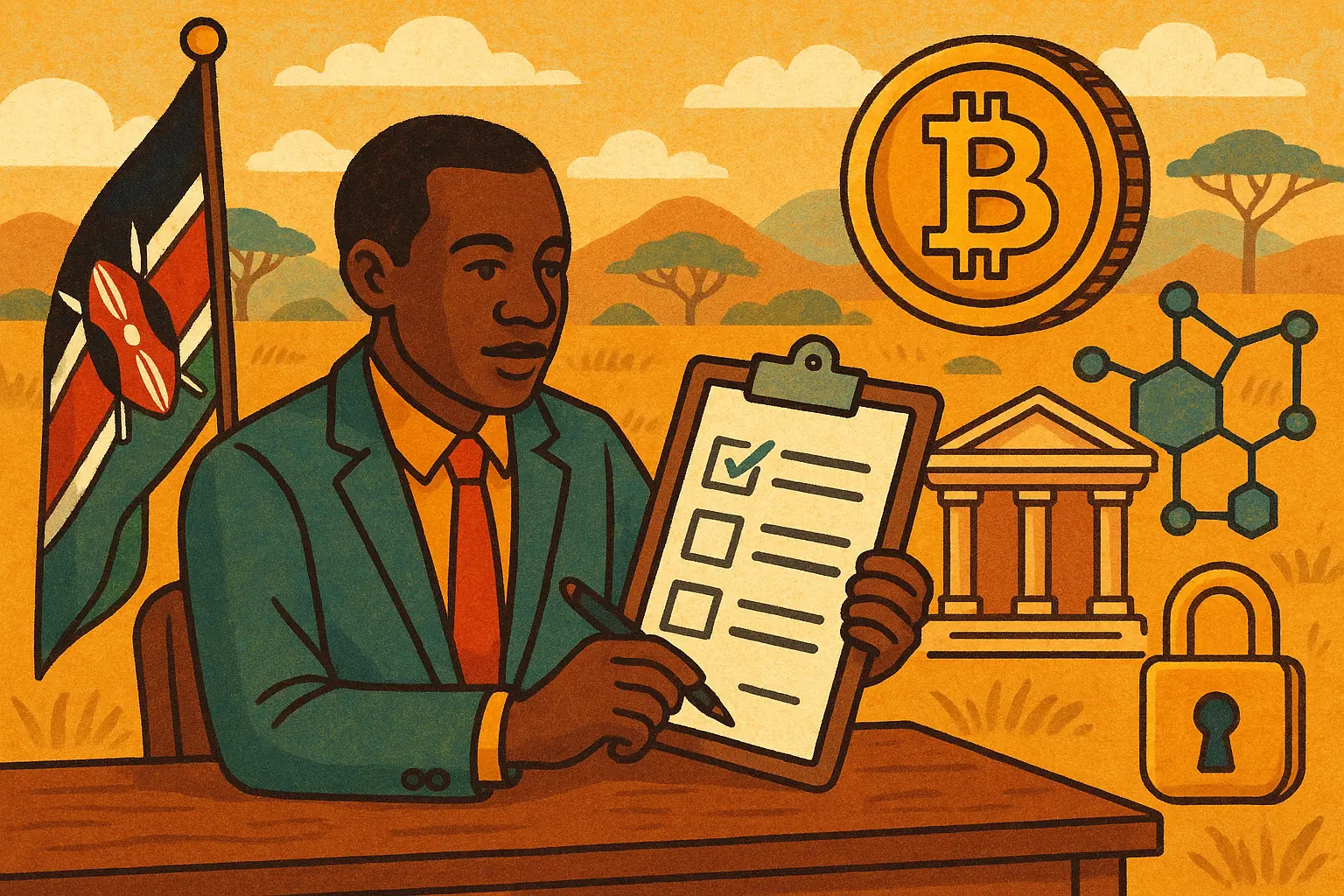
On April 11, Kenya’s Ministry of Finance announced that it has completed the public consultation for the draft regulation governing Virtual Asset Service Providers (VASP), and has formally moved forward with the implementation framework for the 2025 Crypto Business Regulatory Act. The new framework will establish a licensing system, capital requirements, anti-money laundering (AML) compliance obligations, consumer protection measures, and market conduct rules for operators engaged in cryptocurrency, tokenized assets, and stablecoin businesses.
VASP Framework Core Structure: Five Regulatory Pillars
According to the draft released by the Ministry of Finance, the scope of the new regulatory regime covers the full life cycle of crypto business operations. The following are the five core requirements:
Licensing and Admission Standards: Operators must pass all ownership suitability tests (Fit and Proper Test) and meet minimum capital requirements and governance standards in order to obtain a license to operate.
Anti-Money Laundering (AML) Compliance Obligations: Covers customer due diligence (KYC), reporting of suspicious transactions, and ongoing monitoring of transaction activity, aligning with recommendations from the Financial Action Task Force (FATF)
Consumer Protection Mechanisms: Mandatory information disclosure, transparent pricing, and independent protection arrangements for customers’ cryptocurrency funds
Market Conduct Rules: Clearly prohibits market manipulation and insider trading; asset listings must complete due diligence
Compliance Reporting and Auditing: Regular financial reporting, independent audits, and requirements to meet cybersecurity standards, combining a dual track regulatory model of both on-site and off-site supervision
The Ministry of Finance said that the next step will be to review the feedback collected during the consultation period and use it to refine the draft. The final version will determine how crypto businesses can gain market access in Kenya, an African fintech market that is relatively more mature.
Background of Africa’s Crypto Market: Rapid Rise South of the Sahara
The timing of Kenya’s push for the VASP framework closely overlaps with the acceleration of digital asset expansion across Africa. According to market research by Ripple, Africa currently faces three major structural challenges: high transaction costs, delays in cross-border transfers, and limited channels for obtaining stable foreign exchange. These pain points are driving many African users to turn to cryptocurrency tools as alternative means for savings and cross-border settlement.
Sub-Saharan Africa has therefore become one of the fastest-growing cryptocurrency markets globally, with transaction volume increasing significantly over the past year. If Kenya can successfully implement a clear and actionable regulatory framework, it will provide a reference regulatory precedent for other countries in the region. At the same time, it will help attract overseas compliant crypto businesses to enter the market, bringing more legitimate service options to local users.
The Ministry of Finance said: “Kenya is building a trustworthy framework to balance innovation and financial stability.” This position is consistent with a broader global trend in which regulators make room for innovation while developing industry rules.
Frequently Asked Questions
What are the main differences between Kenya’s VASP framework and the existing crypto regulation?
Kenya’s current crypto regulation is based on the Crypto Business Regulatory Act passed in 2025, but it lacks a specific implementing framework. After the VASP draft completes the consultation process, it will provide full operational rules for the law, covering licensing application procedures, capital requirements, AML standards, and consumer protection—so that regulation is implemented from the legal level down to business execution.
Which operators need to obtain a VASP license in Kenya?
All operators conducting cryptocurrency trading, tokenized asset business, or stablecoin services within Kenya must apply for a VASP license and must pass ownership suitability tests, minimum capital requirements, and AML compliance review.
When will Kenya’s VASP regulatory framework officially take effect?
The Ministry of Finance is still reviewing the feedback from the public consultation and refining the draft, so the specific effective date has not yet been confirmed. The regulator said that once the draft is finalized, it will move into the legislative process; the final timeline will depend on the progress of feedback review and rulemaking.
Disclaimer: The information on this page may come from third parties and does not represent the views or opinions of Gate. The content displayed on this page is for reference only and does not constitute any financial, investment, or legal advice. Gate does not guarantee the accuracy or completeness of the information and shall not be liable for any losses arising from the use of this information. Virtual asset investments carry high risks and are subject to significant price volatility. You may lose all of your invested principal. Please fully understand the relevant risks and make prudent decisions based on your own financial situation and risk tolerance. For details, please refer to
Disclaimer.
Related Articles
BIS Report Warns Crypto Exchanges Becoming 'Shadow Banks' with Uninsured User Risk
Gate News message, April 23 — The Bank for International Settlements (BIS) released a report warning that crypto exchanges are increasingly providing bank-like services, including lending and yield products (Earn), but lack the regulatory oversight and deposit protections inherent in traditional
GateNews30m ago
Tether Freezes $344 Million in USDT on Tron in Coordination with OFAC and U.S. Law Enforcement
Gate News message, April 23 — Tether froze more than $344 million in USDT across two Tron addresses on April 23 in coordination with the Office of Foreign Assets Control (OFAC) and U.S. law enforcement agencies. The stablecoin issuer said the action followed information linked to sanctions evasion,
GateNews1h ago
Tether Supports Freezing of $344M in USDT in Collaboration With U.S. Government
Gate News message, April 23 — Tether announced it has supported the U.S. government in freezing over $344 million in USDT across two wallet addresses. The action was coordinated by the U.S. Department of Treasury's Office of Foreign Assets Control (OFAC) and U.S. law enforcement agencies to prevent
GateNews3h ago
Polymarket Faces Insider Trading Scrutiny as Trump-Related Prediction Trading Surges
Gate News message, April 23 — Polymarket, a crypto prediction market platform, has drawn insider trading allegations following a surge in trading volume around predictions related to U.S. President Donald Trump's policies and statements. Between April 5 and 8, markets predicting outcomes related to
GateNews3h ago
Météo France Files Police Complaint Over $35K Polymarket Weather Bet Anomalies
Polymarket traders won more than $35,000 after temperature sensor spikes near Paris-Charles de Gaulle airport resolved long-shot weather bets in their favor, prompting France's national weather agency to file a police complaint. The incidents occurred on April 6 and April 15, when a Météo France sen
CryptoFrontier4h ago
PACE Act Targets Faster Payments With Fed Access for Fintechs
PACE Act introduces optional federal licensing for fintechs, requiring compliance, reserves, and oversight by the OCC.
Direct access to Fed systems like FedNow and Fedwire aims to cut delays, lower costs, and reduce reliance on banks.
Industry groups support the bill, citing improved
CryptoFrontNews7h ago


