The measures seek to fully integrate crypto exchanges into the established financial system and protect the identity information of the institution’s customers. The Central Bank states that this will promote “transparency, comparability, and predictability of information provided to the market.”
Brazil Issues Resolution Including Crypto Brokerages to Comply With Bank Secrecy Laws
Brazil is moving to integrate crypto exchanges into its financial ecosystem.
The National Monetary Council and the Central Bank of Brazil recently approved Resolution No. 5,280, which brings new compliance rules for virtual asset service providers in the country.
The resolution, which states that virtual asset service providers (VASPs) will be considered financial institutions under the Brazilian Bank Secrecy Act, seeks to establish an equivalent regulatory treatment for all exchanges operating in the local financial system and the mechanisms needed to protect it.
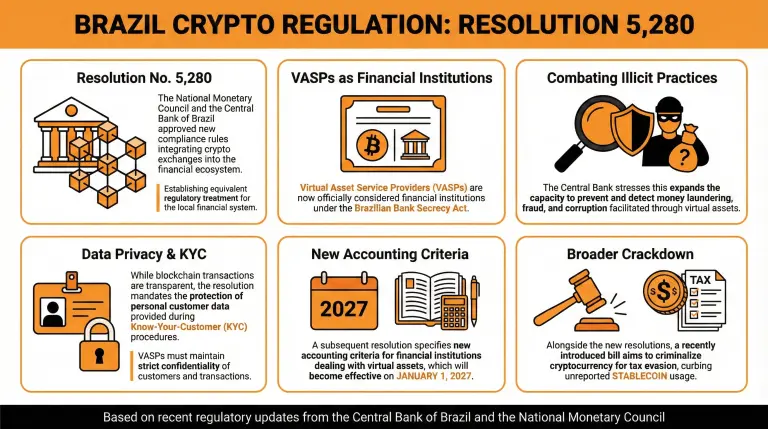
The Central Bank of Brazil stressed that this move “expands the capacity to prevent, detect, and combat illicit practices—such as money laundering, fraud, corruption, and other irregularities—that may be facilitated through the use of virtual assets.”
While blockchain transactions are transparent, given the nature of these structures, experts like Tiago Severo stressed that the identification and personal data of customers, provided when completing Know-Your-Customer (KYC) procedures, is what this resolution seeks to protect.
At the same time, it increases the responsibility of these institutions, which will have to take into account already established provisions regarding the confidentiality of their customers and their transactions.
In a subsequent resolution, the two institutions also approved a new resolution that specifies the accounting criteria that financial institutions dealing with virtual assets must follow.
The central bank states that regulatory clarity will contribute to investor confidence, assigning a clearer role to VASPs about the duties these institutions should fulfill.
The bank secrecy measure is already being applied, while the new accounting rules for financial institutions are set to become effective on January 1, 2027.
Recently, a bill criminalizing cryptocurrency for tax evasion was introduced into Congress, aiming to curb the usage of stablecoins for unreported payments and transactions.
FAQ
- What recent resolution has Brazil approved regarding crypto exchanges?
Brazil approved Resolution No. 5,280, integrating crypto exchanges into its financial ecosystem as virtual asset service providers.
- How does Resolution No. 5,280 affect virtual asset service providers (VASPs)?
VASPs will now be classified as financial institutions under the Brazilian Bank Secrecy Act, requiring compliance with new regulations.
- What is the goal of this regulatory change by the Central Bank of Brazil?
The aim is to enhance the detection and prevention of illicit practices, including money laundering and fraud, associated with virtual assets.
- When will the new accounting rules for financial institutions dealing with virtual assets take effect?
The new accounting criteria for financial institutions will become effective on January 1, 2027.
Disclaimer: The information on this page may come from third parties and does not represent the views or opinions of Gate. The content displayed on this page is for reference only and does not constitute any financial, investment, or legal advice. Gate does not guarantee the accuracy or completeness of the information and shall not be liable for any losses arising from the use of this information. Virtual asset investments carry high risks and are subject to significant price volatility. You may lose all of your invested principal. Please fully understand the relevant risks and make prudent decisions based on your own financial situation and risk tolerance. For details, please refer to
Disclaimer.
Related Articles
Polish Parliament Fails to Override President's Veto on Crypto Law; PM Alleges Russian Interference
Polish lawmakers failed to override President Nawrocki's veto on a cryptocurrency regulation bill aimed at aligning with EU standards. Tensions rise as accusations emerge of Russian influence in a major crypto exchange amid liquidity issues and lack of regulation.
GateNews1h ago
White House Mediates Clarity Act Stablecoin Dispute, Witt Reveals Legislative Timeline
Patrick Witt announced at the Solana Policy Institute summit that the White House mediated a stablecoin dispute to advance the Clarity Act. The compromise allows banks and crypto firms to together address regulatory concerns, with future focus on crypto taxation and blockchain integration strategies among financial institutions.
GateNews7h ago
Hong Kong SFC Investment Committee Warns Prediction Market Trading May Constitute Illegal Gambling
The Hong Kong SFC warns that prediction markets are speculative and not investment products, lacking regulatory protection. They involve gambling elements, potentially making them illegal. The committee urges the public to differentiate between investment and gambling.
GateNews10h ago
Economist Proposes National USD Stablecoin to Eliminate Currency Controls in Venezuela
Alejandro Grisanti, head of Ecoanalitica, proposed issuing a national USD stablecoin as part of a series of measures to lift currency controls in Venezuela. This system would complement the current auction system, allowing the excluded sector to receive dollars via blockchain rails.
Key
Coinpedia12h ago
Elizabeth Warren Accuses SEC Chair Paul Atkins of Misleading Congress Over Enforcement Decline
Senator Elizabeth Warren accused SEC Chair Paul Atkins of misleading Congress about enforcement actions' decline. With only 456 new cases in 2025, concerns arise regarding the SEC's effectiveness and the regulatory landscape for cryptocurrency and market oversight.
GateNews13h ago
CLARITY Act Delay Continues as Senator Thom Tillis Signals Ongoing Talks
Lawmakers are delaying the CLARITY Act due to ongoing negotiations on stablecoin provisions, with timing uncertain and potential markup pushed to late April or early May. Kevin Warsh’s financial disclosures add complexity to regulatory discussions.
CryptoFrontNews15h ago


