US Senator Cynthia Lummis has dismissed claims that the Digital Asset Market Clarity Act fails to protect decentralized finance innovators from legal repercussions, rebutting that recent changes to the draft will make it the “strongest protection for DeFi and developers ever enacted.”
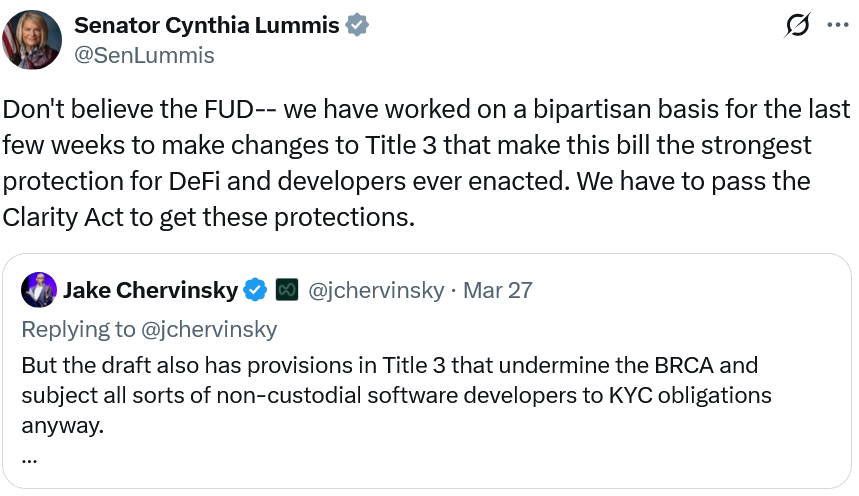
Her comments on Friday came in direct response to crypto lawyer Jake Chervinsky, who argued that Title 3 of the current draft undermines the Blockchain Regulatory Certainty Act — another crypto bill focused on developer protections — by subjecting non-custodial software developers to know-your-customer obligations.
“Don’t believe the FUD,” Lummis said, adding, “We have worked on a bipartisan basis for the last few weeks to make changes to Title 3 that make this bill the strongest protection for DeFi and developers ever enacted. We have to pass the Clarity Act to get these protections.”
The latest changes to the CLARITY Act have not been publicly released.
_Source: _Cynthia Lummis
Chervinsky said these DeFi protection provisions have been overshadowed by intense focus on stablecoin rewards provisions in the CLARITY Act.
His biggest issue with the Senate Banking Committee’s latest CLARITY Act draft is that Title 3’s money transmitter definitions could still expose many non-custodial DeFi builders to liability.
This is despite the CLARITY Act incorporating the BRCA in section 604, which clarifies that non-controlling developers and providers of non-custodial software are not to be treated as financial institutions subject to Bank Secrecy Act KYC obligations.
“The biggest challenge is ensuring non-custodial software developers aren’t misclassified as money transmitters,” Chervinsky argued.
“That’s non-negotiable for DeFi, and it’s still unsettled.”
His concerns come amid several high-profile prosecutions and convictions of developers in the US in recent months, including Tornado Cash co-founder, Roman Storm, who was convicted in August 2025 of conspiracy to operate an unlicensed money transmitting business.
**Related: **__Delaware eyes stablecoin licensing framework under banking laws
US lawmakers have said the CLARITY Act is moving closer toward a Senate Banking Committee markup expected in April after recent bipartisan progress on stablecoin rewards provisions.
Passage of the CLARITY Act is necessary to ensure DeFi developers are afforded legal protections under the BRCA, Lummis noted.
**Magazine: **__Are DeFi devs liable for the illegal activity of others on their platforms?
Cointelegraph is committed to independent, transparent journalism. This news article is produced in accordance with Cointelegraph’s Editorial Policy and aims to provide accurate and timely information. Readers are encouraged to verify information independently. Read our Editorial Policy https://cointelegraph.com/editorial-policy
- #Law
- #United States
- #Bills
- #Developers
- #DeFi
- #Regulation
Disclaimer: The information on this page may come from third parties and does not represent the views or opinions of Gate. The content displayed on this page is for reference only and does not constitute any financial, investment, or legal advice. Gate does not guarantee the accuracy or completeness of the information and shall not be liable for any losses arising from the use of this information. Virtual asset investments carry high risks and are subject to significant price volatility. You may lose all of your invested principal. Please fully understand the relevant risks and make prudent decisions based on your own financial situation and risk tolerance. For details, please refer to
Disclaimer.
Related Articles
The Senate Banking Committee will move the “CLARITY Act” off the agenda for the week of April 20.
The CLARITY Act was not included in the April 20 agenda for consideration by Tim Scott, Chairman of the Senate Banking Committee. Senator Tom Tillis is set to release the latest draft, which includes compromise provisions related to stablecoin yield rates. Coinbase has switched to support, while the banking group still opposes the measure. The bill must pass multiple steps before it can become law.
MarketWhisper1h ago
Bank of England governor warns: Global stablecoin standards are lagging, calls for a unified regulatory framework
Bank of England Governor Andrew Bailey said at an IIF event that the effective functioning of stablecoins depends on users’ confidence in full redemption mechanisms, calling for the development of international standards. The United States has meanwhile released the GENIUS Act, requiring stablecoin issuers to meet compliance requirements. In South Korea, Circle’s CEO said there are no plans to launch a won-pegged stablecoin, and that the company is currently watching local legislative debates.
MarketWhisper1h ago
Cato Institute Recommends U.S. Eliminate Capital Gains Tax on Cryptocurrencies to Promote Monetary Competition
The Cato Institute urges the U.S. to abolish capital gains taxes on cryptocurrencies to simplify tax filing and enhance monetary competition. This move aims to encourage cryptocurrency use in transactions by lessening tax-related complexities.
GateNews1h ago
Senator Warren Presses Musk on X Money Risks, Citing Stablecoin Concerns and Regulatory Gaps
Senator Elizabeth Warren has asked Elon Musk for details on X Money, a payments feature for X, raising concerns about stablecoin risks, regulatory issues, financial stability, and data privacy, with a response due by April 21, 2026.
GateNews1h ago
South Korea’s Ministry of Economy and Finance announces a pilot for a “Blockchain Treasury,” launching in Sejong City in the fourth quarter
On April 16, the Ministry of Economy and Finance of South Korea announced that the “pilot project to use blockchain digital currency to execute treasury funds” has been selected as the regulatory sandbox program hosted by the National Affairs Coordination Office for 2026. According to the Ministry of Economy and Finance’s notice, the pilot program allows government agencies to use blockchain “deposit tokens” to execute part of their commercial promotion expenses, replacing the current government procurement card. The plan is to prioritize launching in Sejong City in the fourth quarter of 2026, and expand the scope afterward based on an assessment of the results.
MarketWhisper2h ago
Bitcoin Core Developers Propose BIP-361 to Freeze 1.7M Early BTC Against Quantum Computing Threats
BIP-361, proposed by co-authors including Jameson Lopp, aims to secure early Bitcoin by migrating 1.7 million coins from weak P2PK addresses to stronger formats, allowing 3-5 years for users before freezing untransferred coins. Community responses vary significantly.
GateNews3h ago


