Pi Network just marked another milestone since launching its Open Network, highlighting what it describes as solid ecosystem growth across multiple fronts. From KYC completions to Mainnet migrations and developer activity, the numbers look impressive on paper.
At the same time, the Pi Coin price chart tells a very different story. Despite the steady stream of updates and expansion metrics, the token continues to trade in a prolonged downtrend. After an initial pump following launch, Pi has gradually faded and is now trading around the $0.16 level, with little to none momentum around it.
The disconnect between ecosystem growth and price performance is clear to anyone who follows Pi Network’s project.
- Pi Network’s Announcement
- Pi Coin Chart Analysis
- Pi Coin Price Prediction Following Recent Updates
Pi Network’s Announcement
In its latest post on X, the Pi Network team shared a detailed breakdown of ecosystem metrics achieved over the past year.
According to the update:
- 16.2 million+ migrations to Mainnet
- 17.7 million+ fully KYC’ed users
- 300+ Mainnet ecosystem apps
- 148,000+ local commerce sellers
- 2.1 million+ Map of Pi users
- 421,000+ nodes
- 46,000+ App Studio apps created
- 111 million+ Pi staked for ecosystem app rankings
From a network participation perspective, these are meaningful numbers. The scale of KYC verification alone suggests a large base of verified users. Developer engagement also appears active, with hundreds of apps and tens of thousands of App Studio creations.
On the surface, this looks like a network steadily building infrastructure, utility, and adoption. The team framed the announcement as proof of collective progress driven by pioneers, developers, businesses, and validators worldwide.
But markets care about something else: demand for the token itself.
Pi Coin Chart Analysis
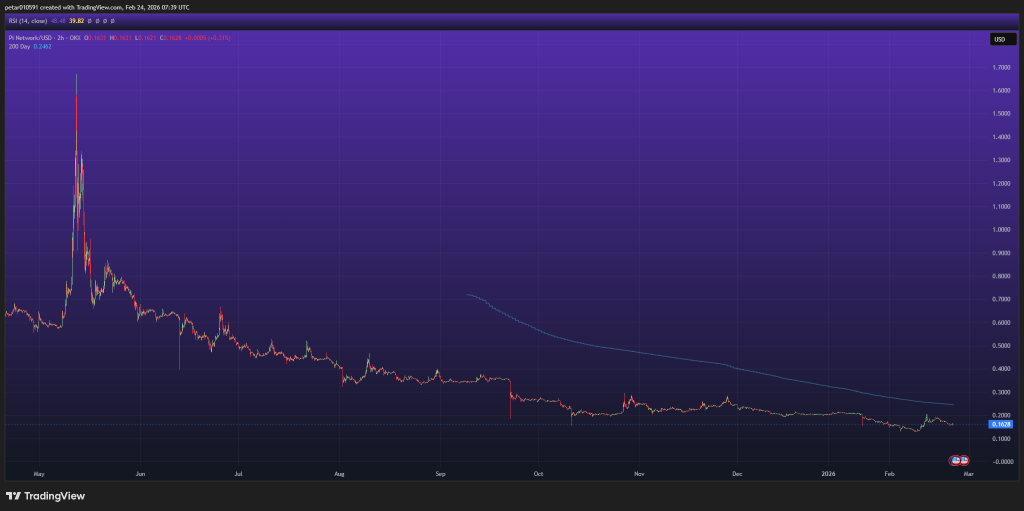
The Pi Coin chart paints a far less optimistic picture. The price did pump around 45% last week, but other than that, the overall downtrend is clear.
After an explosive launch phase that saw price spike aggressively, Pi entered a prolonged downtrend. The early euphoria faded quickly, followed by lower highs and lower lows across multiple months.
Currently trading near $0.16, the price sits dramatically below its initial highs. The 200-day moving average continues sloping downward, reinforcing the long-term bearish structure. Each relief rally has been sold into.
Source: TradingView
Momentum indicators show weakness as well. RSI has struggled to sustain bullish territory for extended periods. Even when short-term bounces occur, they lack follow-through. Volume has also thinned compared to the early post-launch phase.
The broader structure resembles a classic post-launch distribution pattern: strong speculative spike, followed by prolonged cooling as early participants take profit and new demand struggles to match supply.
Despite ecosystem milestones, the chart shows no clear breakout structure, no strong accumulation range with higher lows, and no decisive change in trend.
Read also: Why Bitcoin And Crypto Prices Won’t Stop Crashing
Pi Coin Price Prediction Following Recent Updates
So what happens next?
Fundamental updates alone rarely reverse a downtrend unless they materially change token demand. Ecosystem growth is positive, but markets will eventually ask:
Are these apps generating real transactional volume?
Is Pi being used meaningfully in commerce?
Is staking removing enough supply to tighten the float?
In the short term, price remains technically weak. If the $0.15–$0.16 zone fails, downside toward psychological support around $0.12 cannot be ruled out.
For bullish momentum to return, Pi would need to reclaim prior resistance zones near $0.20–$0.25 with strong volume confirmation. Without that, rallies may continue to be sold.
The long-term thesis depends on whether ecosystem growth translates into sustained token demand. If usage scales and circulating supply becomes better absorbed, price could eventually stabilize and form a base.
For now, however, the chart reflects caution.
Pi Network’s metrics are expanding. The token’s price, at least for now, is not.
Disclaimer: The information on this page may come from third parties and does not represent the views or opinions of Gate. The content displayed on this page is for reference only and does not constitute any financial, investment, or legal advice. Gate does not guarantee the accuracy or completeness of the information and shall not be liable for any losses arising from the use of this information. Virtual asset investments carry high risks and are subject to significant price volatility. You may lose all of your invested principal. Please fully understand the relevant risks and make prudent decisions based on your own financial situation and risk tolerance. For details, please refer to
Disclaimer.
Related Articles
Pi Network PIRC baseline protection mechanism sparks controversy, implying a “quasi-stablecoin” logic
Pi Network member Daniel F raised a logical contradiction in the PIRC token design, noting that if it has a 23.8% floor protection, it would need to behave like a stablecoin, which conflicts with its high volatility on CEX. This floor is based on Pi’s price calculations; if Pi itself fluctuates significantly, it will be unable to effectively protect holders. Daniel emphasized the importance of transparency, but the project team did not respond to it, leading the community to continue speculating about the reasons for its silence.
MarketWhisper5h ago
Pi Network Major Transformation: 210 Ecosystem Applications Deployed, 23k Developers Ready
The Pi Network ecosystem is accelerating its transition, with more than 210 active applications and 23,000 developers actively participating in Pi Studio, spanning multiple areas such as payments, community engagement, education, and gaming. The ecosystem’s diversity shows indicators of healthy development, and developers’ engagement is driving ongoing application optimization. In the future, improving the usefulness of the mainnet will be a key challenge, including issues that need to be urgently addressed such as scalability, security, and user adoption rates.
MarketWhisper5h ago
Pi Network Expands Developer Tools With RPC Server Upgrade
Pi Network has taken another step to improve its system for developers. The project has launched a new RPC server upgrade on its Testnet, making it easier to build and test apps on the network. This update allows node operators to run their own RPC servers
In simple words, developers no longer
Coinfomania04-11 22:55
Pi Network Transfers 30M Coins as Migration Resumes
Pi Network has restarted its long-running migration process after a short pause. In the latest update, around 30 million Pi coins moved from an intermediary address to user-linked wallets. The transfer happened just hours after activity resumed, following a one-week break
The update suggests the n
Coinfomania04-10 21:24
Pi Network restarts the migration, and 30 million Pi have been transferred into users’ wallets
Pi Network resumed mainnet migration after a pause, transferring about 30 million Pi tokens to users’ wallets, mainly targeting users who have completed KYC. The first migration has been completed, and a second migration is currently underway, with the core team emphasizing batch processing. Some false information appeared during the process; the official account has issued a clarification, reminding users to obtain information through official channels.
MarketWhisper04-10 06:39
Pi Network version 21 released; mainnet RPC and smart contract acceleration are advancing
Pi Network released version 21 on April 9. The key update is that the testnet RPC has officially gone live, providing developers with a secure environment to test smart contracts and DApps. Next, smart contracts are expected to be deployed within two months, enabling Pi幣 to transition from a community token into a functional digital asset and to support DeFi applications and automated workflows, while also advancing the KYC migration to ensure compliance.
MarketWhisper04-10 01:50


