
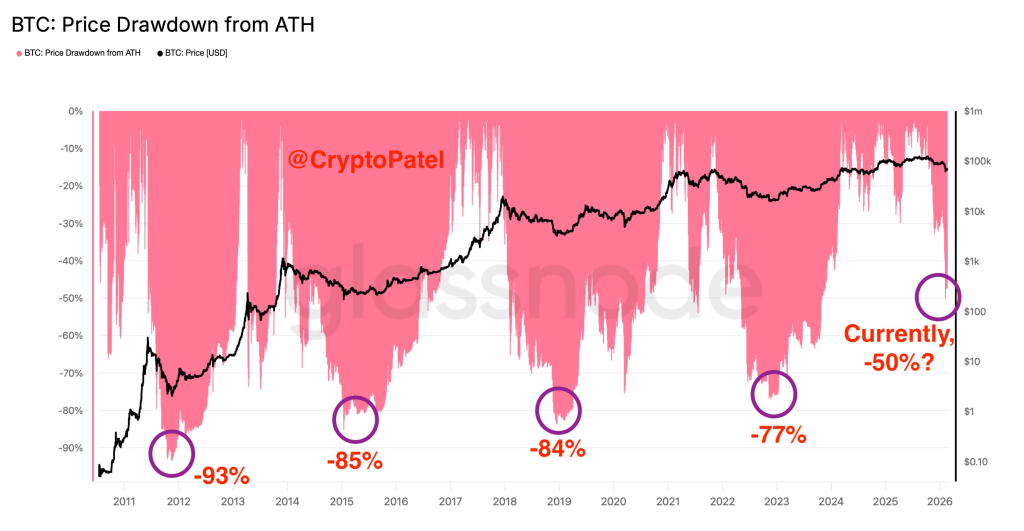
The chart shared by Crypto Patel puts Bitcoin’s current drawdown into long-term perspective by mapping every major peak-to-trough decline since 2011. What immediately stands out is not just how brutal past bear markets were, but how consistently Bitcoin has tested investor conviction before resetting for the next cycle. Compared to earlier crashes, today’s pullback still sits on the shallow end of Bitcoin’s historical spectrum.
The pink area on the chart tracks Bitcoin’s percentage drawdown from its all-time high, overlaid with the BTC price itself. Previous cycle lows were extreme: roughly -93% in 2011, -85% in 2015, -84% in 2018, and -77% in 2022. In contrast, the current cycle is hovering near a -50% drawdown, which is materially less severe than any prior major bottom. From a purely historical standpoint, that suggests Bitcoin has not yet experienced the type of capitulation that has defined past cycle lows.
Crypto Patel’s key observation is valid: each cycle’s maximum drawdown has become less aggressive over time. That trend aligns with Bitcoin’s maturation, deeper liquidity, broader ownership, and increasing institutional participation. However, the chart also delivers an uncomfortable reality check. Even if this cycle continues the pattern of “shallower” losses, a move toward a -70% drawdown would still be well within historical norms, and that would place Bitcoin near the $30,000 zone from current levels.
Source: X/@CryptoPatel
The most important takeaway is not a price prediction, but a framework. Bitcoin does not bottom quietly. Every prior cycle required prolonged pain, time, and psychological exhaustion before a durable low formed. The absence of a deep drawdown does not invalidate the bull thesis long-term, but it does indicate that downside scenarios remain very much alive. Markets rarely reward complacency, especially during transitions between expansion and contraction phases.
Crypto Patel’s conclusion is less about fear and more about preparation. History shows that Bitcoin survives every storm, but not everyone holding it does. Planning for multiple outcomes, including deeper volatility, has historically been the difference between forced exits and long-term survival. If this cycle ultimately bottoms at a higher level than the past, that will be constructive. Until proven otherwise, though, the chart argues for respect (not confidence) in what Bitcoin is still capable of doing on the downside.
Read also: Robert Kiyosaki Buys Another Bitcoin at $67,000 as BTC Price Shows Recovery Signs
Disclaimer: The information on this page may come from third parties and does not represent the views or opinions of Gate. The content displayed on this page is for reference only and does not constitute any financial, investment, or legal advice. Gate does not guarantee the accuracy or completeness of the information and shall not be liable for any losses arising from the use of this information. Virtual asset investments carry high risks and are subject to significant price volatility. You may lose all of your invested principal. Please fully understand the relevant risks and make prudent decisions based on your own financial situation and risk tolerance. For details, please refer to
Disclaimer.
Related Articles
Morgan Stanley Bitcoin ETF Drives 3-Fold Impact as 16,000 Advisors Open Path to Multi-Billion Demand
Bitcoin demand is set to expand rapidly as Morgan Stanley deploys its 16,000 advisors and launches a low-cost ETF, driving institutional inflows and strengthening crypto’s position in mainstream portfolios.
Key Takeaways:
Morgan Stanley’s 16,000 advisors unlock major bitcoin demand, driving
Coinpedia1h ago
DWF Labs Co-Founder: The current market is boring, but it hasn’t disappeared—builders or investors still have a lot to do.
DWF Labs co-founder Andrei Grachev said the market is currently in a “boring” phase, with many important activities quietly underway. He advised investors to stay patient and look for a better timing. He emphasized that opportunities still exist in the market—such as holding Bitcoin or participating in altcoins—and urged retail investors to keep learning and remain optimistic.
GateNews2h ago
Researchers propose a transaction scheme for quantum-resistant Bitcoin without needing a fork
Gate News message, on April 12, a researcher proposed a transaction scheme that enables quantum-resilient protection for Bitcoin without requiring a fork. At present, the quantum computing threat to Bitcoin is still at the theoretical level. Meanwhile, tech companies such as Google and Cloudflare have already begun preparing countermeasures and set a target timeline to complete the migration of quantum cryptography after 2029.
GateNews2h ago
Contract whale “sets 10 big targets first” — the short position is up $3.21 million; the BTC short opening price is $71,554.61.
Gate News message, April 12, according to on-chain analyst Ai Yi (@ai_9684xtpa) statistics, the short positions of the contract whale “first set 10 big targets” (@Jason60704294) are currently up $3.21 million. Of this, the BTC short positions are 2,567.49 BTC, with an opening price of $71,554.61, and an unrealized profit of $1.19M; the ETH short positions are 38,465.22 ETH, with an opening price of $2,248.74, and an unrealized profit of $2.03M.
GateNews3h ago
$789 Million Fresh Capital: Bitcoin ETFs See Highest Weekly Inflow Since February - U.Today
Bitcoin ETFs saw a significant resurgence with $789 million in weekly inflows, the highest since February. BlackRock led the charge, contributing 80% of this total, signaling renewed institutional interest in the market after a period of withdrawals.
UToday3h ago
Strategy Yesterday increased its holdings of 3,447 BTC through STRC, worth $250 million
Gate News message: On April 12, according to @BitcoinArchive monitoring, Strategy added 3,447 bitcoins worth $250 million yesterday (April 11) through its perpetual preferred stock product STRC. This increase is equivalent to the supply of bitcoin mined by the network over the past 8 days.
GateNews3h ago


