Hyperliquid (HYPE) is moving against the overall trend of the digital asset market, recording an impressive double-digit increase, while Bitcoin and many major altcoins like XRP are under downward pressure.
According to data from CoinPhoton, Hyperliquid’s HYPE token is among the top performers over the past two weeks, rising about 70% to around $35 — the highest level since December last year. This development reflects a positive sentiment among traders regarding the protocol’s product expansion potential.
HYPE’s rally becomes even more notable when compared to the broader market context. In recent weeks, a risk-avoidance wave has spread across multiple asset classes, not just digital assets. Macroeconomic shocks have caused crypto, precious metals, and many other risky investments to simultaneously correct, wiping out approximately $6 trillion in the first weeks of 2026.
Amid this “red sea,” HYPE stands out as a different case, with US investors playing a significant role in the upward trend. However, attributing the flow of funds solely to a rotation into a strong chart is insufficient to explain the structural nature of this rally.
HYPE is increasingly trading more like an asset linked to an exchange rather than a typical altcoin. In a risk-averse environment, most tokens are sold off due to their speculative nature. Conversely, platforms that profit from volatility can improve their fundamentals when the market becomes chaotic.
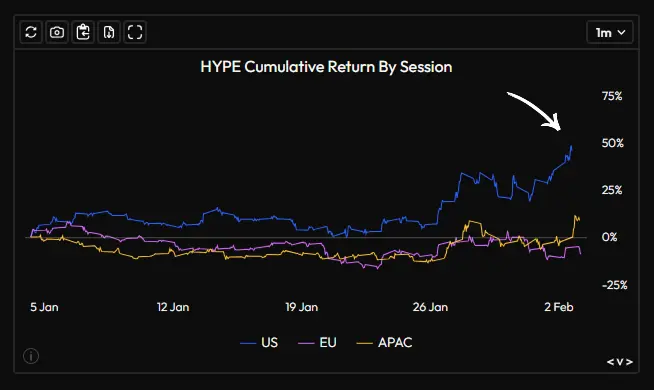 Accumulated profits per trading session (Source: Velo)## Hyperliquid up 70% amid
Hyperliquid’s core product is the perpetual futures contract. When volatility spikes, trading volume for perps usually increases as traders hedge, speculate, rotate positions, and get liquidated more frequently. This activity generates trading fees, and Hyperliquid’s design links these fees directly to the demand for buying tokens through a straightforward mechanism.
Data from DefiLlama shows Hyperliquid Perps recorded a 30-day trading volume of $216.286 billion and a 24-hour volume of $11.778 billion. Accompanying this are 30-day revenue of approximately $68.42 million and an annualized revenue of $834.7 million. The open contracts on the platform currently exceed $6 billion.
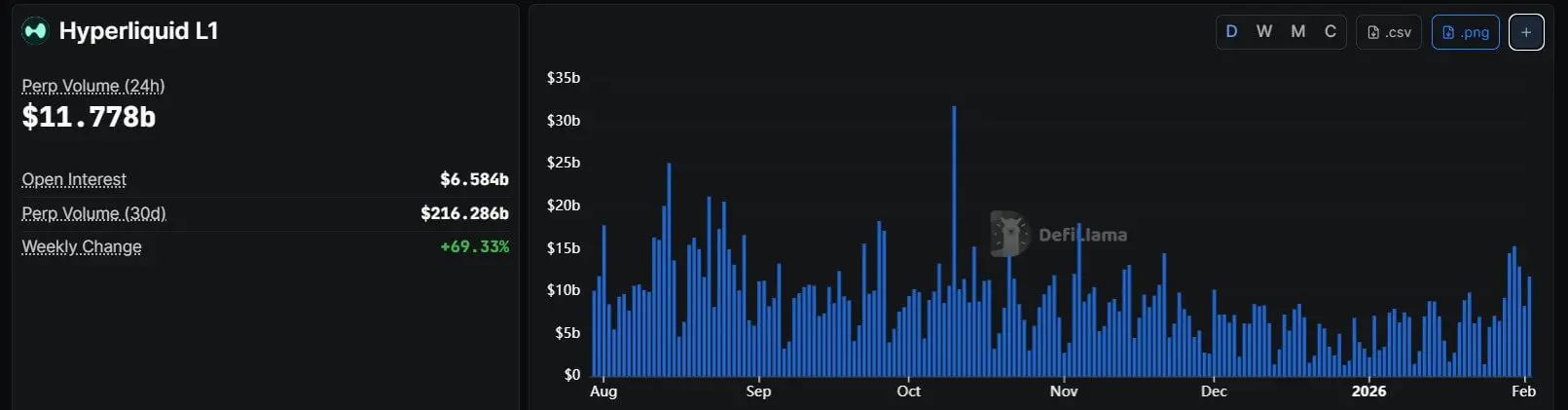 Chart showing trading volume on Hyperliquid Perps DEX (Source: DeFiLlama)The key point lies in the fee allocation mechanism. According to DefiLlama’s methodology, 99% of fees (excluding builder fees) are transferred into a support fund to buy back HYPE tokens. This means that the more active the trading, the greater the buying pressure on the token — a mechanical cycle rather than one solely dependent on market psychology.
This is why HYPE can become a “lone winner” during broad market downturns. When fear increases trading turnover, the protocol’s cash flow can strengthen even as the rest of the market tightens leverage.
Data from ASXN shows that daily buyback volume of HYPE has risen to nearly $4 million earlier this month — the highest since November. Over a month, total buyback value exceeded $55 million.
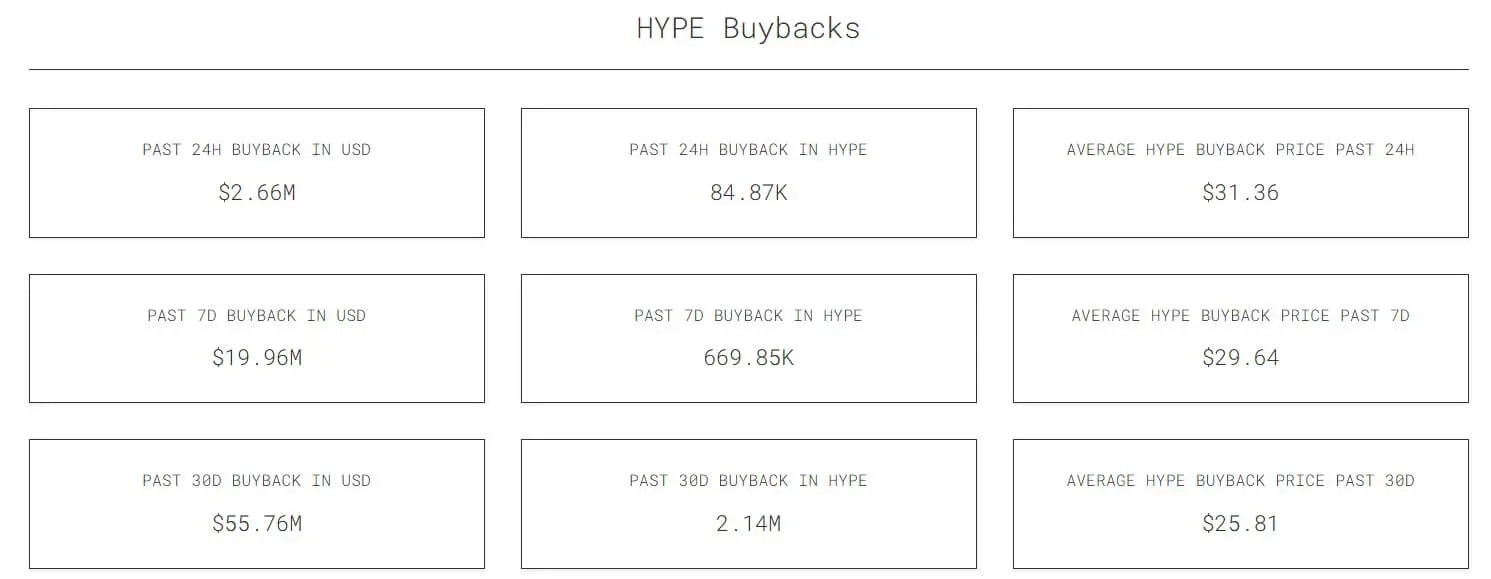 *Chart showing high-liquidity buyback rounds of HYPE (Source: ASXN)*Two notable points emerge from these figures. First, the buyback intensity is accelerating: the 30-day average is around $1.86 million/day, while the last 7 days have reached $2.85 million/day — consistent with a more volatile and active market environment. Second, buybacks are being executed at increasingly higher average prices within shorter timeframes, indicating growing demand for HYPE as activity increases.
Expanding “volatility surface”
HYPE’s rally is also supported by product factors. Hyperliquid is expanding the range of assets that can be exploited for volatility by moving into real-world assets (RWA) and unlicensed markets, thanks to the HIP-3 upgrade.
HIP-3 facilitates more open listing processes, allowing builders to deploy perpetual futures markets. These units must stake 500,000 HYPE and can be penalized (slashed) if they operate improperly. The staking requirement creates a “token sink,” directly absorbing tokens, and imposes entry costs for builders who want to list markets quickly.
This infrastructure has helped Hyperliquid rapidly expand into commodities. Milk Road’s analysis indicates Hyperliquid captured about 2% of the global spot silver market within roughly 30 days of listing, suggesting HYPE can grow strongly rather than just survive during a market downturn.
Data from Flowscan also shows the total open contracts on HIP-3 DEXs have surpassed $28 billion.
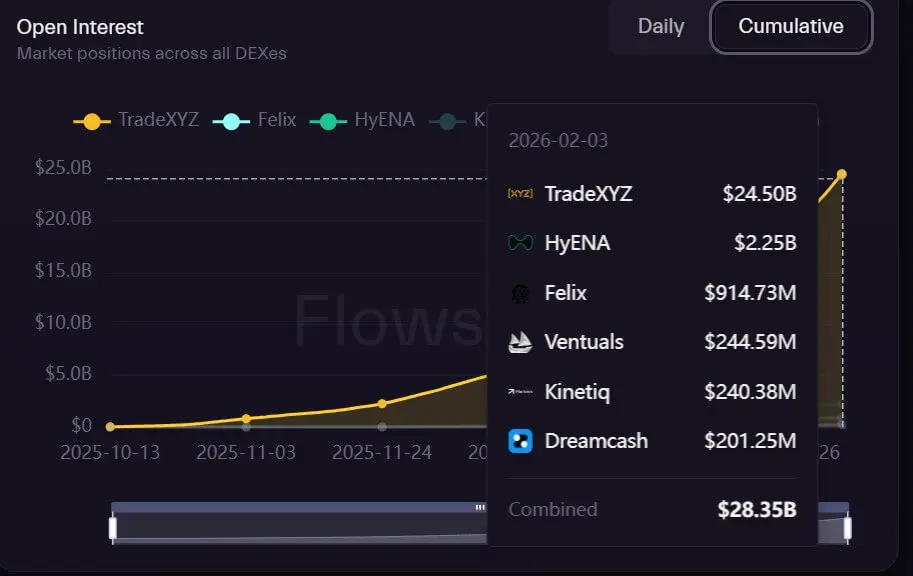 Open interest on HIP-3 DEXs on Hyperliquid (Source: Flowscan)## A new story with HIP-4
The next growth driver comes from HIP-4, which proposes to introduce event-based markets. These are fully collateralized contracts settled within predefined price ranges, resembling prediction markets and limited-risk options structures, designed to avoid margin calls and liquidation chains.
DeFi analysts suggest that if “outcome” contracts can be combined with perps, traders could open long ETH positions and simultaneously buy a “below $2,000 ETH” outcome contract for hedging, reducing margin requirements through offsetting positions — a feature many current platforms do not yet support.
Social sentiment data shows the community has high expectations for HIP-4, believing that new derivatives and prediction markets could attract additional trading volume.
Pressure from token unlocks
Despite the positive structural arguments, HYPE faces a significant challenge. According to Tokenomist, on February 6, about 9.92 million HYPE will be unlocked for the core team, worth roughly $335 million at recent prices.
The nominal value of this unlocked amount is nearly 4.9 times the protocol’s 30-day revenue. This doesn’t mean the buyback mechanism can’t absorb it, but the selling schedule will be decisive. If tokens are sold quickly and aggressively, prices could still face downward pressure even with stable buybacks, especially if overall risk appetite remains weak.
Conversely, if the sell-off is gradually distributed or market volatility continues to stay high, the buyback mechanism could stabilize the price, turning the unlock concern into a “buy-the-dip” opportunity.
However, if overall market volatility declines as macroeconomic conditions ease and traders withdraw, the yield from buybacks will decrease accordingly, and HYPE could revert to trading like a typical risky asset.
The Sanh Stone


