The supply shortage remains one of the main drivers of long-term growth.
Technically, when a portion of the circulating supply is locked, the valuation per coin tends to increase due to the reduced available supply. If this supply contraction occurs simultaneously with rising demand, the market will be conducive to a strong upward move driven by scarcity.
However, the story is not just about price charts. Supply “shocks” also help reinforce investors’ confidence in holding. Nevertheless, the question remains: has the recent LINK accumulation by Chainlink truly strengthened this argument, especially considering LINK has underperformed the overall market?
Chainlink activity signals potential driven by scarcity.
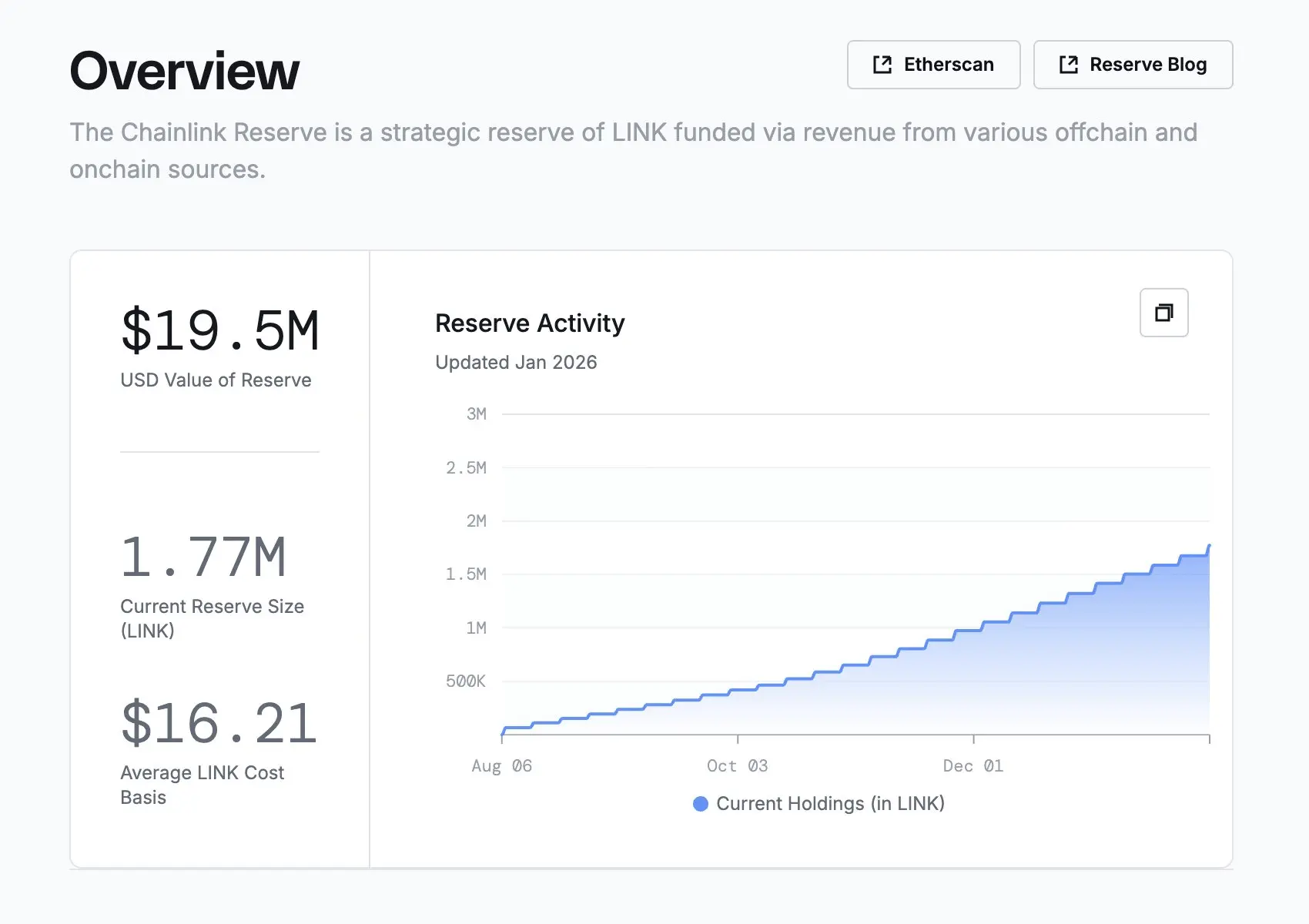
Recently, Chainlink announced that their reserve fund added 99,103 LINK — the largest single purchase to date. As a result, the total LINK locked in reserves reached 1.77 million, further reducing circulating supply on the market.
According to the data mentioned, this figure represents a 377% increase compared to 371,000 LINK before Q4/2025 — meaning about 1.4 million LINK have been added since then. However, the impact of this supply tightening has not yet clearly reflected in price movements.
Notably, Chainlink funds its accumulation activities through both on-chain and off-chain revenue, indicating a relatively solid level of application and network usage. The disconnect between platform activity and price performance highlights a question: is LINK being undervalued by the market?
Network activity signals: potential growth driven by scarcity
In the current context, being “undervalued” can sometimes be a positive signal. And LINK seems to fit this scenario.
Chainlink acts as an infrastructure connector, generating revenue from fees whenever smart contracts on other blockchains use their oracle — for example, a DeFi lending protocol relying on Chainlink’s price feeds.
Recently, fees on 13 blockchains hit all-time highs, with Ethereum alone recording around $6.8 million. This indicates increasing demand for Chainlink’s services, and network usage is creating real value.
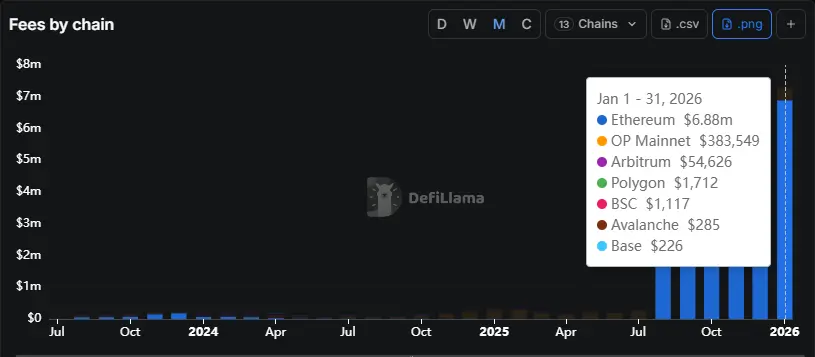 Source: DeFiLlama
In other words, on-chain revenue is directly contributing to the LINK reserve fund.
Source: DeFiLlama
In other words, on-chain revenue is directly contributing to the LINK reserve fund.
However, this has not yet been proportionally reflected in the price. LINK is one of the worst-performing assets, down 39% in Q4/2025 and continuing to decline by 11.7% since the beginning of 2026. Nonetheless, much of this correction may be driven by widespread FUD sentiment in the market.
Conclusion
With strong on-chain activity, clear fee-generating potential, and a systematic accumulation strategy, Chainlink demonstrates a solid fundamental foundation. If market demand recovers, LINK could trigger an upward move driven by scarcity — and the current weakness phase might be viewed as an attractive accumulation/entry point for risk-tolerant investors.
Mr. Giáo
Disclaimer: The information on this page may come from third parties and does not represent the views or opinions of Gate. The content displayed on this page is for reference only and does not constitute any financial, investment, or legal advice. Gate does not guarantee the accuracy or completeness of the information and shall not be liable for any losses arising from the use of this information. Virtual asset investments carry high risks and are subject to significant price volatility. You may lose all of your invested principal. Please fully understand the relevant risks and make prudent decisions based on your own financial situation and risk tolerance. For details, please refer to
Disclaimer.
Related Articles
Bitcoin meltdown to $10,000 remains likely unless prices reclaim $75,000, analyst says
A familiar voice is back with a familiar, and controversial, call on bitcoin BTC$66,860.50.
Mike McGlone, senior commodity strategist for Bloomberg Intelligence, is reiterating that bitcoin could crash to $10,000.
But this time, he's framed it with a very clear line in the sand: $75,000.
If bitco
CoinDesk25m ago
Arthur Hayes: Bitcoin’s long-term target price is $250k to $750k, and in the short term it could fall below $60k
Arthur Hayes said on a podcast that, because the Federal Reserve has not expanded liquidity, he will not put more money into Bitcoin. He expects his medium- to long-term target price to be between $250,000 and $750,000. He warned that if the Iran–U.S. conflict continues, Bitcoin could fall below $60,000 in the short term. Meanwhile, Charles Schwab will launch spot trading for Bitcoin and Ethereum. Research shows that after major shocks, Bitcoin has performed better than gold and the S&P 500, and its current price has rebounded to $67,300.
GateNews4h ago
The Crypto Fear and Greed Index rises to 13 today, and the market is still in an extreme fear state
Gate News message, April 6, according to Alternative.me data, today the Crypto Fear & Greed Index rose to 13, up 1 point from yesterday’s 12. Despite the index recovering, market sentiment is still in an “extreme fear” state.
GateNews4h ago
Michael Saylor dismisses Schiff's warning that 'MSTR will collapse,' citing 36% annual profits from Bitcoin
Michael Saylor, CEO of MicroStrategy, defends the company's Bitcoin strategy against investor Peter Schiff's warning about MSTR stock. Despite losses, Saylor emphasizes Bitcoin's superior performance compared to gold and the S&P 500 since 2020.
TapChiBitcoin4h ago
BTC 15-minute rise of 0.79%: Institutional pullback and structural fund outflows driving market fluctuations
2026-04-05 22:30 to 2026-04-05 22:45(UTC), the BTC price fluctuated in the range of 67416.0 to 67986.7 USDT. Within 15 minutes, the return reached +0.79%, and the amplitude was 0.85%. The rapid change on the market quickly drew attention, with volatility increasing, but overall trading volume did not show extreme amplification, and sentiment was mainly cautious and volatile.
The main drivers behind this move are the continued withdrawal of institutional funds and large capital net outflows to outside trading platforms. On-chain data shows that in the past 24 hours, the whole-network BTC net outflow was -2,1
GateNews6h ago
Bitcoin tends to outperform gold and stocks after global shocks, Mercado Bitcoin finds
Bitcoin BTC$67,345.02 tends to outperform traditional safe haven assets like gold in the two months following major global crises, according to new analysis from Brazilian crypto exchange Mercado Bitcoin.
The study, led by Rony Szuster, head of research at the Latin American crypto platform,
CoinDesk8h ago


