Bitcoin fell to around $88,000 on January 29, with increased trading volume indicating bearish sentiment. The Federal Reserve maintained interest rates at 3.50%-3.75%, with US-Iran tensions boosting safe-haven demand. On-chain data shows rising loss supply, and average exchange deposits increased from 0.7 BTC to 1.2 BTC. Technical analysis points to a descending wedge target of $84,000, with a weekly bear flag pointing to $70,000.
Federal Reserve Pauses Rate Cuts, Reinforcing High-Interest Rate Expectations
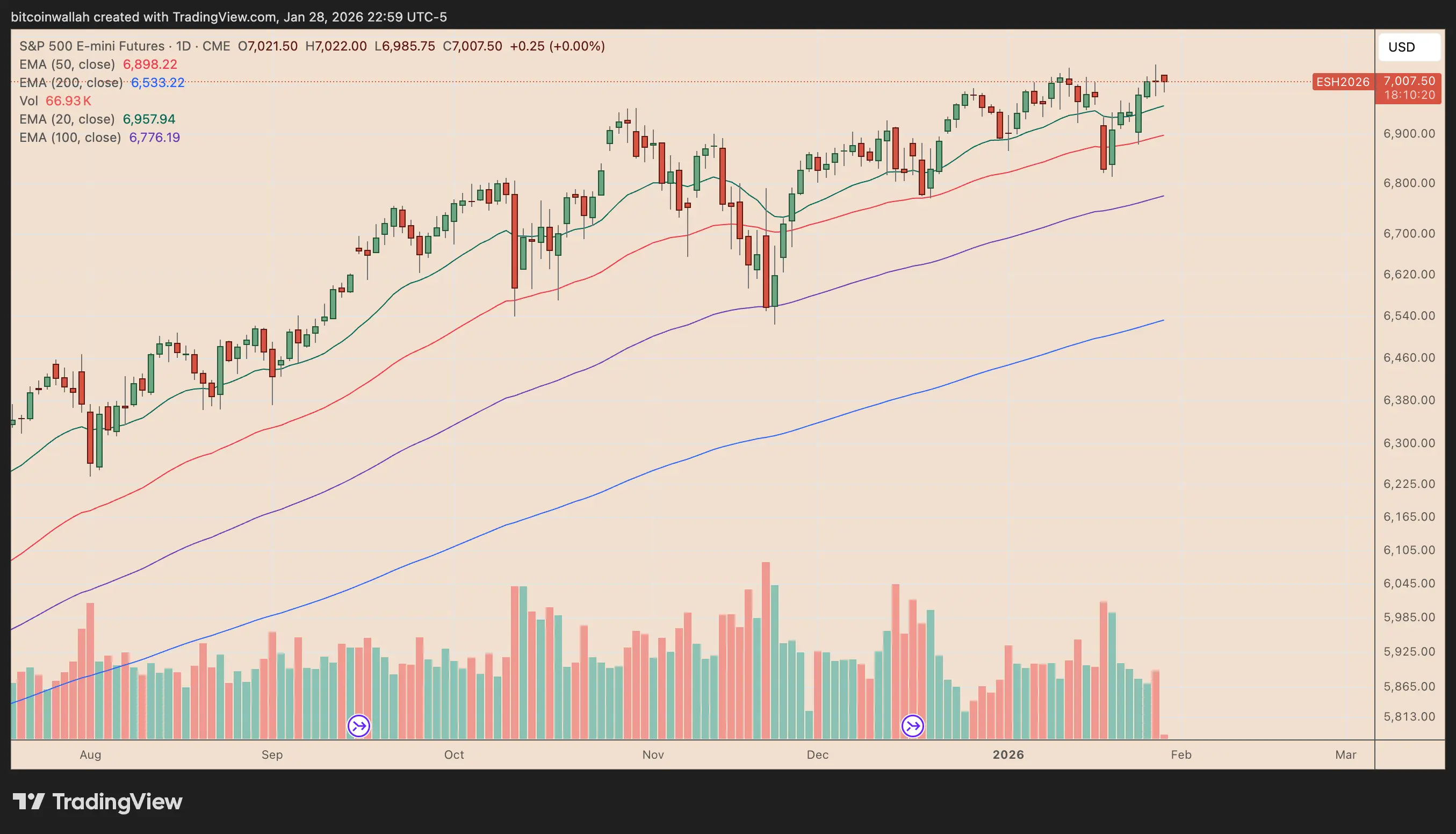
(Source: Trading View)
After three rate cuts last year, the Federal Reserve has kept rates steady at 3.50% to 3.75%. Due to persistent inflation and a cooling labor market, Fed officials suggest a wait-and-see approach. Chairman Powell did not explicitly signal further rate cuts at the press conference, aligning with market expectations but still exerting pressure on risk assets.
Rising interest rates increase the opportunity cost of holding yield-bearing assets like US Treasuries. Conversely, this reduces the attractiveness of risk assets such as Bitcoin and stocks, and recent data supports this. For example, S&P 500 futures contracts declined 0.52% on January 29, consistent with Bitcoin’s decline that day. This correlation indicates Bitcoin is increasingly viewed as a risk asset rather than a standalone safe haven.
The expectation that “high interest rates will persist longer” poses structural pressure on Bitcoin. When risk-free rates stay above 3.5%, investors are less willing to hold assets like Bitcoin that do not generate cash flow. In contrast, US Treasuries offer certain yields with minimal risk, making this competition highly unfavorable for Bitcoin in a high-rate environment.
According to CME FedWatch, market expectations for a March rate cut have fallen below 15%, with only a 60.8% chance of a June cut. This shift suggests high interest rates could persist into late 2026, creating a long-term headwind for Bitcoin.
Escalating US-Iran Tensions: Gold Hits New High, Bitcoin Loses Favor
Geopolitical factors have also heightened risk aversion. This week, US-Iran tensions escalated, with the US deploying aircraft carrier strike groups to the region, increasing the likelihood of conflict. On January 29, oil prices rose for the third consecutive day amid fears of further price increases. Gold prices also hit a record high, surpassing $2,900 per ounce, further diminishing the appeal of Bitcoin and stocks for traders.
This market reaction reveals that Bitcoin’s role as a safe haven is being challenged. Theoretically, during geopolitical uncertainty, decentralized assets like Bitcoin should be in demand. However, in actual crises, investors tend to favor proven safe havens like gold. The “digital gold” narrative for Bitcoin has not gained market acceptance at critical moments.
Rising oil and gold prices often signal renewed inflation pressures. If inflation data rises again, the Fed may refrain from cutting rates or even consider hikes. Such a policy shift would severely impact Bitcoin, as the combination of high inflation and high interest rates spells disaster for risk assets.
With S&P 500 futures down 0.52%, oil prices continuing to rise, and US-Iran tensions escalating, risk aversion intensifies. This confluence of negative factors makes it difficult for Bitcoin to find upward catalysts in the short term. Investors are reassessing asset allocations, shifting funds from risk assets to safe havens, with Bitcoin bearing the brunt.
On-Chain Data Signals Rising Loss Supply Warning
(Source: CryptoQuant)
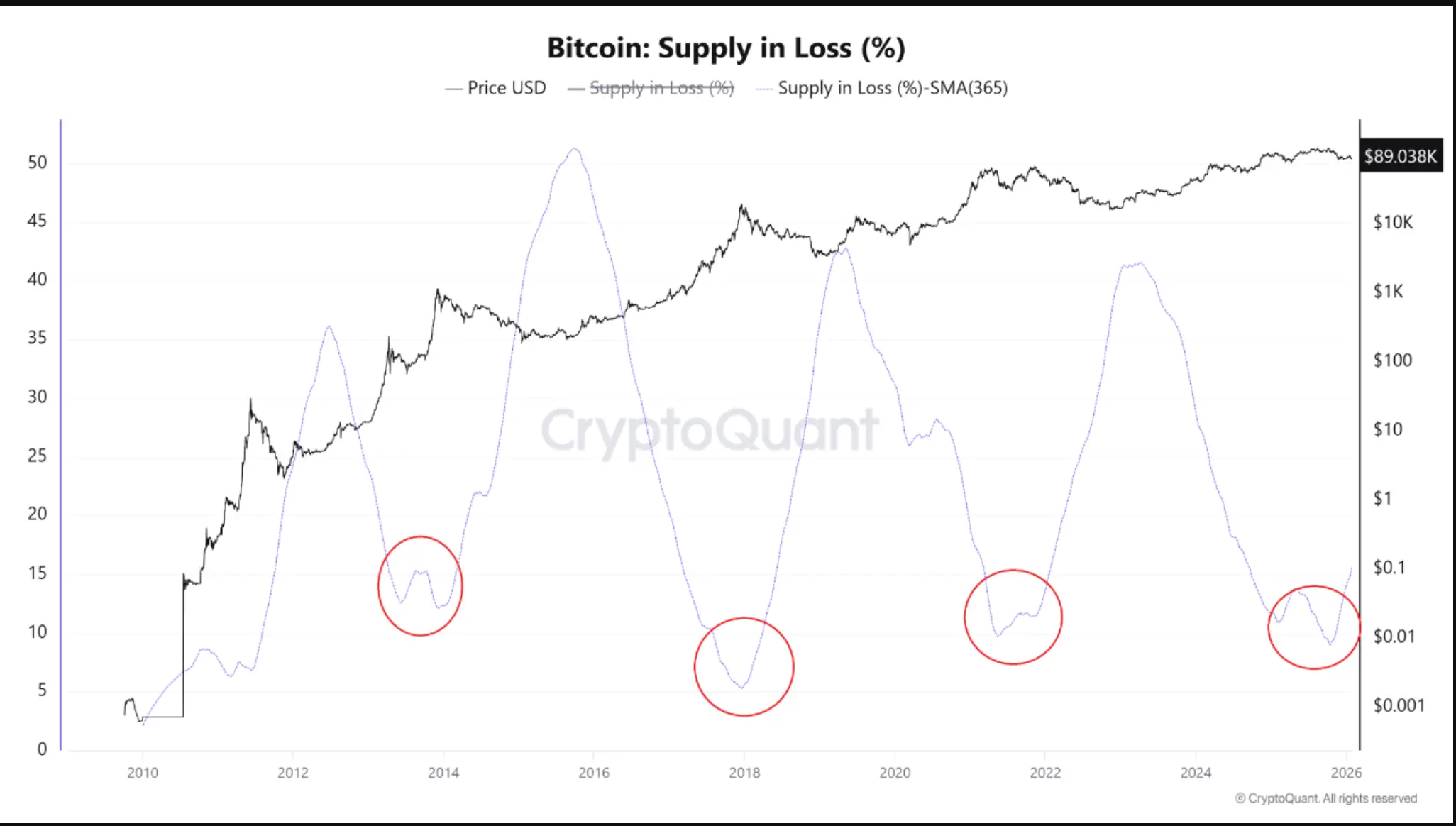
Bitcoin’s loss supply has begun to increase after years of decline, serving as an early warning sign that downside pressure is spreading beyond short-term traders. Historically, this turning point coincides with early bear market stages, where losses shift from weak investors to longer-term holders.
In previous declines (2014, 2018, 2022), this indicator started rising before price bottomed, which continued to decline. The actual lows occurred after loss supply expanded into surrender zones. Currently, loss supply remains well below extreme historical levels, but the directional shift is critical. It suggests Bitcoin may be transitioning into a bear market structure rather than just a quick correction within a bull trend.
Two Major On-Chain Warnings
Rising Loss Supply: From multi-year decline to increase, historically indicating early bear market phase
Exchange Deposits Increase: Average deposits rose from 0.7 BTC to 1.2 BTC, suggesting whale accumulation for potential sell-off
Between November 2025 and January 2026, as Bitcoin prices climbed from $80,000 to $98,000, exchange deposits increased from 0.7 BTC to 1.2 BTC. This indicates whales may be positioning to sell or hedge during market strength, as increased deposits—especially on Binance—often precede or accompany liquidity and distribution before or during volatility.
This whale behavior warrants caution. Large holders transferring Bitcoin from cold wallets to exchanges typically signal intentions to sell or hedge. The 71% increase from 0.7 BTC to 1.2 BTC in deposits has historically preceded significant price swings.
Technical Double-Down on Bearish Structure Points to Deeper Pullback
(Source: Trading View)
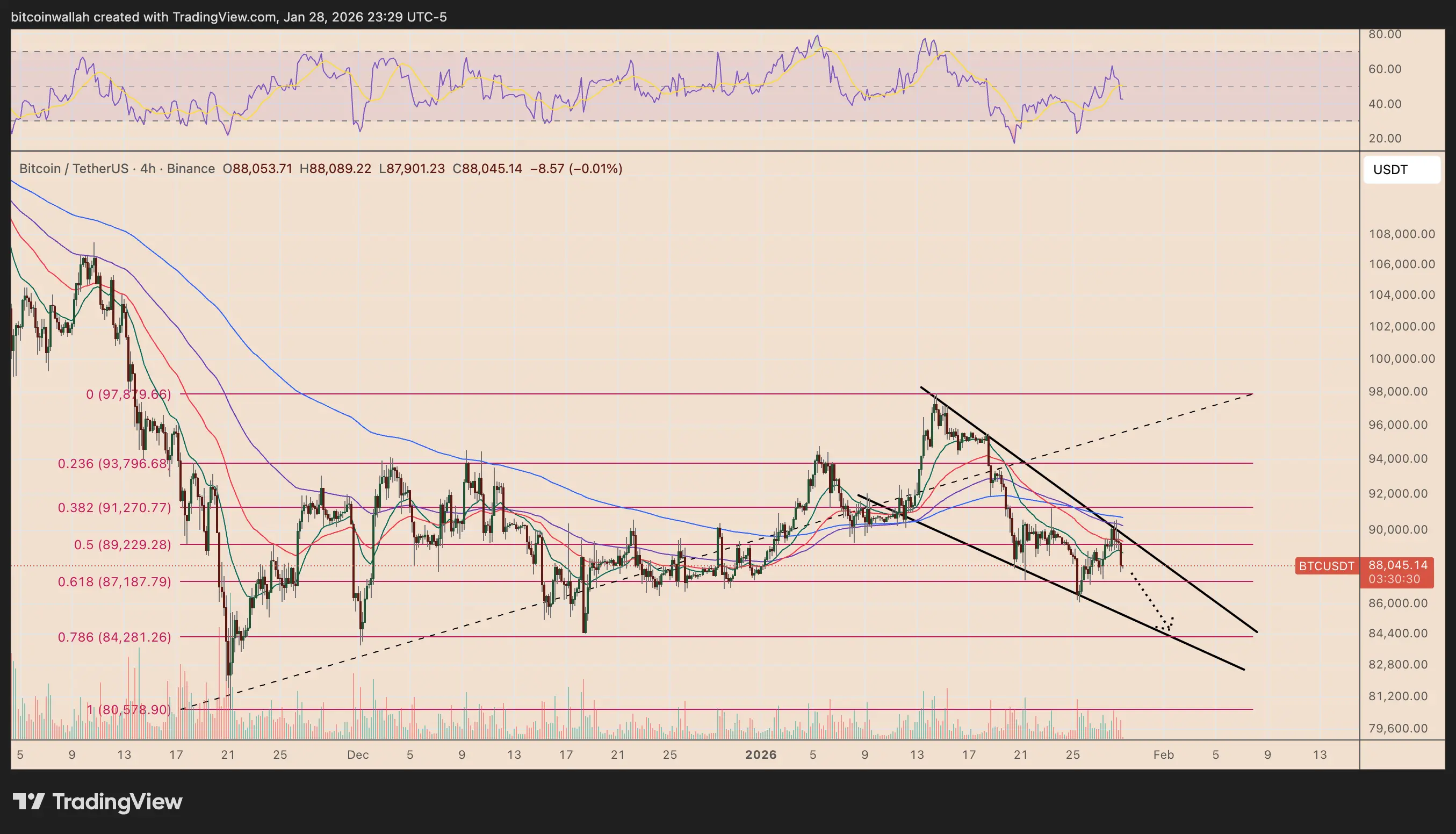
The BTC/USD four-hour chart suggests Bitcoin could decline to $84,000 in early February, as prices continue to oscillate along the lower boundary of a descending wedge. This structure often leads to further declines before a breakout attempt. The zone also coincides with a key Fibonacci support area (near the 0.786 retracement), reinforcing a “magnet” effect. A decisive break below this zone could open the door to deeper downside.
The weekly chart also shows a bear flag pattern. In January, BTC rebounded after testing the flag’s lower trendline (overlapping with the 100-week EMA), helping stabilize short-term prices. However, the overall structure still indicates a downward-sloping channel, with lower highs, implying a bearish trend.
If Bitcoin closes the week below the flag support, it could trigger a continuation of the decline, with the next major support near $70,000, overlapping with the 200-week moving average. The 200-week MA is a key long-term trend indicator, historically providing a final line of defense in bear markets. If this support fails, Bitcoin could enter a deeper bear cycle.
Disclaimer: The information on this page may come from third parties and does not represent the views or opinions of Gate. The content displayed on this page is for reference only and does not constitute any financial, investment, or legal advice. Gate does not guarantee the accuracy or completeness of the information and shall not be liable for any losses arising from the use of this information. Virtual asset investments carry high risks and are subject to significant price volatility. You may lose all of your invested principal. Please fully understand the relevant risks and make prudent decisions based on your own financial situation and risk tolerance. For details, please refer to
Disclaimer.
Related Articles
BlackRock Bitcoin ETF IBIT Posts $983M Net Inflows in Past Week, Marking 6-Month High
Gate News message, April 27 — According to CryptoQuant data, BlackRock's Bitcoin ETF IBIT recorded net inflows of $983 million over the past week, marking the highest level in the past six months.
Driven by inflows into IBIT and other spot Bitcoin ETFs, BTC has shown strong performance, with
GateNews23m ago
Bitcoin's Current Rally Driven by Futures Demand, Spot Demand Yet to Recover: CryptoQuant CEO
Gate News message, April 27 — According to CryptoQuant CEO Ki Young Ju, Bitcoin's current rally is primarily driven by futures market demand rather than spot demand recovery. Open interest has risen and ETF inflows continue alongside buying from Strategy, yet on-chain apparent demand remains net
GateNews35m ago
Hyperliquid Whale Faces Liquidation at $80,929 as $13.8M BTC Short Position Underwater 54%
Gate News message, April 27 — A major whale on the decentralized derivatives platform Hyperliquid is facing imminent liquidation, with its $13.8 million short position in Bitcoin now underwater 54%. The address 0xbac2d8e1e3ef8cba378564667be59a2e2d8ed897, holding approximately 175 BTC, opened a 40x l
GateNews1h ago
Bitcoin Liquidation Levels: $19.03B Long Liquidations if BTC Falls Below $75,188
Gate News message, April 27 — According to Coinglass data, if Bitcoin falls below $75,188, cumulative long liquidations on major centralized exchanges would reach $19.03 billion.
Conversely, if BTC breaks above $82,640, cumulative short liquidations on major CEXs would reach $11.88 billion.
GateNews1h ago
Wong Li-Cheng BTC long position is in profit by over $2.7 million, with gains reaching $4.26 million over the past week
According to data monitored by Hyperinsight on April 27, 2026, after crypto trader Huang Licheng (Maji Big Brother) broke above $79,000 in Bitcoin (BTC) this morning, his series of long positions combined are showing an unrealized gain of more than $2.7 million, with his total open position size rising to $86.18 million. His cumulative profits over the past week have reached $4.26 million. As of the time this report was published, the two leveraged positions and their liquidation lines are maintaining a certain safe distance.
MarketWhisper1h ago
Bitcoin Spot ETFs Post 9 Consecutive Days of Net Inflows as Institutional Demand Strengthens
Gate News message, April 27 — Bitcoin spot ETFs have recorded net inflows for nine consecutive trading days, with institutional buying pressure continuing to accumulate and support prices.
Strategy has invested approximately $11 billion to increase its Bitcoin holdings so far this year. The
GateNews1h ago


