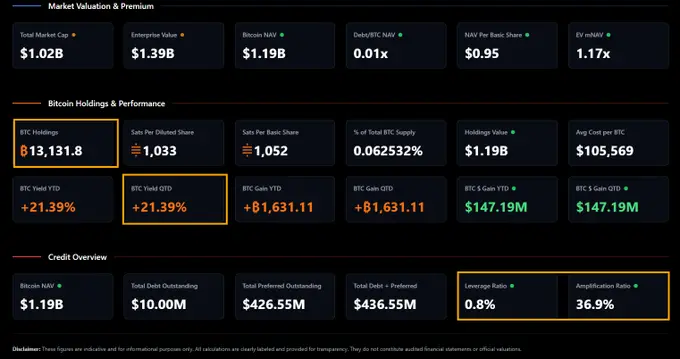
 Strive purchased 333.9 Bitcoins at an average price of $89,851, with a total holding of 13,132 Bitcoins, ranking among the top ten globally. The preferred stock SATA financing demand reached $600 million, with a target increase to $225 million, after repaying $110 million of Semler acquisition debt and a $20 million Coinbase loan, with Bitcoin holdings fully uncollateralized.
Preferred Stock Financing Surges with $600 Million Oversubscription
On Wednesday, Strive announced that the demand for its floating-rate Series A perpetual preferred stock (ticker: SATA) reached $600 million, prompting an increase in the target financing amount from $150 million to $225 million. This oversubscription indicates strong market confidence in Strive’s Bitcoin strategy, despite widespread skepticism about corporate Bitcoin treasury strategies in the second half of 2025.
Preferred stocks are hybrid securities between common stocks and bonds, typically offering fixed dividends and priority over common equity in liquidation. Strive’s choice to issue floating-rate preferred stock rather than fixed-rate means dividend payments will fluctuate with market interest rates, reducing financing costs during a rate decline cycle. Perpetual preferred stocks have no maturity date, and issuers can choose when to redeem, providing financial flexibility for Strive.
The demand of $600 million far exceeds the initial $150 million target, reflecting growing institutional investor interest in indirectly holding Bitcoin. Investors purchasing Strive’s preferred stock can earn dividends while benefiting from Bitcoin price appreciation that increases the company’s value. This structure offers conservative investors an alternative way to gain Bitcoin exposure without directly buying and safekeeping Bitcoin.
The timing of the financing is also noteworthy. Strive launched the preferred stock offering immediately after completing the Semler Scientific acquisition, indicating management’s clear plan to clean up the balance sheet and expand Bitcoin holdings. The decision to increase from $150 million to $225 million demonstrates the team’s ability to quickly adjust strategies based on market feedback—an uncommon trait among corporate Bitcoin treasury companies.
Debt Repayment Releases Bitcoin Collateral with 92% Debt Cleared
Earlier this month, Strive stated it would use proceeds from stock issuance, existing cash, and potential gains from unwinding hedging transactions to repay debt, with remaining funds allocated to purchasing Bitcoin and related products. On Wednesday, the company confirmed it had used the proceeds to repay $110 million (92%) of inherited Semler debt, including $90 million in convertible notes exchanged for SATA stock and full repayment of Coinbase’s $20 million credit loan.
This debt restructuring is strategically significant. Strive added that with Coinbase’s loan repaid, its Bitcoin holdings are now entirely uncollateralized. The company plans to repay the remaining $10 million debt within the next four months. Uncollateralized Bitcoin holdings mean Strive is not at risk of forced liquidation due to Bitcoin price drops, providing critical resilience amid increased market volatility.
Many corporate Bitcoin treasury companies leverage debt to amplify returns by purchasing more Bitcoin. However, such strategies are risky if Bitcoin prices decline below the loan-to-value (LTV) threshold, potentially forcing forced sales at unfavorable prices. Strive’s choice to repay debt and maintain uncollateralized holdings reflects a preference for a prudent financial structure over aggressive leverage.
Strive Debt Repayment Roadmap
Completed: $110 million repaid (92%), including $90 million in convertible notes and $20 million Coinbase loan
Next four months: Repay remaining $10 million, achieving full debt-free status
Supported by Vivek Ramaswamy, Strive completed its acquisition of former Bitcoin finance firm Semler Scientific on January 13, following a merger agreement reached in September. This acquisition rapidly expanded Strive’s Bitcoin holdings but also inherited Semler’s debt burden. The swift debt repayment underscores management’s efficiency in integration.
13,132 Holdings Propel to Top Ten Globally
(Source: Strive)
Strive bought 333.9 Bitcoins at an average price of $89,851, increasing its total Bitcoin holdings to 13,132, valued at $1.17 billion. Strive has now become one of the top ten Bitcoin-holding companies worldwide, a milestone of significant importance in corporate Bitcoin adoption history.
Over 190 publicly listed companies hold Bitcoin on their balance sheets, totaling approximately 1,134,000 Bitcoins, about 5.4% of the total supply. Strive’s 13,132 Bitcoins account for roughly 1.16% of the total corporate holdings. While seemingly modest, considering that nearly 63% of corporate Bitcoin holdings are held by MicroStrategy led by Michael Saylor, Strive is effectively one of the most significant holders outside MicroStrategy.
Strive’s rapid rise is driven by its aggressive acquisition strategy. By acquiring Semler Scientific, which already accumulated Bitcoin, Strive bypassed slow incremental buying and gained a large position directly. This “buying a company is buying Bitcoin” approach is becoming a new trend in corporate Bitcoin adoption. After acquisition, the immediate debt clearance and continued accumulation demonstrate Strive’s strong conviction in Bitcoin’s long-term value.
Strive reports a Bitcoin return of 21.2%, representing the growth percentage of its Bitcoin exposure per share over time. This metric is a key indicator of the success of its Bitcoin strategy, with a 21.2% return suggesting that the company’s equity dilution rate is slower than Bitcoin accumulation, a positive signal for shareholders.
Stock Price Plummets 92% Revealing Corporate Bitcoin Strategy Risks
However, improvements in financial metrics have not immediately translated into stock price gains. According to Google Finance data, asset-liability improvements were insufficient for Strive to escape losses on Wednesday, with ASST falling 2.23% to $0.80. Since announcing its Bitcoin strategy, ASST’s price has dropped 92.4% from its peak of $10.46, highlighting the volatility and execution risks associated with corporate Bitcoin treasury strategies.
This divergence between stock price and fundamentals is common among corporate Bitcoin companies. Building Bitcoin treasuries became a popular institutional trend in early 2024 and 2025, but skepticism about the sustainability of such strategies led to significant declines in many stocks last year. Market concerns focus on whether these companies have actual business operations beyond holding Bitcoin, whether their financing models are sustainable, and their risk management during Bitcoin price drops.
Strive’s situation is unique in that it acquired medical device business Semler, which is not purely a Bitcoin holding company. Yet, the market seems to assign little premium to this diversification, and the stock remains highly correlated with Bitcoin prices. This indicates investors view Strive more as a Bitcoin proxy stock rather than a traditional operating company.
Disclaimer: The information on this page may come from third parties and does not represent the views or opinions of Gate. The content displayed on this page is for reference only and does not constitute any financial, investment, or legal advice. Gate does not guarantee the accuracy or completeness of the information and shall not be liable for any losses arising from the use of this information. Virtual asset investments carry high risks and are subject to significant price volatility. You may lose all of your invested principal. Please fully understand the relevant risks and make prudent decisions based on your own financial situation and risk tolerance. For details, please refer to
Disclaimer.
Related Articles
Whale Liquidates 1,351 ETH and Opens $50.6M Bitcoin Short on Hyperliquid
Gate News message, April 26 — A whale address beginning with 0x310 opened a 16x leveraged Bitcoin short position on Hyperliquid over the past 30 minutes, with a notional value of $50.6 million across 653 BTC at an average price of $77,470. The liquidation price stands at $81,308, making it the
GateNews59m ago
Quantitative Trader Killa Predicts Bitcoin Bear Market Bottom at $40,740 or $42,680
Gate News message, April 26 — Quantitative trader Killa shared his prediction for Bitcoin's bear market bottom on April 25, estimating the floor at $38,800. Accounting for approximately 5% variance, he projects the bottom could be either $40,740 or $42,680.
Killa previously used a model combining c
GateNews1h ago
Bitcoin Liquidation Cascades: $619M in Short Liquidations if BTC Breaks $80K
Gate News message, April 26 — According to Coinglass data, if Bitcoin breaks $80,000, major centralized exchanges will face cumulative short liquidation intensity of $619 million. Conversely, if BTC falls below $76,000, cumulative long liquidation intensity across major CEXs will reach $645 million.
GateNews4h ago
Bitcoin's 'Winter Is Over,' Says Michael Saylor as Institutional and National Adoption Drive Next Rally
Gate News message, April 26 — Michael Saylor, co-founder of MicroStrategy, declared "winter's over" as Bitcoin traded around $78,000. Analyst Mati Greenspan characterized recent price movements as a correction within a broader bull market rather than a new bear phase, noting that Bitcoin's bottom ha
GateNews6h ago
Analyst: $80K Emerges as Bitcoin's Key Resistance Level, Breakout Could Trigger Increased Volatility
Gate News message, April 26 — On-chain analyst Murphy identified $80,000 as Bitcoin's primary resistance level above the current price, citing a combination of options Gamma exposure, open interest (OI), and implied volatility (IV) data. The level represents a critical checkpoint for May's price
GateNews6h ago
South Africa Crypto Draft Triggers 1M Rand Fine Warning From Valr CEO
Industry leaders and financial experts have issued a sharp rebuke of the South African National Treasury’s Draft Capital Flow Management Regulations 2026, calling the proposal a regressive move that mirrors apartheid-era economic controls.
Key Takeaways:
National Treasury draft replaces 1961
Coinpedia6h ago


