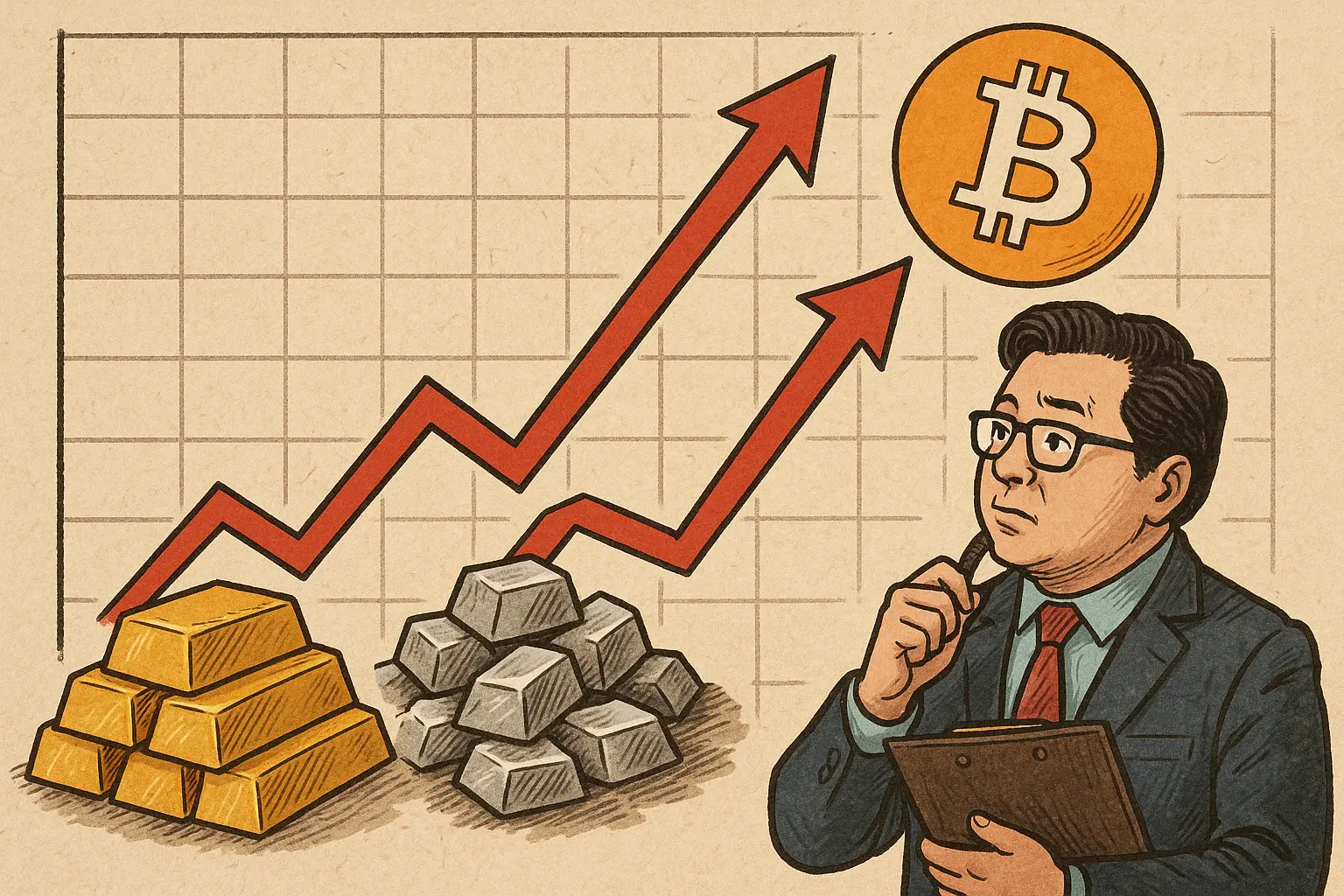
Gold and silver soar to multi-year highs as investors hedge against a weakening dollar. Tom Lee of BitMine points out a historical pattern: metals tend to rise after stabilizing, followed by Bitcoin. After de-leveraging in October 2025 and improving crypto fundamentals, he believes tokenization and blockchain will enhance banking productivity.
Three Major Drivers Turning Metals into a True Asset Class
As gold and silver prices surge to multi-year highs, investors are increasingly turning to precious metals. During a recent appearance on CNBC’s Power Lunch, BitMine Research Director Tom Lee explained why metals have become a “true asset class” and what this means for stocks and cryptocurrencies.
Lee said: “Metals are proving themselves as a genuine, reliable asset class because I think for many years, people may have believed only gold enthusiasts should hold gold. But now, especially over the past three years, I believe metals have demonstrated themselves as an unstoppable force.” There are three main factors behind this shift in perception.
The first is escalating geopolitical uncertainty. The Russia-Ukraine conflict, tensions in the Middle East, US-China trade frictions, and multiple risks are driving central banks and institutional investors worldwide to increase gold reserves. Data from the World Gold Council shows that in 2025, global central bank gold purchases hit a record high, with countries like China, India, and Turkey continuing to add holdings. This “de-dollarization” trend is only accelerating in the current geopolitical environment.
The second is a softening dollar providing price support. The US dollar index has been declining since its 2024 high and is currently hovering around 96. When the dollar depreciates, commodities priced in dollars (such as gold and silver) become cheaper for international buyers holding other currencies, naturally boosting demand. Additionally, a weaker dollar often accompanies expectations of dovish Federal Reserve policies, reducing the opportunity cost of holding non-yielding assets like gold.
The third is rising expectations of dovish central bank policies. Although the Fed kept interest rates unchanged on Wednesday, markets still anticipate a new rate-cut cycle might begin in the second half of 2026. A rate-cut environment is highly favorable for gold, as it lowers real returns on cash and bonds, prompting capital flows into precious metals and other alternative assets. Silver, besides its monetary properties, also has industrial uses (electronics, solar energy), with demand continuing to grow amid the green energy transition.
Lee points out that the rise in metal prices is driven by a combination of geopolitical uncertainty, a weakening dollar, and dovish central bank policies. However, he emphasizes that rising metal prices should not be viewed as a bearish signal for stocks. He explains: “I don’t think this is bad for stocks because if it’s driven by expectations of a weaker dollar or more dovish central bank actions, then it’s actually positive for asset prices.” Lee believes that a softer dollar and accelerated profit growth provide stability to the stock market, even as metals attract investor attention.
Historical Pattern: Metal Rises Precede Bitcoin Breakouts
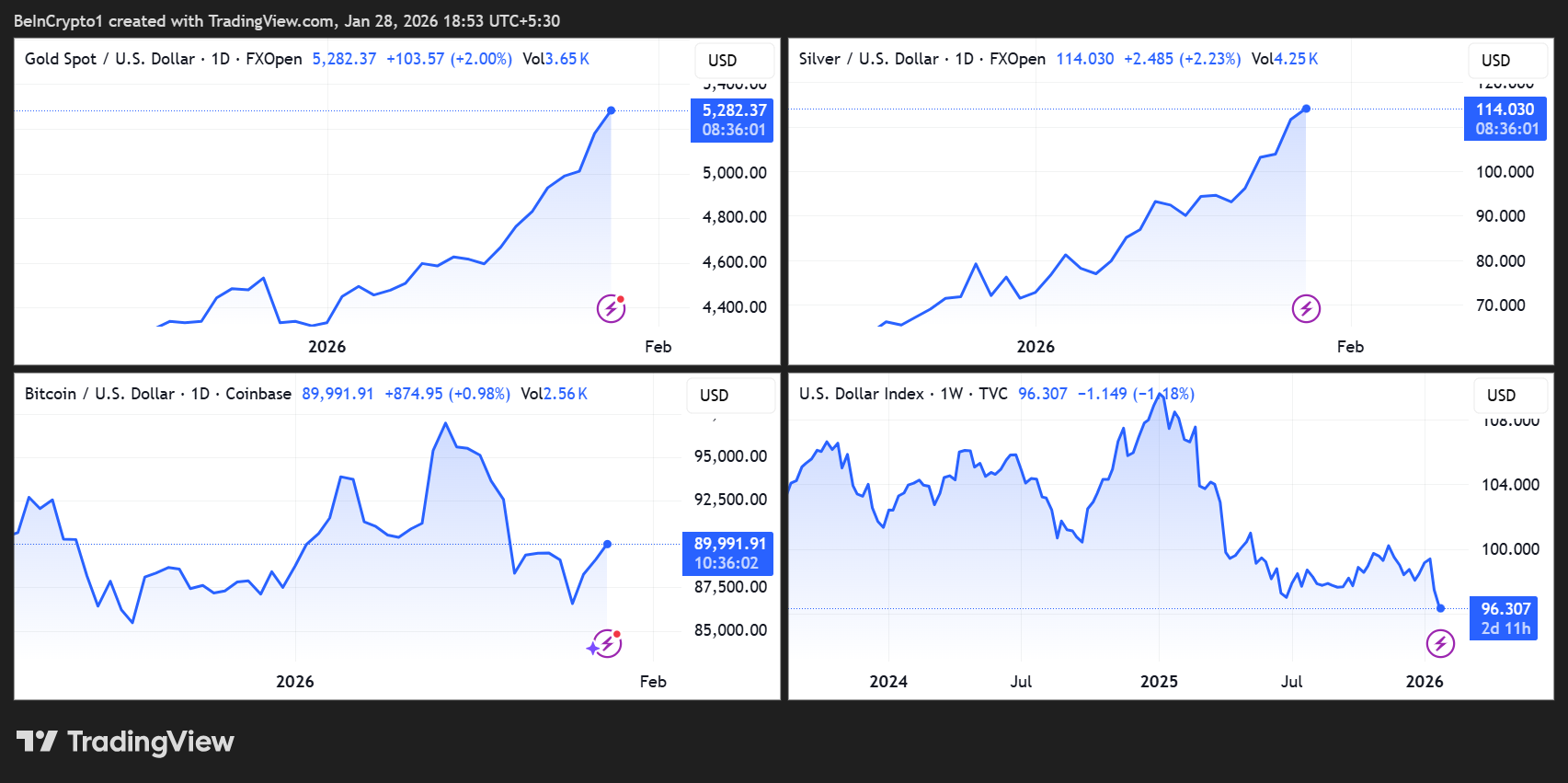
(Source: Trading View)
Tom Lee emphasizes a key historical pattern: after metals’ prices surge significantly and then stabilize, Bitcoin and Ethereum tend to rally again. This capital rotation pattern has repeated across several cycles, supported by clear logic.
When geopolitical risks or economic uncertainties first erupt, investors’ initial reaction is to flock to the most established and recognized safe-haven assets—gold and silver. This “first wave of safe-haven buying” drives metals prices sharply higher. However, once metals reach high levels and stabilize, profit-taking funds seek new investment targets. At this point, Bitcoin, as “digital gold,” with its safe-haven attributes and high growth potential, naturally becomes the next target for capital inflows.
Three Stages of Capital Rotation from Metals to Bitcoin
Stage 1 (Safe-Haven Phase): Geopolitical risk erupts → Capital floods into gold and silver → Metals prices soar
Stage 2 (Stabilization Phase): Metals reach high levels and consolidate → Early investors take profits → Funds seek new assets
Stage 3 (Rotation Phase): Capital flows into Bitcoin and other risk assets → Crypto market initiates a new rally
Historical data confirms this pattern. In 2019, gold rose from $1,300 to $1,550 and then consolidated, followed by Bitcoin’s rally from $7,000 to $64,000 in 2021. After gold broke through $2,000 and stabilized in 2020, Bitcoin surged 540% over the next nine months. This “metals lead, Bitcoin follows” pattern is not coincidental but reflects phases of risk appetite evolution.
Tom Lee believes we are currently transitioning from the second to the third stage of this cycle. Gold has broken above its $3,700 all-time high and begun to consolidate, while silver hovers around $34. This stability indicates that safe-haven sentiment has peaked, and capital may soon rotate into Bitcoin. He states: “Although precious metals have lagged, crypto fundamentals have improved after de-leveraging. The entire industry is a bit shaky now, but the fundamentals have greatly improved.”
Reevaluating Crypto Fundamentals Post-De-leveraging
Lee emphasizes that the de-leveraging policy in October 2025 will continue to influence the crypto market, but its impact is shifting from negative to positive. He says: “Some exchanges and market makers have undergone massive de-leveraging, so the industry is a bit shaky, but the fundamentals have greatly improved.” This judgment is based on declining leverage ratios and improved market structure.
The liquidation event in October, while causing a sharp price drop, also cleared over-leveraged speculative positions. Currently, systemic leverage is around 3% of the total crypto market cap, well below the 5%-7% levels seen in 2024-2025. Lower leverage means the market is more resilient to future volatility and less likely to experience chain liquidations and crashes. Additionally, open interest in Bitcoin options has surpassed perpetual futures, indicating market participants are shifting from “high leverage chasing gains” to “limited risk participation.”
Tom Lee is optimistic about sectors including energy, basic materials, finance, industrials, small caps, and Mag-7 tech companies. He is particularly bullish on banking: “The financial sector is under pressure because the White House is artificially deciding which companies will win or lose, but the fundamentals of banks are very strong. I believe tokenization and blockchain are truly capable of significantly boosting productivity, and AI is a huge tailwind. Over time, I think banks will be revalued like tech stocks.”
This optimism for banks is not at odds with his bullish view on crypto. Lee believes that if traditional banks embrace tokenization and blockchain, they will greatly improve efficiency and reduce costs. Moving cross-border payments, securities settlement, and asset custody onto blockchain could cut settlement times from days to seconds and reduce costs by over 50%. Such technological upgrades will give banks valuation premiums similar to tech companies.
He also mentions short-term uncertainties, including government shutdowns and potential earnings misses. He notes that such events often present buying opportunities rather than long-term threats: “Of course, shutdowns and production halts create uncertainty in the short term, but history shows these are buying opportunities.” This buy-the-dip logic is based on confidence in long-term trends.


