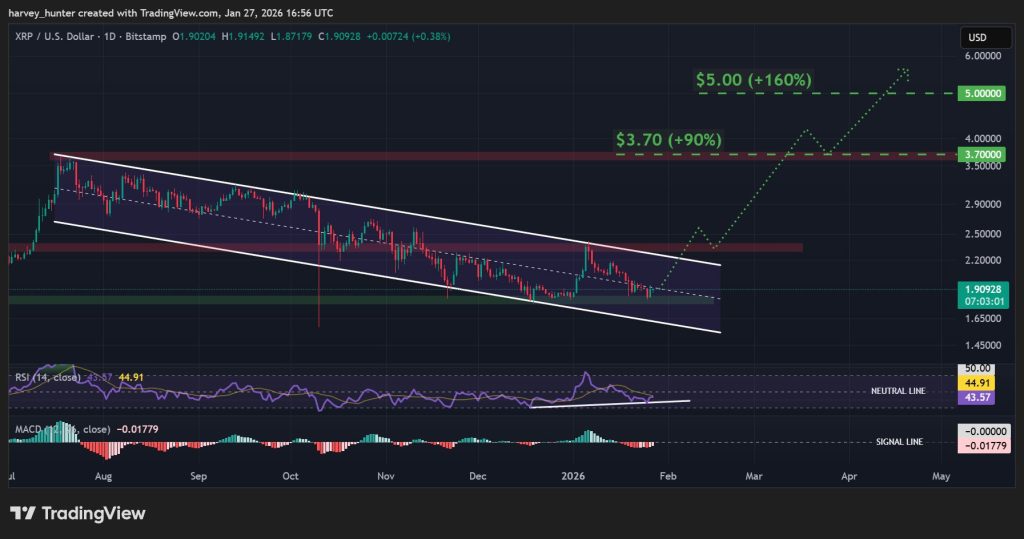
XRP Ledger tokenized assets have reached $2 billion, with an increase of $1 billion in December alone. Technically, after XRP breaks above $2.35, the target is $3.70, and if the trend continues, it could reach $5.
Tokenized Asset Doubling Reveals Accelerated TradFi Penetration
Luke Judges posted on X platform on January 26th: “Just in December, we doubled the market cap of RWA on XRPL, from $1 billion to $2 billion. We have a clear strategy and are already seeing returns. Capital markets will eventually go on-chain, and before full realization, our work is not done.” This unexpected growth makes XRP Ledger a key infrastructure layer connecting TradFi and DeFi.
The over $1 billion asset increase in December has not yet been fully reflected in existing dashboards, as RWA.xyz is currently indexing assets from Ripple partners. This suggests the actual scale of tokenization may be larger than the market currently perceives, and once these data are fully disclosed, it could further drive XRP price revaluation. This “hidden growth” phenomenon is not yet fully reflected in XRP’s price trend, providing fundamental support for subsequent upward movement.
As the native token managing this infrastructure, XRP will directly benefit from the tokenization wave. Each issuance, transfer, and settlement of tokenized assets consumes XRP as network fees, which are very low per transaction (usually 0.00001 XRP). However, when transaction volumes reach billions of dollars, the accumulated network activity will significantly increase XRP’s practical demand. Additionally, institutional participants operating tokenized assets on XRPL often need to hold a certain amount of XRP as account reserves, further locking up circulating supply.
Early positioning has solidified Ripple’s goal of becoming a pillar of global finance, bringing traditional capital markets onto the chain. Nevertheless, Judges also pointed out that the surrounding ecosystem still needs further maturity to fully support such scale. This includes more robust custody solutions, compliance frameworks, and liquidity provider networks. Even so, XRPL’s rapid development indicates that the network is far ahead of current market expectations in the tokenization process.
Technical Indicators Show Parabolic Rise Entering Countdown
(Source: Trading View)
Due to XRP’s development speed exceeding expectations, its price trend may not yet fully reflect the positive fundamentals. The descending triangle pattern over the past six months has entered consolidation, and a breakout may be imminent. This consolidation is often seen as a buildup phase, similar to a compressed spring, which could produce explosive upward movement once released.
Momentum indicators support a bullish view. The MACD shows an early trend reversal, with the trend flattening and a potential bullish crossover of the signal line. The golden cross is one of the most reliable buy signals in technical analysis, occurring when the fast MACD line crosses above the slow line, typically signaling the end of a downtrend and the start of an uptrend. Currently, MACD histogram bars are converging, just one step away from a golden cross.
Although the RSI has fallen below the neutral 50 level, it continues to make higher lows and is still contracting downward. This structure indicates that market forces are quietly accumulating rather than weakening. The “higher lows” pattern in RSI is a classic hidden bullish divergence, where price makes new lows but RSI does not, often foreshadowing a trend reversal.
Recent declines have also reinforced $1.90 as a solid cycle bottom, making it a reliable launchpad for the entire bull phase. From volume distribution, the $1.90 to $2.00 range has many historical trading records, meaning many investors’ costs are concentrated there, giving them strong motivation to defend when prices fall back. This “cost anchoring” effect provides strong support for the price.
Breakout Path and Target Price Analysis
The key resistance level is at the historically contentious $2.35 mark. This price has repeatedly served as both resistance and support for XRP, holding significant psychological and technical importance. If this level turns into support, it could confirm a successful breakout, with a target near the cycle high of $3.70, representing about 90% upside.
XRP Three-Stage Target Path
Stage 1: Break above $2.35 resistance, confirming the downward channel breakout, with a short-term target of $3.00 (27% increase).
Stage 2: Recover the $3.70 cycle high, completing technical recovery, with a mid-term target of 90% increase.
Stage 3: If tokenized assets continue to grow beyond $5 billion, and XRPL DeFi ecosystem matures, the long-term target is $5.00 (160% increase).
The critical factor in Stage 1 is volume confirmation during the breakout. If the breakout above $2.35 is accompanied by increased volume, it will greatly enhance the validity of the breakout and attract trend followers. Conversely, if volume diminishes during the breakout, it may be a false breakout, and prices could quickly fall back. Investors should closely monitor whether the volume on the breakout day exceeds 1.5 times the recent average.
The challenge in Stage 2 lies in the $3.00 to $3.70 range, which may see profit-taking pressure. This zone is near the highs expected at the end of 2024 and early 2025, where many investors’ positions are concentrated. As prices approach these levels, trapped positions may choose to exit, creating resistance. Breaking through this zone requires sufficient buying support, and continued growth of tokenized assets is key to providing this support.
Stage 3 depends entirely on fundamental improvements. A $5 target implies XRP’s market cap reaching about $275 billion (assuming circulating supply remains relatively stable). This requires the tokenized asset scale on XRPL to expand further beyond $50 billion, along with a full explosion of DeFi, payment applications, and institutional adoption. If Ripple can partner with more central banks and multinational corporations, this goal could be achievable before the end of 2026.
As on-chain capital markets on XRPL mature, and cryptocurrency penetrates mainstream traditional finance further, XRP’s upside potential could reach 160%, approaching $5.00. This forecast is based on the assumptions that the tokenization trend is irreversible, XRPL’s technological advantages persist, and regulatory environments gradually clarify.
Risk Warnings and Strategic Recommendations
Although both fundamental and technical aspects of XRP show bullish signs, investors should remain cautious of potential risks. First, the overall crypto market remains influenced by macroeconomic factors; if Fed policies tighten or global liquidity shrinks, XRP may not be immune. Second, although Ripple’s lawsuit with the SEC has been settled, any regulatory changes could impact market confidence. Third, if growth in tokenized assets slows or competitors (like Stellar, Algorand) launch better solutions, XRP’s first-mover advantage could be weakened.
For those considering participation, a dollar-cost averaging strategy is recommended. Initiate a first position in the $1.90 to $2.10 range, with a stop-loss below $1.80. If the price successfully breaks above $2.35 and stabilizes, add positions around $2.40 to $2.50. The target is set at $3.70 (90% increase), with aggressive investors holding until $5.00 (160% increase).


