
Ripple and the Innovation Department of Riyadh Bank in Saudi Arabia have signed a Memorandum of Understanding to explore blockchain applications in cross-border payments, digital asset custody, and asset tokenization. Riyadh Bank manages assets exceeding $130 billion, marking a deep integration of traditional finance (TradFi) with blockchain technology. This signifies a rapid increase in institutional confidence in blockchain within the global banking industry, while also supporting Saudi Arabia’s 2030 vision for economic transformation.
Details of the Collaboration between Ripple and Riyadh Bank’s Innovation Department
Reece Merrick, Senior Executive and Managing Director for the Middle East and Africa at Ripple, announced this strategic partnership on Monday. The memorandum signed with Riyadh Bank’s innovation arm Jeel will focus on three core areas, directly addressing Saudi Arabia’s urgent needs for financial modernization.
Core Business Areas of Cooperation
Cross-border Payments: Leveraging Ripple’s blockchain network to improve international remittance efficiency, reduce transaction fees, and shorten settlement times.
Digital Asset Custody: Providing compliant custody solutions for institutional clients’ crypto assets.
Asset Tokenization: Converting traditional financial assets (such as bonds and real estate) into blockchain tokens to enhance liquidity.
These initiatives directly align with Saudi Arabia’s “Vision 2030” strategic framework. The country aims to achieve economic diversification over the next decade, reducing reliance on oil exports, with fintech and digital infrastructure seen as key drivers. Riyadh Bank, as a pillar of the domestic financial system, participating in Ripple’s blockchain pilot projects sends a clear signal to the entire Middle Eastern banking sector: TradFi is actively embracing blockchain technology rather than passively observing.
From Ripple’s perspective, the partnership with Riyadh Bank represents a significant breakthrough in the Middle Eastern market. Saudi Arabia has historically taken a cautious stance toward blockchain technology, with less clear regulatory frameworks compared to the UAE. This cooperation, through establishing formal relationships with one of the country’s largest banks, lays the groundwork for Ripple’s further expansion in the region. Jeel, as Riyadh Bank’s innovation lab, focuses on testing emerging technologies. This structure allows both parties to validate blockchain applications in a controlled environment, reducing regulatory risks.
Cross-border payments are the most immediate application scenario. Saudi Arabia has extensive trade relations and remittance needs worldwide. Traditional SWIFT systems are costly and inefficient, long-standing issues for businesses and individuals. Ripple’s XRP Ledger can settle cross-border transactions within seconds, with transaction fees only a fraction of traditional systems. If Riyadh Bank successfully deploys this technology, it could trigger other Saudi banks to follow suit, creating a network effect for blockchain-based payments.
Strategic Shift of $130 Billion in Assets in TradFi
The size and importance of Riyadh Bank within Saudi Arabia’s financial system make this cooperation highly significant. By mid-2025, the bank’s assets will exceed $130 billion, making it one of the largest lending institutions in Saudi Arabia. Such a major bank’s move toward blockchain signals a rapid erosion of the boundaries between TradFi and crypto finance.
Traditional banking has long been cautious about blockchain, mainly due to regulatory uncertainty, technological maturity, and operational risks. However, when a bank managing over $130 billion in assets chooses to partner with Ripple, it indicates that decision-makers have completed thorough due diligence and are convinced that blockchain can deliver tangible business value. This endorsement from a major TradFi player is more persuasive than any white paper.
Riyadh Bank’s strategic shift also reflects a broader trend in global banking. Over recent years, institutions like JPMorgan, Citibank, and HSBC have launched blockchain pilot projects covering tokenized deposits and private blockchain networks. However, banks in the Middle East have been relatively conservative. Riyadh Bank’s move could trigger regional chain reactions.
From the perspective of Saudi Arabia’s Vision 2030, this cooperation has symbolic policy significance. The government explicitly aims to position Saudi Arabia as a regional fintech hub, attracting global capital and technology firms. The partnership between Riyadh Bank and Ripple provides a concrete example of this vision, demonstrating that the Saudi banking industry is ready to embrace innovation. This public-private partnership also aligns with recent government reforms promoting economic liberalization.
Digital asset custody is another key dimension. As institutional investors’ interest in crypto assets grows, secure and reliable custody solutions are in high demand. Traditional banks have natural advantages here, with established risk management, insurance arrangements, and regulatory relationships. If Riyadh Bank develops custody services through collaboration with Ripple, it could fill a market gap in the Middle East and offer compliant digital asset management channels for high-net-worth clients and enterprises in Saudi Arabia.
Middle East Becomes a New Battlefield for Blockchain Finance, Led by the UAE
While Saudi Arabia has historically been cautious about blockchain, the broader Middle East is moving more decisively in this direction, largely led by the United Arab Emirates (UAE). Through clearer regulatory frameworks and active attraction of global companies, the UAE positions itself as a regional hub for digital assets.
Regulatory agencies in Dubai and Abu Dhabi have introduced dedicated digital asset frameworks covering exchanges, custody providers, and stablecoin issuers, providing clearer pathways for businesses operating at the intersection of TradFi and crypto finance. The Dubai Virtual Assets Regulatory Authority (VARA) and the Financial Services Regulatory Authority (FSRA) of Abu Dhabi Global Market (ADGM) have issued detailed licensing and compliance guidelines, attracting global exchanges like Binance, Crypto.com, and Bybit to establish regional headquarters.
This initiative has attracted many large banks and fintech firms seeking regulated pathways into the Middle East and beyond. Meanwhile, traditional banks in the UAE are actively exploring blockchain applications. Abu Dhabi First Bank (FAB) and Emirates NBD have launched blockchain trade finance platforms, demonstrating proactive adoption of the technology by TradFi institutions.
Saudi Arabia clearly does not want to lag behind in this regional competition. The partnership between Riyadh Bank and Ripple can be seen as a response to the UAE’s leading position. Despite economic and political competition, the fintech rivalry could have positive effects, accelerating blockchain innovation across the Gulf Cooperation Council (GCC) region.
The Middle East also possesses unique advantages. Abundant capital, a young population, government support for innovation, and its strategic location as a trade hub between East and West make it an ideal testing ground for blockchain finance. More importantly, the banking sector is relatively concentrated, and government influence over the financial system is significant. This means that once policies favor blockchain adoption, implementation could be much faster than in Western countries.
Ripple’s RLUSD Stablecoin and Breakthroughs in Tokenized Assets
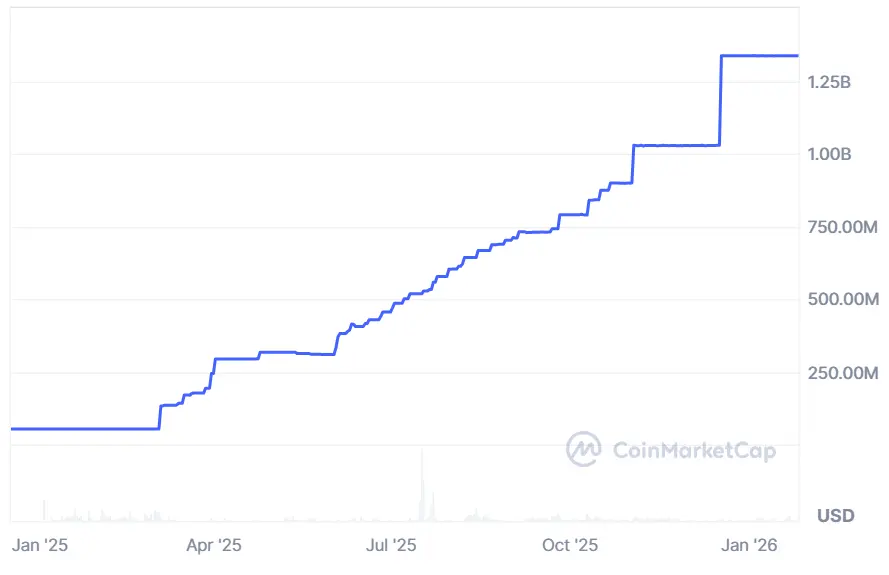
(Source: CMC)
In line with the opening of the Middle Eastern market, Ripple has expanded its operations in the UAE. The company has received regulatory approval for its Ripple USD (RLUSD) stablecoin, designed specifically for payments and settlement applications. The circulation of RLUSD has surpassed $1.3 billion, indicating strong market demand for Ripple’s stablecoin products.
RLUSD differs from other stablecoins on the market in its clear institutional focus. Unlike USDT and USDC, which primarily serve retail traders, RLUSD was designed from the outset for banks, payment providers, and corporate clients. Its compliance framework is more rigorous, including regular audits, transparent reserves disclosures, and proactive communication with regulators. This positioning makes it an ideal tool for TradFi institutions entering the blockchain space.
Riyadh Bank’s collaboration with Ripple is likely to incorporate RLUSD into real-world applications. In cross-border payments, RLUSD can serve as a stable pricing and settlement tool, avoiding volatility risks associated with traditional fiat currency exchanges. In custody services, banks can offer RLUSD deposits to clients, similar to traditional dollar deposits. In asset tokenization, RLUSD can be used as a payment method for purchasing tokenized assets.
Beyond stablecoins, tokenization activities on public blockchains worldwide are also growing rapidly. The tokenized assets on the XRP Ledger recently surpassed $1 billion, reflecting increasing institutional adoption of blockchain infrastructure. This growth is driven by tokenized US Treasury products, funds, and the expansion of RLUSD, which is now traded on major platforms including Binance.
The explosive growth of tokenized assets reveals the true potential of integrating TradFi with blockchain. Tokenizing traditional financial assets enables 24/7 trading, real-time settlement, fractional ownership, and global accessibility. For banks, this opens new business models—acting as issuers of tokenized assets, trading platforms, or custodians. If Riyadh Bank successfully pilots asset tokenization, it could set a benchmark for the entire Middle Eastern banking industry.


