Zcash, Monero, Dash demonstrate strength under macro pressure. U.S. shutdown concerns, Bank of Japan readiness to intervene, and the dollar record the largest decline in May. Historical data shows privacy coins outperform Bitcoin during risk-averse periods. ZEC forms a wedge near $345 support with an upward target of $661, DASH holds at $58 with a potential rise to $71, and XMR maintains $450 support aiming for $515-590.
Macro Pressure Boosts Privacy Coins as Safe-Haven Assets
Privacy coins such as Zcash (ZEC), Monero (XMR), and Dash (DASH) are attempting to rebound, while macroeconomic news shifts toward risk aversion. Over the weekend, concerns about a potential U.S. government shutdown increased market anxiety, as lawmakers remain divided over funding issues and federal operations disruptions. In the forex market, traders are closely watching Japan, amid speculation that the New York Federal Reserve might support direct intervention in the yen exchange rate. Meanwhile, the dollar experienced its largest weekly decline since May.
This combination typically tightens risk appetite for stocks and cryptocurrencies. However, when market sentiment shifts from “chasing beta” to “hedging positions,” privacy coins may perform differently. Last year, Zcash experienced such a scenario: Bitcoin declined while ZEC rose, viewed as a relative strength anomaly during uncertain risk appetite. This decoupling is not accidental but reflects the structural advantages of privacy coins in certain market environments.
Historically, privacy coins tend to outperform during periods of heightened risk aversion. This trait stems from their core function: protecting transaction privacy. When macroeconomic conditions worsen, government interventions increase, and regulatory uncertainties rise, demand for financial privacy naturally grows. Unlike traditional financial systems where all transactions are traceable and reviewable, privacy coins offer an alternative. Although this demand may be subtle during normal times, it can surge during crises.
The sharp decline of the dollar also creates a favorable environment for privacy coins. As the dollar weakens, global investors seek alternative stores of value. Bitcoin is an obvious choice, but privacy coins are more attractive to certain user groups due to their enhanced privacy features. Especially in regions with strict capital controls or political instability, privacy coins provide a tool to preserve wealth and privacy simultaneously.
While the threat of a U.S. government shutdown is a domestic political event, its impact is global. A shutdown means federal agencies halt operations, employees take unpaid leave, and public services are interrupted. This chaos can undermine confidence in the U.S. government’s debt repayment ability and policy continuity, prompting capital flows into alternative assets. Although privacy coins have a much smaller market cap than Bitcoin, in such an environment, they may attract funds seeking higher privacy protection.
ZEC Descending Wedge Builds Toward $661 Breakout
(Source: TradingView)
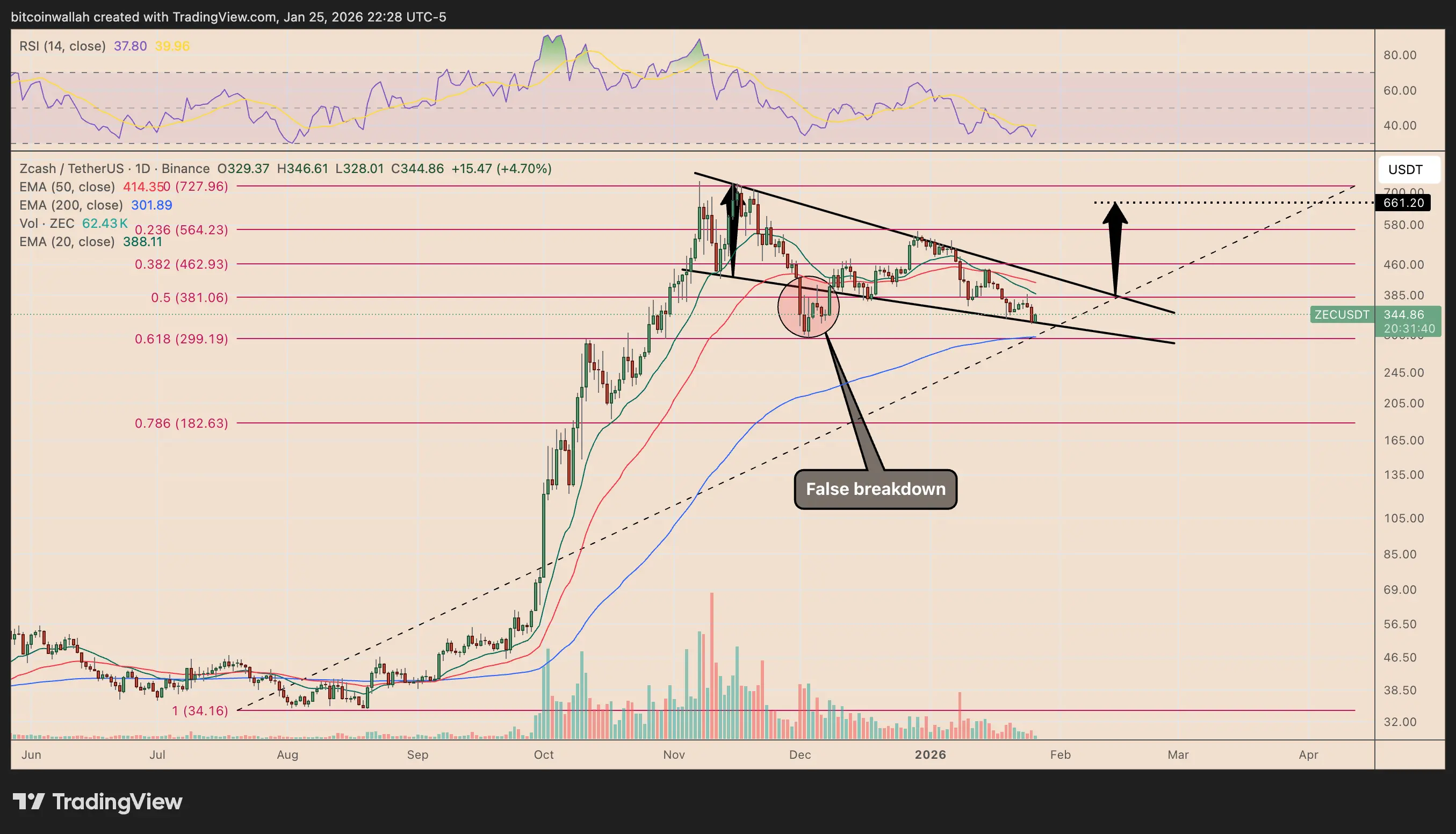
On the daily chart, ZEC/USDT is in a descending wedge pattern, currently near the lower boundary at about $345. This pattern is significant because wedges often indicate exhaustion of selling pressure: prices make new highs but bears struggle to accelerate the downtrend. A descending wedge is a bullish continuation pattern, typically appearing in an uptrend, representing a temporary correction rather than a trend reversal.
Previously, ZEC experienced a false breakout near the late 2025 lows, followed by a quick rebound—often a sign of a shakeout before a rally. A false breakout occurs when price briefly breaks support but quickly recovers, luring in short sellers, whose subsequent covering fuels a rapid upward move. RSI remains weak (around 30), but price is closer to support than resistance, improving risk-reward for a rebound.
If price reclaims the wedge’s upper trendline, initial targets are in the $381-$462 range, with a longer-term target of about $661. This target is derived from the measurement rule of the wedge: height of the wedge added to the breakout point. $661 offers approximately 91% upside from current levels, a realistic target within privacy coin volatility. If the wedge’s lower boundary is broken, downside targets include around $300 (0.618 Fibonacci retracement) and the 200-day moving average.
Key Levels for ZEC
Current Price: $345
Wedge Support: $345 lower boundary
Initial Target: $381-$462
Breakout Target: $661 (+91%)
Support if Breakdown: $300 (0.618 Fibonacci)
DASH at Confluence Support of $58 as Critical Defense Line
(Source: TradingView)
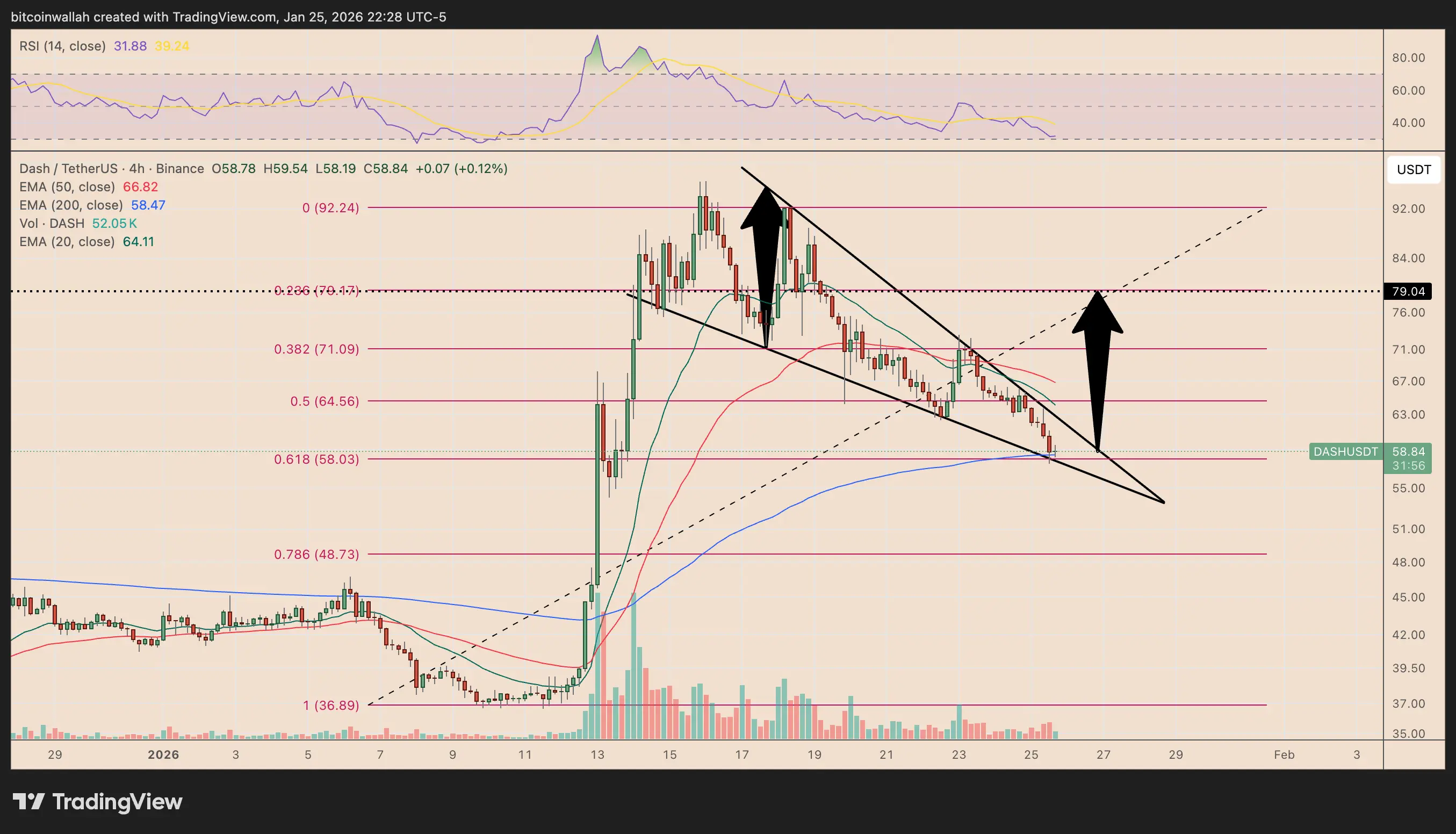
DASH/USDT on the 4-hour chart shows a similar descending wedge, with a notable convergence point below current price. DASH hovers around $58.8, just above the 0.618 Fibonacci retracement at about $58.0, and near the 200-day moving average at approximately $58.5. This zone acts as a first line of defense, where sellers may take profits and buyers start testing the lows.
Momentum remains strong: RSI around 30 indicates bearish dominance but also suggests a potential rebound if selling pressure eases. RSI in oversold territory (below 30) often signals exhaustion, and a bounce can occur once buying interest resumes. Bulls need to break out of the wedge and reclaim the 20/50-day moving averages. Resistance levels are around $64.5 (0.5 Fibonacci retracement) and $71 (0.382 Fibonacci).
A successful breakout above these resistances targets $79-$80, about 35% higher than current levels. If support at $58 fails, the wedge pattern invalidates, and DASH could further decline toward the next support zone near $50.
XMR After Surge, $450 as Critical Support/Death Line
(Source: TradingView)
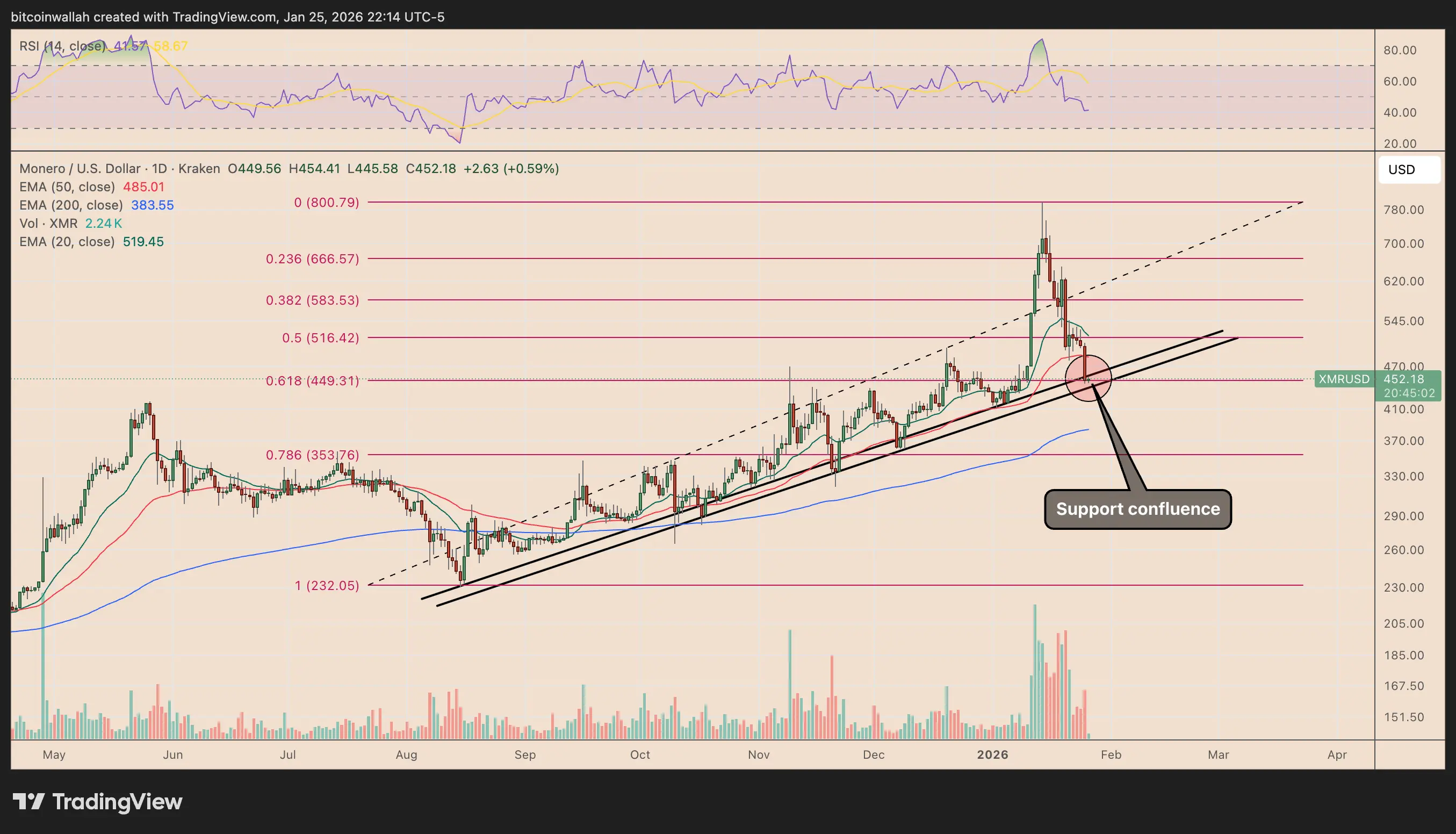
XMR/USD, after a nearly vertical surge, faces unstable liquidity and remains the most perplexing pair. The correction has reached a clear technical inflection point: around $450, at the 0.618 Fibonacci retracement level, reinforced by the lower boundary of the rising trendline. Thus, $450 is a key decision point.
If buyers hold this level, XMR could rebound toward $515-$590, where the 0.5/0.382 Fibonacci retracement levels and previous congestion zones converge. Conversely, if $450 support fails, price may drop toward the 200-day moving average near $385 and the 0.786 Fibonacci retracement around $350. XMR’s extreme behavior—vertical rise attracting speculative capital but also creating unstable structures—makes its current correction a test of whether the overextended move is healthy or signals trend reversal.
Summary of Key Levels for the Top 3 Privacy Coins
ZEC: Hold $345 for target of $661 (+91%), break below $300
DASH: Hold $58 for target of $79 (+35%), break below $50
XMR: Hold $450 for target of $515-590 (+15-31%), break below $385
Disclaimer: The information on this page may come from third parties and does not represent the views or opinions of Gate. The content displayed on this page is for reference only and does not constitute any financial, investment, or legal advice. Gate does not guarantee the accuracy or completeness of the information and shall not be liable for any losses arising from the use of this information. Virtual asset investments carry high risks and are subject to significant price volatility. You may lose all of your invested principal. Please fully understand the relevant risks and make prudent decisions based on your own financial situation and risk tolerance. For details, please refer to
Disclaimer.


