
Wikipedia announces data licensing agreements with AI giants like Google, Meta, and others to address traffic decline and support non-profit operations. This move marks a shift in the content industry from confrontation to coexistence with generative AI.
Wikipedia licenses data from AI giants to solve traffic decline concerns
The world’s largest online encyclopedia, Wikipedia, celebrated its 25th anniversary on January 15, 2026, and announced agreements with multiple AI giants to license content for training large language models (LLMs).
Current partners include Microsoft, Google, Amazon, Meta, as well as emerging AI companies like Mistral AI and Perplexity, but it is not mentioned whether Elon Musk’s Grok is involved.
In the future, AI companies will obtain human knowledge bases from Wikipedia on a large scale and in compliance with regulations, while also generating revenue for Wikipedia to support its non-profit operations.
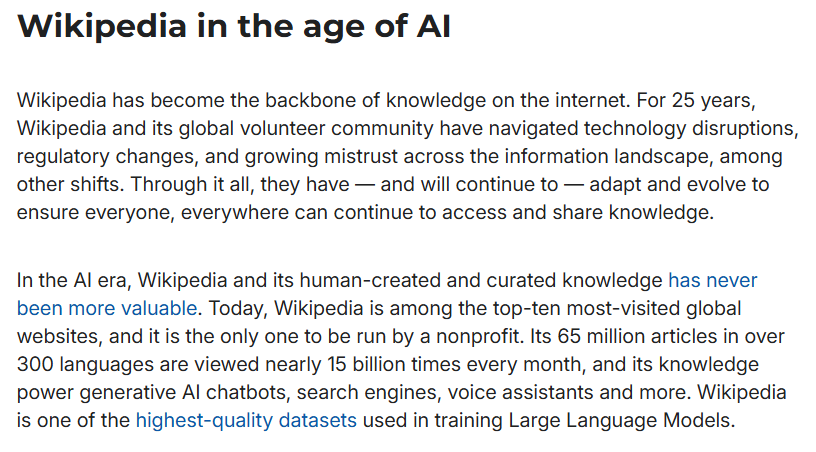
Image source: Wikipedia press release Wikipedia licenses data from AI giants to solve traffic decline concerns
Previously, the Wikimedia Foundation admitted that as users gradually get used to reading AI-generated summaries instead of clicking on original links, Wikipedia’s traffic patterns are changing.
Data from October 2025 shows that human visits to Wikipedia decreased by 8% compared to the same period the previous year. In Google search results, nearly 60% of queries are answered directly on the page, reducing the need for users to click into the website, which forces Wikipedia to seek new sustainable development models.
From confrontation to commercial coexistence, Wikipedia once criticized Grokipedia
Before establishing a coexistence strategy with AI, Wikipedia’s founder clashed with Elon Musk’s AI encyclopedia “Grokipedia.”
Elon Musk repeatedly criticized Wikipedia for having a left-wing bias and even mocked that if Wikipedia changed its name, he would donate 1 billion USD. However, after Grokipedia launched, content controversies were quickly discovered, such as obvious factual errors in the articles about African American George Floyd and Elon Musk himself.
In response, Wikipedia founder Jimmy Wales publicly stated that he expects many errors to appear in Grokipedia because AI models are not yet mature.
Now, licensing content to AI companies is aimed at encouraging AI developers to include source citations and provide funding, maintaining a healthy cycle between human contributors and AI technology.

Image source: Wikimedia Commons, photographed by Zachary McCune Wikipedia founder Jimmy Wales
Generative AI impacts the content industry, sparking copyright battles
While Wikipedia chooses licensing cooperation to mitigate AI impacts, other content industries are still resorting to legal actions.
Major US publishers Hachette Book Group and Cengage Group have filed class-action lawsuits against Google, accusing Gemini of training on copyrighted books without authorization.
Disney has also issued cease-and-desist notices to Google over copyright issues and teamed up with several major film studios to sue image generation company Midjourney. However, Disney has also reached an equity agreement with ChatGPT developers, licensing their copyrighted materials for training and generation.
Compared to lawsuits in the publishing and film industries, the paid licensing model reached between Wikipedia and tech giants is another solution to copyright issues between content owners and AI companies. Recently, Universal and Warner Music also settled copyright disputes with AI music platform Udio, which will launch an authorized AI music platform sharing revenue with artists and songwriters.
Further reading:
Really unbearable! Copyright associations representing 36 companies including Ghibli have sent letters to OpenAI requesting no infringement
Disclaimer: The information on this page may come from third parties and does not represent the views or opinions of Gate. The content displayed on this page is for reference only and does not constitute any financial, investment, or legal advice. Gate does not guarantee the accuracy or completeness of the information and shall not be liable for any losses arising from the use of this information. Virtual asset investments carry high risks and are subject to significant price volatility. You may lose all of your invested principal. Please fully understand the relevant risks and make prudent decisions based on your own financial situation and risk tolerance. For details, please refer to
Disclaimer.


