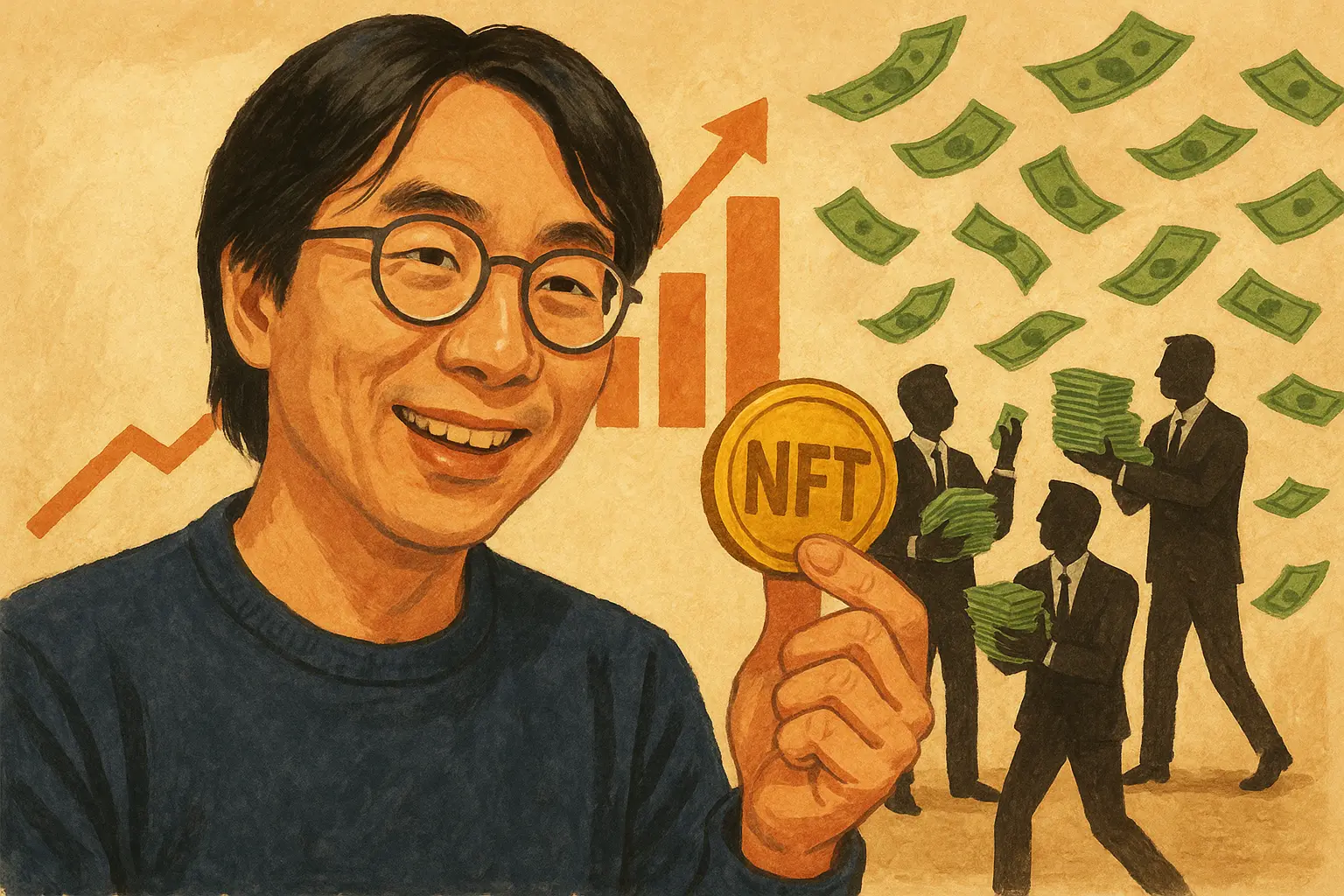
Animoca founder Yat Siu states that NFTs have not disappeared. Monthly sales dropped from $1 billion to $300 million, but five years ago, they were zero. His personal investment portfolio has fallen 80% but he still does not sell, emphasizing that these are long-term assets. Wealthy collectors buy NFTs like collecting Picasso, forming exclusive communities. NFT Paris was canceled due to changing attitudes in France and security concerns.
NFT Monthly Sales Drop to $300 Million but Market Still Exists
The once booming non-fungible token (NFT) market seems to have entered a lull, with token valuations only a fraction of their 2021/22 peaks, not to mention the flagship event in France, NFT Paris, being canceled a month before opening. Yat Siu, co-founder of Animoca Brands, says that although the market is currently subdued, it has certainly not vanished. Animoca Brands is a Web3 development and venture capital firm that has ventured into tokenization of real-world assets.
NFTs are a class of unique tokens that first appeared on the Ethereum blockchain in late 2017, initially as collectible cat images. Like other crypto trends, NFT development has experienced ups and downs, starting with CryptoKitties, then rebounding with more development and funding, reaching a peak in 2021/22 with monthly sales exceeding $1 billion.
In an interview at the CfC St. Moritz Crypto Conference, Siu said wealthy collectors are driving the NFT market’s boom. Some investors develop interest in certain types of digital art, similar to how family office heirs might collect Picasso works. Siu pointed out that today, NFT monthly sales are close to $300 million, mainly driven by wealthy digital art enthusiasts.
“Don’t forget, five years ago, this was a zero-dollar market,” Siu said. “So everything is relative, depending on your perspective. Of course, the beauty is that all data can be seen on the blockchain.” The trajectory from zero to $300 million in monthly sales itself proves the vitality of NFTs as an emerging asset class. Although down 70% from the peak, $300 million in monthly sales still represents a significant market size.
Evolution of the NFT Market Size
End of 2017: CryptoKitties launched, market size near zero
Peak in 2021/22: Monthly sales over $1 billion
Current in 2025/26: Monthly sales around $300 million (down 70%)
Market shift: From speculative frenzy to collector-led
Long-term Holding Logic of Wealthy Collectors
“Are NFTs still popular among wealthy collectors? Of course. I am also a seasoned collector, and I share similar views with my peers in this field. It’s a community,” Siu said. “For example, Picasso collectors feel a kinship with other Picasso collectors; you are part of this circle. The same goes for Ferrari, Lamborghini, or Rolex watches. It’s just the digital version.”
This collector mentality is fundamentally different from that of speculators. Speculators buy NFTs for short-term profit and panic-sell when prices start to decline. Collectors buy NFTs for ownership and appreciation, and price fluctuations do not shake their commitment to hold. This long-term holding behavior provides a stable demand base for the NFT market.
Siu pointed out that wealthy collectors buy NFTs not only for the assets themselves but also to join exclusive communities. When you own a blue-chip NFT project (like Bored Apes or CryptoPunks), you automatically become part of that community, able to attend exclusive events, interact with other collectors, and even gain business opportunities. This social value is a unique advantage of NFTs compared to traditional art.
For example, billionaire Adam Weitsman publicly purchased NFTs like Otherdeed Lands (representing land deeds in Yuga Labs’ blockchain-based 3D virtual world Otherside) and Bored Apes. Such public purchases are a social declaration, showing membership in the circle. For the wealthy, multi-million dollar NFT purchases are not just investments but also symbols of status and social tools.
Yat Siu’s Personal Portfolio Down 80% but Still Not Selling
Siu said his personal NFT investment portfolio has “fallen about 80%,” but he added that these NFTs were never intended to be sold quickly. “They are important long-term assets.” This stance is highly illustrative for the market. As a co-founder of Animoca Brands, Siu is one of the most influential figures in the crypto and NFT space.
His frank admission that his portfolio has dropped 80% reveals the harsh reality of the NFT market. Even insiders with the best information and resources cannot avoid the impact of a bear market. However, his choice not to sell and to emphasize these as long-term assets provides confidence to other holders.
Animoca Brands is also an avid NFT collector. Siu said some NFT holders buy for ownership, not for resale. This “buy to own” mentality is a core feature of the collectibles market. Whether traditional art, luxury watches, or luxury cars, true collectors buy these items for long-term holding and appreciation, not short-term profit.
This mindset is especially important during the NFT bear market. When the market is filled with panic and sell-offs, these long-term holders provide liquidity bottoms. They will not rush to sell just because prices fall, preventing a bottomless collapse. In the long run, these steadfast holders will be the beneficiaries of the next bull run.
NFT Paris Cancellation Reflects France’s Changing Attitudes and Security Concerns
Regarding the flagship NFT Paris event, Siu said the cancellation was not a criticism of NFTs or the well-organized conference itself. “I think it’s a protest against France; France used to be very supportive of cryptocurrencies,” Siu said. “But France has completely distanced itself from crypto. As for NFTs, platforms like Sorare, a fantasy football game, are under scrutiny by gambling regulators. Moreover, we see similar anti-crypto stances in other parts of Europe.”
Siu said another key issue in Paris is security. Over the past year, France has seen a series of kidnapping and attempted kidnapping incidents targeting crypto executives and investors. “The failure of NFT Paris is not just because they couldn’t find sponsors. Many of us, including myself, are avoiding Paris due to security concerns,” Siu said. These security worries are increasingly serious in the crypto industry, as blockchain transparency makes wealthy holders more identifiable and vulnerable.
France’s attitude shift reflects a broader tightening of European regulatory environment. Frameworks like MiCA provide compliance pathways but also increase costs and restrictions. For innovative and boundary-blurring assets like NFTs, regulatory uncertainty is especially prominent. The scrutiny of Sorare by gambling regulators is a typical example, showing that regulators still debate how to classify NFTs.
Disclaimer: The information on this page may come from third parties and does not represent the views or opinions of Gate. The content displayed on this page is for reference only and does not constitute any financial, investment, or legal advice. Gate does not guarantee the accuracy or completeness of the information and shall not be liable for any losses arising from the use of this information. Virtual asset investments carry high risks and are subject to significant price volatility. You may lose all of your invested principal. Please fully understand the relevant risks and make prudent decisions based on your own financial situation and risk tolerance. For details, please refer to
Disclaimer.
Related Articles
ETH drops 0.63% in 15 minutes: whale sell-offs and large net inflows to exchanges trigger selling pressure
2026-04-09 22:45 to 2026-04-09 23:00 (UTC), ETH saw a clear price swing. During this period, the 15-minute candlestick’s return rate recorded -0.63%. The quoted price ranged from 2197.61 to 2215.0 USDT, with a swing of 0.79%. Although this move did not reach extreme levels, as a mainstream, highly liquid asset, the change in the return rate over a short time has already drawn market attention—trading activity increased and volatility became noticeably more intense.
The main driving force behind this deviation is that on-chain top-position holders (whale addresses) continuously reduced their holdings in small increments, and ET
GateNews54m ago
ETH 15-minute drop of 0.69%: Price pressure from declining burn volume and short-term capital arbitrage
2026-04-09 18:00 to 2026-04-09 18:15 (UTC), ETH closed down 0.69% within a 0.88% intraday trading range, with the price fluctuating between 2203.91 and 2223.58 USDT. Trading volume in this range rose slightly, market attention stayed high, but short-term volatility increased, prompting investor caution.
The main drivers behind this unusual move are that ETH on-chain Gas fees have fallen to historical lows, causing the EIP-1559 burn amount to decline. As a result, the net-supply contraction effect weakened, and the supply-demand structure faced adjustment pressure in the short term. Meanwhile,
GateNews5h ago
ETH 15-minute pump of 0.71%: spot marginal buy pressure amplifies liquidity, pushing the short-term move higher
2026-04-09 17:00 to 2026-04-09 17:15 (UTC), the ETH price fluctuated in the range of 2207.09 to 2224.42 USDT, recording a positive return of +0.71%, with an amplitude of 0.78%. The short-term price increase attracted market attention. Although overall sentiment remains relatively cautious, volatility in the spot market has increased.
The main driving force behind this move was that the spot market saw marginal active buy orders amid a backdrop of tighter derivatives conditions and an overall contraction in liquidity. As ETH perpetual contract open interest and trading volume both saw a clear decline (within 24 hours, it c
GateNews6h ago
ETH 15-minute pump 1.31%: On-chain capital inflows and whale buying power are in sync, driving the rally
2026-04-09 15:30 to 2026-04-09 15:45 (UTC), the ETH price closed at 2219.86 USDT, with a range low of 2181.68 USDT. The 15-minute return was +1.31%, and the amplitude was 1.75%. During this period, market trading activity was active, attention increased significantly, and short-term volatility intensified.
The main drivers of this unusual move are on-chain capital inflows and persistent buying by large whales. First, on-chain trading volume suddenly surged during the window above; the frequency of large transfers increased, indicating that institutions or major players entered quickly. At the same time, active addresses
GateNews8h ago
Bitcoin ETF Sees $159.62M Single-Day Outflow While Ethereum and Solana ETFs Continue Negative Trend
Gate News message, according to April 9 data, Bitcoin ETFs recorded a single-day net outflow of 2,242 BTC (valued at $159.62M), while showing a 7-day net inflow of 2,723 BTC ($193.89M). Ethereum ETFs experienced a single-day net outflow of 23,158 ETH ($50.48M), with 7-day net outflows reaching 22,90
GateNews8h ago


