Author: Michel Athayde
Warning: This is a wake-up call “report”
Have you ever had this illusion:
- “4 hours is too slow, I want to do 5-minute short-term trading, 1% daily compounding, and become the world’s richest person in a year.”
- “Spot trading is too slow, I leverage 3x, 5x, as long as the direction is correct, the profits are several times others.”
To verify these “get-rich-quick fantasies,” we not only backtested the 4-hour timeframe but also analyzed all the 15m (15m), 30m (30m), 1H (1H) data to “expose” them;
We examined not only spot trading but also simulated the real outcomes of 200% (2x), 300% (3x), 500% (5x) leverage positions under extreme market conditions.
The conclusion is extremely harsh: If you don’t use leverage, after 5 years of reckless trading, 90% of people can’t even beat “dumb dollar-cost averaging.”
Baseline data: the “passing line” you must beat
Before evaluating any strategy, we must first see how much “lying flat” can earn. Based on the past 5 years of spot data:
- BTC spot only: +48.86%
- ETH spot only: +53.00%
( Note: This means if you bought and unloaded the APP 5 years ago, you now have about 50% profit. This is the “passing line” that strategies must beat. )
MACD strategy data summary
I backtested the performance of MACD over the past 5 years across different cycles and leverage levels for BTC/ETH:
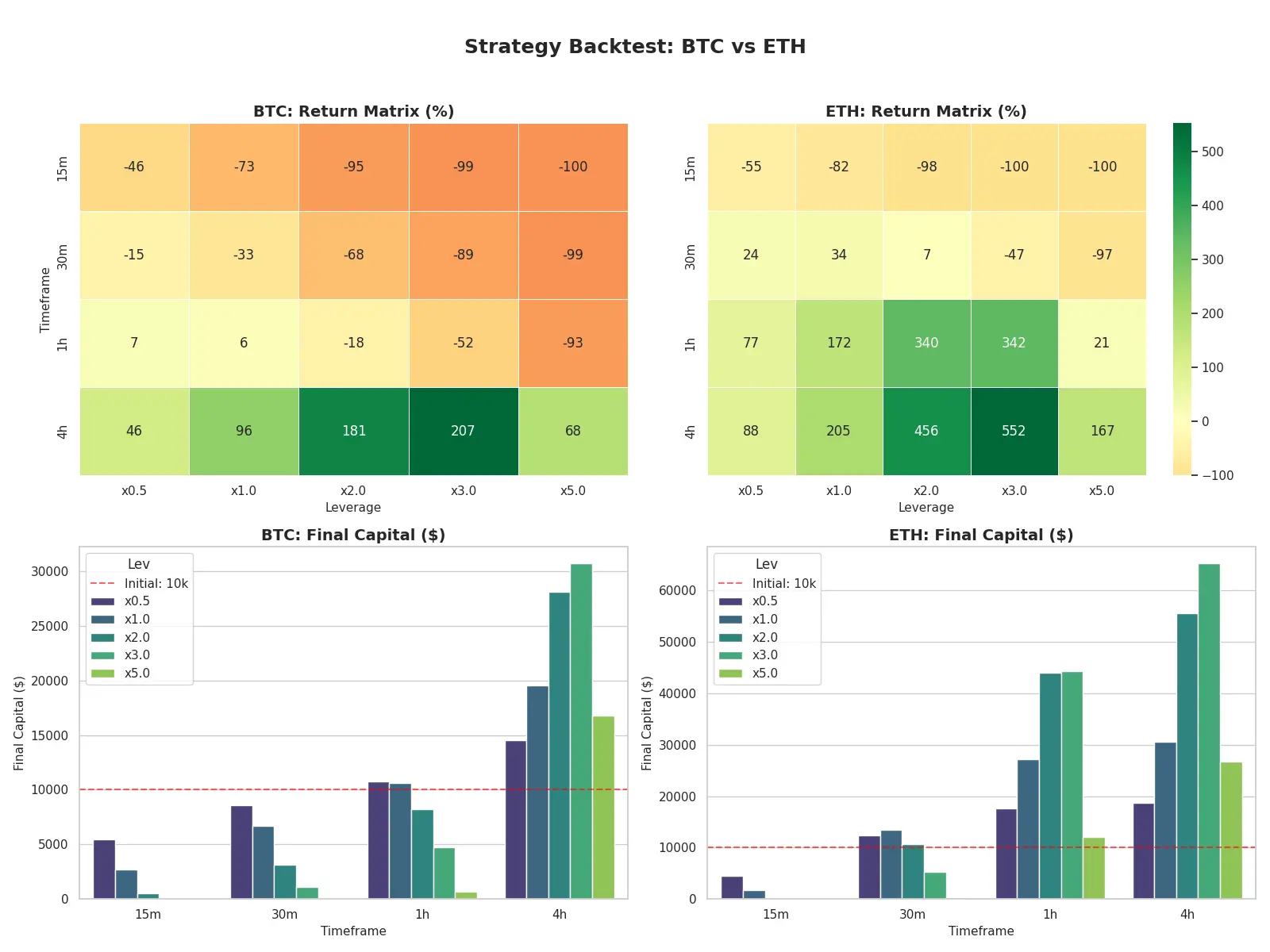
| Chart Label | Meaning |
| Strategy Backtest | Strategy Backtest Analysis |
| Return Matrix (%) | Heatmap of Returns (The redder, the more loss; the greener, the more profit) |
| Final Capital ($) | Final Capital (Initial principal of 10,000 U) |
| Timeframe (TF) | Time Cycle (15m, 30m, 1h, 4h) |
| Leverage (Lev) | Leverage Multiple (x0.5, x1.0, x2.0, x3.0, x5.0) |
| Initial: 10k | Initial Principal (Red dashed line baseline) |
-
Top-left & Top-right (Heatmap - Return Rate):
- Danger Zone (Red/Dark Orange): Concentrated on short cycles like 15m and 30m. Especially with high leverage (x3.0, x5.0), capital nearly wiped out (-99%, -100%).
- Golden Zone (Deep Green): Focused on the 4h cycle. ETH performs particularly well in the 4h cycle, almost all blocks are green.
-
Bottom-left & Bottom-right (Bar Chart - Final Capital):
- Red dashed line (10k): This is the breakeven line. Bars below the red line indicate losses, above indicate profits.
- BTC vs ETH: Pay attention to the ETH 4h bars in the bottom right. When using x2.0 or x3.0 leverage, the capital bars are extremely tall, far surpassing BTC’s performance, confirming that ETH’s volatility in trending markets yields higher excess returns.
( 1. The painful lesson: 90% of short-term operations are “negatively optimized”
Data reveals a cruel fact: on medium and small cycles (15m, 30m, 1h), MACD strategies not only fail to generate excess returns (Alpha), but also, due to overtrading and wear, significantly lag behind “dumb dollar-cost averaging.”
)# 1. BTC 1-hour cycle “reckless busywork”
- Strategy performance: BTC 1h x1.0 yields +6%.
- Baseline performance: BTC spot holding yields +48.86%.
- Deep analysis:
At the 1-hour level, you have diligently monitored the market for 5 years, traded thousands of times with MACD golden/death crosses, paid huge exchange fees, and finally earned only 6%. Meanwhile, doing nothing could have earned you 49%.
Conclusion: Running MACD on the 1H cycle essentially destroys value. Your frantic operations turn from profit to loss (relative opportunity cost).
(# 2. The complete failure of short-term trading (15m / 30m)
-
All strategies: all lost money or got liquidated.
-
Compared to baseline: +50% positive return from buy-and-hold, short-term strategies are a -100% destructive blow.
-
Analysis of causes:
- Noise: Fluctuations at the 15m level are mostly meaningless random walks.
- Fee wear: Frequent opening and closing incurs fees and slippage, eating up principal like termites.
- Psychological breakdown: High-frequency stop-loss leads to distorted operations.
) 2. The only way to surpass: 4-hour cycle “excess returns”
Only when the cycle extends to 4 hours does MACD strategy show the ability to beat “buy-and-hold.” This is the only meaningful purpose of quantitative trading.
1. BTC 4h: a risky victory
- MACD x1.0 ###spot###: returns about +96%.
- Buy-and-hold baseline: +48.86%.
- Winning logic:
MACD at the 4H level successfully helped BTC avoid the deep bear main decline wave (e.g., the 2022 crash). Although it missed some gains in the bull market, the advantage of avoiding risk by holding cash allowed it to ultimately outperform.
2. ETH 4h: absolute crushing
- MACD x1.0 ###spot(: returns about +205%.
- Buy-and-hold baseline: +53.00%.
- MACD x3.0 )best leverage###: returns +552%.
- Winning logic:
ETH has a very strong trend. Buy-and-holders enjoyed the rise but also endured a -80% retracement. MACD in a bear market kept profits safe by staying in cash, then compounded in the next bull cycle. The 4x return (205% vs 53%) proves the huge value of timing on ETH.
( 3. The real meaning of leverage: amplifying “win rate” or “gambling” risk?
Combining baseline data, we can redefine the role of leverage.
)# 1. x2.0 - x3.0: secrets of the golden zone
- BTC 4h x3.0 (+207%) vs BTC buy-and-hold ###+48.86%###:
With 3x leverage, the strategy amplifies returns fourfold. This is a healthy leverage ratio, indicating the strategy captures genuine trends, and leverage acts as a “tailwind.”
- ETH 4h x3.0 (+552%) vs ETH buy-and-hold (+53.00%):
Returns are amplified tenfold! This is the peak performance of quantitative trading—leveraging high volatility assets with reasonable leverage and correct cycles achieves leapfrog gains.
(# 2. x5.0: inverted yield
Note! Although it outperforms buy-and-hold (+53%), it far underperforms the low-leverage strategy (+552%).
- Warning: When you leverage 5x, you’re essentially working for the exchange (paying high funding fees) and giving money to the market (high volatility wear). You bear the risk of liquidation to zero but only get mediocre returns.
) 4. Your “Death Matrix” report ###The Death Matrix(
To discourage you, we list the final outcomes under different configurations.
| Asset | Cycle | Leverage | Status | Final Return | Outcome Evaluation |
| BTC | 15m | x5.0 | 💥 Liquidation | -100% | Absolutely doomed. Pure gambling, fees can wipe you out. |
| BTC | 15m | x1.0 | | -73% | Chronic suicide. Better to save in bank. |
| BTC | 1h | x1.0 | | +6% | Reckless busywork. Outperformed by buy-and-hold (+49%), wasted 5 years. |
| BTC | 4h | x1.0 | ✅ | +96% | Excellent. Outperformed buy-and-hold by double, steady mindset. |
| BTC |
4h |
x3.0 |
✅ |
+207% |
Outstanding. Maximize gains, risk controllable. |
| ETH |
15m |
x5.0 |
💥 Liquidation |
-100% |
Absolutely doomed. Victim of noise trading. |
| ETH |
1h |
x1.0 |
✅ |
+172% |
Still okay. ETH volatility allows some short-term gains, but tiring. |
| ETH |
4h |
x1.0 |
✅ |
+205% |
Excellent. 4x buy-and-hold, no late nights needed. |
| ETH |
4h |
x3.0 |
✅ |
+552% |
King. The holy grail zone of quant trading. |
| ETH |
4h |
x5.0 |
✅ |
+167% |
Lame. Increased risk, returns decrease (funding fees + wear). |
) 5. Final decision guide: what should you do?
Based on the buy-and-hold +50% baseline, here are the final strategy recommendations:
-
If you don’t want to bother / lack time / poor mental state:
- Strategy: Pure buy-and-hold ###Buy & Hold( or MACD 4h x1.0 )spot###.
- Expected: ~50% - 100% returns.
- Cost: Endure asset drawdowns, but this beats losing money with reckless operations a thousand times.
-
If you want to beat the market (BTC):
- Strategy: MACD 4h (x1.5 - x2.0).
- Expected: ~150% - 200% returns.
- Key: Strict stop-loss, only trade on 4H cycles, never look at 15m.
-
If you pursue excess returns (ETH):
- Strategy: MACD 4h (x2.0 - x3.0).
- Expected: ~400% - 550% returns.
- Key: This is the best sweet spot. Use ETH’s high volatility + moderate leverage. Never exceed 3x.
-
If you are a gambler / short-term trader:
- Strategy: MACD 15m/1h + x5.0 or higher.
- Expected: -100% (zero).
- Warning: Data proves this can’t beat buy-and-hold, and is even worse than donating your money.
( Core conclusion
“Since spot buy-and-hold yields only about 50% over 5 years, this actually proves the value of excellent quantitative strategies.”
However, this value is only valid at the 4-hour level.
At cycles below 1 hour, all your efforts are counterproductive; better to lie flat.
Only standing at the golden crossover point of 4H + 3x leverage can you truly mock those “dead holding” people.
) This data is based on historical backtesting and does not guarantee future returns. Market risks exist, leverage should be used cautiously. (


