Venture capitalist Chamath Palihapitiya believes a new cryptographic paradigm will emerge to overcome the privacy limitations inherent to bitcoin and gold. He emphasized that this is needed to create assets that are “not easily disclosed.”
Chamath Palihapitiya Raises the Problem of Bitcoin’s Lack of Privacy
The issue of bitcoin’s lack of privacy has been raised as a key concern that may affect its adoption as a central bank digital currency by state nations.
In the latest episode of the “All-In Podcast,” venture capitalist Chamath Palihapitiya presented his contrarian take for 2026, stating that central banks will realize both gold and bitcoin have limitations, and will seek out a “completely new cryptographic paradigm.”
This new paradigm will be controlled by the central bank’s balance sheet and will be “fungible, tradable, and completely secure and private.”
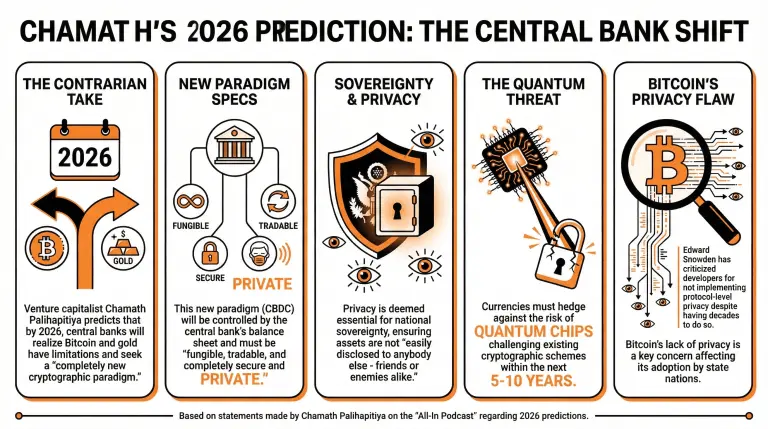
Explaining the motivations for this shift, he declared:
I think the reason why that privacy needs to exist is that, for the sovereignty of a country, you need to be in a position where you have assets that are not easily disclosed to anybody else – friends or enemies alike.
In addition, he also explained that quantum superiority posed risks to Bitcoin, stating that this new paradigm would have to be ready to face this upcoming threat. “If you’re going to own a currency, you need to hedge against the eventual risk in the next five to ten years that there’s a quantum chip that can challenge the existing cryptographic schemes that are used,” he concluded.
The issue of privacy -or lack thereof- in Bitcoin has been raised many times before. NSA whistleblower Edward Snowden has been calling for a robust implementation of privacy at a protocol level, criticizing that developers had years to implement this feature without advancements.
“This is the final warning. The clock is ticking,” said Snowden in 2024, warning that bitcoin transactions could be easily traced back to individuals and institutions with today’s technology.
Read more: Snowden Issues ‘Final Warning’ to Bitcoin Developers on Privacy Enhancements
FAQ
- What concerns about Bitcoin are affecting its potential adoption as a central bank digital currency?
The lack of privacy in Bitcoin transactions has raised concerns that may hinder its acceptance by state nations.
- What does venture capitalist Chamath Palihapitiya suggest for the future of currency?
Palihapitiya argues that central banks will seek a new cryptographic paradigm that is fungible, tradable, and ensures privacy and security.
- Why does Palihapitiya emphasize the need for privacy in a currency?
He claims that for a country’s sovereignty, there must be assets that cannot be easily disclosed to anyone, including friends and adversaries.
- What warning did Edward Snowden give regarding Bitcoin’s privacy?
Snowden cautioned that without robust implementation of privacy features, Bitcoin transactions could be traced back to individuals, stating it was “the final warning” as technology advances.
Disclaimer: The information on this page may come from third parties and does not represent the views or opinions of Gate. The content displayed on this page is for reference only and does not constitute any financial, investment, or legal advice. Gate does not guarantee the accuracy or completeness of the information and shall not be liable for any losses arising from the use of this information. Virtual asset investments carry high risks and are subject to significant price volatility. You may lose all of your invested principal. Please fully understand the relevant risks and make prudent decisions based on your own financial situation and risk tolerance. For details, please refer to
Disclaimer.
Related Articles
BTC 15-minute drop of 0.58%: Large on-chain withdrawals and bearish derivatives sentiment coincide to weigh on the price
From 2026-04-12 22:00 to 22:15 (UTC), the BTC price fluctuated between 70693.8 and 71371.8 USDT. During this period, the candlestick return rate recorded -0.58%, and the amplitude reached 0.95%. The short-term downside caused market attention to rise rapidly, and some investors accelerated adjustments to their hedging positions.
The main drivers behind this change were concentrated on-chain large-fund outflows and a short-term defensive shift in the derivatives market. On-chain data shows that net outflow transactions of large funds $100k and above totaled more than 800 BTC in aggregate from exchanges; meanwhile, the exchanges’ overall BTC holdings
GateNews55m ago
The New York Times reignites the “Satoshi identity mystery”; after Adam Back was targeted, he quickly clarified
Author: Nancy, PANews
Satoshi Nakamoto’s real identity remains the mystery that has continued for 17 years in the crypto world. Guesses surrounding this pseudonym have never stopped—candidates ranging from cryptographers to company founders have come and gone, yet there has always been a lack of decisive evidence.
Recently, The New York Times published a 10,000-plus-word investigation. Based on multiple comparisons drawn from language style, technical paths, and historical context, it ranked Blockstream CEO Adam Back as the strongest candidate for Satoshi Nakamoto. However, this claim was quickly and explicitly denied by Back himself, and the relevant arguments were widely questioned by the industry as difficult to substantiate.
Satoshi Nakamoto identity controversy flares up again; the 10,000-plus-word investigation targets Adam Back
In this investigation, New York Times reporter John Carreyrou spent more than a year deeply sorting through decades of archives and the cypherpunk email mailing lists to
区块客3h ago


