
U.S. Representative Davidson Warns that the “GENIUS Act” Is Incorporating Crypto Assets into Account-Based Surveillance Systems, Undermining Self-Custody and Decentralization, Potentially Paving the Way for CBDC and Digital Identity.
Davidson Warns That Regulatory Focus Is Off-Target, and the U.S. Is Slipping Toward a “Permitted Money System”
U.S. Congressman Warren Davidson recently issued a strong warning about the direction of U.S. cryptocurrency regulation, directly stating that current legislation is gradually diverging from the core values that gave rise to crypto assets. In a post on New Year’s information and social platforms, he pointed out that America is heading toward a financial system “requiring government permission and full surveillance,” with crypto legislation being a key driver of this trajectory.
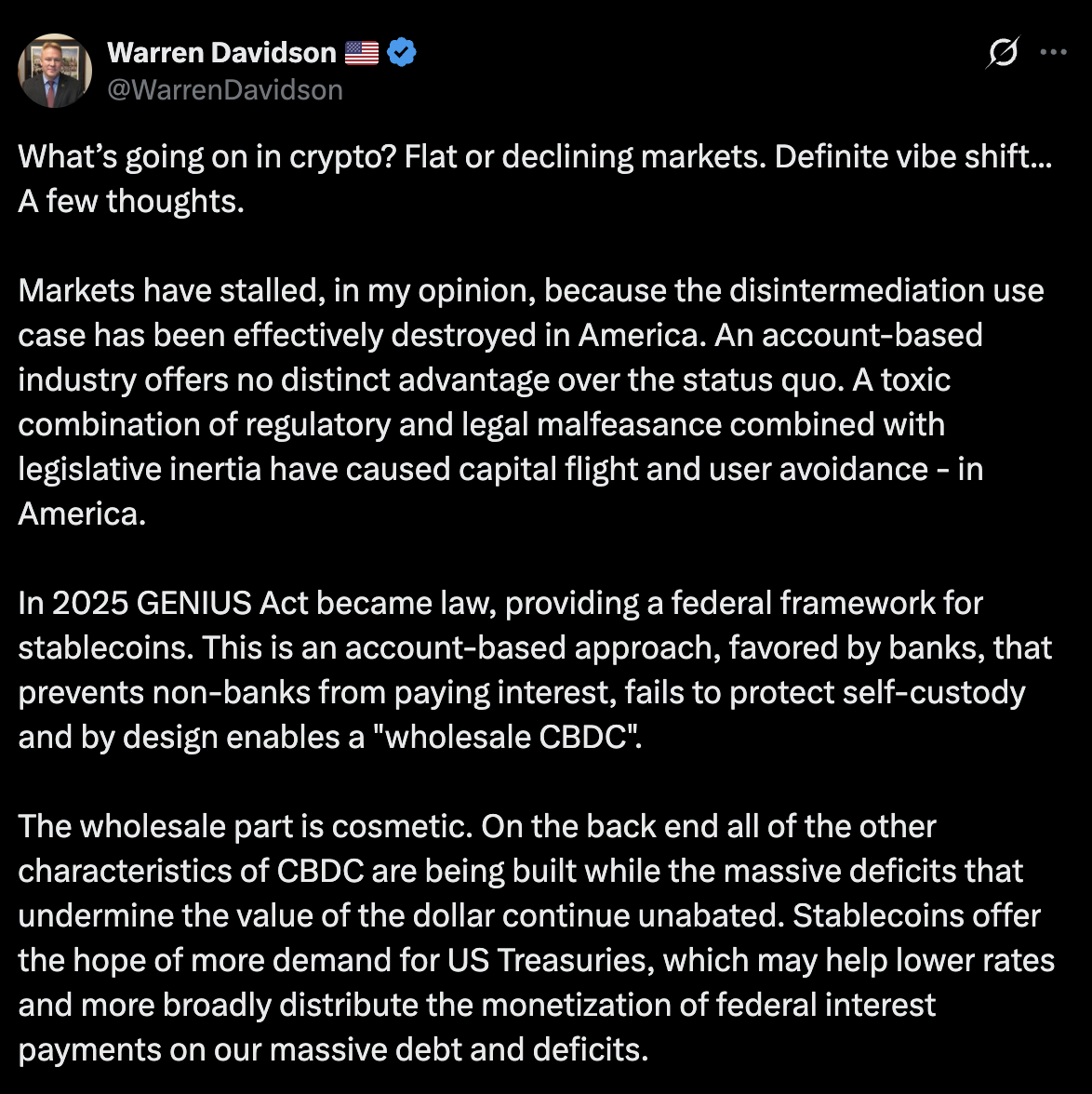
Image Source: X/@WarrenDavidson U.S. Congressman Warren Davidson recently issued a strong warning about the direction of U.S. cryptocurrency regulation, directly stating that current legislation is gradually diverging from the core values that gave rise to crypto assets.
Davidson believes that the market’s stagnation is not due to technological stagnation or lack of demand, but because “decentralized usage scenarios are being systematically dismantled in the U.S.” He bluntly states that legislative bodies are choosing to deny the structural changes originally brought by digital assets like Bitcoin ($BTC), instead trying to incorporate them into traditional account-based financial frameworks, which will ultimately weaken innovation and personal freedom.
GENIUS Act Named, Stablecoin Framework Criticized as “De Facto CBDC”
Davidson criticizes the already enacted “GENIUS Act” first. He points out that the law appears to establish a regulatory foundation for stablecoins on the surface, but in reality, it creates a system architecture with “central bank digital currency (CBDC) features in the backend.”
In Davidson’s view, the “GENIUS Act,” with its account-centric design, not only favors the existing banking system but also paves the way for future wholesale CBDC development.
He warns that once combined with digital identity verification, this system will enable the government to monitor, restrict, or even intervene in individual funds. He emphasizes that this runs counter to the principles of Bitcoin, which stand for “permissionless, peer-to-peer payments.”
Davidson also mentions that as massive deficits continue to erode the dollar’s value, the government is simultaneously building highly controllable digital currency infrastructure, which is concerning. He reminds the public, “Don’t be fooled by appearances,” as the real issue lies not in the names but in the power structures behind the system design.
The “CLARITY Act” Outlook Is Conservative, Self-Custody May Only Receive Symbolic Protection
Compared to the “GENIUS Act,” which is still under Senate review, the “CLARITY Act” is seen by some legislators as a remedial measure. Davidson also admits that the law attempts to patch the flaws of the “GENIUS Act,” such as including provisions to protect self-custody. However, he is not optimistic about the final outcome.
Davidson bluntly states that as long as the “GENIUS Act” becomes law, even if the “CLARITY Act” passes, improvements to personal freedom will likely be “cosmetic fixes.” He expects that account-based financial systems will remain the policy focus, while truly decentralized, trustless forms of money will continue to be marginalized.
Lawmakers with similar views to Davidson are not few. Republican Congressman Marjorie Taylor Greene also publicly opposes the “GENIUS Act,” directly criticizing it for handing power back to banks and opening a backdoor for CBDC. She emphasizes that the real risks come from digital identity, central bank digital currencies, and the erosion of self-custody.
Bitcoin’s Original Promise Revisited, Self-Custody Becomes a Regulatory Divide
In multiple speeches, Davidson repeatedly emphasizes that Bitcoin’s original purpose was not as a “liquidity-starved inflation hedge,” but as a payment system that allows value transfer globally in real-time without third-party permission. He believes that current policies overly focus on account management and compliance controls, which stifles this fundamental innovation.
Davidson warns that future government and industry efforts will continue to push digital identity systems, linking “ability to use money” with identity verification. While appearing to enhance security and convenience, this could evolve into a highly monitored financial order. He advocates that transaction rights should be regarded as a basic freedom and should not be restricted without reasonable cause.
Faced with this trend, Davidson calls on voters to pressure Congress to oppose CBDC, resist mandatory digital identities, and defend the right to self-custody. He admits that reversing this course may require a “miracle,” but still believes that defending decentralization principles will determine the future shape of money.
Disclaimer: The information on this page may come from third parties and does not represent the views or opinions of Gate. The content displayed on this page is for reference only and does not constitute any financial, investment, or legal advice. Gate does not guarantee the accuracy or completeness of the information and shall not be liable for any losses arising from the use of this information. Virtual asset investments carry high risks and are subject to significant price volatility. You may lose all of your invested principal. Please fully understand the relevant risks and make prudent decisions based on your own financial situation and risk tolerance. For details, please refer to
Disclaimer.
Related Articles
BTC 15-minute pump 0.55%: Large on-chain funds inflows and options positioning resonate to lift spot prices
2026-04-09 17:00 to 2026-04-09 17:15 (UTC), the BTC spot market saw a rapid spike with a +0.55% return. The price range was 72,063.9 to 72,518.5 USDT, and the full-period amplitude reached 0.63%. This upswing coincided with rising market attention; volatility clearly intensified, drawing funds into short-term trading in a mix of cautious sentiment and localized increased volume.
The main driving force behind this move was concentrated inflows to exchanges from on-chain large transfers, which pushed up spot market buy orders in a short time. Data shows that, in the past 24 hours, on-chain BTC transfers
GateNews32m ago
Mainstream CEX and DEX funding-rate displays suggest an increasingly bearish market sentiment
On April 10, the Bitcoin price broke through $72k again. According to Coinglass data, the funding rates on major trading platforms show that the market’s bearish sentiment is strengthening. Funding rates are used to balance the contract price with the asset price; a rate below 0.005% indicates that the market is broadly bearish.
GateNews1h ago
Over the past 1 hour, forced liquidations across the entire market totaled $101 million, including $80.39 million in BTC liquidations.
Gate News message, on April 9, CoinGlass data shows that over the past 1 hour, liquidations across the entire network totaled $101 million, including $97.07 million from short liquidations and $3.54 million from long liquidations. In addition, the liquidation amount for BTC reached $80.39 million, while the liquidation amount for ETH reached $11.79 million.
GateNews1h ago
CME Group BTC futures liquidity falls to a 14-month low, with basis trading failures triggering institutional capital outflows
The Chicago Mercantile Exchange’s Bitcoin futures market has continued to weaken. In March 2026, the daily average open interest fell to $7.2 billion, hitting a new low since February 2024, and has been declining for five straight months. The main reason is the large-scale unwinding of basis trades, which eliminated the arbitrage spread and caused leveraged capital to exit.
GateNews1h ago
BTC 15-minute pump of 1.03%: integer-level breakout and macro risk-hedging resonance amplifying the move
From 2026-04-09 15:30 to 15:45 (UTC), the BTC return rate recorded +1.03%, with the price ranging from 71,291.5 to 72,226.9 USDT, and the amplitude reaching 1.31%. During the abnormal move, market attention rose rapidly, volatility noticeably intensified, and prompted investors to closely watch short-term trends.
The main driver behind this abnormal move was BTC breaking through the 72,000 USDT integer level at 15:34, which directly activated some algorithmic trading and drew short-term funds in. The rapid breakout above this key price level boosted spot and derivatives trading volumes in the short term
GateNews2h ago


