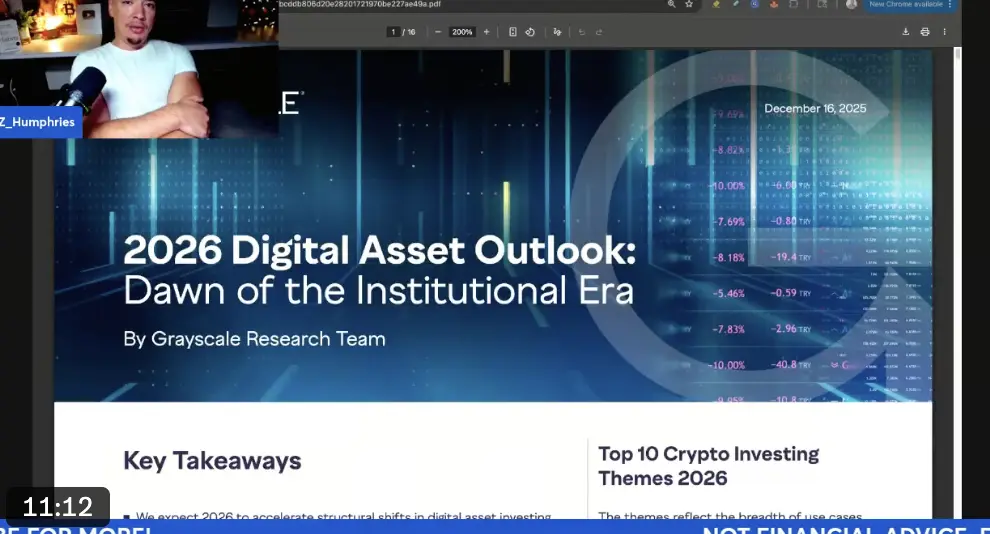
As 2025 comes to a close, Grayscale Research has released its outlook for the year ahead, predicting that regulatory progress—particularly a bipartisan U.S. crypto market structure bill—will be the dominant force driving digital asset markets in 2026, while concerns over quantum computing remain overstated in the near term.
(Sources: X)
Regulatory Framework Expected to Drive Institutional Adoption
Grayscale analysts anticipate the passage of comprehensive U.S. legislation in 2026, establishing clearer rules for digital assets across registration, disclosure, asset classification, and insider protections.
This framework would harmonize oversight between agencies like the SEC and CFTC, providing the legal certainty long sought by the industry.
The firm argues that robust regulation would accelerate institutional participation, enabling regulated financial firms to hold digital assets on balance sheets and conduct transactions directly on blockchains.
Such developments could mark the beginning of a more mature, institution-led era for crypto, with increased on-chain activity and broader economic integration.
Quantum Computing Risks: Real but Distant
While acknowledging the theoretical threat quantum computers pose to current cryptographic standards—potentially allowing private keys to be derived from public ones—Grayscale views this as a long-term issue rather than an imminent price driver.
The report expects quantum topics to generate headlines and debate in 2026 but predicts minimal material impact on asset valuations next year.
Most major blockchains, including Bitcoin, will eventually require upgrades to post-quantum cryptography. However, Grayscale believes markets will not significantly discount networks based on quantum preparedness in the coming year.

(Sources: Coin Metrics)
Broader Market Implications
Clearer U.S. rules, potentially mirrored in other major economies, could unlock substantial capital flows by reducing legal ambiguity.
Financial institutions may increasingly view digital assets as viable for portfolios and operations, shifting the market from retail speculation toward institutional frameworks.
Grayscale emphasizes that regulatory clarity would catalyze utility-driven growth, distinguishing sustainable projects from speculative ones.
Potential Risks and Counterarguments
The report contrasts with community concerns raised in recent discussions, including:
- Quantum breakthroughs eroding Bitcoin confidence
- Unexpected Fed tightening triggering risk-asset selloffs
- Midterm election outcomes stalling pro-crypto policy
- Failure to pass key bills like Clarity slowing adoption
- Stablecoin de-pegging events (e.g., USDT issues)
- Major DeFi hacks cascading to RWAs
- AI advancements diverting capital from Web3
Grayscale downplays most near-term disruptive scenarios, focusing instead on regulatory tailwinds as the primary 2026 catalyst.
Outlook for 2026: Regulation as the Key Catalyst
With foundational progress in 2025—including stablecoin laws and ETF expansions—Grayscale sees 2026 as the year crypto transitions from regulatory uncertainty to structured growth.
The anticipated market structure bill would provide the clarity needed to bridge traditional finance and blockchain, potentially ushering in broader institutional adoption and more stable market dynamics.
While quantum and other risks merit monitoring, Grayscale concludes that regulatory evolution—not technological disruption—will define crypto’s trajectory in the year ahead.
Disclaimer: The information on this page may come from third parties and does not represent the views or opinions of Gate. The content displayed on this page is for reference only and does not constitute any financial, investment, or legal advice. Gate does not guarantee the accuracy or completeness of the information and shall not be liable for any losses arising from the use of this information. Virtual asset investments carry high risks and are subject to significant price volatility. You may lose all of your invested principal. Please fully understand the relevant risks and make prudent decisions based on your own financial situation and risk tolerance. For details, please refer to
Disclaimer.
Related Articles
Stablecoins Emerge as Financial Infrastructure, but Banks Remain Cautious: S&P Report
Stablecoins are rapidly evolving beyond their original role in crypto trading, emerging as a key layer of financial infrastructure, according to new research from S&P Global Market Intelligence.
The report highlights a growing shift toward institutional use cases, particularly in cross-border
CryptoBreaking4h ago
Chainalysis Sees Stablecoin Volume Reaching $1.5 Quadrillion by 2035
Chainalysis forecasts stablecoin transaction volume could reach $1.5 quadrillion by 2035 due to generational wealth transfer and increased merchant adoption. Even without new catalysts, it may grow to $719 trillion, indicating a significant shift towards stablecoins becoming a mainstream payment method.
CryptoNewsFlash9h ago
Bank of America research report: The global economy’s dependence on oil has fallen to one-third of what it was in the 1970s. Huatai Securities says gold’s safe-haven appeal has stopped working
A U.S. bank research report said that since the 1970s, the global economy’s reliance on oil has declined, and the oil required now is only one-third of that at the time, with economic resilience strengthening. In addition, Haitong Securities’ analysis found that gold did not exhibit safe-haven characteristics; after experiencing a pullback due to geopolitical shocks, it rebounded.
GateNews10h ago
TRM Labs: While Risks Remain, Compliance Advances in Latam
TRM Labs reports that while illicit finance risks persist in Latam, including cartel activity and laundering networks, regulatory compliance is strengthening across the region, influenced by stablecoins driving 95% of illicit inflows.
Coinpedia13h ago
Morgan Stanley’s Bitcoin ETF officially begins trading! It attracted $34 million on its first day, demonstrating steady performance
Morgan Stanley’s Bitcoin ETF “MSBT” officially launched, becoming the first such product issued by a major bank, with management fees as low as 0.14%. It pulled in $34 million on day one, showing market demand for low fees and adviser distribution channels. This move signals that traditional financial institutions are moving fully into the crypto asset market, with competition shifting toward fees, liquidity, and customer reach.
CryptoCity22h ago
Gate Releases Crypto Industry Employment White Paper: AI Reshapes Job Structures, Making Hybrid Talent the Core Competitive Advantage
The white paper jointly released by Gate Research Institute and Global HR states that by Q1 2026, the crypto industry will face job shifts driven by AI transformation, and cross-functional talent will become a core competitive advantage. The industry is mainly divided into four areas: exchanges, public chains and infrastructure, DeFi and derivatives, and stablecoins, with technology research and development needs being the most prominent.
GateNews04-10 13:02


