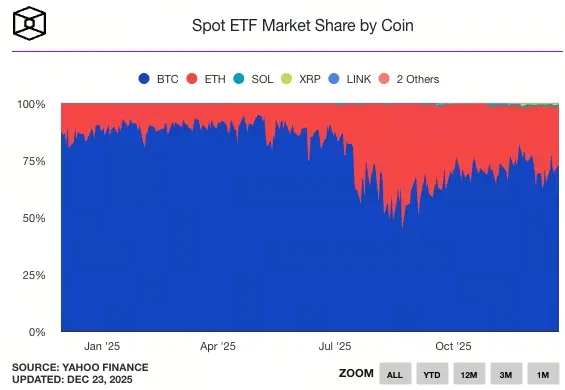
In 2025, Crypto Assets ETFs attracted $31 billion, with Bitcoin holding a market share of 70-85% firmly on the throne. Ethereum's market share increased from 15% to 30%, with BitMine Immersion adding 590,000 ETH in a single month, pushing public holdings over 5 million coins. Over the past three weeks, Bitcoin ETF volume has contracted, with the daily average in December struggling to surpass $5 billion.
The Institutional Logic Behind Bitcoin ETF Dominance
(Source: The Block)
The crypto assets ETF market will exhibit extreme concentration in 2025, with Bitcoin maintaining a stable market share of 70% to 85% throughout the year. This overwhelming advantage stems from the conservative strategies of institutional investors, who view Bitcoin as “digital gold” or a macro hedge tool, rather than categorizing it within the broader crypto assets space. The concentration of capital flows indicates that institutional investors treat Bitcoin distinctly from other digital assets.
The total capital inflow of 31 billion USD is considerable, but the distribution is extremely uneven. Based on an average market share of 80%, Bitcoin ETF has absorbed about 24.8 billion USD, while Ethereum and other assets only share 6.2 billion USD. This gap reveals the institutional mindset: Bitcoin is seen as a necessity, Ethereum is an option, and other assets are almost ignored.
Institutional investors' continued purchases have provided ongoing price support for Bitcoin throughout 2025, allowing it to outperform the broader crypto assets market. Even during the crash triggered by the October tariffs, Bitcoin's decline was significantly smaller than that of altcoins. This “hedging property” further reinforced institutions' preference for Bitcoin, creating a positive feedback loop.
However, the significant contraction in the trading volume of spot Bitcoin ETFs over the past three weeks is worth noting. The daily average trading volume in December has mostly struggled to break through the $5 billion mark, far below the $8-10 billion level seen in the middle of the year. This indicates that as the end of the year approaches, the behavior of market participants may change, leading to a stabilization in market activity, similar to the sluggish period of this summer, rather than the explosive growth seen in the fourth quarter of last year.
The Quiet Rise of Ethereum ETF and the BitMine Effect
Ethereum's position in the Crypto Assets ETF is steadily improving. From early 2025 to December, Ethereum's market share has gradually increased from about 15% to 30%, becoming the second largest allocation for institutional investors. This position makes Ethereum's market share an effective indicator of the overall sentiment in the altcoin market (relative to Bitcoin). The gradual increase in market share indicates that institutional investors' confidence in this second largest cryptocurrency is growing.
Three Major Drivers of Ethereum ETF Growth
Smart Contract Narrative Attracts Technical Institutions: Ethereum, as a programmable blockchain, provides infrastructure for applications such as DeFi, NFTs, and tokenization, attracting investors optimistic about Web3.
Valuation Discount Provides Attractiveness: Compared to the high valuation of Bitcoin, Ethereum offers greater potential upside, and institutions view it as a high-beta version of Bitcoin.
Staking Yield Enhances Holding Motivation: The Ethereum PoS mechanism offers approximately 3-4% staking yield, creating cash flow for long-term holders.
The most notable case is BitMine Immersion (BMNR). Despite the overall volatility and pullback in the crypto assets market in recent weeks, the amount of Ethereum held by the public has significantly increased. As of the time of writing, the total amount of ETH held by the public has risen from 4.5 million coins at the beginning of the month to 5.09 million coins. Analyzing the data in more detail, this recent surge of 590,000 ETH purchases is entirely attributed to BitMine.
The purchasing power of BitMine comes from an active “market price issuance” (ATM) equity strategy, which allows the company to issue new shares to fund its ETH acquisitions when the stock price is above the net asset value. This operational model is similar to MicroStrategy's strategy for Bitcoin, buying crypto assets through equity premiums, forming a positive cycle. BitMine's continuous buying not only increases the amount of ETH held by the public but also provides bottom support for the price of Ethereum.
Other well-known ETH DAT positions are basically flat, indicating that BitMine is the main force driving the market share increase of Ethereum ETFs. This growth model driven by a single large holder, while effective, also reveals the vulnerability of the Ethereum ETF market. If BitMine stops buying or turns to selling, the market share growth of Ethereum may immediately stagnate.
The Awkward Situation of Long-Tail Assets ETF
Long-tail assets including XRP, SOL, LINK, LTC, and DOGE seem to be insignificant in the current market share of crypto assets ETFs. Most of these ETF products are expected to be approved by the end of 2025, so they are still in the early stages of their lifecycle. In terms of capital flow, these assets may account for less than 5% of the total inflows, indicating that institutions are very conservative in their allocation to non-mainstream assets.
This pattern is difficult to change in the short term. The decision-making processes of institutional investors often take months or even years, and they tend to choose the most mature and liquid assets during their initial allocations. Bitcoin, as the narrative of “digital gold,” has become deeply ingrained, and Ethereum's status as a smart contract platform is gradually being recognized. However, narratives such as XRP's cross-border payments, SOL's high performance, and DOGE's community culture have yet to translate into institutional-level allocation logic.
The key in 2026 lies in whether these long-tail assets can prove their unique value. If XRP makes breakthrough progress in the cross-border payment field, SOL attracts large DeFi protocols to migrate, or DOGE gains mainstream corporate adoption, institutions may reassess their allocation strategies. However, before that, the Crypto Assets ETF market will continue to maintain a structure of “Bitcoin as king, Ether as queen, and others fighting for the leftovers.”
Disclaimer: The information on this page may come from third parties and does not represent the views or opinions of Gate. The content displayed on this page is for reference only and does not constitute any financial, investment, or legal advice. Gate does not guarantee the accuracy or completeness of the information and shall not be liable for any losses arising from the use of this information. Virtual asset investments carry high risks and are subject to significant price volatility. You may lose all of your invested principal. Please fully understand the relevant risks and make prudent decisions based on your own financial situation and risk tolerance. For details, please refer to
Disclaimer.


