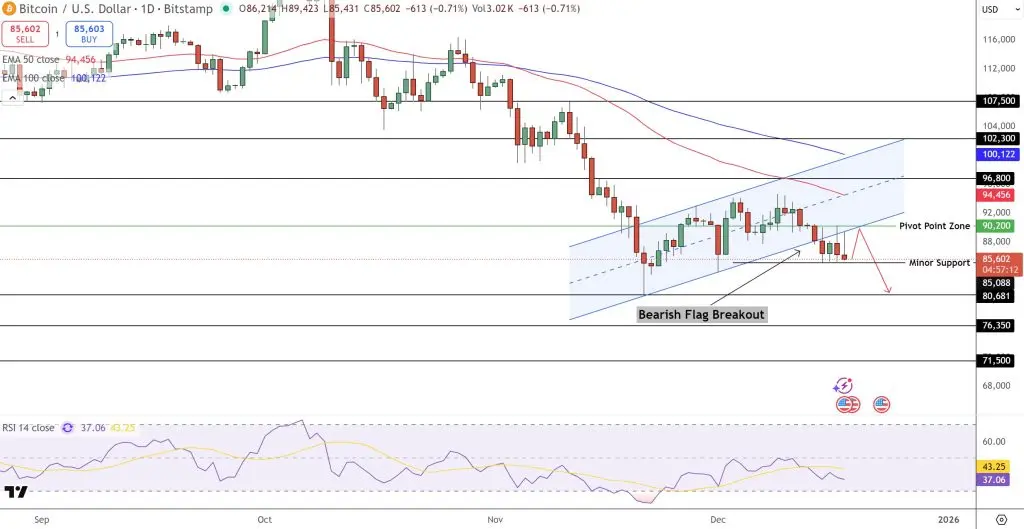
Bitcoin prices today hover around $85,600, with a confirmed bearish flag breakout on the technicals, and the next target at $80,600. Although the US November CPI data was below expectations, economists warn that a 43-day government shutdown led the Bureau of Labor Statistics to interpolate about 40% of the data, raising doubts about the report’s credibility. Internal divisions within the Federal Reserve have intensified policy uncertainty, putting risk assets under pressure.
CPI Data Distortion Doubts and Market Skepticism
The US Bureau of Labor Statistics released November CPI data on December 18, showing an eye-catching headline: overall inflation at 2.7%, significantly below Bloomberg economists’ forecast of 3.1% and also below September’s 3.0%. Core CPI, excluding food and energy, rose 2.6% year-over-year, also below the market expectation of 3.0%. However, the credibility of this report has been questioned by multiple Wall Street economists.
The key issue lies in the impact of the government shutdown. A six-week shutdown recently forced the BLS to halt price data collection, setting a record for the longest shutdown. As a result, the BLS canceled the October inflation report and had to estimate a large portion of the data in subsequent reports rather than based on actual surveys. This practice is known as “imputing” in statistics. Data shows that in September, the BLS imputed up to 40% of CPI data but did not disclose the specific proportion for November.
JPMorgan senior economist Michael Hanson stated that the lower-than-expected inflation data “may imply that the BLS, when unable to collect prices in October, assumed some prices remained unchanged,” leading to a “substantial downward bias” in the current figures, which could be corrected in the coming months as full data becomes available. Diane Swonk, Chief Economist at KPMG US, also warned that because the survey month was compressed, “this data must be interpreted with caution.” She said, “Some prices that should have increased actually fell, and some that should have declined rose. The results are confusing.”
CPI Data Distortion vs. Bitcoin’s Triple Blow
Policy Uncertainty Rises: If data is distorted, future revisions could push inflation figures higher, undermining Fed rate cut expectations.
Market Confidence Deteriorates: Investors lose trust in official data, risk appetite declines, and capital flows out of risk assets.
Trading Strategies Disrupted: Doubts about data reliability undermine both technical and fundamental analysis, increasing volatility.
Barclays US Inflation Strategist Jon Hill said, “The market is not buying it because this data ‘does not pass the smell test.’ Without a clear explanation of how the BLS made these statistical decisions, it’s hard to take it at face value. Because the deviation is so large and interpretation is difficult, investors are reluctant to make big bets based on it.”
Fed Three Votes Against Spark Policy Disagreement
The second reason for Bitcoin’s sharp decline today is severe internal disagreement within the Federal Reserve. Last week’s rate decision saw three FOMC members voting against the majority, an extremely rare occurrence in Fed history. The meeting cut rates for the third time by 25 basis points, bringing the target range to 3.5%-3.75%.
Kansas City Fed President Jeff Schmid and Chicago Fed President Austan Goolsbee both called for caution, opposing complacency on inflation, and advocated keeping rates unchanged. Conversely, Fed Governor and Trump ally Stephen M. Miran proposed a one-time 50 basis point cut. He stated this week that “phantom inflation” is distorting the Fed’s decision-making, and the actual underlying inflation rate is much lower.
This internal discord has caused market confusion. If hawks dominate, future rate cuts will be fewer than expected, and a high-rate environment is unfavorable for risk assets like Bitcoin. If doves prevail, rapid rate cuts could reignite inflation, triggering another tightening cycle. Regardless of the scenario, policy uncertainty itself is the biggest bearish factor.
According to Capital Edge’s rate probability data, the market’s expectation of a rate cut at the Fed’s next meeting on January 28 remains at 24%. Still, investors anticipate about 60 basis points of rate cuts over the next year, with the first cut expected in June. This outlook differs from actual statements by Fed officials, and the market is awaiting clearer policy guidance.
Technical Bear Flag Breakout and the $85,000 Critical Level
(Source: Trading View)
On the technical front, Bitcoin’s daily chart shows the market entering a sensitive phase, trading near $85,600, slightly above the support zone at $85,000–$85,100. This zone has repeatedly attracted buy-the-dip interest, but subsequent buying momentum has weakened, indicating waning demand.
Structurally, Bitcoin has confirmed a bearish flag breakout, a continuation pattern formed after a sharp decline from the $100,000 region earlier this season. This breakout further suggests the overall trend remains in a correction phase. Price remains below the 50-day moving average (around $94,500) and the 100-day moving average (around $100,100), both sloping downward, forming dynamic resistance.
Momentum remains weak. RSI is in the 30s, indicating limited buying strength, but no oversold signals yet, leaving room for further decline. Recent candlesticks are small and overlapping, suggesting a consolidation rather than accumulation phase, with no reversal signals at present.
If the daily close falls below $85,000, the price could test $83,000, and the bearish flag pattern indicates a potential downside target of $80,600. To alleviate downside pressure, the price needs to sustain above $90,200 and refocus on the $94,500 level, where supply remains strong. In the short term, failure to rebound above $90,000 after a dip remains favorable for sellers. A move near $80,000 could attract long-term buyers rather than aggressive short covering.
The reason for Bitcoin’s sharp decline today is the resonance of macro uncertainty and technical breakdowns. The CPI data distortion doubts erode confidence in economic outlook and policy paths, while Fed internal divisions amplify this uncertainty. On the technical side, the bearish flag breakout and the $85,000 support are at risk, further fueling panic. In this environment, risk assets are the first to bear the selling pressure, and Bitcoin, as one of the most volatile mainstream assets, naturally becomes a heavy casualty.


