Author: Jasper De Maere
Compiled by: Deep Tide TechFlow
Preface
Liquidity drives the cryptocurrency cycle, but inflows through stablecoins, ETFs, and DATs (Digital Asset Trusts) have noticeably slowed.
Global liquidity remains strong, but higher SOFR (Secured Overnight Financing Rate) is directing funds into government bonds rather than the crypto market.
Currently, cryptocurrencies are in a self-financing phase, with capital cycling internally, waiting for new inflows to return.
Liquidity determines every crypto cycle. While long-term technological applications may be the core driver of the crypto story, it is the movement of funds that truly influences price changes. Over the past few months, the momentum of capital inflows has weakened. In the three main channels through which capital enters the crypto ecosystem—stablecoins, ETFs, and Digital Asset Trusts (DATs)—the flow momentum is diminishing, causing cryptocurrencies to be in a self-financing rather than expansion phase.
Although technological adoption is an important driver, liquidity is the key factor that drives and defines each crypto cycle. It’s not just about market depth but also about the availability of funds themselves. When global money supply expands or real interest rates decline, excess liquidity inevitably seeks risk assets. Historically, especially during the 2021 cycle, cryptocurrencies have been among the biggest beneficiaries.
In previous cycles, liquidity primarily entered the digital asset space through stablecoins, which serve as the core fiat on-ramp. As the industry matures, three major liquidity channels are becoming critical in determining new capital inflows into crypto:
- Digital Asset Trusts (DATs): Tokenized funds and yield structures connecting traditional assets with on-chain liquidity.
- Stablecoins: On-chain representations of fiat liquidity, providing collateral for leverage and trading activities.
- ETFs: Entry points for passive investment and institutional capital exposure to BTC and ETH in traditional finance.
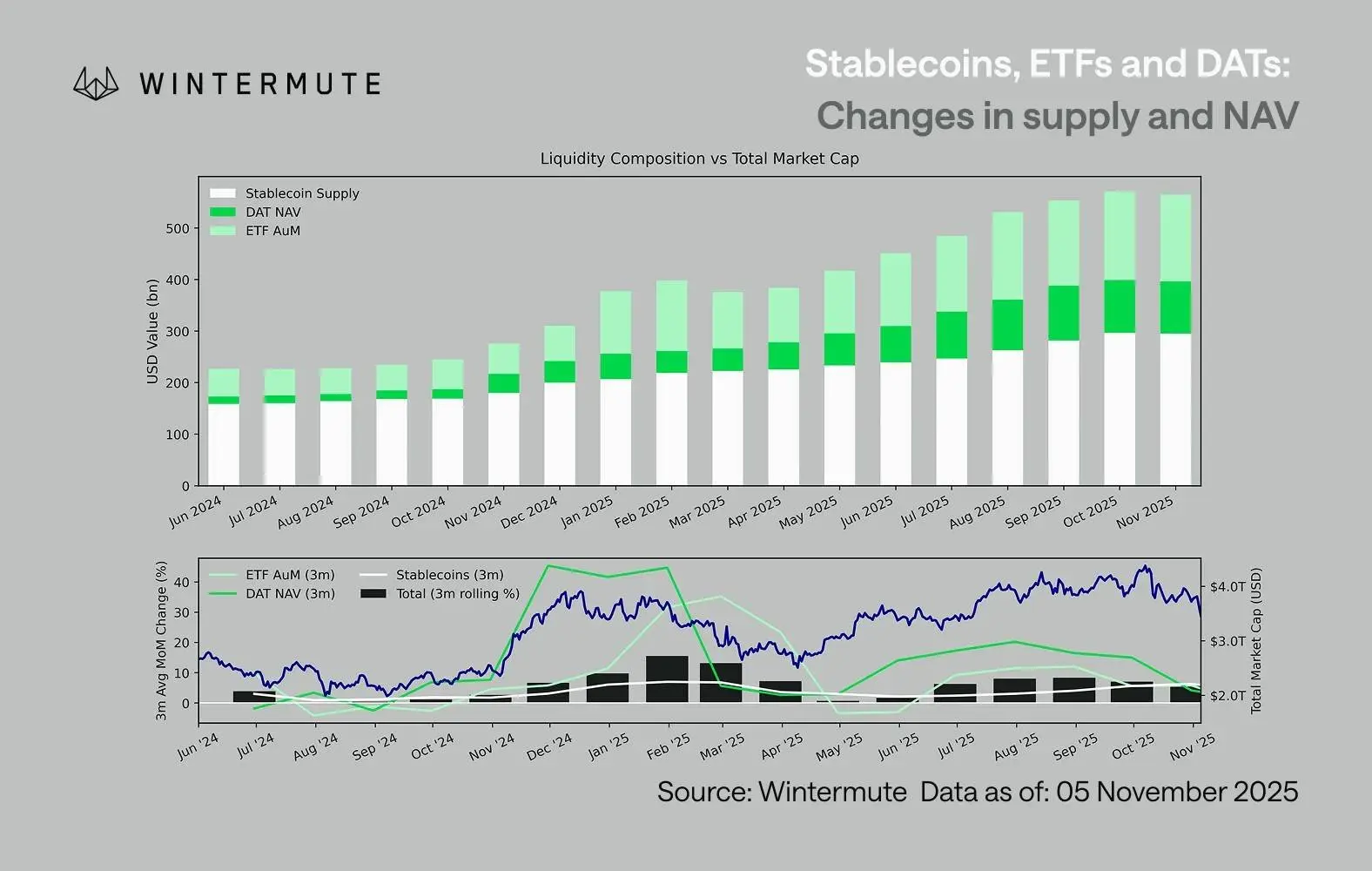
By combining ETF Assets Under Management (AUM), DAT Net Asset Value (NAV), and the number of issued stablecoins, it’s possible to reasonably estimate the total capital flowing into digital assets. The chart below shows the trend of these components over the past 18 months. At the bottom, it’s clear that total volume correlates closely with the overall market cap of digital assets; when inflows accelerate, prices tend to rise.
A key observation is that the inflows into DATs and ETFs have significantly slowed. Both performed strongly in Q4 2024 and Q1 2025, with a brief rebound in early summer, but this momentum has since waned. Liquidity (M2 money supply) is no longer flowing into the crypto ecosystem as naturally as at the start of the year. Since early 2024, the total size of DATs and ETFs has grown from approximately $40 billion to $270 billion, while stablecoin volume has doubled from about $140 billion to roughly $290 billion. Although this indicates strong structural growth, it also shows a clear slowdown.
This deceleration is crucial because each channel reflects different sources of liquidity. Stablecoins represent risk appetite within the crypto industry, DATs capture institutional demand for yields, and ETFs reflect broader traditional financial (TradFi) allocation trends. The simultaneous slowdown across all three suggests a general reduction in new capital deployment, not just a rotation between products. Liquidity isn’t disappearing; it’s merely cycling within the system rather than expanding.
From the broader economy outside crypto, liquidity (M2 money supply) is also not stagnant. Although higher SOFR rates have temporarily constrained liquidity, making cash yields attractive and locking funds into government bonds, the global cycle remains accommodative. The US’s quantitative tightening (QT) has officially ended. The overall structural environment remains supportive; currently, liquidity is being allocated to other risk assets, such as equities.
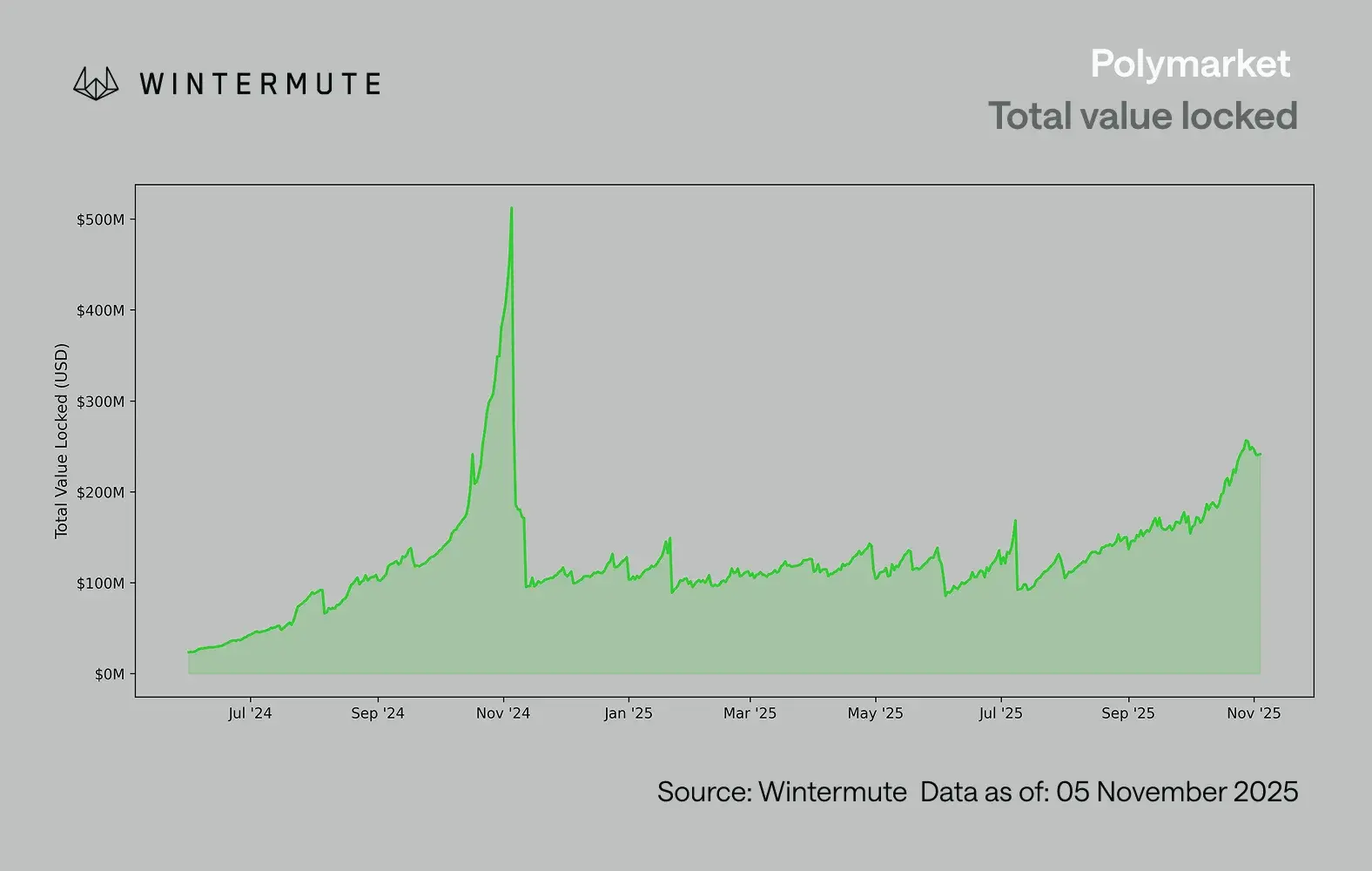
As external inflows decrease, market dynamics become more insular. Capital is shifting more between mainstream coins and altcoins rather than new net inflows, creating a “player versus player” (PVP) scenario. This explains why market rebounds tend to be short-lived and why market breadth narrows, even as total assets under management (AUM) remain stable. The recent volatility peaks are mainly driven by liquidation cascades rather than sustained trend formation.
Looking ahead, any significant revival in one of the liquidity channels—such as renewed stablecoin issuance, new ETF launches, or increased DAT issuance—would signal macro liquidity flowing back into digital assets. Until then, cryptocurrencies remain in a self-financing phase, with capital cycling internally without generating value expansion.
Disclaimer: The information on this page may come from third parties and does not represent the views or opinions of Gate. The content displayed on this page is for reference only and does not constitute any financial, investment, or legal advice. Gate does not guarantee the accuracy or completeness of the information and shall not be liable for any losses arising from the use of this information. Virtual asset investments carry high risks and are subject to significant price volatility. You may lose all of your invested principal. Please fully understand the relevant risks and make prudent decisions based on your own financial situation and risk tolerance. For details, please refer to
Disclaimer.
Related Articles
Bitcoin Price Outlook Shifts as Iran Toll Demand Revives $1M Target Talk
Iran Bitcoin toll revives debate on crypto as global payment infrastructure
Geopolitical tensions push Bitcoin beyond store-of-value into currency role
Institutional adoption and flows strengthen long-term million-dollar Bitcoin narratives
Bitcoin price outlook has shifted again after fr
CryptoNewsLand14m ago
MicroStrategy Proposes Semi-Monthly Dividends for STRC to Improve Liquidity and Stabilize Stock Price
MicroStrategy has proposed changing its STRC preferred stock dividends from monthly to semi-monthly to enhance liquidity and stabilize stock prices, maintaining an 11.5% annual yield. Concerns about this structure have been raised by Bitcoin critic Peter Schiff.
GateNews2h ago
Tim Draper-Linked Wallet Deposits 150.84 BTC to Major CEX, Facing ~$2.57M Loss
Tim Draper's wallet transferred 150.84 BTC, valued at $11.62 million, to a centralized exchange after a year of holding, leading to an estimated loss of $2.57 million.
GateNews2h ago
Bitcoin Spot ETFs Record $664M Net Inflows, Highest Single Day in Three Months
Bitcoin spot ETFs saw significant net inflows of $664 million on April 17, the largest in three months. BlackRock led the funds with $284 million, followed by Fidelity and ARK. Other products saw minimal contributions.
GateNews3h ago
Bitdeer Maintains Zero Bitcoin Holdings After Selling 177 BTC This Week
Bitdeer reported producing and selling 177 BTC in the week ending April 17, resulting in no net increase in its holdings, leaving the firm with a zero Bitcoin position.
GateNews4h ago
MicroStrategy Stock Rallies as Bitcoin Breaks $78K, Unrealized Gains Return to $1.37B
MicroStrategy's stock surged 13.83% as Bitcoin reclaimed $78,000, returning the company to an unrealized profit of $1.37 billion. The rise follows easing tensions in the Middle East and a broader rally in risk assets, despite criticism of its preferred stock.
GateNews5h ago


