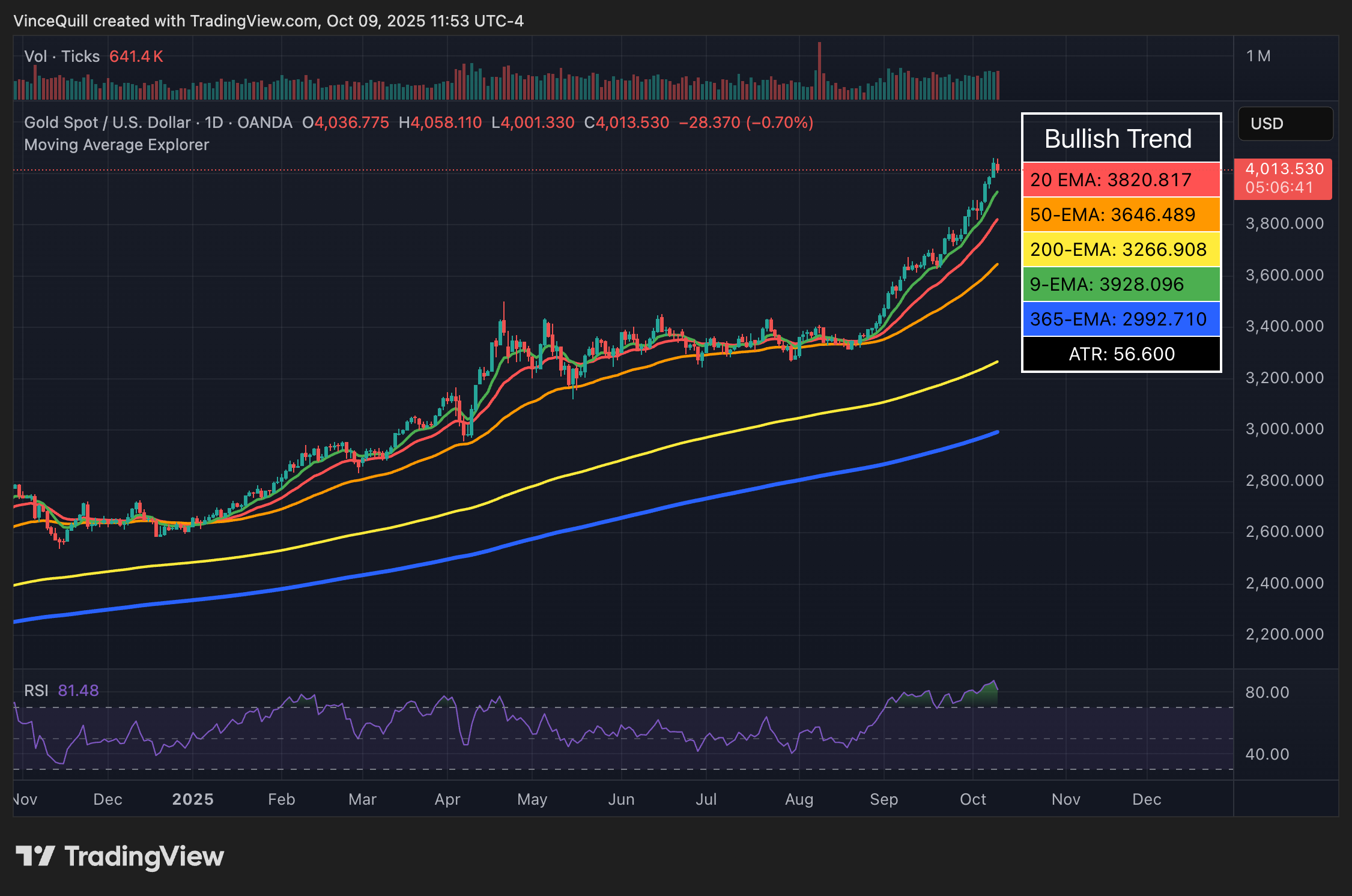
The US Dollar Index has fallen more than 10% this year, marking its worst performance since 1973, driving gold to break through $4,000 and silver to soar past $50, reaching a 45-year high. Nic Puckrin, the founder of Coin Bureau, warned that precious metals are “overheated,” and investors are turning their attention to Bitcoin and tokenization of physical assets as alternative hedging tools, with BTC's value relative to gold still being severely undervalued.
Gold rises 50% after analysts warn of overheating
(Source: Trading View)
Gold prices have surged over 50% year to date, briefly touching a historic high of $4,000 per ounce, while silver has also broken through the $50 per ounce barrier, marking its highest record since 1980. However, Nic Puckrin, founder of the Coin Bureau education company, believes that this surge has shown signs of being “overheated.”
Puckrin pointed out that Goldman Sachs predicts the price of gold will reach $4,900 per ounce by the end of 2026, but the current increase has already been too concentrated in the precious metals sector. He stated:
“So far this year, gold prices have risen over 50%, and now people's attention may turn to other alternative assets with similar views. These alternative assets include other metals and commodities, tokenized physical assets, and Bitcoin, which are still undervalued relative to gold.”
Comparison of Safe-Haven Attributes of Precious Metals and Bitcoin
Both types of assets can serve as tools to hedge against the inflation of fiat currencies and geopolitical uncertainties, but the current market allocation shows a clear imbalance:
Gold: Annual increase of 50%+, price at 4,000 USD/ounce
Silver: Breaks 50 dollars, hits a 45-year high
Bitcoin: Reached a new high of $126,000 in October, but still undervalued compared to gold.
Tokenization of physical assets: An emerging hedging option with better liquidity and transparency than physical precious metals.
Analysts emphasize that when the prices of traditional safe-haven assets like gold enter the “overheated zone”, funds will naturally seek more reasonably valued alternative hedging tools, and Bitcoin is the preferred target.
The dollar sees its worst fall since 1973, driving a massive capital relocation
Kobeissi Letter market analysts pointed out: “The US dollar is expected to have its worst year since 1973, having fallen over 10% year-to-date. Since 2000, the purchasing power of the dollar has declined by 40%.”
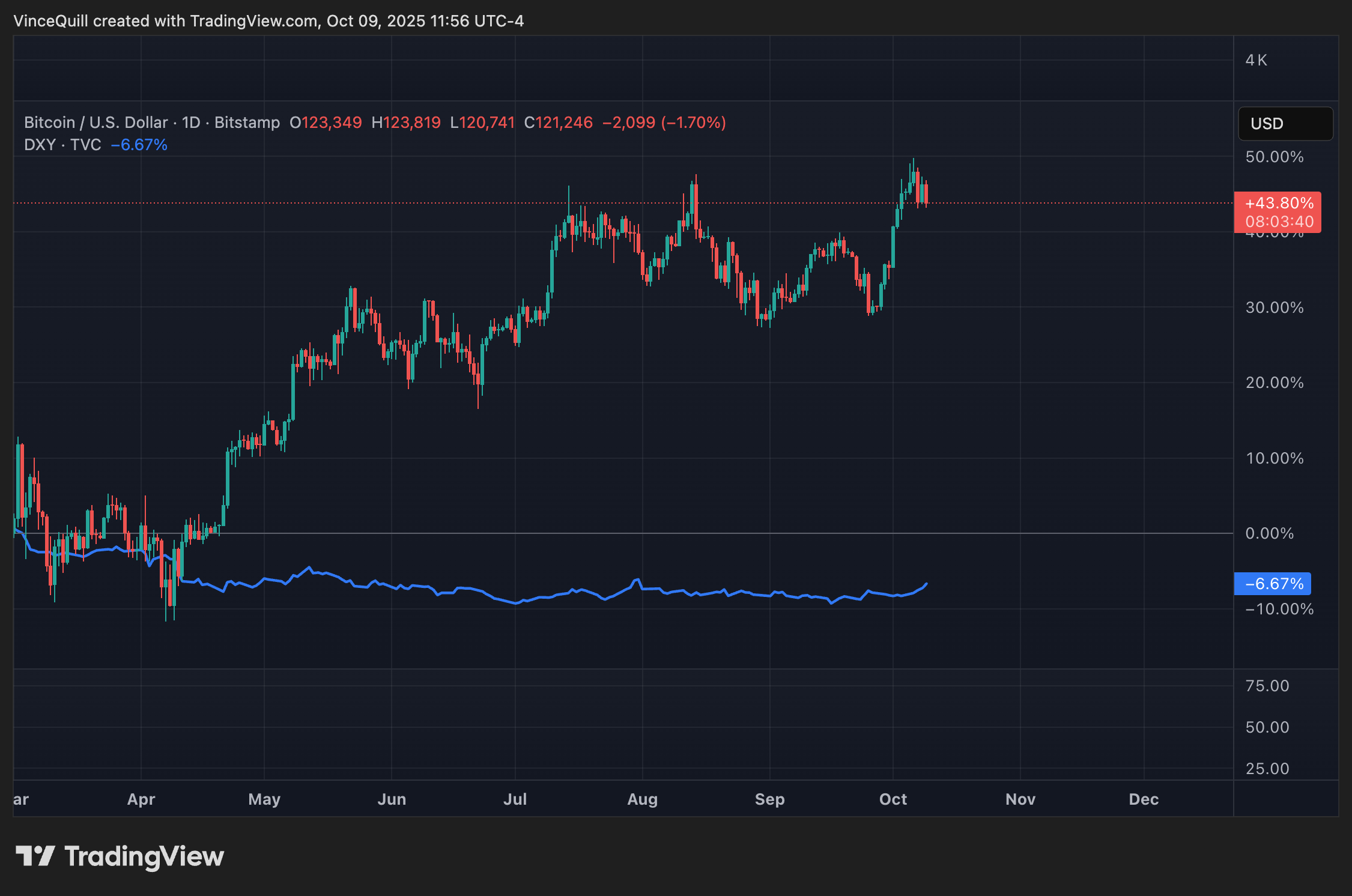
This historic depreciation of the dollar has led investors to flock to both value-preserving assets and risk assets simultaneously, breaking the traditional paradigm where the two usually move in opposite directions. As the Dollar Index (DXY) continues to fall, Bitcoin prices soar to new historical highs, and gold and silver also set records together. This rare phenomenon of “broad-based rally” reflects that investors are repricing assets for a “new monetary policy era.”
Three Major Logics for Bitcoin Benefiting from the Collapse of the US Dollar
(Source: Trading View)
Analysts believe that in an environment where the government finances its fiscal deficit through further devaluation of the currency, Bitcoin has unique advantages:
Supply cap: 21 million coins, total supply cannot be increased, inflation resistance is better than gold (gold still has new mining output every year)
Liquidity Advantage: 24/7 global trading, transfer costs are far lower than physical precious metals.
Institutional adoption accelerates: ETF inflows hit record highs, Wall Street allocation ratio continues to rise.
Matt Hougan, Chief Investment Officer of investment firm Bitwise, stated that due to the continuous depreciation of currency, the price of BTC is expected to soar in the fourth quarter as investors attempt to preserve their wealth by purchasing large amounts of hedging assets.
VanEck Model: Bitcoin “Equivalent” Gold Value Reaches 644,000 USD
Research from asset management company VanEck indicates that if Bitcoin gains the same level of market recognition as gold, the “equivalent” price of each BTC should reach $644,000 based on gold's current market value. This means that even though Bitcoin has set a new high of $126,000, there is still more than a 5-fold upside potential relative to gold's safe-haven status.
When gold enters a technically overbought zone after rising 50% in a year, the rotation of funds to relatively reasonably valued Bitcoin becomes a logical choice. Especially against the backdrop of the continued decline in the purchasing power of the US dollar, investors need to look for more growth-oriented hedging tools rather than just chasing the already significantly risen traditional precious metals.
Tokenization of physical assets has also become an emerging option. These products combine the stability of physical assets with the liquidity of blockchain, providing investors with an intermediate choice between gold and Bitcoin.
Disclaimer: The information on this page may come from third parties and does not represent the views or opinions of Gate. The content displayed on this page is for reference only and does not constitute any financial, investment, or legal advice. Gate does not guarantee the accuracy or completeness of the information and shall not be liable for any losses arising from the use of this information. Virtual asset investments carry high risks and are subject to significant price volatility. You may lose all of your invested principal. Please fully understand the relevant risks and make prudent decisions based on your own financial situation and risk tolerance. For details, please refer to
Disclaimer.


