The Ethereum Foundation will launch the privacy-first wallet Kohaku at the Devcon conference in Argentina, alongside a privacy research cluster of 47 people and zk-SNARKs technology, promoting “default privacy” as the protocol standard. The Privacy Coin zone has outperformed the market by 65.3% over the past 30 days, and Ethereum is upgrading privacy from an optional feature to a blockchain native attribute, redefining on-chain transaction security standards.
Kohaku Wallet has its first public test at the Devcon conference
Ethereum Foundation developer Nicolas Consigny announced on October 9 that the Kohaku Wallet will be officially unveiled during the Devcon conference in Argentina this November. This brand new wallet framework adopts a privacy-first design concept, allowing users to conduct transactions without exposing unnecessary personal or transaction details.
Kohaku will provide both a browser extension version and a software development kit (SDK) for developers to integrate privacy primitives directly into applications. Consigny emphasized the core design principle: “Ensure that each party to a transaction only knows the information directly related to the transaction, and minimize the risks required for the transaction.”
This minimal information disclosure framework represents a philosophical shift for Ethereum from passive compliance to active privacy design, especially in the context of increased on-chain surveillance by governments and AI reshaping data risks.
Ethereum forms a 47-person privacy research cluster
On October 8, the Ethereum Foundation announced the establishment of a new privacy cluster, composed of 47 engineers, researchers, and cryptographers, with the goal of integrating privacy features at every layer of the Ethereum stack. This cluster will closely collaborate with the Privacy and Scalability Exploration (PSE) program, covering the following key areas:
Research Layer: Pioneering advanced cryptographic technologies such as zk-SNARKs to achieve a balance between scalability and confidentiality.
Protocol Layer: Integrating privacy breakthroughs into Ethereum's core infrastructure, ensuring built-in rather than external patches.
Application Layer: Demonstrating real-world use cases through projects like Semaphore, MACI, and stealth addresses.
Compliance Layer: Institutional Privacy Working Group Explores Solutions for Coexistence of Privacy Technologies and Regulatory Requirements
Vitalik Buterin's Privacy Vision Practice
The Ethereum Foundation has made it clear: “Privacy is normal and necessary to ensure that this infrastructure remains usable, trustworthy, and consistent with human freedom.” This echoes Vitalik Buterin's long-standing position that privacy should be “a human right embedded in protocol design,” rather than an optional feature for advanced users.
The institutional privacy working group will release guidelines to assist businesses, financial institutions, and auditors in pairing privacy tools with compliance frameworks, paving the way for large-scale applications.
Performance verification of Privacy Coin zone to meet market demand
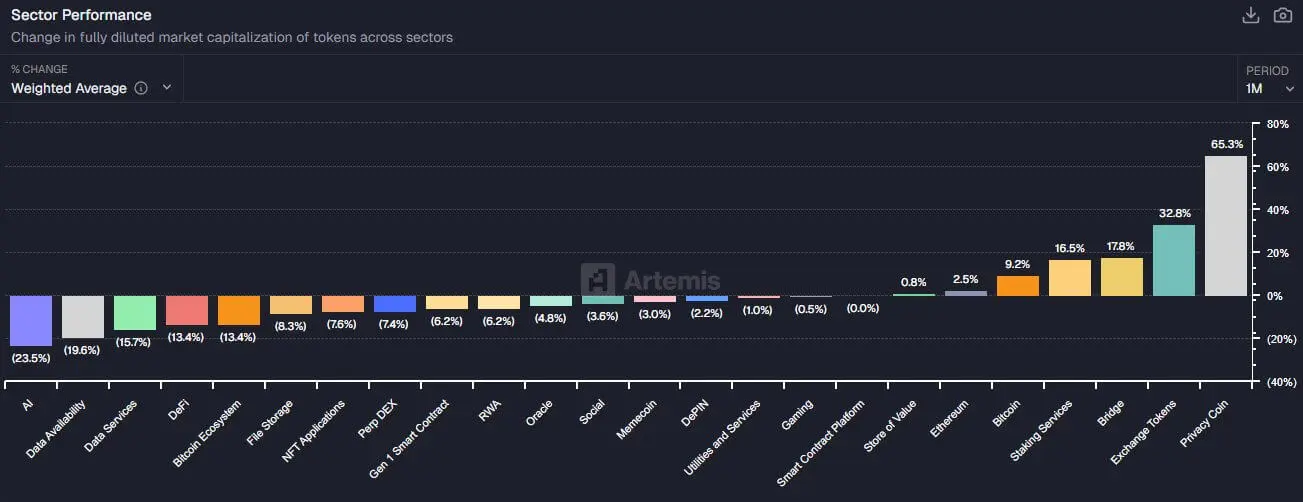
(Source: Artemis)
According to Crypto Rand data, privacy-focused tokens have outperformed the overall crypto market by 65.3% in the past 30 days, reflecting strong investor interest in tools that provide transactional-level confidentiality. As AI expands data extraction capabilities and governments strengthen on-chain monitoring, the market is voting with capital to support privacy protection infrastructure.
If the technology breakthroughs of the Kohaku Wallet and Privacy Zone are successfully implemented, Ethereum's next iteration may truly achieve “default privacy” as a protocol standard, rather than just a marketing slogan. This will fundamentally change the industry landscape of blockchain privacy from an optional feature to a core attribute.
Disclaimer: The information on this page may come from third parties and does not represent the views or opinions of Gate. The content displayed on this page is for reference only and does not constitute any financial, investment, or legal advice. Gate does not guarantee the accuracy or completeness of the information and shall not be liable for any losses arising from the use of this information. Virtual asset investments carry high risks and are subject to significant price volatility. You may lose all of your invested principal. Please fully understand the relevant risks and make prudent decisions based on your own financial situation and risk tolerance. For details, please refer to
Disclaimer.
Related Articles
Claude code leak sparks an LLM crisis, hackers have stolen researchers’ ETH
Security research reveals that in the LLM agent ecosystem, over 20% of free API routers actively inject malicious code, leading to asset theft and credential crises. In addition, the Claude code-leak incident has enabled attackers to spread malware by exploiting developers’ curiosity. The research team proposes a three-layer defense mechanism to address supply-chain security risks.
MarketWhisper3h ago
Solayer founder issues a warning: AI agent routers face malicious injection risks, and ETH is being stolen
Solayer’s founder exposes a security vulnerability in large language model (LLM) routers; in 428 routers, more than 20% exhibit malicious behavior, such as private keys being stolen. The research recommends that developers implement a separate end-to-end integrity verification mechanism on the client side and provides three defense options to mitigate supply-chain attacks.
MarketWhisper3h ago
Giant whale “first set 10 big goals” keeps adding to BTC and ETH short positions, with a position size of up to $270 million
Gate News announcement, April 10, the whale “sets 10 big targets first” (social media account @Jason60704294) has updated its latest positions. Currently, total unrealized profit is $644k. The specific holdings include: BTC short positions of 2567.49 units, entry price $71,554.61, unrealized loss of $644k; ETH short positions of 38,465.22 units, entry price $2,248.74, unrealized profit of $1.37M.
GateNews4h ago
Ethereum’s staking rate hits a record high, with staked ETH valued at about $85 billion
Gate News message: On April 10, according to Token Terminal data, Ethereum’s staking rate hit a record high. Currently, the network is secured by staked ETH with a value of about $85.0 billion.
GateNews4h ago
Today, BTC and ETH options with a nominal value of $2.27 billion expire, and the IV index drops sharply
On April 10, 27k BTC options and 151k ETH options expired, with Put Call Ratios of 0.71 and 0.77, respectively. Bitcoin broke above $72,000 on news of a U.S.-Iran ceasefire, but the overall market is still in a correction phase, and implied volatility has fallen significantly.
GateNews4h ago


