Under the support of the “Strategic Bitcoin Reserve” policy established by the Trump administration, a global wave of virtual asset reserve enthusiasm has emerged. By 2025, over 160 listed companies have adopted the DAT strategy (Digital Asset Reserve Strategy), incorporating Bitcoin and Ethereum into their balance sheets, with a total holdings value exceeding $240 billion. The leading company Strategy saw its stock price experience a big pump of 2,461% over five years, and in 2025, the fundraising scale of listed companies' DAT strategy surpasses traditional encryption venture capital, reaching $15 billion.
Virtual Asset Reserves Become a New Trend in Corporate Finance
As traditional investors are still hesitating whether to “trade coins,” a cryptocurrency revolution led by publicly listed companies is quietly unfolding on Wall Street. By 2025, over 160 publicly listed companies globally have adopted the “Digital Asset Treasury (DAT)” strategy, incorporating cryptocurrencies like Bitcoin and Ethereum into their corporate balance sheets, with a total holdings value exceeding $240 billion.
This represents a paradigm shift in corporate financial management—cryptocurrency has officially upgraded from a “speculative tool” to a “strategic asset,” becoming a core component of the balance sheet alongside cash, bonds, and gold.
What is the publicly listed company DAT strategy?
Digital Asset Treasury (DAT) refers to a financial strategy where companies incorporate cryptocurrencies such as Bitcoin and Ethereum into their balance sheets as long-term strategic reserve assets.
Core Elements of DAT Strategy:
Long-term holding orientation: Treat cryptocurrency as a strategic reserve rather than a short-term trading target.
Balance sheet management: formally incorporated into the company's financial statements, subject to accounting standards regulations.
Diversified allocation: hedge against inflation and fiat currency depreciation risks
Ecological participation income: Earn passive income through staking, validating nodes, and other methods.
Shareholder Value Creation: Enhancing Company Value through the Appreciation of Encryption Assets
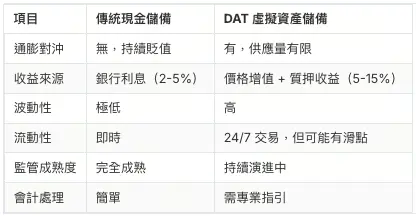
Unlike traditional cash and bonds, the DAT strategy aims to hedge against inflation, achieve asset diversification, and participate in blockchain ecosystem yields (such as staking, validating nodes, etc.).
Comparison of DAT and Traditional Asset Management:
Trump's Policy Boost: Virtual Asset Reserves Become a National-Level Strategy
The turning point of the listed company DAT's strategic trend appeared in March 2025, when U.S. President Trump signed an executive order to officially establish the “Strategic Bitcoin Reserve,” viewing Bitcoin as a national-level reserve asset.
This move not only endorses the company's DAT strategy but also upgrades cryptocurrency from a “speculative tool” to a “strategic asset.”
According to the report by Latham & Watkins, the Trump administration clearly stated: “The Bitcoin held by the U.S. government will not be sold, but will be held as a reserve asset for the long term.” This policy provides strong confidence support for the corporate DAT strategy.
Core content of the policy:
· Prohibition on the sale of Bitcoin held by the government: Bitcoin seized by federal law enforcement agencies will no longer be auctioned.
· Establish a strategic reserve framework: manage Bitcoin analogous to the gold reserve model.
· Encourage enterprises to hold: provide tax incentives and accounting guidance
· Clarification of regulations: SEC and CFTC release DAT strategy compliance guidelines
· International competition considerations: Prevent other countries from gaining an advantage in the encryption asset field.
Global governments follow the trend:
After Trump's policy announcement, many governments have followed suit to study virtual asset reserves:
· El Salvador: As early as 2021, it designated Bitcoin as legal tender and continues to increase its holdings.
· UAE: Dubai announces the establishment of a sovereign encryption fund
· Singapore: The Monetary Authority of Singapore (MAS) studies central bank digital asset allocation
· Switzerland: Zug government accepts Bitcoin for tax payments
· Japan: The Liberal Democratic Party proposes to study the feasibility of Bitcoin as a national reserve.
This dual drive of “government endorsement + corporate practice” has transformed virtual asset reserves from marginal experiments to mainstream financial strategies.
Using DAT strategy, the company's stock price has surged remarkably
The stock performance of companies adopting the publicly listed company DAT strategy far exceeds the market, becoming a target of investors' pursuit.
Leader Case: Strategy Five-Year Big Pump 2,461%
Strategy (formerly MicroStrategy, stock code: MSTR):
5-year stock price increase: 2,461%
S&P 500 increase during the same period: 93.1%
Outperforming the market by multiples: 26.4 times
Bitcoin Holdings: Approximately 250,000 BTC (worth over 15 billion USD)
Founder: Michael Saylor (the most steadfast believer in Bitcoin)
The strategy adopts a “lending and borrowing to purchase coins” approach, by issuing convertible bonds to raise funds for buying Bitcoin, transforming the company into a “Bitcoin investment vehicle.” This aggressive strategy has achieved astonishing returns during the Bitcoin bull market.
2025 DAT Strategy Star Company
SharpLink Gaming (SBET):
Positioning: The world's largest Ethereum holdings publicly traded company
Fundraising scale: 425 million USD
Holdings assets: approximately 500 million dollars in Ether
Stock price performance: a 187% increase in the three months following the announcement of the DAT strategy.
Sol Strategies (Stock Code: HODL/CYFRF):
Positioning: A DAT company focused on the Solana ecosystem.
Fundraising scale: $500 million convertible bond financing
Holdings: Solana (SOL) + ecosystem project tokens
Additional income: Operating Solana validator nodes to earn staking rewards
Upexi (UPXI):
Positioning: Traditional e-commerce company transformation DAT strategy
Deployment scale: 100 million USD to purchase SOL
Earnings model: SOL staking generates an annual passive income of 5-7%
Business Integration: Using staking rewards for e-commerce business expansion
BitMine (BMNR):
Positioning: One of the largest Ethereum Holdings companies.
Holdings scale: approximately 500 million USD Ethereum
Business Model: Encryption Mining + Asset Reserve Dual Track Parallel
Technical advantages: Own mining farms reduce holding costs
Hyperion DeFi (HYPD, formerly Eyenovia):
Positioning: Focused on the Hyperliquid ecosystem's HYPE coin
Features: Transitioning from traditional pharmaceutical companies to cryptocurrency investments.
Strategy: Deeply participate in DeFi protocol governance
Risk and Return: High-risk, high-reward strategy for small-cap tokens
The common point of these companies is: treating cryptocurrencies as long-term strategic assets rather than short-term speculative targets.
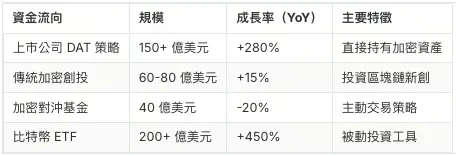
DAT strategy fundraising size of listed companies in 2025 surpasses traditional venture capital
According to insights4.vc statistics, as of August 2025, the funds raised by public and private companies through the DAT strategy have exceeded 15 billion USD, far surpassing the traditional cryptocurrency venture capital of 6-8 billion USD.
This represents a key shift in the allocation of encryption capital: companies choose to hold cryptocurrencies directly rather than invest in encryption startups.
Capital Flow Comparison (2025):
Why do companies choose DAT instead of venture capital?
· Direct price exposure: Benefit directly from the appreciation of encryption assets without intermediaries.
· Simple accounting treatment: Holding assets is easier to include in financial reports than investing in startups.
High liquidity: Available for trading 24/7, unlike venture capital which requires waiting to exit.
· Complete control: Make independent decisions on buying and selling without being restricted by fund management.
· Tax Optimization: Long-term holdings can enjoy capital gains tax benefits.
This change in capital allocation logic shows that institutional investors' confidence in the maturity and long-term value of encryption assets has significantly increased.
Virtual asset reserve diversification: not just Bitcoin
Although Bitcoin remains the mainstream virtual asset reserve (with a total value of $215 billion), other encryption assets are also rapidly rising, and companies are beginning to allocate diversified digital asset portfolios based on risk preferences and strategic goals.
Main Virtual Asset Reserve Categories
Bitcoin (BTC) reserves:
Total value: 215 billion USD
Holdings: Strategy, Tesla, GameStop, etc.
Advantages: Highest consensus, best liquidity, “digital gold” status
Suitable for: conservative enterprises, large-scale allocation
Ethereum (ETH) Reserve:
Total value: 23 billion USD
Holdings: SharpLink Gaming, BitMine, etc.
Advantages: Smart contract ecosystem, staking yield (annualized 3-5%)
Suitable for: profit-seeking enterprises, technology industry
Solana (SOL) Reserve:
Total Value: 3.4 billion USD
Holdings Company: Sol Strategies, Upexi, etc.
Advantages: High-performance public chain, staking yield (annualized 7-10%), rapidly growing ecosystem.
Suitable for: growth-oriented enterprises, high-risk tolerance
Other Emerging Assets:
HYPE (Hyperliquid): Hyperion DeFi focuses on targets
Stablecoins (USDC/USDT): Cash management tools
Governance Token: Participate in DeFi Protocol Governance
Diversified Allocation Example:
A medium-sized technology company virtual asset reserve allocation:
· Bitcoin 60% (defensive asset)
· Ethereum 25% (staking rewards)
· Solana 10% (growth assets)
· Stablecoin 5% (liquidity buffer)
Staking yield becomes a new highlight of the DAT strategy
Unlike the pure value-add logic of Bitcoin, Ethereum and proof-of-stake (PoS) blockchains like Solana allow holders to earn passive income through staking.
Staking Yield Comparison:
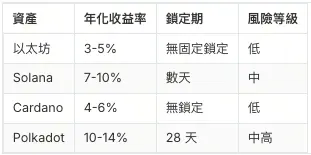
This dual return model of “asset appreciation + staking yield” makes virtual asset reserves more attractive than traditional cash.
The industry spans technology, aquaculture, and gaming: Who is adopting the publicly listed company DAT strategy?
Surprisingly, the public company DAT's strategy is no longer limited to technology companies and has even expanded into traditional industries, indicating that this has become a new option for financial management across industries.
Technology Industry:
Strategy (MSTR): A business intelligence software company transforming into a Bitcoin investment vehicle
Tesla (TSLA): Early Bitcoin holders, currently holding over 11,000 BTC.
Block (SQ): A payment company that holds Bitcoin and provides encryption trading services.
Gaming Industry:
GameStop (GME): Stock price surged after announcing the inclusion of Bitcoin into reserves in March 2025.
SharpLink Gaming (SBET): Gaming marketing company transforms Ethereum reserve strategy
Animoca Brands: A Web3 gaming company with a diversified cryptocurrency asset portfolio.
Traditional Industries:
Nocera Inc. (NCRA): A sustainable seafood and recirculating aquaculture system company, listed on Nasdaq in 2022.
Metaplanet (Japan): Hotel industry transforming into Bitcoin reserve company
Semler Scientific (SMLR): Medical equipment company adopts Bitcoin reserves
Financial Industry:
Galaxy Digital: A cryptocurrency financial services company that holds a large amount of Bitcoin and Ethereum.
This shows that the virtual asset reserve DAT strategy has crossed industry boundaries, becoming a new option for corporate financial management, no longer the patent of technology companies.
Why are traditional industries also adopting DAT?
Hedge against inflation: Seeking alternative reserves under cash depreciation pressure
Shareholder value enhancement: Crypto holdings attract a new generation of investors
Brand Rebranding: Transforming from Traditional Enterprises to “Web3 Pioneers”
Financing Innovation: Issuing convertible bonds to purchase encryption assets, creating leverage effects
Business Collaboration: Some companies are integrating encryption assets into their core business.
Risk still exists, experts remind to assess with caution
Although the listing company DAT strategy brings great opportunities, experts also remind investors to be aware of the risks.
Main Risk Factors
Price Volatility Risk:
· Bitcoin daily volatility can reach 10-20%
· Ethereum and Solana are more volatile
· The significant volatility in market capitalization affects financial report performance.
· May trigger impairment loss (accounting standards requirement)
Regulatory Uncertainty:
· Although the Trump administration supports it, future policies may change.
· The regulatory attitudes of different countries vary greatly.
· Accounting standards are continuously evolving (IFRS, GAAP)
· High complexity in tax processing
Company Fundamentals Dilution:
· Some companies are overly reliant on DAT strategies.
· Ignore core business development
· Stock prices are highly correlated with cryptocurrency asset prices.
· Management focus is scattered
Liquidity Risk:
· Large-scale sell-offs may cause market impact.
· The buying and selling price spread widens under extreme market conditions
·Custody security risks (hacker attacks, private key loss)
Leverage Risk:
· Some companies purchase encryption assets through debt financing.
· Market downturn may trigger margin calls.
· Debt default risk


