Original Author: Weilin, PANews! XRPFi: A New DeFi Path to Activate 100 Billion Market Cap XRP
On June 10, the XRP Ledger Apex 2025 conference was held in Singapore. At the conference, a concept called “XRPFi” became the focus of heated discussion on social media. XRPFi, which is the combination of XRP and Decentralized Finance (DeFi), is increasingly seen by more practitioners as a new path to activate XRP, this long-established crypto asset, and drive the growth of the XRPL and Ripple ecosystem.
XRP is one of the most representative assets in the cryptocurrency market, with a market capitalization close to 134.4 billion USD, making it the highest non-smart contract cryptocurrency by market capitalization, after Bitcoin. With its fast and low-cost cross-border payment capabilities, XRP has stable applications in traditional financial scenarios. However, in the on-chain domain, XRP has long lacked smart contract support, making it difficult to integrate into the mainstream Decentralized Finance ecosystem. This structural contradiction has gradually become a focal point of attention.
With the SEC pausing its lawsuit against Ripple, the market capitalization of Ripple’s stablecoin RLUSD approaching $390 million, and ongoing speculation about an XRP ETF, investor expectations for XRP’s future are gradually heating up. Some institutions and retail investors are beginning to focus on how XRP can leverage Decentralized Finance to generate returns and enhance asset efficiency, which has also driven the birth and development of the “XRPFi” concept.
Empowering XRPFi with Flare to Build a Multi-Chain Interoperable Decentralized Finance Ecosystem
In the current development process of XRPFi, Flare Network is seen as a key infrastructure provider. Although the XRP Ledger (XRPL) performs excellently in terms of speed and stability, it has inherent limitations in the composability and contract functionality required for Decentralized Finance. Therefore, Flare chooses to technically empower XRP, becoming the core engine that bridges the traditional XRPL with the multi-chain DeFi ecosystem.
Flare is an EVM-compatible L1 blockchain designed for multi-chain interoperability. Its FAssets protocol can map non-smart contract assets such as XRP into FXRP, enabling them to have contract call capabilities, thereby seamlessly integrating into decentralized lending, trading, and derivatives protocols. With this mechanism, XRP holders can participate in mainstream chain yield activities including staking, liquidity mining, and more.
In addition, Flare has also introduced the USD₮ 0 stablecoin as a native asset issued based on LayerZero’s OFT (Omnichain Fungible Token) standard, with cross-chain native interoperability. When paired with XRP, USD₮ 0 can not only be used to build deep trading pools and lending collateral, but also connect to the USDT ecosystem with a market capitalization of more than ₮155 billion, injecting a highly liquid “capital base” into the XRPFi ecosystem.
According to official data, the Flare ecosystem has seen significant growth recently: as of June 10, the TVL surpassed $157 million, mainly due to the launch of USD₮ 0, which currently has a supply of approximately $92.1 million. Looking at a longer timeframe, from February 2024 to February 2025, Flare’s TVL is expected to grow by over 400% year-on-year. Additionally, Flare has integrated wallet tools compatible with XRPL, such as Bifrost and Oxenflow, further lowering the entry barrier for users.
Flare describes its XRPFi system as a “flywheel model”: providing a capital source at USD₮ 0, FXRP achieves contract composability, and the pairing of the two brings liquidity, further driving more DeFi applications and real-world scenarios, which in turn feeds back into the long-term ecological value of XRP.
In the future, Flare also plans to bring non-smart contract assets such as Bitcoin and Dogecoin to Flare, expanding its use cases in the Decentralized Finance field.
Build the XRPFi Yield Matrix, CeDeFi and On-chain Strategies Running in Parallel
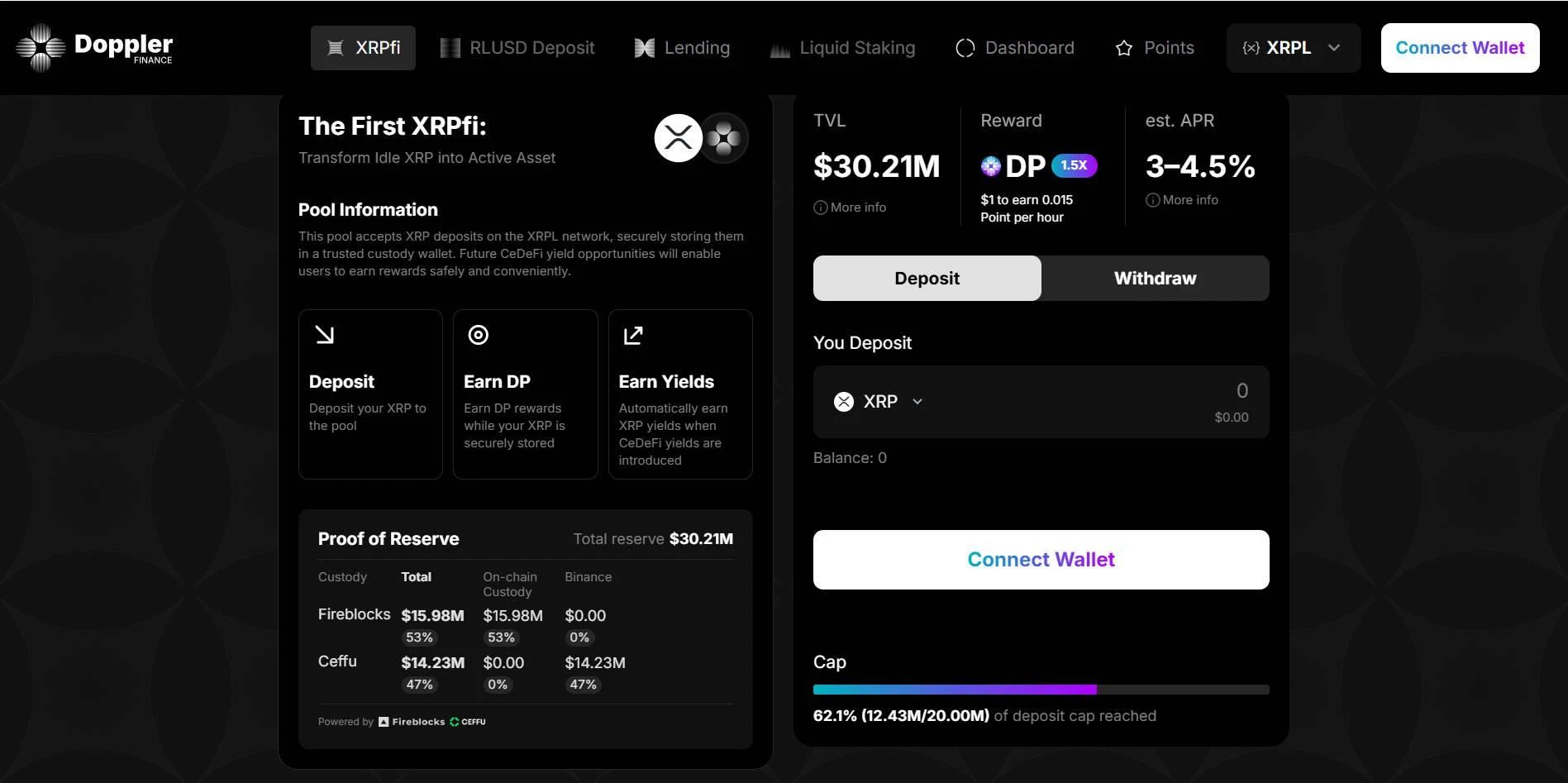
While building compatibility on the Flare chain, Doppler Finance has designed a complete set of yield mechanisms around XRP, attempting to fill the gaps in XRP’s past regarding yield generation and financial products. As of June 8, the platform has attracted over $30 million in TVL, becoming one of the important participants in the XRPFi space.
Doppler Finance offers two main types of yield products: CeDeFi yield and on-chain DeFi strategies. The former mainly manages assets through institutional-grade custody and quantitative operations, while the latter explores on-chain yield scenarios including lending, stablecoin strategies, and staking.
In the CeDeFi model, users deposit XRP into a dedicated address, and the assets are held by custodians such as Fireblocks and Ceffu, and are scheduled to be transferred to centralized exchanges for quantitative strategies, such as arbitrage and basis trading. The profits are then settled off-chain and returned to the user’s account.
In terms of on-chain yield, Doppler is actively integrating with the XRPL sidechain ecosystem, including EVM-compatible networks and emerging protocols. Its strategy includes:
- XRP Lending: Earn interest or native rewards by depositing XRP into an audit-compliant lending protocol. Borrowers use other assets as collateral, and the platform automatically manages the liquidation process to ensure security.
- Stablecoin Yield Strategy: Use XRP as collateral to borrow stablecoins (such as USDC), and then deploy them into stablecoin yield protocols. Doppler adopts a conservative LTV ratio and dynamically adjusts positions to achieve low-risk returns.
- Liquidity Staking and Leverage Strategy: Users can perform one-click leveraged staking in specific LST pools, especially around sidechain tokens like ROOT. This mechanism simplifies cumbersome operational processes through automated contracts, enhancing user experience.
In order to further reduce risk, Doppler Finance is building a risk-isolated lending marketplace that allows different asset pools to operate independently, so as to avoid high-volatility assets dragging down the overall system stability. In addition to the core pool containing mainstream assets such as XRP, USDC, ROOT, etc., Doppler Finance also plans to launch multiple segregated markets, including an LST pool designed for leveraged yield farming, and a segregated marketplace containing game tokens from the Futureverse ecosystem.
As XRPFi involves asset cross-chain, custody, and advanced strategy execution, its security mechanism has become an important part of project design. Currently, Doppler Finance adopts a multi-layer risk control mechanism.
In terms of asset custody, the platform selects top industry service providers (such as Fireblocks and Ceffu) and ensures asset security through methods such as cold wallet management, on-chain verification, and bankruptcy isolation. In terms of quantitative trading, the platform adopts a multi-strategy and multi-team collaboration model, designing most operations as “lending contract structures” to ensure that the principal can be recovered under non-extreme circumstances.
In addition, according to official information, all cooperating operators must undergo rigorous due diligence, including assessments of historical performance, strategy stability, AUM scale, and financial risks, to select qualified institutions to participate.
Fill the gap in the DeFi market, XRPFi is still in the early stages
With the involution of the Ethereum DeFi ecosystem, the market is turning its attention to high-capitalization assets that have not yet been fully activated. The emergence of XRPFi is filling the gap of XRP’s long-standing “high market cap, low chain use”. XRPFi is implemented through technologies such as the FAssets protocol of the Flare network, allowing XRP, which originally lacked smart contract capabilities, to enter the DeFi ecosystem. Doppler Finance is building a set of sustainable yield mechanisms, including CeDeFi yields and liquid staking, which not only has a real path, but also invests resources to improve security and user experience.
Logically, the development of XRPFi responds to the urgent demand generated by the activation of the XRP and Ripple ecosystem. However, it should be noted that the current XRPFi ecosystem is still in its early stages. Although the product roadmap of Flare and Doppler is relatively clear, the overall user scale, liquidity depth, and protocol maturity still need to be verified. How will old assets integrate into the new narrative? PANews will continue to keep an eye on this.


