The Thunderbolt protocol reconstructs off-chain interaction logic in the form of a Soft Fork, introducing UTXO Bundling and OP_CAT, enhancing scalability and Programmability, and providing a more native and composable infrastructure paradigm for BTCFi.
Written by: YBB Capital Researcher Ac-Core
1. Why can’t Bitcoin buy coffee?
When it comes to Bitcoin, most people first think of its attributes of “decentralization” and “immutability”. However, when you really want to use it to buy a cup of coffee, you quickly encounter an awkward issue: the transaction confirmation time can take longer than waiting for the coffee, and sometimes the transaction fees are even more expensive than the coffee itself. The assets on Bitcoin are still “as immobile as a mountain” — primarily relying on HODL, unable to loan, unable to pool, and unable to interoperate.
Bitcoin Script’s script structure is extremely conservative, restricting most off-chain interactions, and it is not designed to process tens of thousands of payments per second. But the real demand is there - everyone just wants Bitcoin to be usable, even if it’s just to buy a game skin, watch a video and get a reward, and don’t want to wait ten minutes.
2. Lightning Network: A Double-Edged Sword
Source: Cointelegraph
The Bitcoin main chain is like a highway, while the Lightning Network is akin to a toll express lane built alongside it. Its core concept stems from a compromise on the transaction efficiency of the main chain: since there are speed bottlenecks in on-chain transactions, there is no longer a fixation on recording every transaction on the chain but rather establishing exclusive “payment channels” between users to achieve high-frequency bookkeeping, ultimately synchronizing the fund status to the blockchain only when the channel is closed. This model is similar to the settlement method of friends taking turns to treat each other weekly—people do not immediately bank transfer after each meal but rather settle the accounts all at once after accumulating ten expenses. The Lightning Network is essentially a transaction network woven together by tens of thousands of such payment channels.
However, this seemingly ingenious system exposes multiple dilemmas in practical application. First is the high threshold for channel construction; users must lock funds in advance to establish a trading channel, which means that to trade with any party, a dedicated channel connection must be established in advance. Second is the complex routing problem; when user A lacks a direct channel to B, even if there is an indirect path A-C-B, if the intermediate channel has insufficient funds or the path nodes are unavailable, the transaction will still fail. More severe is the security risk; the system requires users to remain online to prevent the counterparty from submitting expired transactions for fraud when the channel is closed, which imposes unrealistic demands on the operational capabilities of ordinary users’ devices.
Despite the fact that the Lightning Network has been operational for many years, these structural flaws have led to its practical application being difficult to break through the bottleneck. Public data shows that the current total amount of funds locked in the Lightning Network is only around 100 million USD, which is nearly marginalized in its ecological status compared to the trillion-dollar market value of the Bitcoin system. This inevitably raises deep thoughts in the industry: Can we build a more完善的离链支付协议 to break through the existing dilemma?
According to Chain Catcher on April 15, HSBC disclosed in an official press release that Bitcoin Thunderbolt is the most landmark technological upgrade of Bitcoin in a decade. The overall view of Thunderbolt is more like “Lightning Network 2.0”, but it is not just an upgrade, but more like a reconstruction of the off-chain Bitcoin interaction paradigm.
3. What is the Thunderbolt protocol?

Image source: Nubit | Bitcoin Thunderbolt
Bitcoin Thunderbolt is a Soft Fork upgrade method based on the Bitcoin base layer. It does not rely on second-layer networks or cross-chain bridge compromises, but rather makes changes directly at the protocol level of the Bitcoin main chain, fundamentally enhancing Bitcoin’s scalability, transaction performance, and Programmability.
From a performance perspective, Nubit leverages UTXO (Unspent Transaction Output) Bundling technology to achieve significant optimization compared to the traditional Bitcoin transaction processing model. The traditional Bitcoin network, due to its single UTXO model, has notable limitations in transaction speed and throughput. UTXO Bundling allows multiple UTXOs to be aggregated for processing, effectively compressing the transaction data size, thereby increasing transaction speed by approximately 10 times without sacrificing security.
In terms of programmability, Bitcoin Thunderbolt reintroduces and expands the OP_CAT opcode (which originally existed in early versions of Bitcoin but was later removed). OP_CAT allows for data concatenation operations, enabling developers to build more complex script logic, thus directly implementing smart contracts on the Bitcoin main chain. The most immediate benefit of this upgrade is that developers can deploy decentralized applications (dApps) on the native Bitcoin network without relying on sidechains, Rollups, or cross-chain bridges.
In terms of asset protocol integration, Nubit advocates and implements a unified standard called Goldinals. Goldinals provides an asset issuance framework based on zero-knowledge proofs and state commitments. Simply put, this is a “Bitcoin-native” token standard that can verify the existence and status of each token on-chain without relying on external trust agencies or requiring complex off-chain bridges. BitMM, which operates on Bitcoin, integrates various protocol assets such as BRC-20, Runes, and Ordinals as an on-chain automated market maker. Nubit has also made significant breakthroughs in trustless trading. Its launched BitMM (Bitcoin Message Market) system supports users in conducting trustless transaction matching and information verification on the Bitcoin chain.
Unlike traditional scalability approaches (such as using sidechains, Plasma, Rollups, or bridged wrapped tokens), Nubit adopts a “mainchain native scalability” path. BitVisa provides a decentralized identity and credential system. Whether it’s transaction compression, smart contract support, or asset standard integration and on-chain transaction matching—everything runs directly on the Bitcoin mainchain. It uses native BTC instead of cross-chain mapped tokens.
3.1 Core Mechanism Analysis
This chapter is based on the explanation in the article “Stateless and Verifiable Execution Layer for Meta-Protocols on Bitcoin” (see reference link 1). From my personal understanding, Bitcoin Thunderbolt (雷霆网络) and Bitcoin Lightning (闪电网络) are similar, both proposed as scaling solutions to address the issue of slow transaction confirmations on the Bitcoin main chain, with the core goal of improving efficiency and reducing costs. The differences between the two are:
- The design of the Lightning Network is more inclined towards “payment channels” — it can only be used for transfer payments, does not support smart contracts or complex logic, and its setup and maintenance have a high threshold, which is not conducive to large-scale adoption.
- Thunderbolt is launched by Nubit, dedicated to providing an off-chain protocol with programmability, supporting Turing-complete operations, capable of constructing more complex state assets, liquidity protocols, and financial applications.
Flexible and Adjustable Multisignature
Imagine splitting a Bitcoin “signature” in half: one half is in Alice’s hands, and the other half is with the committee. Each time a new user is transferred, Alice and the committee each “add a little secret” to their respective halves of the signature - only the receiving new user knows this secret. The recipient can use the little secret they know to “stitch” the two halves back together and obtain the complete signature, without needing to have an online conversation with Alice and the committee.
Asynchronous Fault-Tolerant Committee Ledger
A “service group” composed of several nodes (such as 4n+1) is responsible for bookkeeping, and everyone confirms who the current owner is. Even if a few nodes fail, as long as the majority are still online, the ledger can continue to operate normally. These nodes only “help with signing” and “bookkeeping” and cannot arbitrarily use funds, ensuring safety and decentralization.
Atomic Swap Finalization
When it comes time to actually spend this money on-chain, it goes through three steps of “atomic swaps”: 1. Alice+ the committee spends the original locked output, temporarily giving the money to the committee; 2. The committee locks an equivalent amount into a vault that can only be accessed by both “Zenni and the committee”; 3. Finally, Zenni uses two signatures to take the money from the vault. This way, neither Zenni nor the committee can run off with the money, ensuring that off-chain reconstruction and on-chain redemption are completed seamlessly.
3.2 Thunderbolt Protocol Design and Key Innovations
· Non-interactive, recursive signature delegation
Designed a tweakable threshold Schnorr signature structure, traditional payment channels often require several back-and-forth messages, Thunderbolt only needs to “send a signed message with a small secret” each time to get it done, greatly reducing the online requirements.
· Each transfer changes to a ‘new lock’
Each time a transfer occurs, Alice and the committee update the signature with a new small secret, completely invalidating the old “lock”. This way, no one from before can obtain the new signature, preventing the old signature from being reused.
· Leave a trace on-chain only once
Only lock once on-chain at the beginning, and all subsequent changes are done off-chain, with the final spending occurring on-chain. Compared to the Lightning Network, which requires constant opening and closing of channels, Thunderbolt has fewer on-chain operations and better privacy.
· You won’t lose money offline
Even if Alice or Zenni is offline, as long as the majority of the committee is online, the transfer or redemption can be completed at any time without worrying about the expiration of the time lock or malicious closure of the channel by the counterpart.
· True “Proof of Machine” Security
All key steps in the protocol have been “formally verified” using Tamarin Prover, which means that these security assurances are not just theoretical, but have been repeatedly tested by automated tools.
4. How does Thunderbolt differ from existing Lightning Network solutions?
Let’s take a look at how Thunderbolt compares to existing solutions (e.g., BOLT protocol, Breez SDK, Phoenix) to see where it improves.
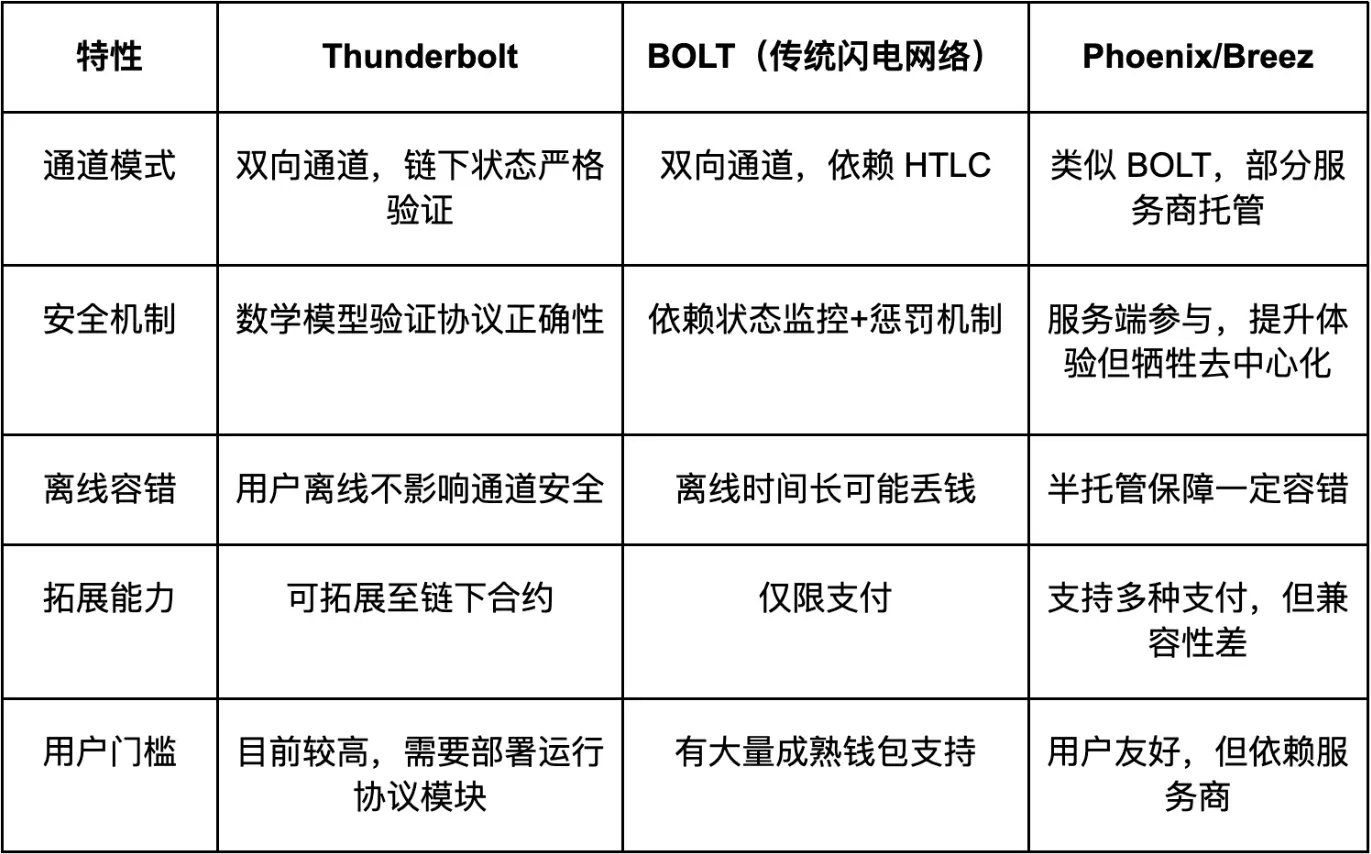
The difference between Thunderbolt and existing Lightning Network solutions:
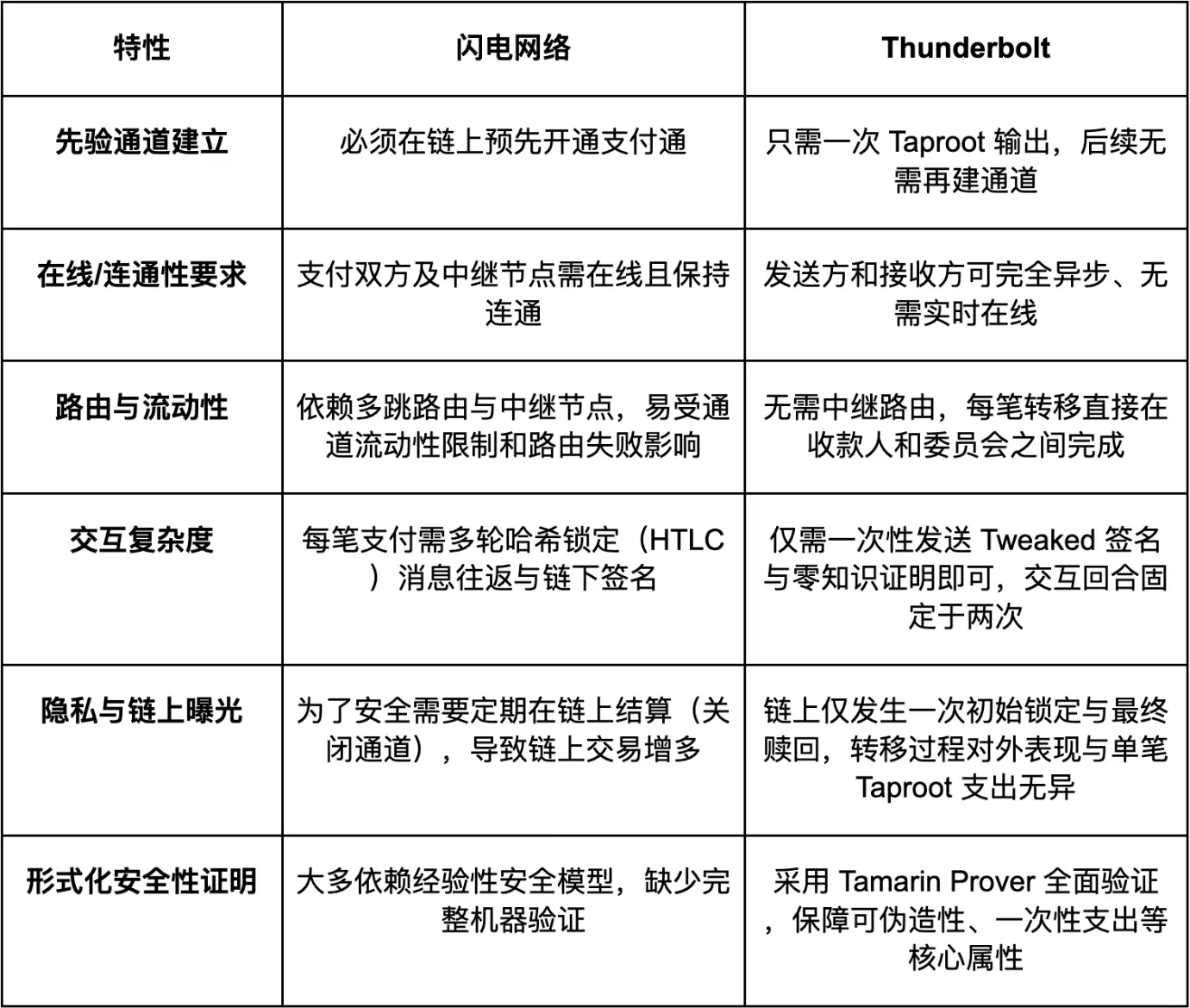
We can see that the main advantages of Thunderbolt lie in “security” and “theoretical completeness”. It is one of the few that can achieve this:
- The protocol design can be proven to be secure.
- Malicious users cannot profit unilaterally under any circumstances.
But its disadvantages are also very obvious:
- Deployment Complexity: To use Thunderbolt, you currently need to run the complete protocol stack, which is difficult for ordinary wallet users to grasp.
- Main chain compatibility: The scripting language of the Bitcoin main chain is too simplistic, and Thunderbolt must implement functionality through clever workarounds, increasing the difficulty of implementation.
- Ecosystem support is still lacking: Unlike BOLT which already has a large number of wallets and nodes supporting it, Thunderbolt is currently still in the “early research stage”.
5. The Potential Impact of Thunderbolt: A Catalyst for BTCFi?
Source: Homemade
So is Thunderbolt the optimal solution for BTCFi? Let’s throw out a bold opinion:
Thunderbolt is currently the theoretically optimal solution for BTCFi, but it is still in the “Alpha stage” in practice. In other words, it is like the “Ethereum 2.0 white paper” in the world of Bitcoin, full of vision but has not yet entered the “engineering system level” of implementation. Based on current observations, I believe there are three potential development paths for Thunderbolt:
- Integrated as a Rollup: As a DeFi engine on the Bitcoin side.
The Bitcoin main chain itself lacks scalability, and Thunderbolt may eventually become an off-chain module on some Bitcoin L2 (such as BitVM, Nomic, BOB). This is similar to integrating Thunderbolt into a Rollup as a general contract execution layer.
For example:
- BOB can integrate the Thunderbolt channel layer to achieve native BTC transactions.
- The RGB ecosystem may also introduce Thunderbolt state management logic.
- BitVM itself supports more complex logic, Thunderbolt will become one of the contract standards.
- Services such as Babylon, Bitlayer, etc.
- Form an independent standard ecosystem that runs in parallel with the main chain.
Like the Lightning Network, Thunderbolt is likely to develop its own network ecology, node operation and maintenance system, aggregators, etc., and even form a Thunderbolt-LSP operator. At the same time, the soft fork upgrade of the protocol layer promoted by Nubit and Satoshi Nakamoto miners introduces the two major features of UTXO Bundling and OP_CAT, and can also directly undertake BTC protocol assets (BRC20, Runes, Ordinals), which will generate a very large imagination here. Perhaps in the future it may have:
- Thunderbolt Wallet (similar to Phoenix)
- Thunderbolt Node (Light Node Operating Channel)
- Thunderbolt DEX (off-chain order matching)
- Thunderbolt AMM (Liquidity Pool)
- Replaced by a simpler solution
Of course, if in the future a system emerges that can achieve similar functions without state channels, without formal languages, and without off-chain protocol collaboration, then Thunderbolt may just be a transitional product, akin to:
- BitVM would achieve a more efficient contract execution environment.
- Cross-chain ZK technology allows BTC assets to be fully trusted and deployed on other chains.
- A certain native Bitcoin protocol unifies payment + lending + contracts modeling.
Finally, from an ecological perspective, the biggest significance of Thunderbolt is not that it can run payments, but that it enables Bitcoin assets to have off-chain contract programmability for the first time. This may sound abstract, but we can see how crucial this “programmability” is from the explosion of Ethereum’s DeFi. The explosion of Ethereum is attributed to the complete ecosystem of Solidity + Hardhat + Ethers.js + Metamask.
The biggest highlight of Thunderbolt is the introduction of two major features: UTXO Bundling and OP_CAT. OP_CAT introduces native programmability to the Bitcoin network, while UTXO Bundling ( bundles multiple small transactions together for processing, compressing the scale of transaction data and increasing on-chain throughput, with logic similar to Ethereum Rollup. It seems that unifying all Bitcoin ecosystem protocols and accommodating various assets and the implementation of BitMM is no longer a pipe dream, but Thunderbolt still feels like it has written a very strong mathematical paper, and there may still be a considerable distance before developers can use it.
Reference link:
(1)


