 Ethereum (ETH), once the “gem” of the altcoin community, is currently under heavy pressure as its price has dropped to the lowest level since 2020.
Weakened network activity, a sharp decline in active addresses, and reduced transaction fees – although somewhat offset by the record low token burn rate following the Dencun upgrade – has created significant inflationary pressure.
With the value continuing to decline, the question arises: Can this “big player” in blockchain recover after the long slide, or is this just the beginning of an endless downturn?
Ethereum lags behind Bitcoin with a deeper decline
The latest price drop of Ethereum marks a worrying divergence compared to Bitcoin. As ETH plummets to a 5-year low, its downtrend is even stronger than that of BTC.
Data shows that in recent weeks, Bitcoin has only lost about 10% of its value, while Ethereum has dropped nearly 45%, reflecting a serious decline in investor confidence in ETH.
 Source: TradingViewWhile Bitcoin has maintained relative stability in the context of a declining market, Ethereum faces its own challenges, indicating deeper internal issues beyond macroeconomic impacts.
Ethereum is free-falling
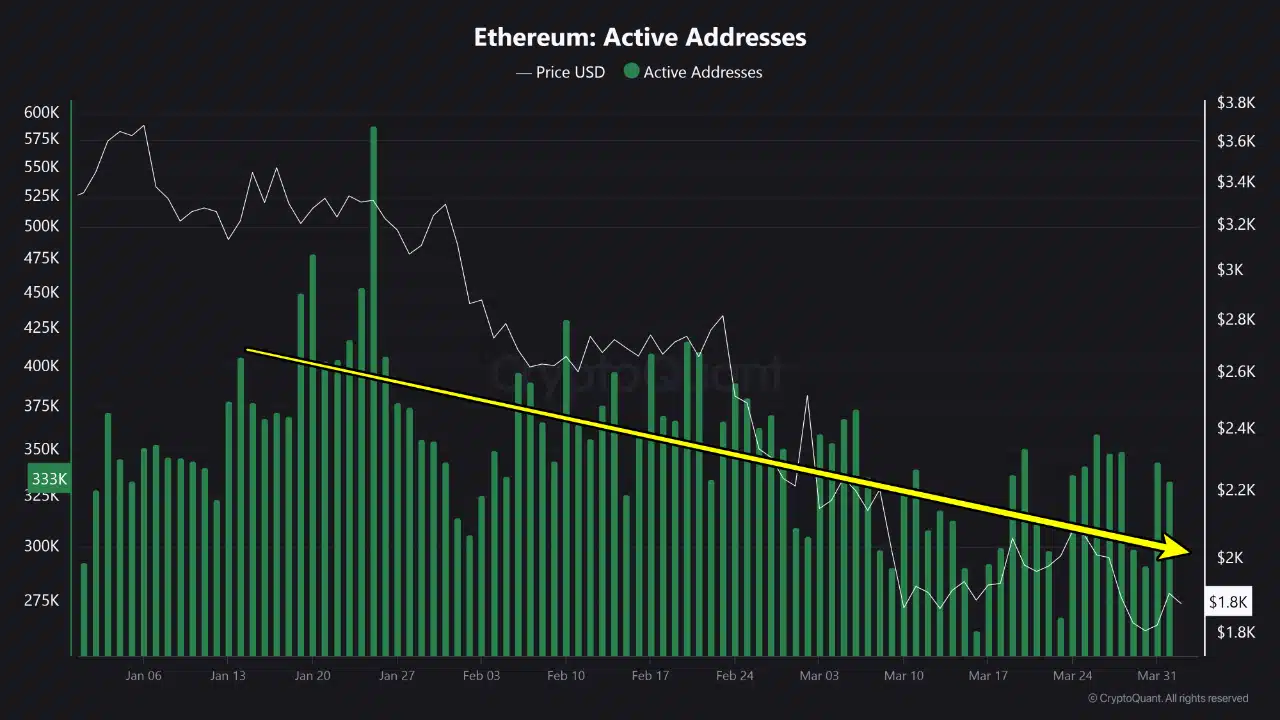 Source: CryptoQuantThe number of active addresses on Ethereum has decreased sharply since the beginning of the year, from about 525,000 to around 333,000. This decline is occurring alongside the downward price trend, which is currently stabilizing around the $1,800 mark.
The continuous decline in network activity reflects a significant weakening in user engagement and transaction volume.
 Source: CryptoQuantRecent data also shows that the total amount of fees burned of Ethereum has decreased sharply, in sync with the declining trend of the number of active addresses, indicating a decline in on-chain activity.
A lower burn rate may mean that the network is less congested or has fewer high-priority transactions, further reinforcing Ethereum’s downtrend.
Is inflation an inevitable consequence?
The Dencun upgrade was once expected to make Ethereum more sustainable in the long run. However, subsequent developments have sparked much debate, as the total supply of Ethereum unexpectedly surged.
Data shows a stark contrast between the pre-The Merge phase – when supply was gradually decreasing – and the inflation trend following this upgrade.
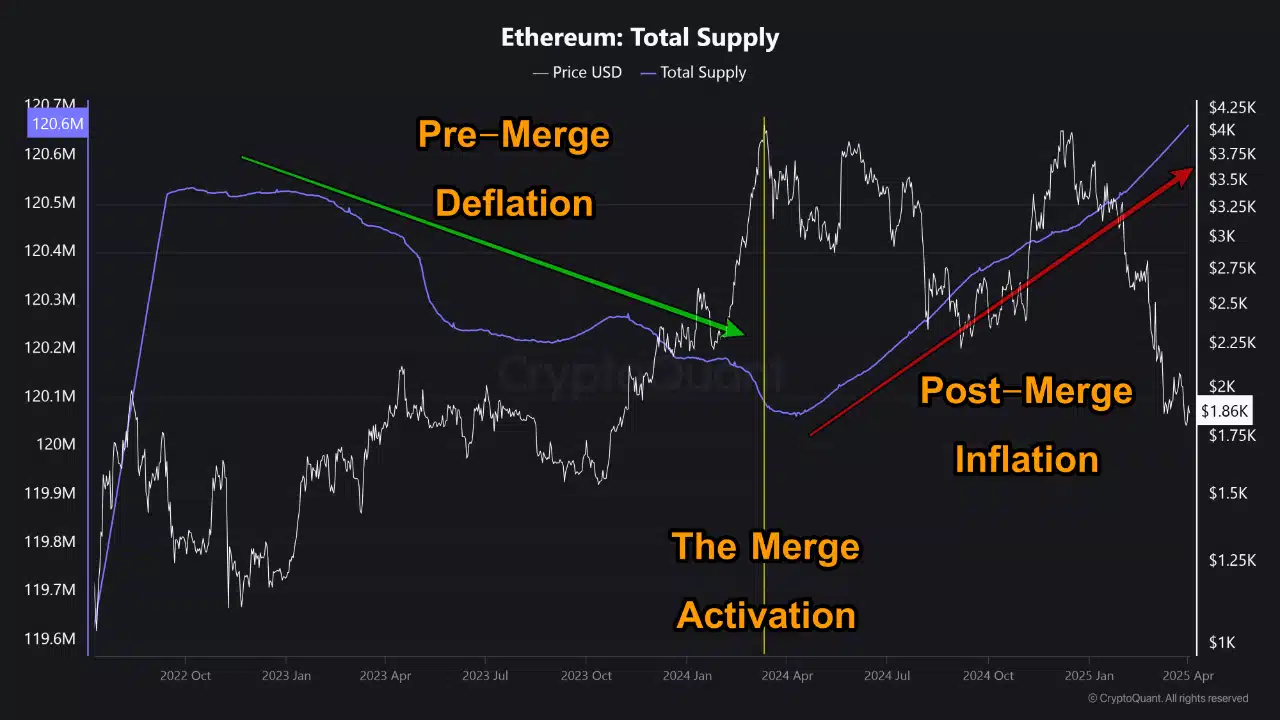 Source: CryptoQuantInitially, The Merge brought optimism with the deflationary benefits, as the issuance rate of ETH decreased and the amount of tokens burned was greater than the amount created.
However, after the Dencun upgrade, the burning mechanism could not contain inflation due to decreased transaction volume and weakened network activity. As the burned fees gradually decreased, Ethereum returned to an inflationary state.
Although Dencun is designed to make Ethereum more flexible, it inadvertently exacerbates inflation during the bear market.
This reality raises questions for many about whether Ethereum’s initial deflationary vision is still valid. It remains unclear whether future updates – such as the anticipated Pectra upgrade on April 30 – can rebalance sustainability and inflation control.
You can check the price of ETH here.
Disclaimer: This article is for informational purposes only and is not investment advice. Investors should conduct thorough research before making any decisions. We are not responsible for your investment decisions.
- Ethereum has recorded a prolonged downtrend, but data indicates the bottom for ETH/BTC.
- Ethereum (ETH) is attempting to recover as the downward momentum is gradually weakening.
Itadori
@media only screen and (min-width: 0px) and (min-height: 0px) {
div[id^=“wrapper-sevio-d89f58f5-7b63-40be-98c0-6b1fd62584fb”] {
width:320px;
height: 100px;
}
}
@media only screen and (min-width: 728px) and (min-height: 0px) {
div[id^=“wrapper-sevio-d89f58f5-7b63-40be-98c0-6b1fd62584fb”] {
width: 728px;
height: 90px;
}
}
Disclaimer: The information on this page may come from third parties and does not represent the views or opinions of Gate. The content displayed on this page is for reference only and does not constitute any financial, investment, or legal advice. Gate does not guarantee the accuracy or completeness of the information and shall not be liable for any losses arising from the use of this information. Virtual asset investments carry high risks and are subject to significant price volatility. You may lose all of your invested principal. Please fully understand the relevant risks and make prudent decisions based on your own financial situation and risk tolerance. For details, please refer to
Disclaimer.


