
On Wednesday, the Pi Network core team announced that the remote procedure call (RPC) servers for the testnet have officially gone live, allowing developers to simulate, test, and deploy smart contracts on-chain. This marks an important technical milestone for ecosystem development. PiScan data shows that more than 1.21 million PI tokens have flowed into centralized exchanges (CEX). The core team has also同步 (simultaneously) sold off more than 21.8 million tokens, with cumulative pressure continuing to build on the supply side.
Testnet RPC Goes Live: A Foundational Technical Milestone for the Smart-Contract Ecosystem
According to an announcement from Pi Network’s official X account, the testnet RPC servers use a standard JSON-RPC interface, enabling developers to interact with the Pi Network blockchain through industry-standard protocols. This also lays the technical groundwork for later integrations with mainstream crypto wallets such as MetaMask and decentralized applications (dApps).
It’s worth noting that the RPC servers are currently deployed only in the testnet environment and have not yet been running on the mainnet. This means there is still some distance before smart-contract functionality is officially opened to the public. At the same time, retail market sentiment continues to be suppressed by multiple factors: the ongoing second mainnet migration, users’ dissatisfaction with the KYC verification process, and the fact that token liquidity has not been fully opened yet.
Supply-Side Pressure: Dual Selling Pressure Sources and Ongoing Downward Signals
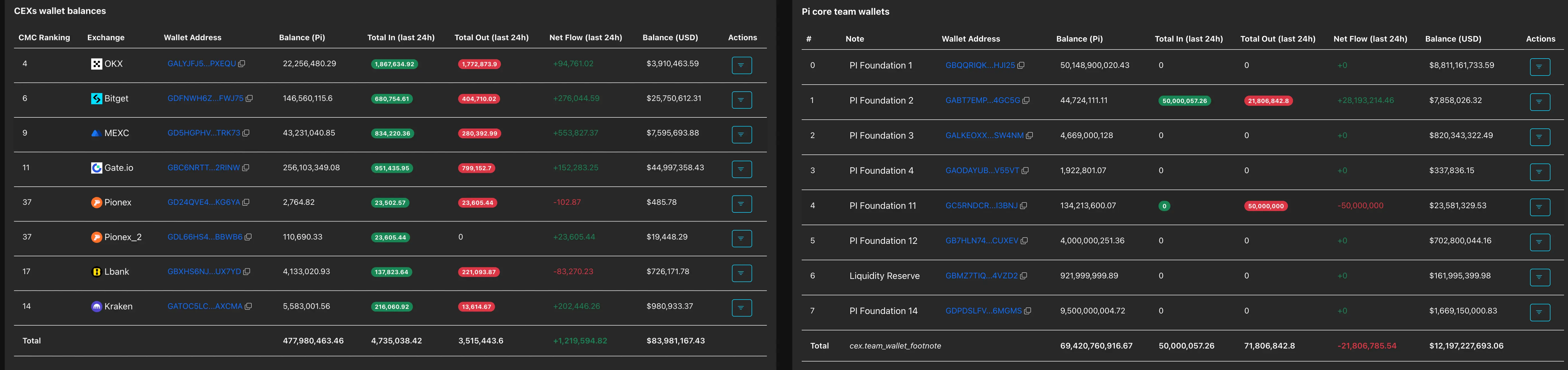 (Source: PiScan)
The sell-off pressure currently faced by the PI token comes from two structural sources, creating a compounded effect:
Core Team Selling: In the recent period, the core team has cumulatively sold about 21.8 million PI tokens. Analysts believe this is related to the second mainnet migration process being pushed forward. While it is considered routine activity, it still adds downward pressure in an environment where market liquidity is relatively weak.
User Recharges Entering the Market: The second mainnet migration allows users to deposit their held PI tokens into CEX. PiScan shows that there are currently more than 1.21 million PI tokens circulating on centralized exchanges. Ongoing recharges bring additional tradable supply, creating structural sell pressure.
The combined effect of these two sell pressures means that even with the positive news of the RPC server going live, the PI token still cannot form effective upward momentum.
Technical Analysis: Triple EMA Suppression and a Bull-Bear Standoff at Key Support Levels
 (Source: Trading View)
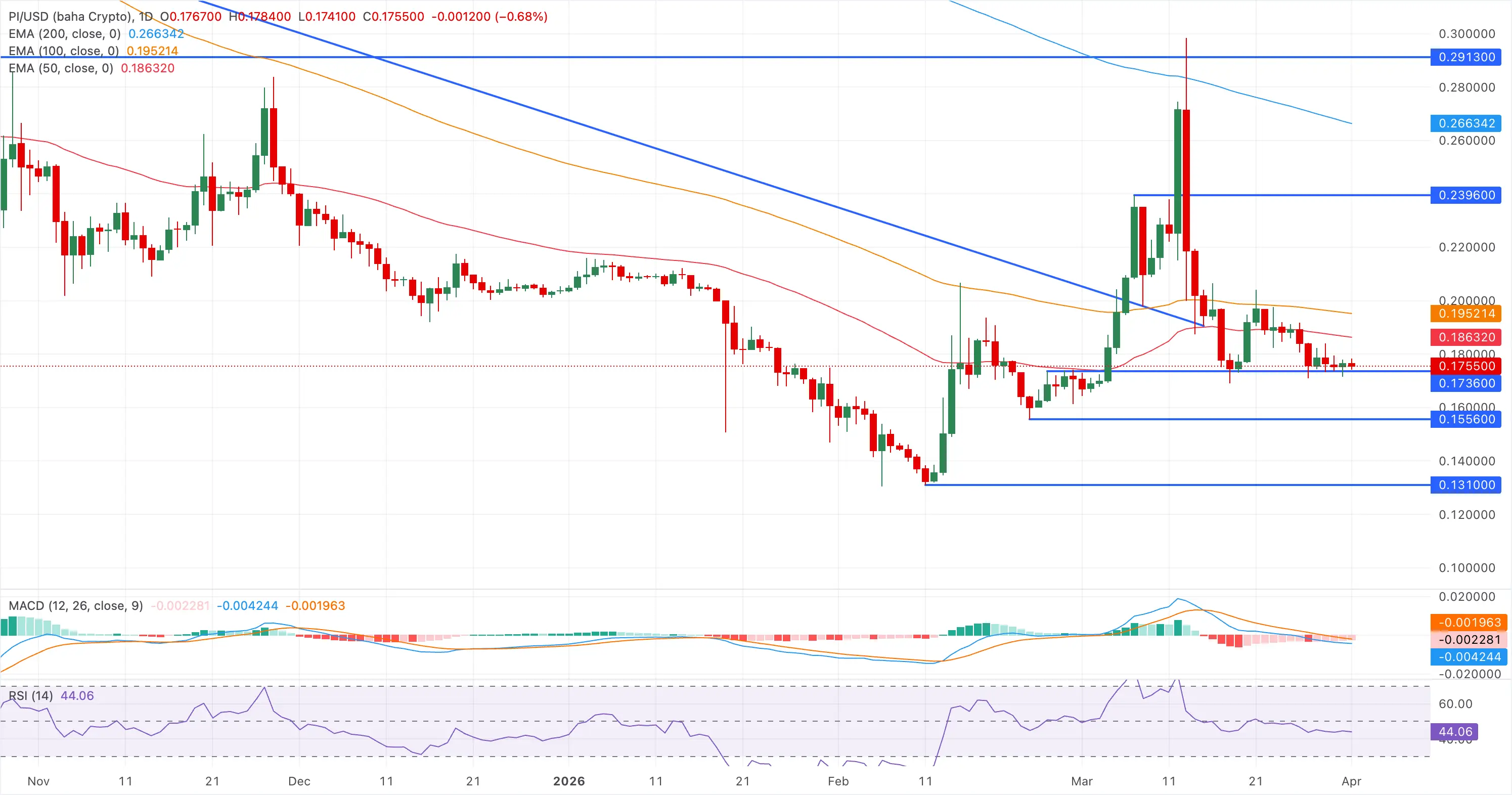
The PI token is currently trading under comprehensive suppression from three moving averages:
· The 50-day exponential moving average (EMA) is at $0.1863, the 100-day EMA is at $0.1952, and the 200-day EMA is at around $0.2663—forming a layered technical resistance band. The token has consolidated for three consecutive days around the $0.1736 support level, indicating that buyer strength is insufficient to drive an effective breakout.
· The MACD line remains below the signal line and the zero axis, with the histogram showing mild negative values—reflecting weak momentum, though there is no sign of aggressive selling. The Relative Strength Index (RSI) is 44, below the 50 midline, consistent with persistent but moderate bearish pressure.
· Key technical levels to watch: If the daily close falls below $0.1736, support will be tested in sequence at the Feb 23 low of $0.1556 and the Feb 11 low of $0.1310. If market sentiment turns and breaks through the $0.1952 resistance zone, it could pave the way for a retest of the March 7 high of $0.2396.
Frequently Asked Questions
What does the launch of the Pi Network testnet RPC server mean for developers?
The RPC server enables developers to simulate and test smart contracts in the Pi Network testnet environment using the standard JSON-RPC protocol, and to explore potential integrations with wallets such as MetaMask. Since the functionality is currently limited to the testnet and no timeline has been announced for the launch of smart-contract features on the official mainnet, ecosystem development is still in an early stage of technical validation.
Where are the most critical technical support and resistance levels for the PI token right now?
According to technical analysis, $0.1736 is the most critical short-term support level at present, and the token has consolidated around this area for three consecutive days. If this level fails, support below will be $0.1556 and $0.1310 in sequence. The initial resistance level for a bullish rebound is $0.1863 ($50-day EMA) and $0.1952 ($100-day EMA).
How does the Pi Network core team’s selling of PI tokens affect the market?
In this round, the core team sold approximately 21.8 million PI tokens. PiScan data shows that this is related to the second mainnet migration process and constitutes routine activity during the migration. However, in a context where market liquidity is weak and user recharges bring additional sell pressure, an increase in such supply adds downward pressure to short-term prices. Investors should continue to monitor on-chain fund flow data.
Disclaimer: The information on this page may come from third parties and does not represent the views or opinions of Gate. The content displayed on this page is for reference only and does not constitute any financial, investment, or legal advice. Gate does not guarantee the accuracy or completeness of the information and shall not be liable for any losses arising from the use of this information. Virtual asset investments carry high risks and are subject to significant price volatility. You may lose all of your invested principal. Please fully understand the relevant risks and make prudent decisions based on your own financial situation and risk tolerance. For details, please refer to
Disclaimer.
Related Articles
Pi Network: 1 Million KYC Users Complete 526 Million AI Verification Tasks
According to an article published on April 28 on the official Pi Network website, Pi Network announced that its decentralized workforce infrastructure has been completed by more than 1 million KYC identity-verified users with over 526 million verification tasks. The tasks are part of Pi’s native KYC system, and contributors are compensated with Pi tokens.
MarketWhisper8h ago
Pi Network Breaks Year-Long Resistance as Analyst Maps 1,400% Rally to $2.80
Gate News message, April 28 — Pi Network has broken through a resistance level that held for over a year, reigniting interest in the cryptocurrency ahead of Consensus 2026 in Miami, where the project's founders are scheduled to speak. With 10.2 billion tokens in circulation and a market cap of $1.91
GateNews04-28 07:41
Pi Network Agreement 22.1 Confirmation deadline, v21.2 nodes will automatically disconnect
Pi Network Mainnet Node Operators Agreement 22.1’s upgrade deadline is April 27. After the deadline, nodes that continue running version v21.2 will automatically disconnect from the mainnet, losing the eligibility to process transactions, validate blocks, and receive node rewards. The CEX technical guide also confirms that the deadline for Agreement 23.0 has been moved up from May 18 to May 11, which is one week earlier than the original schedule.
MarketWhisper04-28 03:55
Singapore's Foreign Minister Deploys Custom AI Assistant on Raspberry Pi Using Claude Code
Gate News message, April 27 — Singapore's Foreign Minister Vivian Balakrishnan recently announced he has built a custom AI assistant system, which he calls "the diplomat's second brain," running on a Raspberry Pi 5 (a credit-card-sized microcomputer). The system integrates with his WhatsApp and
GateNews04-27 03:53
Pi Network launches the PiRC1 token framework, banning projects that have no real-world applications from issuing tokens
Pi Network unveiled the Pi Token Design Framework PiRC1 on April 22 as part of the Protocol V22 upgrade. PiRC1’s core rule is: only projects that already have deployable applications within the Pi ecosystem and that have real user demand are eligible to issue tokens. Token proceeds do not flow to the project team; instead, they flow into a perpetual liquidity pool anchored by Pi Coin to prevent rug-pull behavior.
MarketWhisper04-24 03:27
OpenClaw 2026.4.22 Unifies Plugin Lifecycle Across Codex and Pi Harnesses, Reduces Plugin Load Time by Up to 90%
Gate News message, April 23 — OpenClaw, an open-source AI Agent platform, released version 2026.4.22 on April 22, with its biggest change being the alignment of Codex harness and Pi harness lifecycles. Previously, plugins behaved inconsistently across the two harness pathways, with some hooks
GateNews04-23 14:41


