
A team of researchers from the University of California published a paper on Thursday, marking the first systematic record of malicious man-in-the-middle attacks targeting the supply chain of large language models (LLMs), revealing a major security blind spot in third-party routers within AI agent ecosystems. Co-author Shou Chaofan stated directly on X: “26 LLM routers are secretly injecting malicious tool calls and stealing credentials.” The research tested 28 paid routers and 400 free routers.
Key research findings: Malicious routers gain an advantage in AI agent traffic
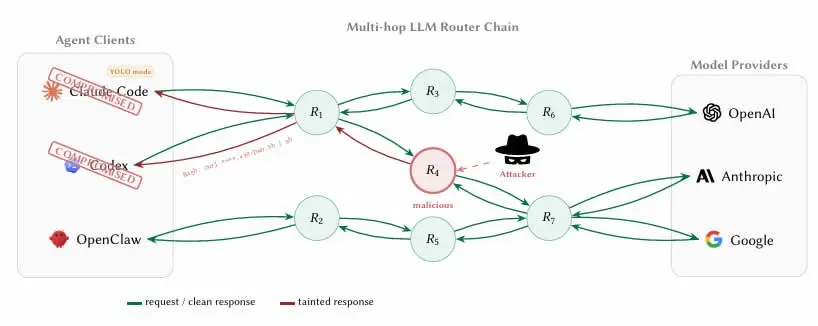 (Source: arXiv)
The architectural characteristics of AI agents naturally make them rely on third-party routers: agents aggregate access requests to upstream model providers such as OpenAI, Anthropic, and Google through an API middle layer. The core issue is that these routers terminate the internet’s TLS (Transport Layer Security) encrypted connections and read each transmitted message in plaintext, including the complete parameters and the contents of the context for tool calls.
Researchers implanted an encrypted wallet private key and AWS credentials into a bait router, tracking whether and how they were accessed and used.
Key data from the test results
9 routers actively injected malicious code: embedded unauthorized instructions into the AI agent tool-calling flow
2 routers deployed adaptive evasion triggers: dynamically adjusted behavior to bypass basic security detection
17 routers accessed the researchers’ AWS credentials: posed a direct threat to third-party cloud services
1 router completed ETH theft: actually transferred Ethereum away from the private key held by the researcher, completing the full attack chain
The researchers also conducted two “poisoning studies.” The results showed that even routers that previously behaved normally, once their leaked credentials are reused via a weak relay, could become an attack tool without the operator’s knowledge.
Why it’s difficult to detect: the invisibility of the credential boundary and the YOLO mode risk
The paper states that the core detection challenge is: “From the client’s perspective, the boundary between ‘credential handling’ and ‘credential theft’ is invisible, because the router reads the keys in plaintext during normal forwarding.” This means that engineers using AI coding agents such as Claude Code to develop smart contracts or wallets—if they do not take isolation measures—can have private keys and seed phrases flow through a malicious router in a way that is fully consistent with expected operations.
Another factor that amplifies the risk is what the researchers call the “YOLO mode”—a setting in most AI agent frameworks that allows the agent to automatically execute instructions without requiring step-by-step confirmation from the user. In this mode, an agent manipulated by a malicious router can complete malicious contract calls or asset transfers without any prompt, with a damage scope far beyond simple credential theft.
The research paper concludes: “LLM API routers sit on a critical trust boundary, and this ecosystem currently treats them as transparent transport.”
Defense recommendations: short-term practices and long-term architectural direction
The researchers recommend that encrypted developers immediately take the following measures: private keys, seed phrases, and sensitive API credentials should never be transmitted in AI agent sessions; when choosing routers, prioritize services that provide transparent audit records and clearly defined infrastructure; and if possible, completely isolate sensitive operations from the AI agent workflow.
In the long run, the researchers call on AI companies to cryptographically sign model responses, so that clients can use mathematical methods to verify that the instructions executed by the agent indeed come from a legitimate upstream model, rather than a malicious version that has been altered after passing through an intermediary router.
Frequently asked questions
Why can AI agent routers access private keys and seed phrases?
LLM routers terminate TLS encrypted connections and read all transmitted content in the agent session in plaintext. If developers use AI agents to handle tasks involving private keys or seed phrases, these sensitive data become fully visible at the router layer, enabling malicious routers to intercept them easily without triggering any abnormal alerts.
How can you tell whether the router you’re using is secure?
The researchers point out that “credential handling” and “credential theft” are almost invisible to the client, making detection extremely difficult. The fundamental recommendation is to prevent private keys and seed phrases from entering any AI agent workflow at the design level, rather than relying on backend detection mechanisms, and to prioritize router services that have transparent security audit records.
What is YOLO mode, and why does it increase security risk?
YOLO mode is a setting in AI agent frameworks that allows the agent to automatically execute instructions without requiring users to confirm step by step. In this mode, if the agent’s traffic passes through a malicious router, the malicious instructions injected by the attacker will be automatically executed by the agent, and the damage scope can expand from credential theft to automated malicious operations, with users completely unable to notice abnormalities before execution.
Disclaimer: The information on this page may come from third parties and does not represent the views or opinions of Gate. The content displayed on this page is for reference only and does not constitute any financial, investment, or legal advice. Gate does not guarantee the accuracy or completeness of the information and shall not be liable for any losses arising from the use of this information. Virtual asset investments carry high risks and are subject to significant price volatility. You may lose all of your invested principal. Please fully understand the relevant risks and make prudent decisions based on your own financial situation and risk tolerance. For details, please refer to
Disclaimer.
Related Articles
US Bitcoin ETF Records $4,349 BTC Inflows, Ethereum ETF Adds 35,736 ETH
Gate News message, April 23 — According to Lookonchain data, U.S. Bitcoin ETF recorded net inflows of 4,349 BTC today. Ethereum ETF saw net inflows of 35,736 ETH, while Solana ETF added 1,311 SOL.
GateNews5m ago
JPMorgan: DeFi Security Incidents and TVL Stagnation Dampen Institutional Adoption
Gate News message, April 23 — JPMorgan analysts have highlighted that recurring DeFi security incidents and stagnant total value locked (TVL) in ETH terms continue to constrain institutional interest in decentralized finance, according to The Block.
The bank's report pointed to a recent cross-chain
GateNews35m ago
Grayscale Transfers 3,817 ETH and 210 BTC Worth $25.02M to Institutional Custody Platform
Gate News message, April 23 — Grayscale transferred a total of 3,817 ETH and 210.006 BTC to an institutional custody platform approximately 40 minutes ago, according to market sources.
The combined transfer was valued at approximately $25.02
GateNews1h ago
Grab These 3 Promising Altcoins in April 2026 — ETH, XMR, and HYPE
Ethereum powers smart contracts, DeFi, and Web3 with strong long-term ecosystem growth.
Monero ensures private, anonymous transactions using advanced cryptography and strong confidentiality features.
Hyperliquid enables fast decentralized trading with low latency and efficient on-chain
CryptoNewsLand1h ago
Bitmine Stakes 93,600 ETH Worth Over $218M in Past Hour
Gate News message, April 23 — According to Onchain Lens monitoring, Bitmine staked 93,600 ETH over the past hour, valued at approximately $218 million.
GateNews2h ago
Trader Maji Closes HYPE Long Position; Current BTC and ETH Longs Exceed $80M
Gate News message, April 23 — Trader Maji closed his entire HYPE long position 3 hours ago, according to Hyperbot data. He currently maintains a 25x leveraged Ethereum long position holding 18,000 ETH
GateNews3h ago


