In a new report, TRM Labs stated that while illicit finance threats remain in Latam, including cartel-linked OTC brokers, Venezuelan sanctioned flows, and Chinese laundering networks, regulations are encircling these threats, with every major Latam market increasing its compliance efforts.
Key Takeaways:
- TRM Labs reports stablecoins drive 95% of illicit Latam inflows, forcing VASPs to upgrade tech next.
- The Sinaloa Cartel laundered $103B in 2025, pushing governments to enforce upcoming AML laws.
- Following these reports, Latam countries are enhancing their compliance standards.
TRM Labs: Regulation is Narrowing Threat Windows In Latam
Crypto regulations are advancing internationally, and Latam is not an exception, even with numerous documented threats. According to TRM Labs, a blockchain intelligence firm, regulations are coming to make cryptocurrency transactions and flows more secure in the region.
In a recent report, TRM Labs disclosed that stablecoins have become the dominant payment rails across Latam, accounting for 95% of inflows to sanctioned entities globally in a region that, due to its economic traits, is open to the adoption of these new technologies.
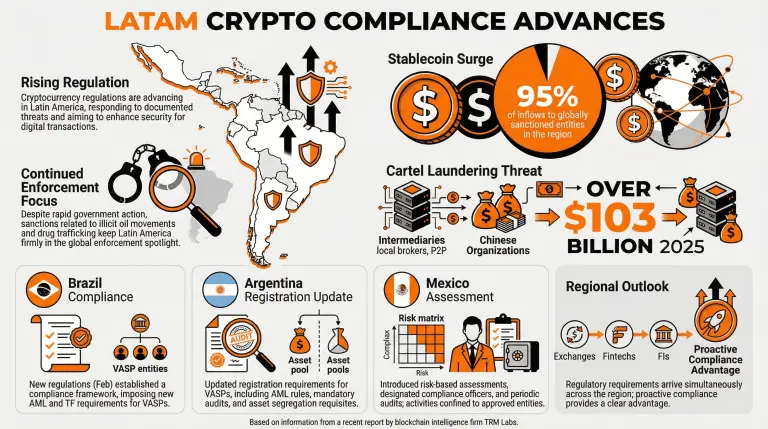
TRM Labs states that the threats are well-documented in the region, including flows linked to the Sinaloa Cartel, leveraging local brokers and P2P exchanges to launder funds using Chinese organizations as intermediaries to process over $103 billion in 2025 alone.
In addition, the institution highlighted that sanctions that remain in place related to illicit oil movements and drug trafficking keep Latam in the enforcement spotlight. Nonetheless, governments are moving quickly to plug these holes and strengthen compliance across the sector.
In Brazil, new regulations passed in February establish a compliance framework that includes new anti-money laundering (AML) and terrorism financing (TF) requirements for virtual asset service providers (VASPs) to receive authorization to operate.
Argentina also tightened oversight over the crypto market, with updated registration requirements for VASPs that include AML rules, audit, and asset segregation requisites.
Mexico also introduced risk-based assessments, designated compliance officers, and periodic compliance audits for entities, as virtual asset activities are still confined to organizations approved by the Central Bank of Mexico (Banxico).
TRM Labs concluded that “for exchanges, fintechs, and financial institutions operating in Latin America, regulatory requirements are arriving across the region simultaneously. Institutions building compliance infrastructure ahead of enforcement deadlines carry a clear operating advantage.”
Disclaimer: The information on this page may come from third parties and does not represent the views or opinions of Gate. The content displayed on this page is for reference only and does not constitute any financial, investment, or legal advice. Gate does not guarantee the accuracy or completeness of the information and shall not be liable for any losses arising from the use of this information. Virtual asset investments carry high risks and are subject to significant price volatility. You may lose all of your invested principal. Please fully understand the relevant risks and make prudent decisions based on your own financial situation and risk tolerance. For details, please refer to
Disclaimer.
Related Articles
Declare Your Crypto or Face Jail: South Africa’s Aggressive New Capital Flow Rules
South Africa’s proposed capital flow management regulations 2026 introduce strict new requirements for travelers entering or leaving South Africa with cryptocurrency.
Key Takeaways
South African Treasury draft rules require visitors to declare crypto or face up to 5 years in prison.
New 2026 cap
Coinpedia1h ago
U.S. OCC Sets Draft Framework for Stablecoin Issuers Under GENIUS Act Framework
OCC draft sets federal rules for stablecoin issuers and custody services, focusing on safety and regulatory compliance.
Proposal excludes AML and sanctions rules, leaving those areas for separate coordination with Treasury agencies.
Framework marks initial step in multi-agency
CryptoFrontNews3h ago
Tether freezes $344 million in USDT on the Tron network: OFAC collaboration, two addresses implicated in sanctions evasion
According to a Decrypt 4/23 report, stablecoin issuer Tether froze two wallets on the Tron chain that day, totaling $344 million USDT—one of the largest single-instance freezing actions in Tether’s history. The entity coordinating the action did so in conjunction with the U.S. Treasury Department’s Office of Foreign Assets Control (OFAC) and U.S. law enforcement agencies. The two addresses were marked as allegedly involved in sanctions evasion, criminal networks, or other illegal activities.
Two Tron addresses total $344 million USDT frozen
Decrypt cites Tether data, saying that this freeze was concentrated on the Tron network, broken down into the following two transactions:
Address (prefix) Frozen amount Chain TNiq9…QZH81 About $213 million USDT Tron
ChainNewsAbmedia3h ago
JPMorgan: DeFi hackers are increasingly common, and interest in compression mechanisms to address TVL stagnation is drawing capital into USDT
JPMorgan Chase’s report believes that DeFi continues to face ongoing vulnerabilities, cross-chain bridge and oracle attacks are frequent, causing TVL to stagnate and weakening institutional investors’ willingness to invest, with capital shifting to USDT that is traceable and can be frozen. The KelpDAO and Rhea Finance attacks reveal risk-management risks; centralized stablecoins and custodial solutions are more favored. In the long run, improving this will require going beyond insurance and governance. DeFi will not be able to return to the 2021 era of high TVL, and stablecoins will become even more concentrated.
ChainNewsAbmedia3h ago
BIS Report Warns Crypto Exchanges Becoming 'Shadow Banks' with Uninsured User Risk
Gate News message, April 23 — The Bank for International Settlements (BIS) released a report warning that crypto exchanges are increasingly providing bank-like services, including lending and yield products (Earn), but lack the regulatory oversight and deposit protections inherent in traditional
GateNews4h ago
Tether Freezes $344M in USDT on Tron Blockchain in Coordination with OFAC
Gate News message, April 23 — Tether froze two large whale wallets on the Tron blockchain holding a combined $344 million in USDT on Wednesday in coordination with the U.S. Treasury's Office of Foreign Assets Control (OFAC) and U.S. law enforcement. The two addresses held approximately $131.3 millio
GateNews5h ago


