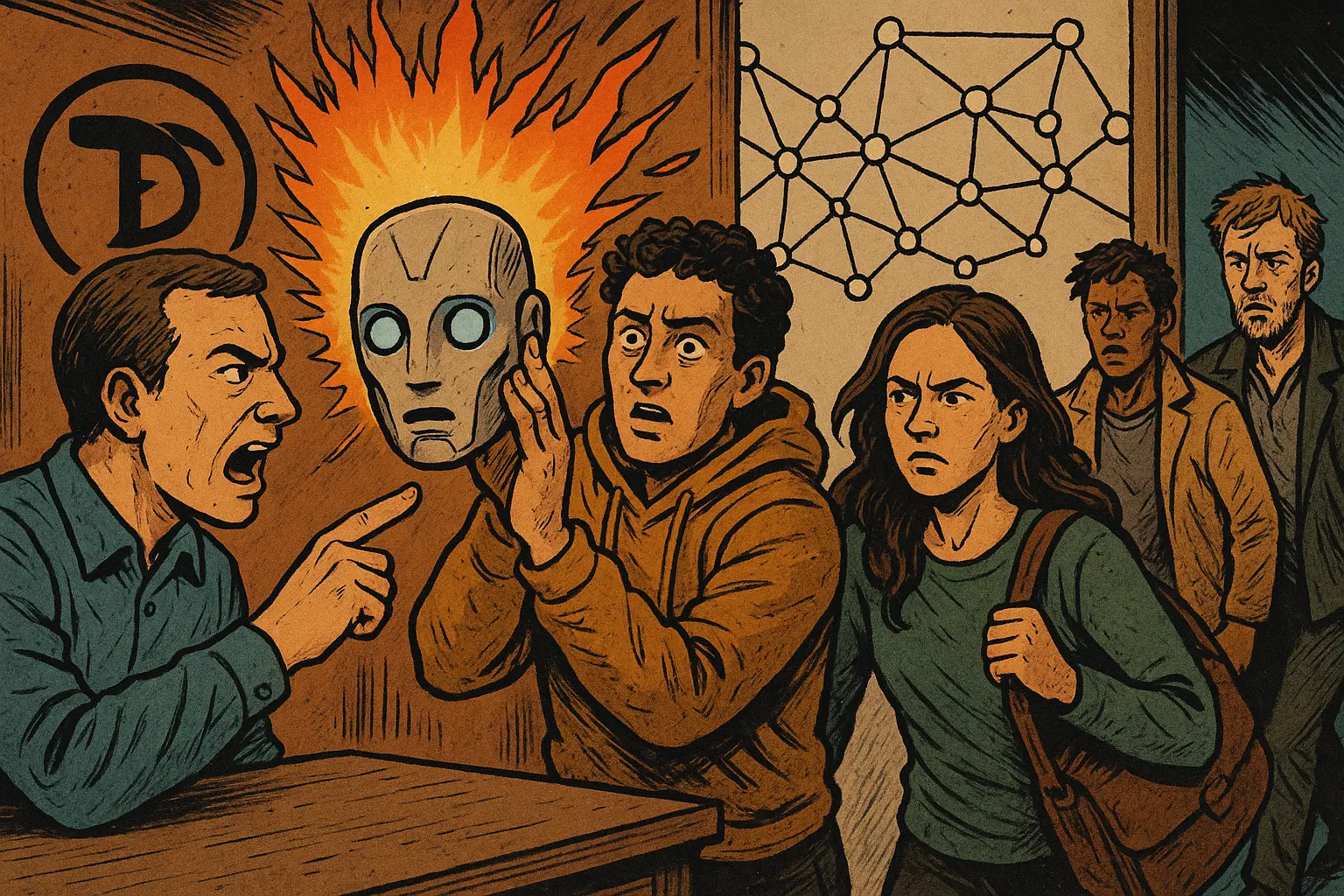
Decentralized AI training team Covenant AI announced on April 10 that it is exiting the Bittensor network, and specifically called out the network’s key figure, Jacob Steeves, accusing him of betraying its decentralization promises. Covenant AI founder Sam Dare said: “The entire core commitment of Bittensor—that no single entity can control it—is a lie.”
Accusation List: Five Suppression Actions by Const Against Covenant AI
In its statement, Covenant AI detailed a series of specific actions that Const took against its team, forming the direct basis for its decision to withdraw:
Sam Dare Accuses Const of the Main Suppression Actions
Pausing token emissions: Const unilaterally paused the token emissions for Covenant AI’s subnet under its control, directly cutting off its source of economic incentives within the Bittensor ecosystem
Revoking community administration permissions: Const stripped Covenant AI of control over its own community channels, effectively taking control of its external communication channels
Decommissioning subnet infrastructure: Const unilaterally decommissioned Covenant AI’s subnet infrastructure, causing its technical deployments on the Bittensor network to fall into collapse
Applying pressure through large-scale token selloffs: During the period of conflict between the two sides, Const applied economic pressure on Covenant AI through large-scale, high-visibility token selloffs
Bypassing the consensus mechanism: All of the above actions were not carried out through the network’s formal consensus process for governance, showing effective individual control over the multisig mechanism
Bittensor “Decentralization Theater”: The truth behind the 3-of-multisig of three people
Covenant AI’s core accusations point to the fundamental gap between Bittensor’s claimed governance mechanism and its real-world operation. Bittensor publicly markets that it uses a “3-of-multisig” governance framework as an institutional safeguard for decentralization. However, Covenant AI directly states that Const exerts effective control over this multisig mechanism, enabling unilateral changes to be pushed through at any time while bypassing consensus, and that the other multisig participants are merely “a shield to carry legal responsibility.”
If this allegation is true, it would mean that while Bittensor’s governance architecture is decentralized at the technical design level, it is still led by a single individual at the operational level—forming a kind of “decentralization theater,” where decentralization exists in documents and whitepapers, but centralization exists in real decision-making.
Covenant AI’s confidence: This exit is not a failure—it’s a deliberate choice
The credibility of this withdrawal statement is built on Covenant AI’s actual technical achievements. Covenant-72B is, to date, the largest decentralized LLM pretraining project, with 72 billion parameters, spanning participation from over 70 independent contributors. It received public recognition from NVIDIA CEO, and was cited by Anthropic’s co-founder—making its reputation in the AI industry exceed the Bittensor ecosystem itself.
Covenant AI announced that the team, research outcomes, and models will all be taken along, and also previewed that new project announcements will be released soon, showing that this exit is more like an intentional ecosystem migration rather than a forced departure.
Frequently Asked Questions
What is the core reason Covenant AI is exiting Bittensor?
According to the public statement by Covenant AI founder Sam Dare, the core reason for the exit is that Bittensor’s core figure Const (Jacob Steeves) took a series of suppression actions against its team, including pausing token emissions, revoking community administration permissions, decommissioning infrastructure, and applying economic pressure through token selloffs. Moreover, all actions were carried out unilaterally by bypassing formal governance consensus.
What problems exist with Bittensor’s 3-of-multisig governance?
Covenant AI points out that in real-world operations, Bittensor’s claimed “3-of-multisig” governance framework is under Const’s effective control, leaving other multisig participants without real checks and balances. They only bear legal responsibility and are unable to prevent Const from unilaterally pushing changes. Covenant AI directly describes this as “decentralization theater.”
What is Covenant AI’s Covenant-72B project?
Covenant-72B is Covenant AI’s decentralized LLM pretraining project completed within the Bittensor ecosystem. It has 72 billion parameters, involves over 70 independent contributors, and is the largest of its kind to date. The project received public recognition from NVIDIA’s CEO and was cited by Anthropic’s co-founder, giving Covenant AI substantial industry influence even at the time of its exit.
Disclaimer: The information on this page may come from third parties and does not represent the views or opinions of Gate. The content displayed on this page is for reference only and does not constitute any financial, investment, or legal advice. Gate does not guarantee the accuracy or completeness of the information and shall not be liable for any losses arising from the use of this information. Virtual asset investments carry high risks and are subject to significant price volatility. You may lose all of your invested principal. Please fully understand the relevant risks and make prudent decisions based on your own financial situation and risk tolerance. For details, please refer to
Disclaimer.
Related Articles
Google launches Deep Research Max: supports MCP and can access enterprise private data
According to a Google DeepMind official blog announcement, Google launched a new generation of autonomous research agents, Deep Research and Deep Research Max, on April 21, 2026. They are built on Gemini 3.1 Pro, as the official release following the preview version provided through the Interactions API in December 2025. Both agents are now available in the paid tiers of the Gemini API in the form of a public preview, and new startups and enterprise users on Google Cloud will be able to connect gradually.
The two variants are positioned differently: interactive vs asynchronous depth
Google categorizes the two agents by use case: Deep Research
ChainNewsAbmedia47m ago
OpenAI Codex Monthly Active Users Reach 4 Million in Under Two Weeks
OpenAI Codex hit 4 million MAUs, announced by Sottiaux and Altman; the jump came in under two weeks from 3 million, and rate limits were reset across all tiers to celebrate.
OpenAI Codex reached 4 million monthly active users in under two weeks since reaching 3 million, according to statements by OpenAI executives. To mark the milestone, rate limits across all tiers were reset.
GateNews2h ago
Two South African AI Startups Selected for Google for Startups Accelerator Africa Class 10
Two SA startups, Loop and Vambo AI, join Google's Accelerator Africa 10th cohort from 2,600 apps; Loop enhances mobility/payments, Vambo AI enables multilingual AI; program runs Apr-Jun 2026 with mentors and AI workshops.
Abstract: Two South African startups, Loop and Vambo AI, have been selected for the Google for Startups Accelerator Africa's 10th cohort, chosen from about 2,600 applications and one of 15 African participants. Loop digitizes mobility and payments, while Vambo AI provides multilingual AI infrastructure for translation, speech, and generative AI across African languages. The 2026 program runs April 13–June 19 and offers mentorship and hands-on workshops focused on AI/ML. Since 2018, the accelerator has supported 106 startups from 17 African countries, helping them raise over $263 million and create more than 2,800 jobs.
GateNews3h ago
Forbes AI 50 List Features 20 New Companies; OpenAI and Anthropic Capture 80% of Total Funding
Gate News message, April 21 — Forbes released its 2026 eighth edition AI 50 list, featuring 20 newly included companies. OpenAI and Anthropic continue to lead the rankings, attracting substantial capital from top Silicon Valley venture capitalists and major tech firms. The combined funding for all l
GateNews4h ago
Zi变量 Unveils WALL-B Embodied AI Model; Robots to Enter Real Homes in 35 Days
Gate News message, April 21 — Zibianliang (自变量), a Chinese robotics company, held a press conference on April 21 to unveil its next-generation embodied AI foundation model, WALL-B. The company announced that robots powered by WALL-B will enter real households in 35 days.
According to Zibianliang co
GateNews4h ago
OpenAI Prepares Agents Feature for ChatGPT, Codenamed Hermes
Gate News message, April 21 — OpenAI is preparing a new Agents feature for ChatGPT, codenamed "Hermes," according to Tibor Blaho, who monitors AI product updates. The feature includes a new agent builder called "studio" that allows users to create agents from templates, schedule runs, and
GateNews5h ago


