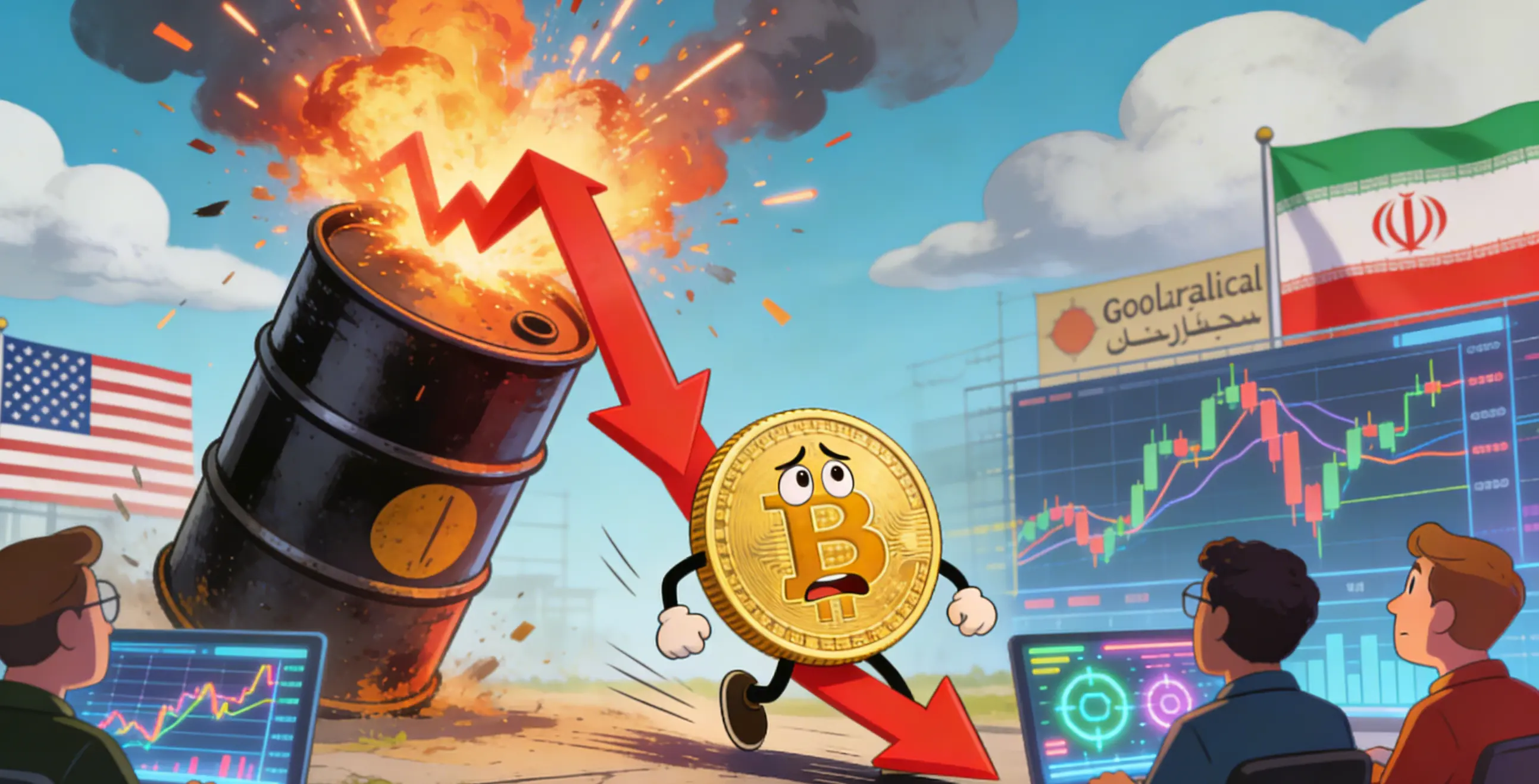
 Bitcoin traded at approximately $66,500 on March 2, 2026, down 1.1% over 24 hours, as global markets repriced following U.S. and Israeli military strikes on Iran that resulted in the death of Supreme Leader Ayatollah Ali Khamenei and the effective closure of the Strait of Hormuz.
Brent crude surged as much as 13% at the Asian open before settling at $77.50, up 6.4%, marking the largest jump since Russia’s 2022 invasion of Ukraine, while Asian equity benchmarks including Japan’s Nikkei fell over 2% before paring losses. Bitcoin’s weekend volatility saw the asset swing between $63,000 and $68,000, with futures funding rates turning sharply negative to -6% and the Crypto Fear and Greed Index remaining in “Extreme Fear” territory at 15.
Asian Markets Plunge as Oil Shock Reverberates
Japan’s Nikkei 225 index opened down 2.15%, shedding over 1,260 points, before paring losses to 1.66% by midday, trading at 57,875. Hong Kong’s Hang Seng declined 2.54%, while Singapore’s Straits Times fell 2.13%. The Shanghai Composite demonstrated relative resilience, dipping only 0.45%.
Regional airline stocks experienced sharp declines exceeding 5%, with Qantas, Singapore Airlines, and Japan Airlines affected by disrupted flight routes and surging fuel costs following the Strait of Hormuz closure. Chinese carriers also faced significant selling pressure.
U.S. equity futures recovered from initial lows, with the S&P 500 down 0.67% and the Dow Jones Industrial Average off 0.71%, improving from earlier declines exceeding 1%. Gold rose 1.76% to $5,350 per ounce as investors sought traditional safe-haven assets.
China’s energy sector bucked the broader market decline, with PetroChina opening up 7% in Shanghai and the CSI Energy Index gaining 5%. South Korea’s Kospi, one of Asia’s best-performing markets in 2026, remained closed Monday for a national holiday, with potential sharp reaction expected upon reopening Tuesday.
Oil Markets React to Strait of Hormuz Closure
The effective closure of the Strait of Hormuz, through which approximately 20% of global seaborne oil flows, represents the most significant market risk emerging from the conflict. Digital signals indicate tanker traffic has nearly halted, with at least three vessels reportedly attacked near the mouth of the Persian Gulf.
Brent crude’s initial 13% surge at the Asian open faded through the session, with gains moderating to 6.4% by midday. West Texas Intermediate crude was up 4.24%. Economists have warned that sustained closure could potentially push oil prices toward $108 per barrel.
OPEC+ moved to address supply concerns on Sunday, announcing a production increase of 206,000 barrels per day commencing in April, exceeding analyst expectations. Saudi Arabia, Russia, Iraq, the UAE, and four other member countries are scheduled to boost output. However, analysts cautioned that additional production may offer limited relief if Gulf export routes remain constrained, as physical delivery capacity outweighs headline output targets.
Bitcoin Demonstrates Relative Strength Amid Volatility
Bitcoin’s weekend trading saw the asset experience significant volatility following the strikes. The initial reaction saw Bitcoin drop below $64,000 within hours of the attack as the total cryptocurrency market capitalization shed approximately $128 billion, with forced liquidations cascading across derivatives markets.
Following Iranian state media confirmation of Khamenei’s death, traders speculated that the power vacuum could accelerate de-escalation, pushing Bitcoin back above $68,000 in thin Sunday liquidity. This optimism faded as Iran launched retaliatory missile and drone strikes across the Gulf, hitting targets in Israel, the UAE, and Bahrain, dragging prices back below $66,000.
By early Monday in Asia, Bitcoin traded with a 24-hour range of $65,149 to $68,043. Trading volume exceeded $43.6 billion, reflecting heightened activity as traders repositioned ahead of U.S. market opening.
Ether fell 2.5% to $1,967, Solana dropped 4.1% to $84, and XRP lost 3.6% to $1.36. Over seven-day periods, Solana led losses among major cryptocurrencies with an 8.1% decline.
Derivatives Positioning Signals Extreme Bearish Sentiment
Bitcoin futures funding rates have turned sharply negative to approximately -6%, indicating that short positions are paying longs to maintain their positioning. The CMC Crypto Fear and Greed Index registered at 15, remaining in “Extreme Fear” territory where it has been stuck for weeks.
Some analysts interpret extreme bearish positioning as a potential contrarian signal, noting that the market is effectively paying traders to establish long positions through negative funding rates. This mechanical dynamic could contribute to short-squeeze potential if prices move higher.
Spot Bitcoin ETFs recorded approximately $254 million in net inflows over three sessions during the preceding week. Monday’s market open will test whether institutional holders maintain positions through escalating geopolitical uncertainty.
Inflation Concerns and Federal Reserve Implications
Higher energy prices feed directly into inflation expectations, potentially delaying Federal Reserve rate cuts that markets have been pricing. Prolonged disruption to Gulf oil flows could keep crude elevated sufficiently to push inflation readings higher, creating headwinds for risk assets including cryptocurrencies.
The situation remains fluid regarding diplomatic developments. Conflicting reports emerged Monday about potential negotiations, with some sources indicating a fresh push for talks while Iranian officials stated the country will not negotiate. President Trump indicated the bombing campaign will continue until objectives are achieved, though other reports suggested openness to discussions with Iran’s new leadership.
Some market participants suggest further downside for cryptocurrencies may be limited. Analysts note that Iran has been isolated from global financial markets for an extended period, reducing direct exposure. Regarding oil prices and inflation concerns, increased supply from OPEC and U.S. producers may be sufficient to stabilize prices if the Strait of Hormuz reopens.
Technical Levels and Key Catalysts
For Bitcoin, the $60,000 support level represents a critical threshold. A sustained break below this level could potentially open the path to the mid-$50,000 range. Conversely, a sustained move above $70,000 could trigger short-squeeze dynamics given the substantial bearish positioning accumulated in derivatives markets.
The Consumer Price Index report scheduled for March 11 and the Federal Open Market Committee decision on March 18 represent significant upcoming catalysts. The Iran conflict has increased the complexity of navigating these events, with geopolitical developments potentially influencing inflation data and monetary policy expectations.
FAQ: Bitcoin and Iran Conflict Market Impact
Why did Bitcoin initially drop then rally following the Iran strikes?
Bitcoin initially fell below $64,000 as markets reacted to the uncertainty of U.S.-Israeli strikes on Iran, with broad risk-off selling across cryptocurrency markets. The subsequent rally above $68,000 occurred after Iranian state media confirmed Supreme Leader Khamenei’s death, as some traders speculated that leadership transition could accelerate de-escalation. The rally faded as Iran launched retaliatory strikes, demonstrating how geopolitical developments continue to drive intraday volatility.
How does the Strait of Hormuz closure affect cryptocurrency markets?
The Strait of Hormuz handles approximately 20% of global seaborne oil. Its effective closure has sent oil prices sharply higher, which feeds into inflation expectations. Higher inflation typically pushes back expectations for Federal Reserve rate cuts, which would tighten liquidity conditions that influence risk asset prices including cryptocurrencies. The primary transmission mechanism is through monetary policy expectations rather than direct exposure to the region.
What are the key technical levels for Bitcoin following this volatility?
Analysts identify $60,000 as the critical support level to watch. A sustained break below this level could potentially open the path to the mid-$50,000 range. On the upside, a sustained move above $70,000 could trigger short-squeeze dynamics given the substantial bearish positioning evidenced by negative funding rates near -6% and the Crypto Fear and Greed Index remaining in “Extreme Fear” territory at 15.


